
The collective worldwide Harley-Davidson fan club shed a tear and said a prayer of remembrance when Harley-Davidson ended the Dyna family after the 2017 model year. That was it; rides gone but not forgotten, and models names welcomed into a new family. From 2018 onward, the Street Bob, Low Rider and Fat Bob names (among others) moved to a completely redesigned Softail chassis and gained Milwaukee-Eight engines.
For anyone deep in the Harley-Davidson world, this was huge. A Softail Low Rider? No more twin shocks?! Harley-Davidson tends to move slowly with its big, air-cooled line, for good reason — people who buy them and like them prefer the old stuff. So anyone who liked the old style, rubber-mounted engines, or even the slightly unruly character of a Dyna, felt a little betrayed.
But there were obvious benefits to the Softail chassis. It’s lighter and it handles better (objectively, I think I can say). It looks good — different, but good.
So the argument has been running ever since: Is the new Softail simply a better chassis, or did Harley remove something worth keeping?
This is not a recommendation between two particular motorcycles. “Dyna” covers 27 model years and some very different bikes; “Softail” covers more than 40 years and two fundamentally different suspension layouts. Instead, this is a guide to what changed, what did not, and what people usually mean when they say they prefer one.
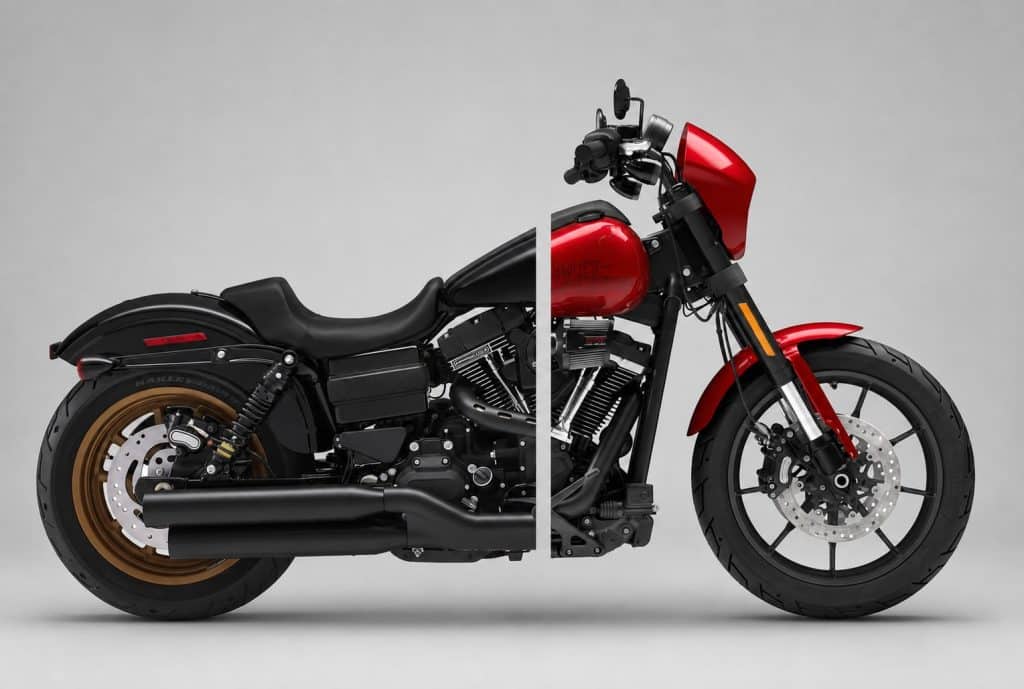
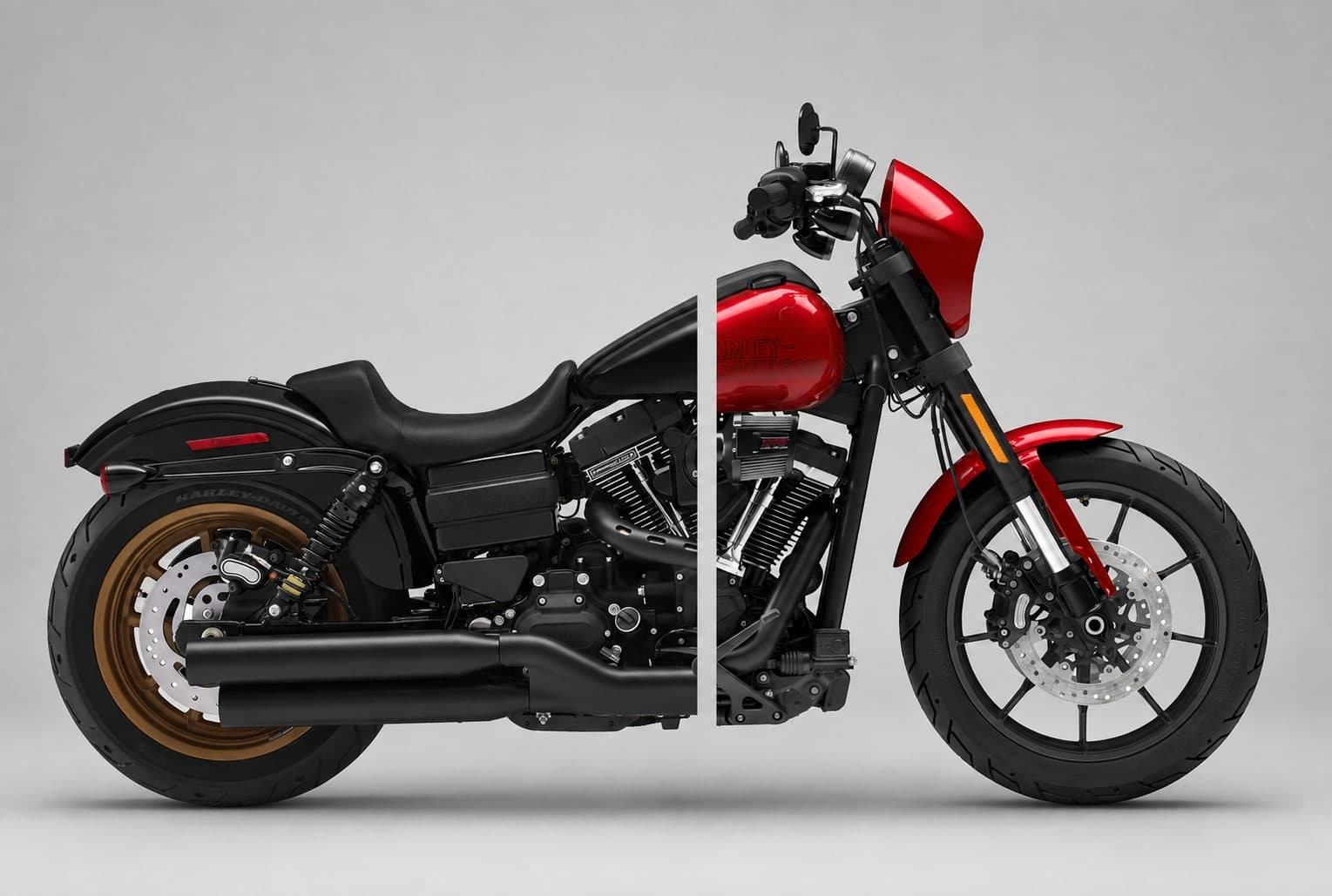
The short version: A Dyna has visible twin rear shocks and a rubber-mounted engine. A 1984-2017 Softail hides two horizontal shocks below the transmission. A 2018-on Softail has one coil-over shock below the seat, a much stiffer frame and a rigid-mounted, counterbalanced Milwaukee-Eight engine. The 2018 chassis is lighter, more precise and easier to build several kinds of cruiser around. The Dyna has more mechanical movement, easier-to-see suspension and a look that Harley has not recreated exactly.
Are you obsessed with motorcycles?
Well, I am. That’s why I created this site — as an outlet. I love learning and sharing what others might find useful. If you like what you read here, and you’re a fraction as obsessed as I am, you might like to know when I’ve published more. (Check the latest for an idea of what you’ll see.)
First: Dyna and Softail Are Chassis Families
Harley model names have a habit of outliving the hardware beneath them. The Low Rider began in 1977, well before the Dyna existed. The Street Bob started as a Dyna and is now a Softail. The Fat Bob made the same move but changed so much in the process that the two generations barely look related.
So “Dyna versus Softail” is not the same question as “2017 Street Bob versus 2018 Street Bob”. That comparison also includes different engines, brakes, forks, wheels, geometry and styling.
| Family | Years | Rear suspension | Engine mounting | What you see |
|---|---|---|---|---|
| Dyna | 1991-2017 | Two conventional coil-over shocks outside the frame | Rubber-mounted Evolution or Twin Cam | Both shocks, a separate battery/oil-tank area and a visibly moving engine at idle |
| Original Softail | 1984-2017 | Two horizontal shocks hidden below the transmission | Rigid-mounted Evolution or counterbalanced Twin Cam B | A triangular swingarm shaped to resemble an old rigid frame |
| New Softail | 2018 onward | One coil-over monoshock below the seat | Rigid-mounted, dual-counterbalanced Milwaukee-Eight | The same clean hardtail outline, with the shock mostly concealed inside the bike |
The FXR also matters here. Harley introduced the Dyna while the FXR was still in production, and the two overlapped until 1994 in the regular range. Both used rubber-mounted engines and exposed twin shocks, but the FXR had a more heavily triangulated frame. Many riders still consider it the better pure handling chassis.
How the Two Families Developed
Softail: 1984 to Today
Harley launched the FXST Softail for the 1984 model year. The idea was wonderfully simple: give a motorcycle the clean rear triangle of a vintage hardtail without giving its rider a rigid rear axle.
The first design used a triangular swingarm and two gas-charged shocks mounted horizontally beneath the transmission. This left the sides of the rear wheel uncluttered and allowed a low seat. The same year also brought the 1,340 cc (80 cu in) Evolution V-twin, so the first Softail arrived during one of the most important mechanical recoveries in Harley-Davidson history.
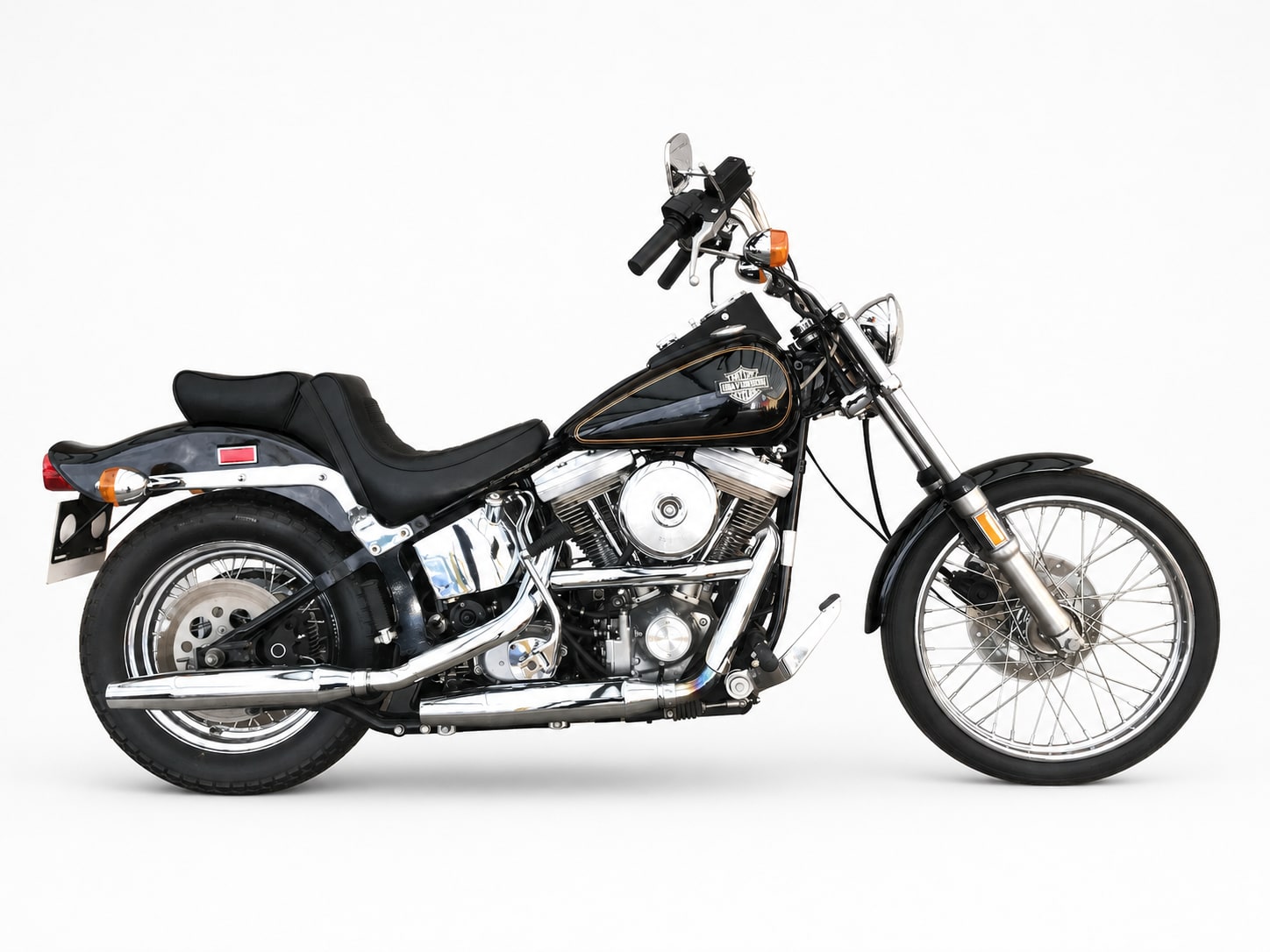
The platform soon supported the Heritage Softail, Springer Softail, Fat Boy, Deluxe, Deuce, Rocker, Cross Bones, Breakout and several other factory customs. That range explains the original Softail’s priorities. Its suspension worked, but appearance and packaging were central to the design.
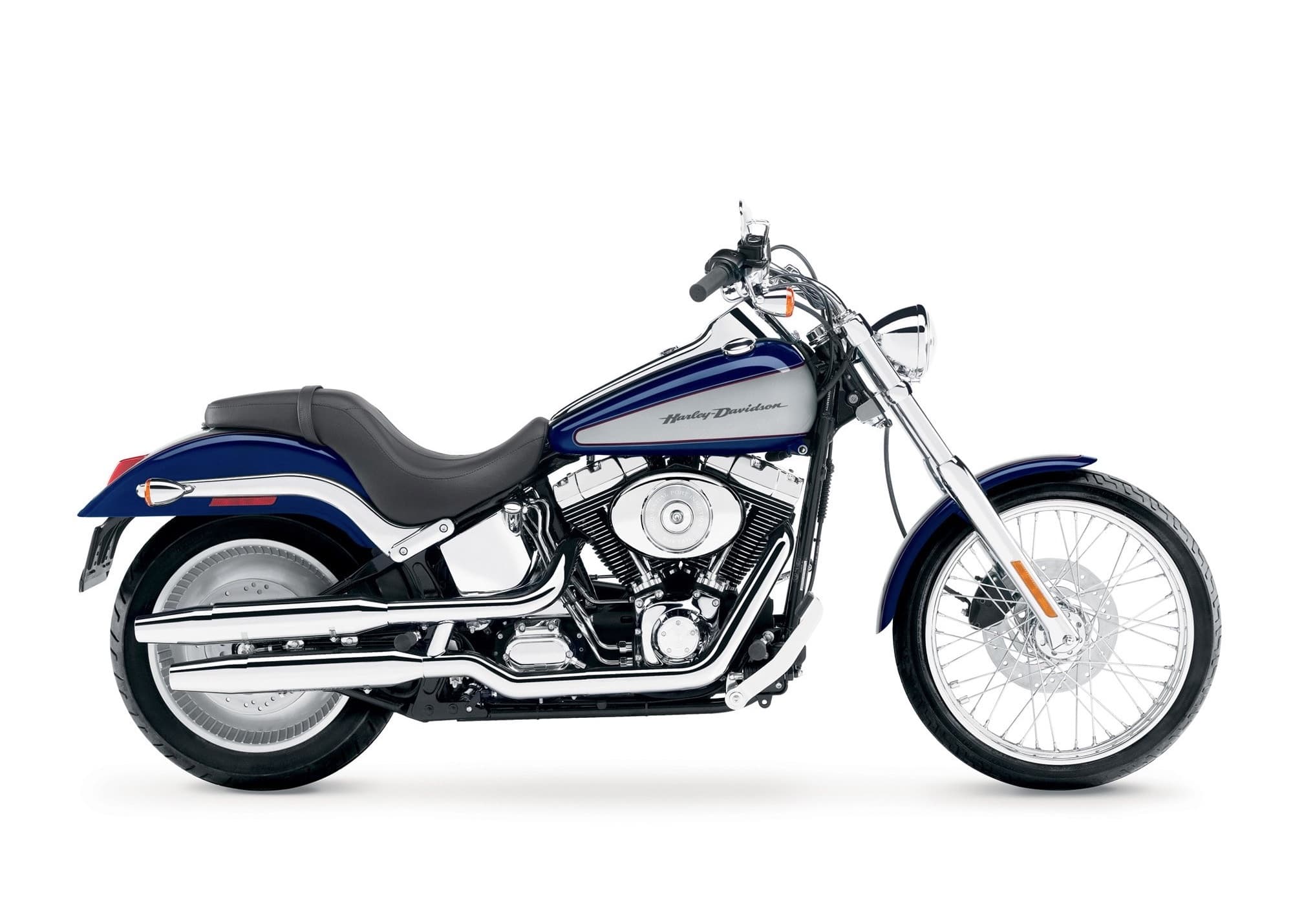
Harley revised the engines and suspension over the years. The Twin Cam 88B arrived in the Softail Deuce for 2000 with internal balancers to make rigid mounting tolerable. Capacity later grew to 96B, 103B and 110B versions. Forks, damping, tyre sizes and brakes changed by model, but the two concealed under-frame shocks survived through 2017.
Dyna: 1991 to 2017
The first Dyna was the limited 1991 FXDB Sturgis. Harley expanded the family during the 1990s as the Dyna replaced the FXR in the mainstream range.
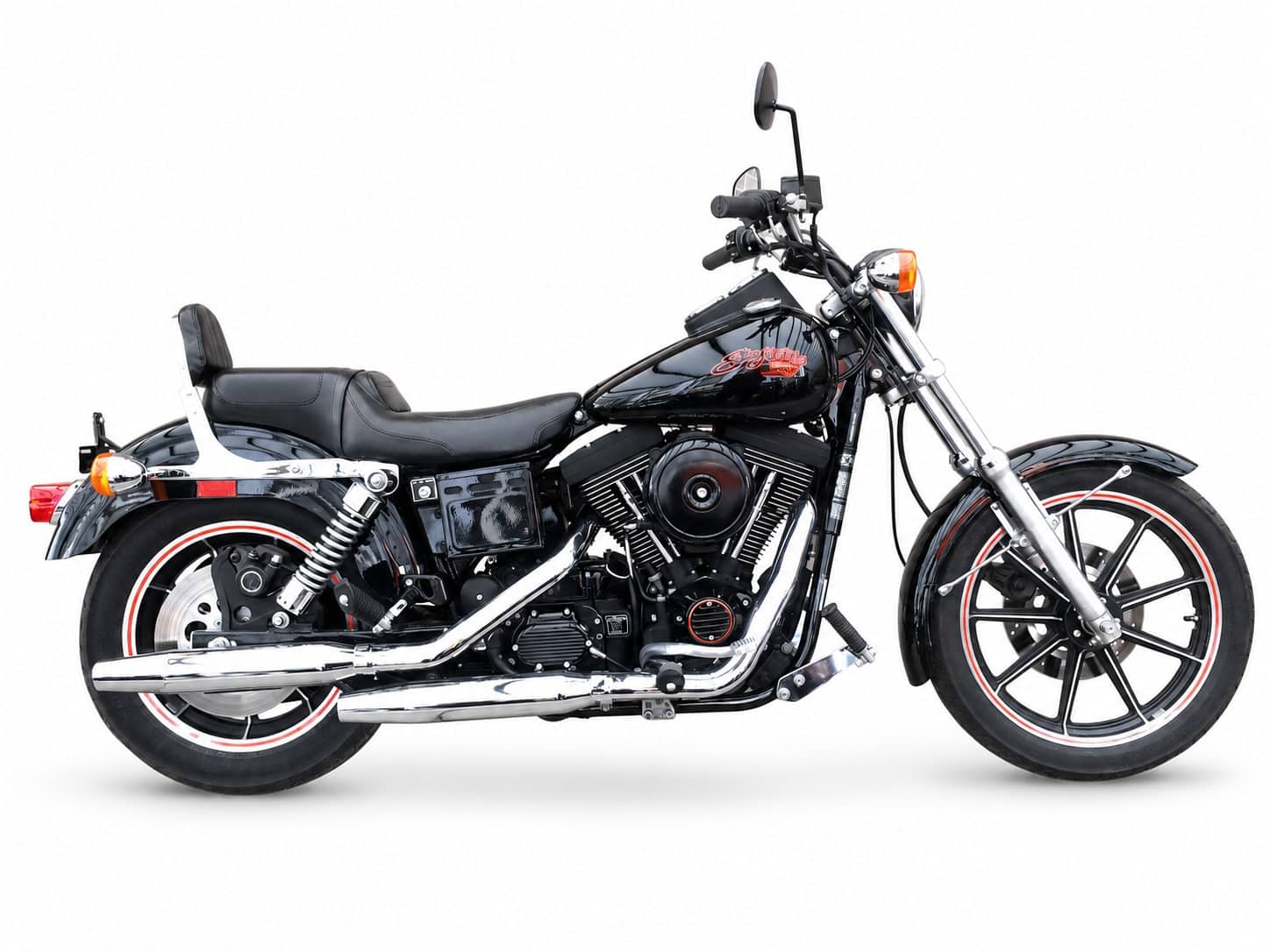
The Dyna kept two things riders could identify immediately: conventional shocks on either side of the rear wheel and a rubber-mounted Big Twin. Early bikes used the Evolution engine. The Twin Cam 88 arrived for 1999, followed by the Twin Cam 96 for 2007 and the 103 in much of the later range. The 2016-2017 Low Rider S ended the factory story with the 1,801 cc (110 cu in) Screamin’ Eagle Twin Cam 110.
Harley didn’t leave the chassis untouched for 27 years. The company re-engineered the Dyna for 2006 with new frames and geometry, a wider and stiffer swingarm, 49 mm forks, larger axles, revised shocks and a six-speed transmission. Those bikes feel more substantial and controlled than an early 1990s Dyna, even though the basic visual formula is the same.
The 2018 Merger
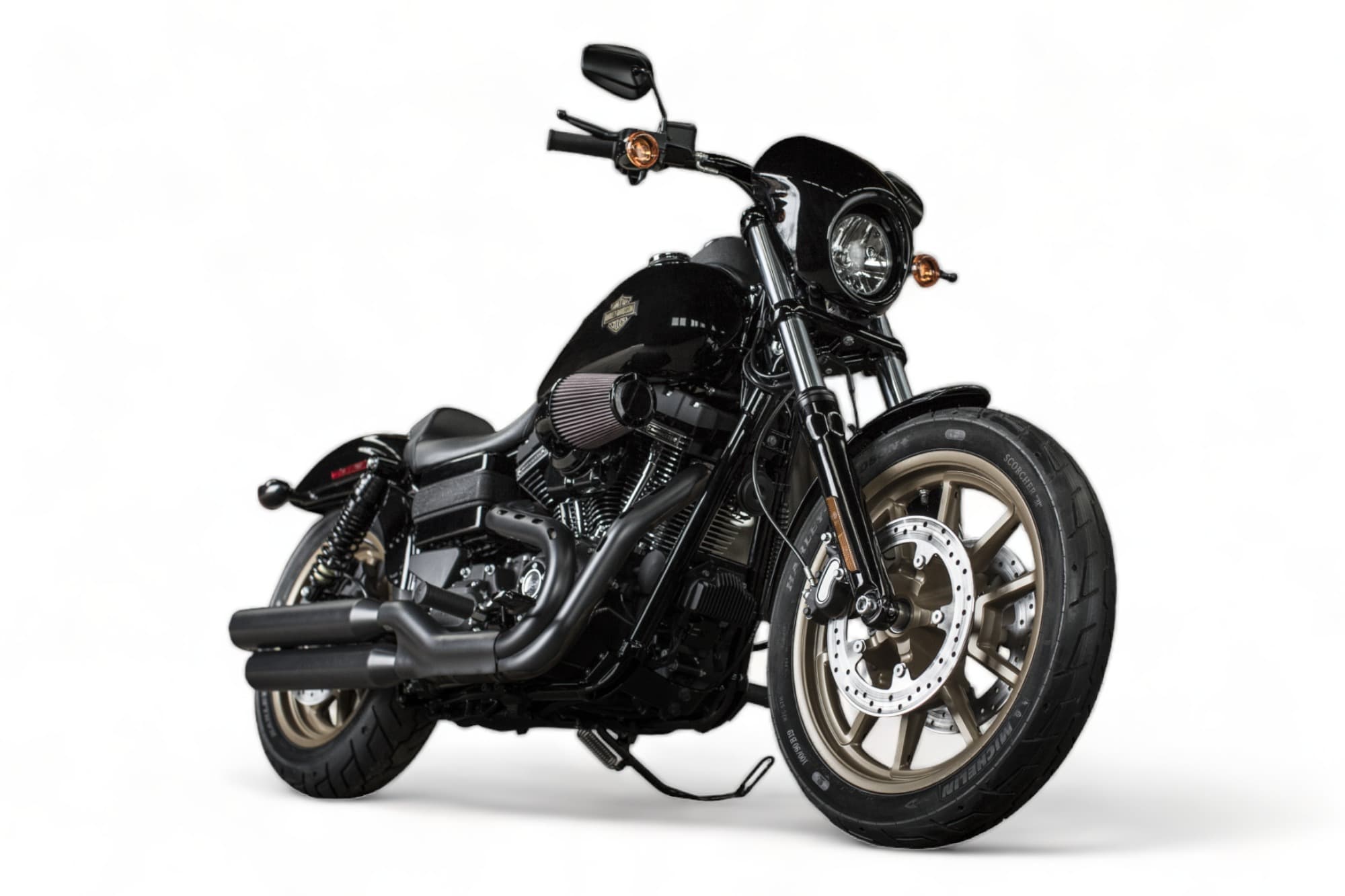
For 2018 Harley replaced both the old Softail and the Dyna with one new Softail architecture. The launch range had eight models: Street Bob, Low Rider, Fat Bob, Fat Boy, Heritage Classic, Softail Slim, Deluxe and Breakout.
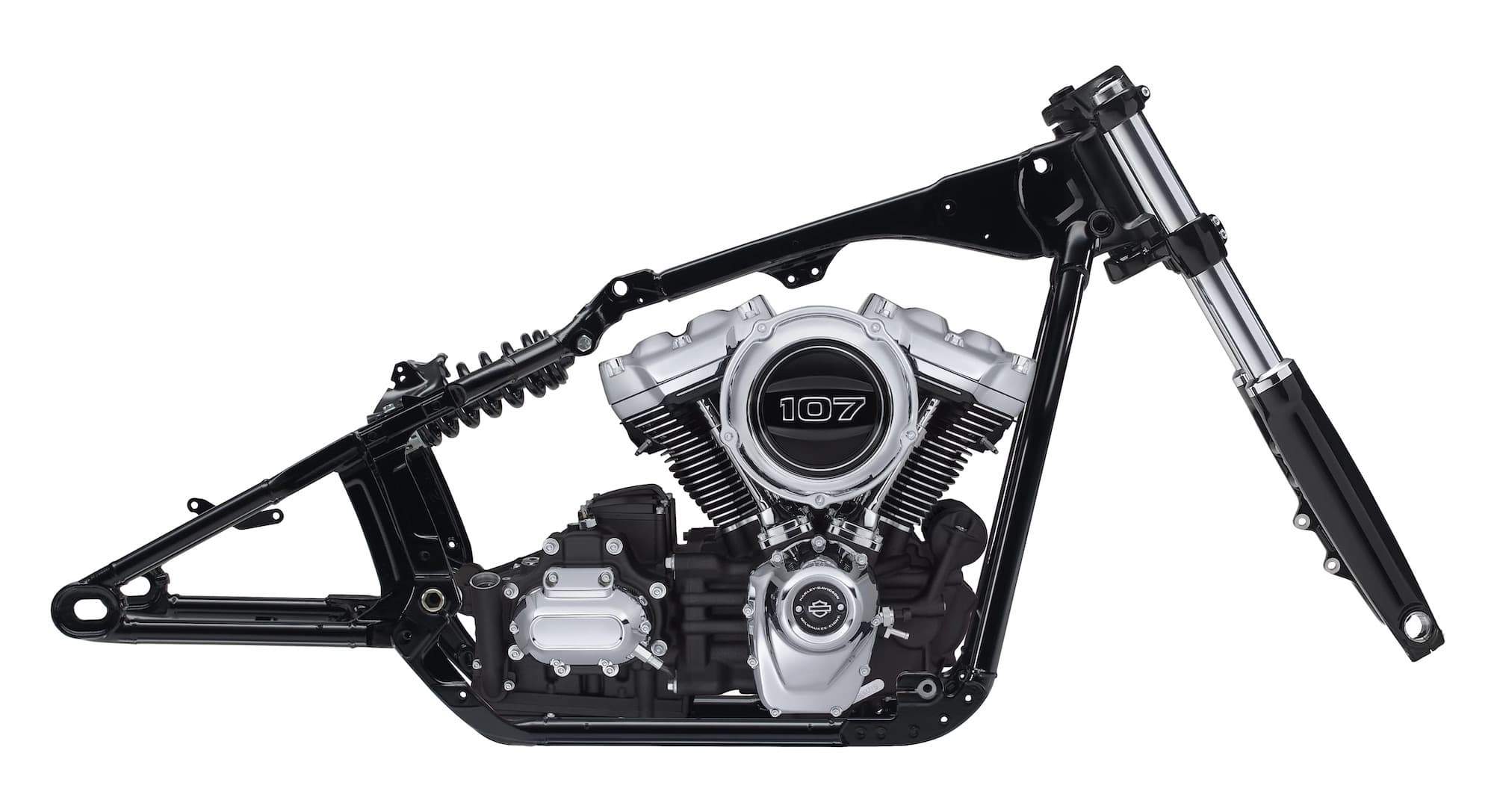
Harley described the programme directly as a merger of Dyna performance and Softail custom styling. The new carbon-steel frame was 65 percent stiffer than the 2017 Softail frame, making the complete chassis 34 percent stiffer. It used half as many frame components and 22 percent fewer welds. Narrow- and wide-tyre swingarms covered motorcycles with very different rear ends.
Depending on the model, complete bikes lost as much as 15.9 kg (35 lb). Harley claimed better turn-in, more lean angle, easier lifting from the side stand and better acceleration and braking. Those are related benefits: a frame that bends less gives the suspension a more stable platform, and lower mass asks less of the tyres and brakes.
Why Did Harley Kill the Dyna?
It was strange timing. It’s not like the layout stopped working overnight. Harley had just sold an especially desirable version, the Low Rider S, and the family had a large owner community and aftermarket.
The public engineering answer was that the new Softail could do both jobs better. It was lighter and stiffer than the old Softail, preserved the hidden-suspension outline, and had the control and clearance needed for models that previously sat in the Dyna range. Harley could rigidly mount the counterbalanced Milwaukee-Eight and use the engine to reinforce the chassis rather than isolating it on rubber mounts.
The practical manufacturing result was one cruiser platform instead of two overlapping ones. Harley could vary wheels, forks, bodywork, brakes, swingarms and shock specifications without maintaining separate Dyna and Softail frame families. The new architecture reduced parts and welds while replacing both ranges.
There was also nowhere obvious for the old Dyna to go. Fitting the Milwaukee-Eight would have required more development, while keeping the Twin Cam would have left one cruiser family on the previous engine. Once the new Softail met Harley’s handling targets, sentiment was the strongest remaining case for a separate Dyna.
Rear Suspension: The Most Obvious Difference
Dyna: Conventional Twin Shocks
A Dyna’s swingarm acts directly on two coil-over shocks mounted outside the frame. You can see them, reach them and replace them without explaining to anyone where Harley hid the suspension.
The layout is simple and gives the bike its familiar mechanical rear end. It also makes suspension upgrades easy. Owners can change shock length, spring rate and damping with a large range of aftermarket parts. Taller shocks can add travel and cornering clearance, although changing rear ride height also changes steering geometry and belt tension through the suspension arc.
Stock quality varied. A Dyna with short, basic shocks can ride harshly and run out of control over repeated bumps. A well-set-up Dyna with good shocks, correct springs and a sorted fork is a different motorcycle. This is one reason two owners can give completely opposite descriptions of “Dyna handling”.
1984-2017 Softail: Two Shocks Under the Gearbox
The original Softail also used two shocks, but placed them horizontally below the transmission. The triangular swingarm made the rear of the frame look rigid. The system lowered the seat and cleaned up the sides of the motorcycle, but the position made the shocks less obvious to inspect and less convenient to adjust or replace.
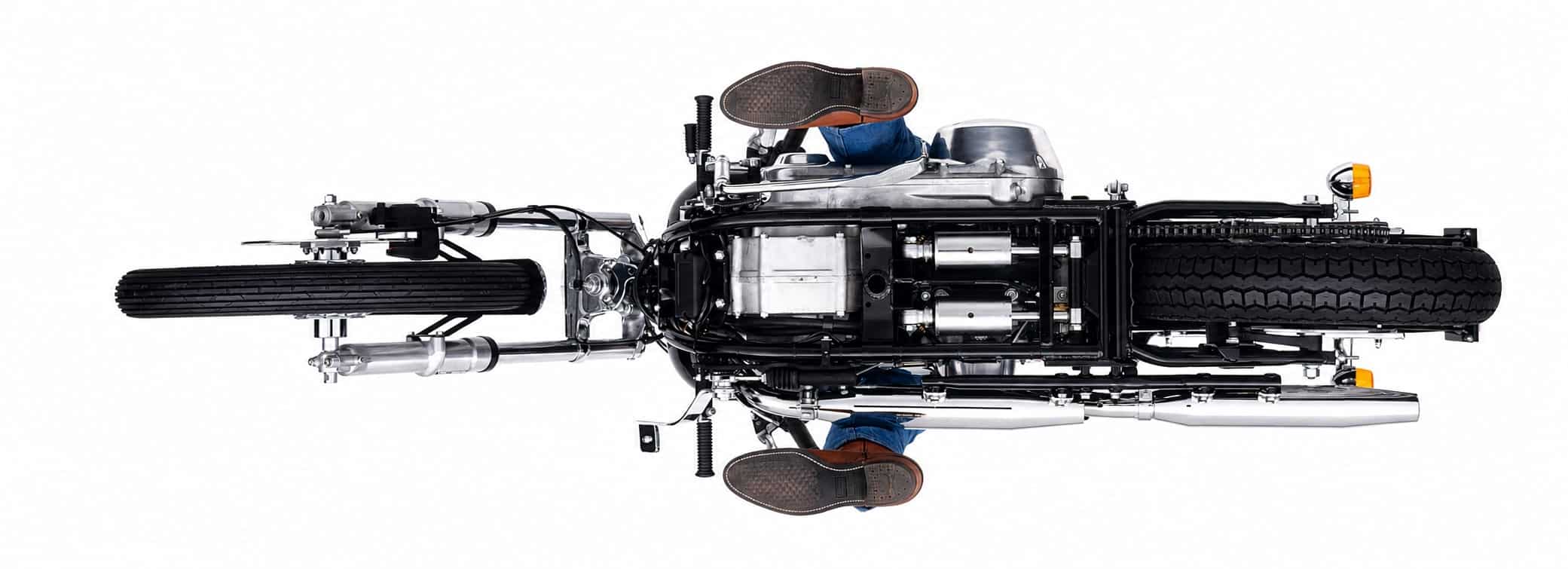
Early Softails earned a reputation for limited travel and a ride that put style ahead of bump absorption. That is too broad as a verdict on every model year, but the design had less room to evolve than a normal pair of external shocks. Harley improved springs and damping over time without changing the basic packaging.
2018-On Softail: One Shock Below the Seat
The new Softail uses a conventional coil-over monoshock below the seat. Rear-wheel movement passes through the swingarm to the shock. Wheel travel, shock specification and preload adjustment method vary by model; the taller performance and touring versions do not use the same setup as the lowest cruisers.
Some bikes use a spanner beneath the seat, while others have a remote hand-adjustment knob. Correct preload matters on any cruiser, but especially when the motorcycle has a passenger or luggage. Too little preload uses up travel before the first large bump and also changes steering geometry.
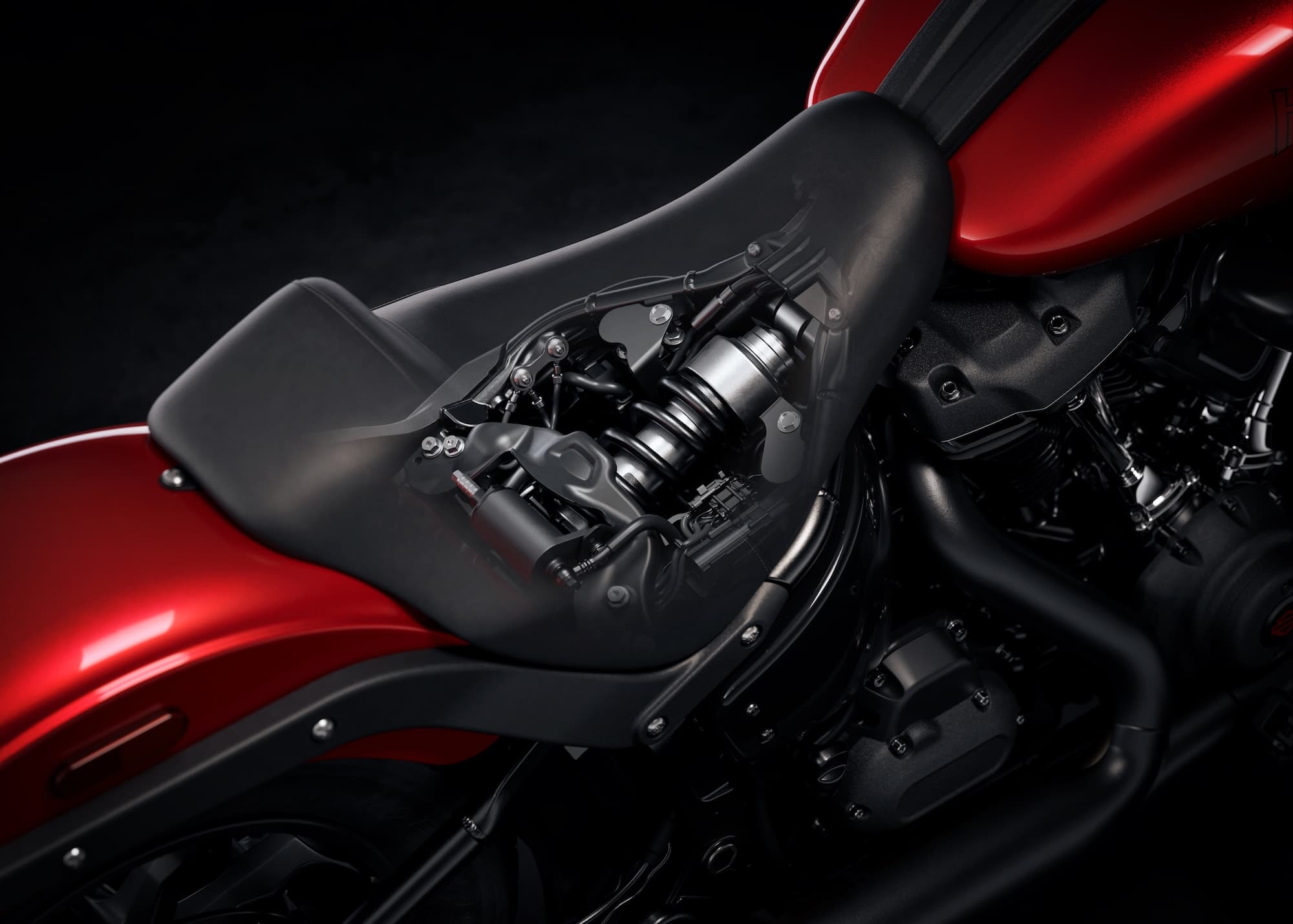
One shock is not automatically better than two. The benefit comes from the complete design: frame stiffness, shock motion, spring and damping choices, suspension travel and geometry. In this case, the new layout gave Harley more control while preserving the look that makes a Softail a Softail.
Front Suspension Changed Too
The rear shocks attract the attention, but the fork has just as much influence on steering and braking.
Dyna specifications ranged widely. Earlier models commonly used 39 mm conventional forks. The 2006 redesign brought 49 mm forks across the range. Performance versions such as the FXDX Super Glide Sport and late Low Rider S added better damping, adjustment or firmer settings, while chopper-styled Wide Glides used geometry chosen for a very different response.
Harley launched the 2018 Softails with Showa dual-bending-valve fork internals intended to give cartridge-like damping without a full cartridge assembly. The Fat Bob got a 43 mm inverted fork; most of the range kept conventional forks. Later Low Rider S and ST models also use an inverted fork.
This is why a chassis-family label cannot predict the whole ride. A Dyna Wide Glide and FXDX do not steer alike. A Softail Breakout and Low Rider S do not either.
Looks: Exposed Machinery or a Clean Rear Triangle
The Dyna makes its suspension part of the design. The shock springs, top mounts and swingarm all sit in view. That gives the rear half a functional, slightly busy look. Add the separate side covers and the gap around a rubber-mounted engine and the bike looks assembled from mechanical systems you can identify.
The Softail hides the suspension to create one continuous line from the steering head toward the rear axle. Harley can then dress that line as a 1950s cruiser, drag-style custom, bobber or club bike without two shocks interrupting it.
Neither treatment is more authentic. The Softail has been in production since 1984, seven years longer than the Dyna. Its fake-hardtail outline is now part of Harley history in its own right.
Handling: What Changes on the Road?
Weight and Low-Speed Control
The 2018 platform cut meaningful weight from several direct predecessors. Harley quoted 7.7 kg (17 lb) for the Street Bob and 15 kg (33 lb) for the Fat Bob. The difference is noticeable when lifting a bike from its stand, backing it out of a parking space or changing direction at walking speed.
But it’d be wrong to generalise and say that “every Softail is lighter than every Dyna”. A stripped Street Bob, long Wide Glide, heavy Heritage Classic and wide-tyred Fat Boy occupy different parts of the scale. So you’ve got to niche down and look at each model individually.
Steering and Chassis Precision
The new Softail generally responds to steering inputs with less delay. Its rigid engine mounting and stiffer frame give the suspension and tyres a more consistent platform. When you brake, turn in and accelerate, fewer parts of the motorcycle move relative to each other.
A Dyna feels looser by comparison. It’s not like it’s unstable or unpleasant, but it just moves differently. The engine moves in its mounts, the chassis communicates differently and the bike can feel alive beneath the rider. Some people like that extra motion because speed feels more physical, but others experience it as imprecision.
Cornering Clearance
Harley increased lean angles across the 2018 launch range, but model design still sets the limit. Low footboards, forward controls, exhausts and sidestands can touch down before the chassis or tyres run out of ability.
A taller Dyna on longer shocks can have excellent clearance by cruiser standards, whereas a low Softail can scrape early. The later Low Rider S gained taller rear suspension for precisely this reason, while the Breakout gives away cornering ease to its long wheelbase, raked fork and 240 mm rear tyre.
If clearance matters, compare the two motorcycles in front of you. Rather than get hung up on “Softail” or “Dyna”, consider shock length, control position, exhaust routing, tyre profile, rake and wheelbase.

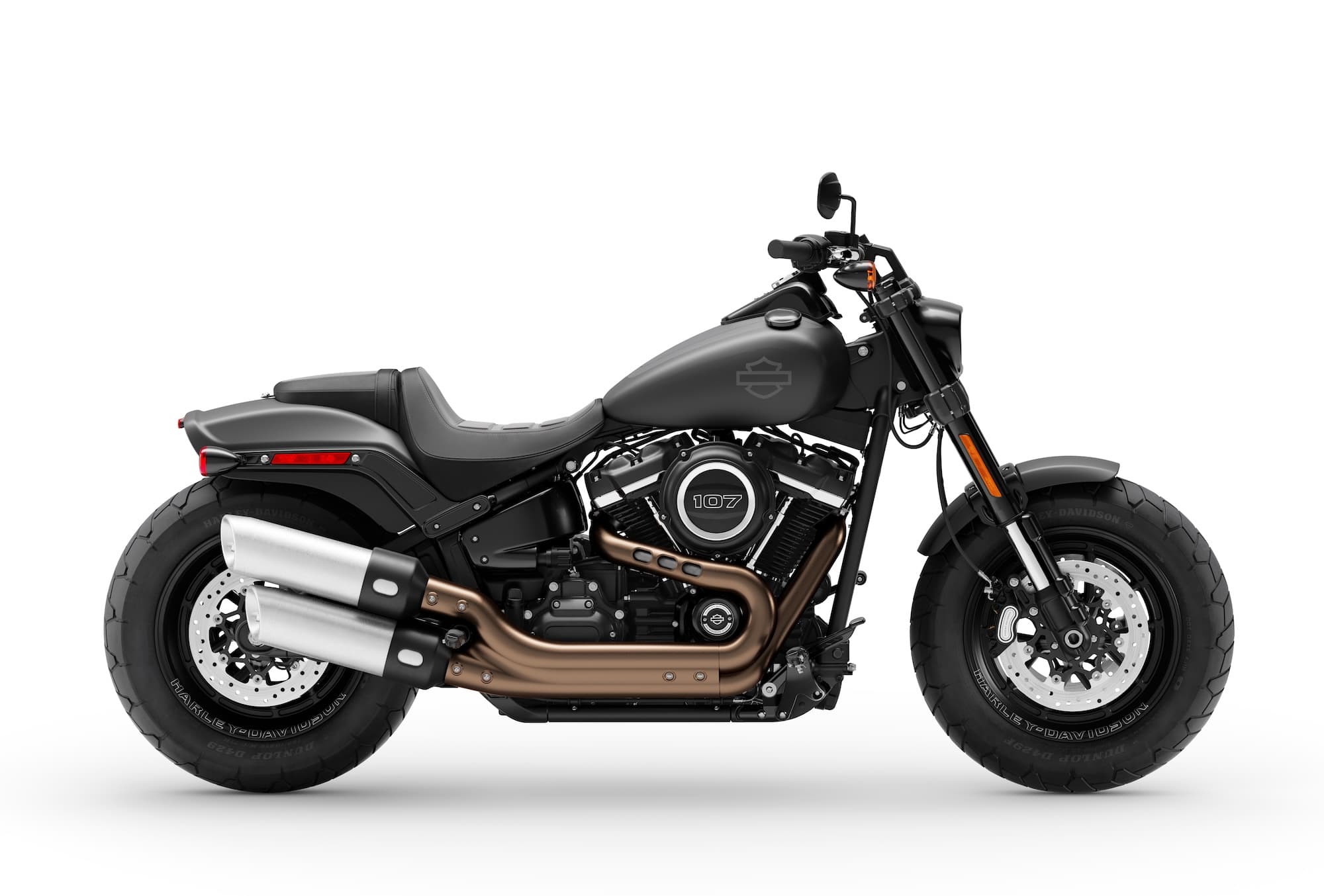
The Fat Bob generations show how much changed at once. The newer bike lost the twin shocks, and got a new frame, engine, fork, exhaust, tyres and even a sportier stance.
Engine Feel Is Mixed Into the Argument
It’s not exactly about the chassis, but there’s a 100% correlation — Dynas had the Evo or Twin Cam, and Softails have the Milwaukee-Eight. This makes it difficult to separate chassis character from engine character during a back-to-back ride.
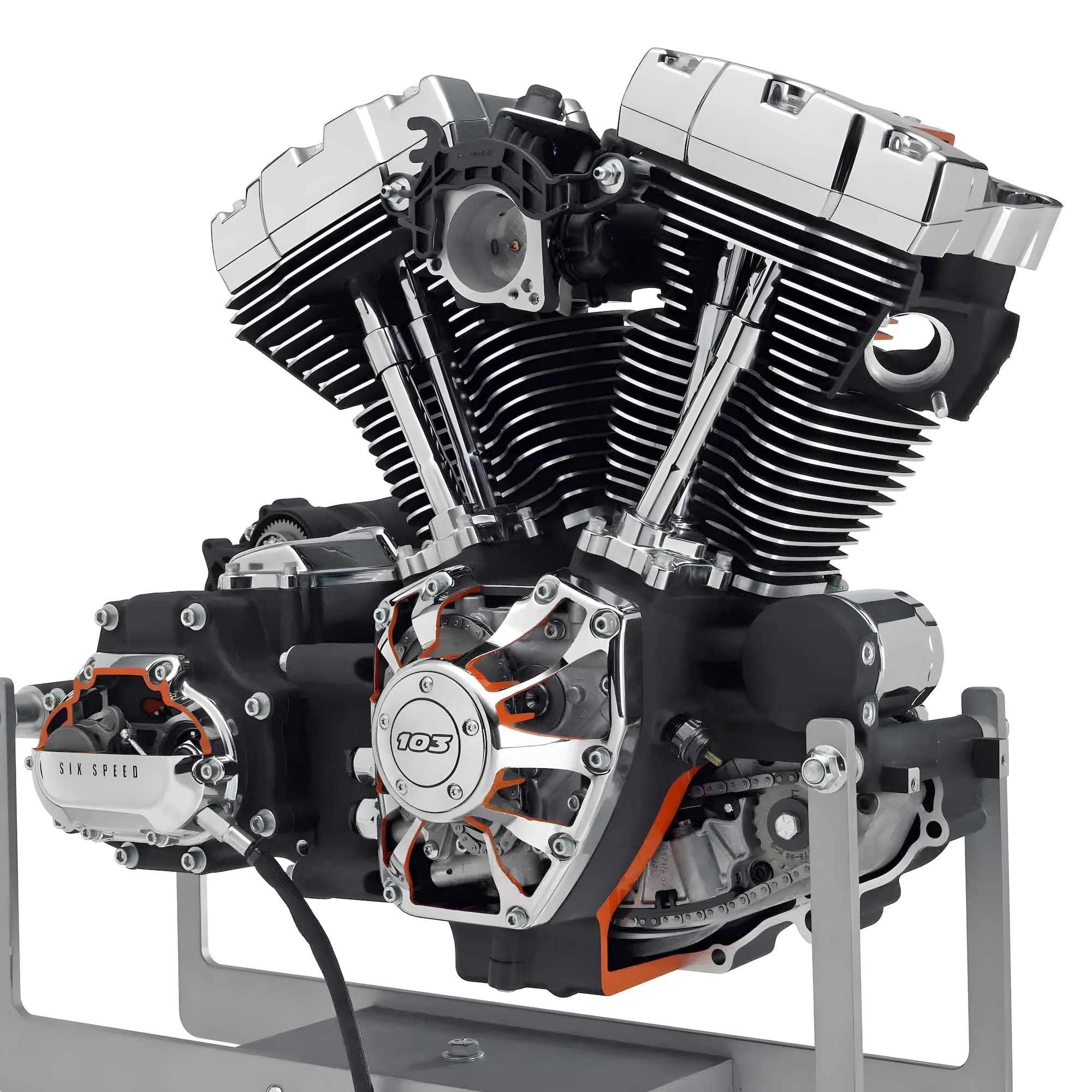
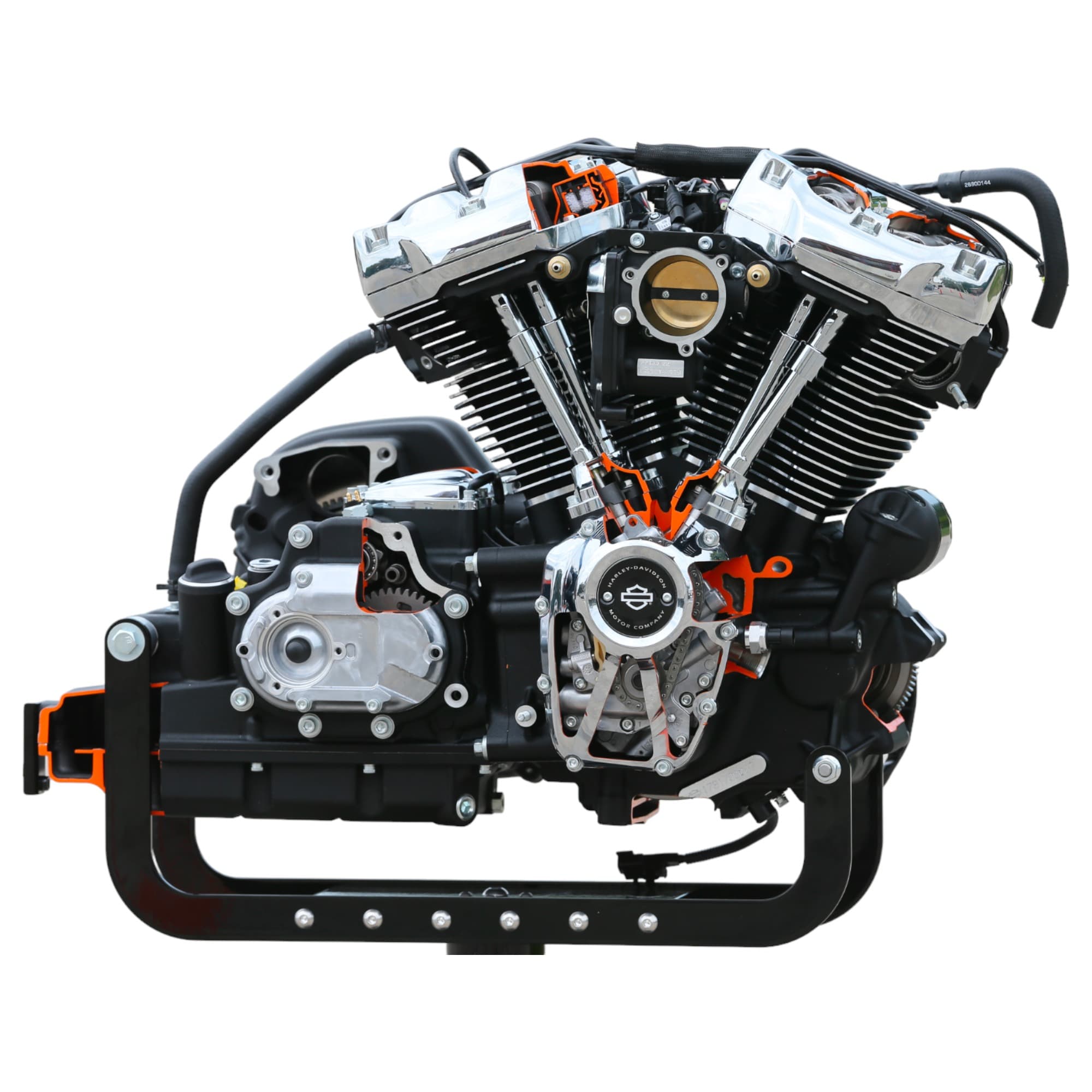
The Dyna’s Evolution or Twin Cam engine hangs in rubber mounts. At idle, it rocks visibly. As revs rise, the mounts isolate much of that vibration from the rider. The movement is part of the character, especially with a lumpy cam and exhaust.
The Softail Milwaukee-Eight uses two internal balancers and bolts rigidly into the frame. It moves less at idle, sends less primary vibration through the motorcycle and contributes to chassis stiffness. It also makes more torque, sheds heat more effectively around the heads and runs with less mechanical noise than a Twin Cam.
Some riders call that refinement. Others say the engine has lost the loose, breathing quality they associate with a Big Twin. Both descriptions can be honest; they are just different reactions to a varying mechanical systems.
Which Dyna Models Became Softails?
Harley moved three current Dyna names directly for 2018. The Low Rider S returned a little later. Other Dyna ideas either disappeared or resurfaced in a different form.
| Dyna model | What happened after 2017 | How direct was the replacement? |
|---|---|---|
| Street Bob (FXDB) | Became the Softail FXBB for 2018 | Very direct in purpose and appearance, although the chassis and engine were new |
| Low Rider (FXDL) | Became the Softail FXLR for 2018 | The name and ’70s cues continued; the first FXLR lost one front disc |
| Fat Bob (FXDF) | Became the Softail FXFB/FXFBS for 2018 | Same broad performance-cruiser job, but a major visual and mechanical redesign |
| Low Rider S (FXDLS) | Ended after 2017; returned as the Softail FXLRS for 2020 | A spiritual successor with stronger brakes and suspension, not a 2018 carry-over |
| Wide Glide (FXDWG) | No same-name Softail replacement | The Breakout covers some long-fork, factory-chopper territory but is a different model |
| Switchback (FLD) | Had already ended after 2016 | No direct replacement; the later Low Rider ST takes a sport-touring idea much further |
| Super Glide / Super Glide Custom | Had left the range before the Dyna ended | The Softail Standard is the nearest simple Big Twin, but does not use the name |
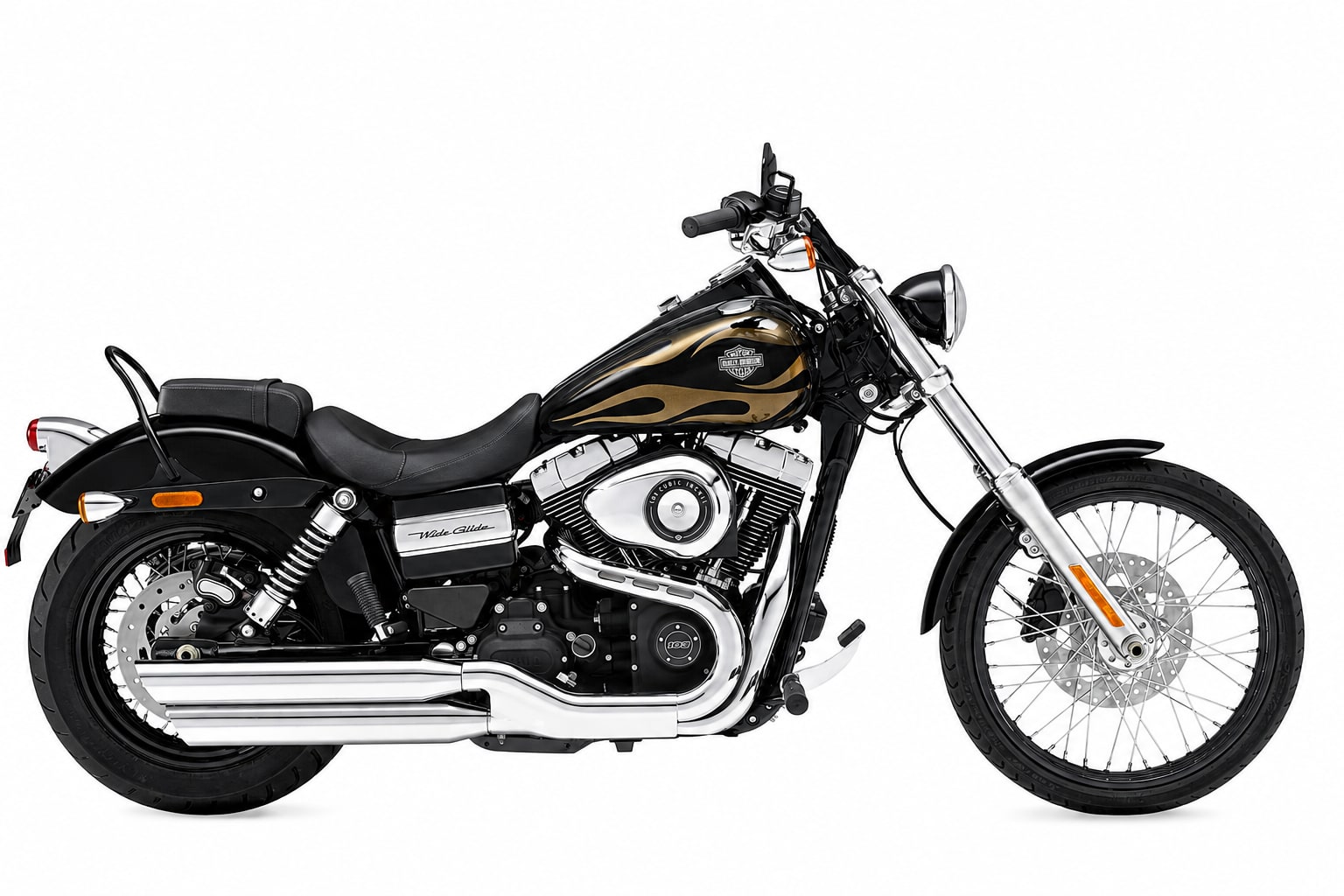
The Low Rider model history is the clearest long view because that name moved from the old four-speed FX frame to FXR, Dyna and Softail chassis.
Models Unique to Each Chassis
If you want a particular badge, the chassis argument may resolve itself.
| Dyna-only factory models | Softail-only factory models |
|---|---|
| FXDB Sturgis, the first Dyna | Fat Boy and Fat Boy Lo |
| FXDX Super Glide Sport and FXDXT T-Sport | Heritage Softail / Heritage Classic |
| FXDS Convertible | Softail Deluxe and Softail Slim |
| FLD Switchback | Deuce, Rocker and Rocker C |
| Dyna Wide Glide versions | Springer Softail and Cross Bones |
| CVO Dyna and CVO Fat Bob variants | Breakout and CVO Pro Street Breakout |
| 35th Anniversary Super Glide | FXDR 114 and Low Rider ST |
The old and new Softail generations also have their own exclusives. Springer models, the Deuce, Rocker and Cross Bones belong to the 1984-2017 layout. The FXDR 114 and Low Rider ST only exist on the 2018-on frame. The Breakout spans both Softail generations; see the complete Breakout guide for those changes.
The Other Things Worth Mentioning
The Dyna vs Softail debacle has more to it than just aesthetics or engine character. I’ll go through a few of the pros and cons of each side that people discuss.
The “Dyna Wobble”
You can google this term and get a bunch of forums where people discuss it, or even a few videos of people getting squirrelly on a Dyna. It looks a little scary!
Dyna wobble happens when riding one hard and when tyres, steering-head bearings, wheel bearings, swingarm components, engine mounts, alignment or suspension are worn or poorly matched. The rubber-mounted powertrain and the relationship between engine, transmission and swingarm give the chassis more variables than a rigid-mounted Softail. Oh, also, there are two shocks, which have to be calibrated to each other!
But it’d be wrong and rude to say every Dyna develops a wobble. It just can happen, and is more notorious for happening on a Dyna.
A bike that moves around needs inspection, not a forum diagnosis or an expensive brace fitted before anyone checks tyre condition and alignment.
Aftermarket Parts and Club-Style Builds
The Dyna has decades of mature aftermarket support. External shocks, fork cartridges, braces, risers, fairings, seats and exhausts can turn a basic bike into a tall, controlled club-style build. Many used examples have already been modified, which can save money or leave you correcting someone else’s geometry.
But hey, it’s around a decade since the new SOftail, so the Softail aftermarket is now large too. Its advantage is a stronger starting chassis; its complication is tighter packaging around the hidden shock, electronics and model-specific bodywork.
Maintenance and Adjustment
Dyna shocks are easy to see for leaks and corrosion, and preload is usually accessible. The 2018-on Softail shock is protected inside the bike but can be easier to forget. On either chassis, the factory setting may be wrong once you add luggage, a passenger or a heavier rider.
Engine-generation checks often matter more than frame servicing. Early Twin Cam cam-chain tensioners, engine mounts, electrical modifications and the quality of past work deserve attention on a Dyna. On a newer Softail, service history, shock-adjuster condition, electronic accessories and model-specific recalls matter. Neither chassis name replaces a proper inspection.
Passenger Use and Luggage
A Softail is not automatically a solo custom and a Dyna is not automatically the practical choice. Harley built the Dyna Switchback with detachable bags and screen, while the Heritage Classic has always made the Softail into a light tourer. The Low Rider ST now does the same with a frame-mounted fairing and hard cases.
For two-up use, seat shape, rear spring rate, preload range, footpeg position and luggage capacity matter more than the number of shocks.
Resale, Originality and “Soul”
Dyna production ended, so clean late Low Rider S, T-Sport and unusual factory models attract people who specifically want that platform. That can support prices, but rarity doesn’t make them a better bike, much less account for a worn engine mount or a poor custom build.
“Soul” usually bundles several real sensations: engine movement at idle, vibration through the controls, intake and exhaust sound, chassis motion and familiarity with a particular silhouette. The Dyna gives more of those signals in stock form. The new Softail filters some of them while adding accuracy and control.
So What Is the Actual Question?
If you compare the engineering, the 2018-on Softail is the more capable base. Harley made it lighter, stiffer and easier to steer, gave it better suspension architecture and paired it with a stronger engine. That is why one frame could replace two cruiser families.
But if wanted a lighter, better-handling bike, we might just get a Sportster S, or not a Harley. The reasons why people buy Harley-Davidsons are things like heritage, friends, style, an emotional connection with the brand, wanting to buy something American-made, and many other things… as long as it doesn’t handle like a bag of bricks and drive the owner straight into a brick wall or oncoming traffic, it’s fine.
If you compare the experience, the Dyna offers things the new chassis deliberately removed: visible twin shocks, a rubber-mounted engine that moves at idle, simple access to the rear suspension and the proportions of models Harley no longer builds.
So there’s no “winner” in this debate. Except if you have a Dyna Low Rider S, in which case, lucky you. I think I missed that boat!