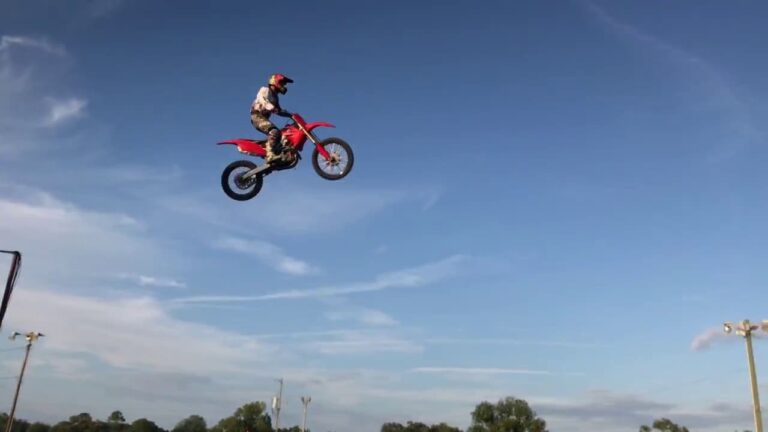

Anyone who has bought and sold a motorcycle and made a profit — even once — has done the mental maths. If I could do this ten times a month, maybe I could earn a living and spend every day around motorcycles. Maybe I should open a dealership. It can’t be that hard, can it?
People do start dealerships, so the idea is plainly possible. The mistake is imagining that love of motorcycles prepares you for the work. A dealership is a buying, selling, paperwork and inventory business that happens to stock motorcycles.
Reminds me of the advice a café owner once gave me: “Don’t start a café if you want to make coffee. Start a café if you want to sweep floors.” So, start a dealership if you love finding stock, negotiating, documenting, pricing, cleaning, photographing, financing, chasing leads and turning inventory before interest eats the margin. You should also be able to tolerate rosters, mechanics, rent, customer disputes, insurance renewals, audits and the occasional motorcycle that looked profitable until you learned a hard lesson by looking somewhere you had never looked before.
I did some digging into the business by speaking with dealers, reading public dealer accounts and administration reports, checking licensing rules, and building three simple financial models (a hangover from my days as an empty suit). The figures below are illustrative rather than a promise of what your shop will earn. They show where the business bends and breaks.
Who am I to write this? I may be writing on a motorcycle blog for fun, but as a management consultant (these days specialising in AI-driven operations for tech companies, i.e. how to do the boring but important things smarter, faster, and more cheaply), people pay me money to tell them how to run their businesses. I used to work a bunch of companies that you’ve definitely heard of if you went to business school. I run my own, too, and do it how I tell others to do it. The below is based on decades of doing that.
Are you obsessed with motorcycles?
Well, I am. That’s why I created this site — as an outlet. I love learning and sharing what others might find useful. If you like what you read here, and you’re a fraction as obsessed as I am, you might like to know when I’ve published more. (Check the latest for an idea of what you’ll see.)
The Motorcycle Dealer Business Model — In a Nutshell
A dealer buys access, certainty and convenience, then sells those things to both sides of a transaction. The seller accepts a lower price to avoid advertising, inspections, finance settlements and tyre-kickers. The buyer pays more for available stock, trade-in convenience, finance, test rides, documentation and some recourse if the deal goes wrong. I wrote about that customer-side value in the case for motorcycle dealerships — why I love them (the summary: they let me test ride stuff conveniently and for free! Try that on Marketplace…)
The dealer earns money from several connected departments:
- New motorcycles: large transaction values, modest percentage margins, manufacturer targets and expensive stock.
- Used motorcycles: more pricing freedom and often better margins, balanced against buying mistakes, preparation and slow stock.
- Parts, accessories and clothing: better percentage margins, but more stock to order, display and count.
- Service: recurring work that keeps producing after the bike leaves the showroom.
- Finance, insurance and warranties: commission income attached to a transaction that was already happening.
- Consignment, storage, detailing and transport: useful income for a dealer that has the process and premises to provide them.
Those departments explain why a busy showroom can still lose money, and why an unglamorous workshop can carry the whole operation.
Where a Dealership Actually Makes Its Money
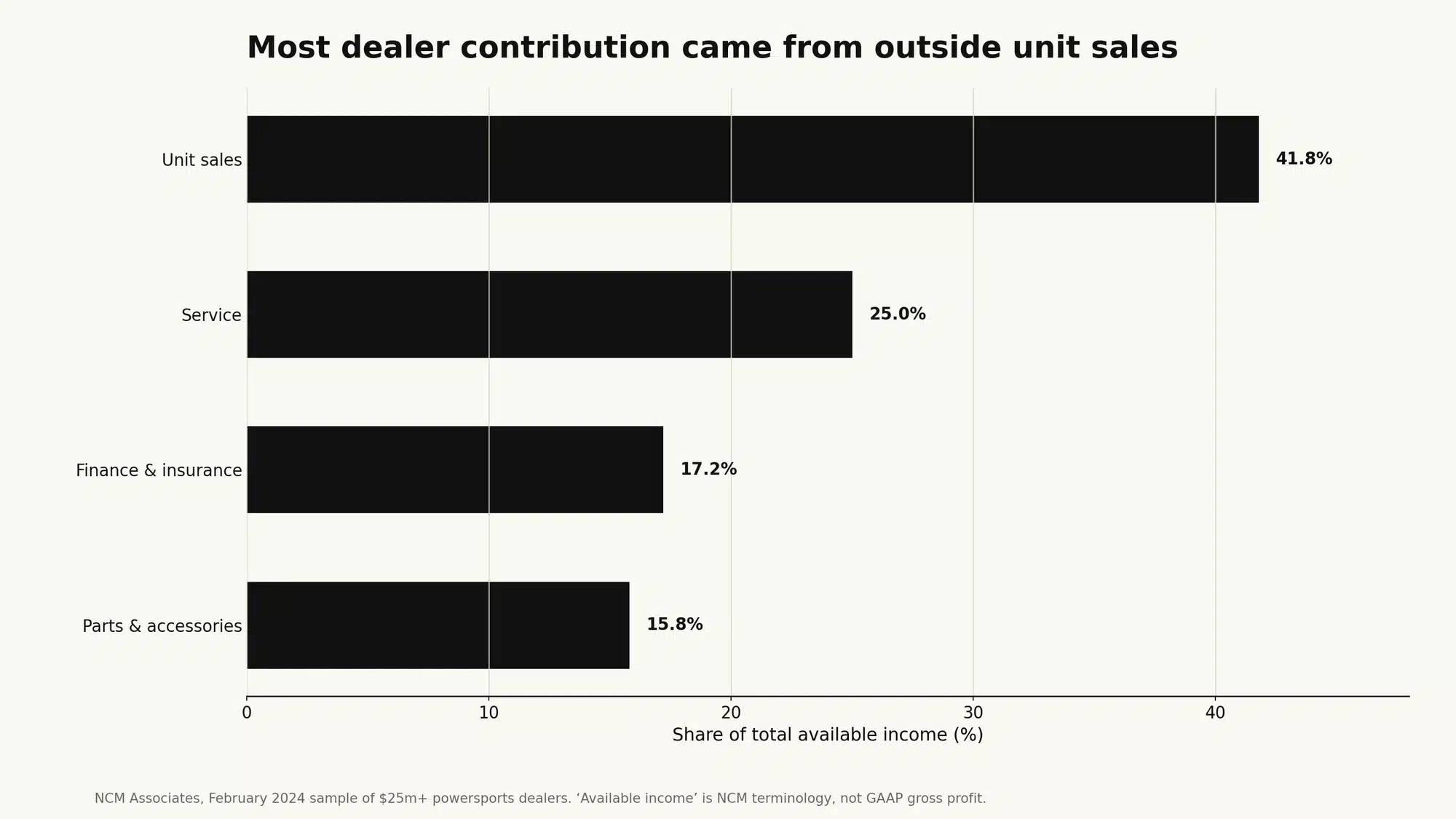
A February 2024 NCM Associates powersports benchmark gives a useful view. In its sample of dealers with more than US$25 million in annual sales, unit sales supplied 75% of operating revenue but only 41.8% of total “available income”. Service, parts, finance and insurance supplied the other 58%. NCM’s “available income” is a dealer-management measure rather than standard accounting gross profit, and the sample includes other powersports products, so treat it as a directional benchmark.
| Department | Share of operating sales | Available-income margin | Share of total available income |
|---|---|---|---|
| Unit sales | 75.0% | 13.4% | 41.8% |
| Finance and insurance | 6.0% | 68.9% | 17.2% |
| Service | 6.2% | 97.5% | 25.0% |
| Parts and accessories | 12.7% | 30.0% | 15.8% |
The same NCM sample reported net operating profit of only 1.0% of sales. The most profitable fifth earned 6.8%; the least profitable fifth lost 7.2%. It also reported motorcycle margins of 12.1–14.7% for new bikes, depending on origin, and 16.0% for used bikes across all dealers. The best fifth made 21.5% on used bikes. The worst fifth made 0.3%.
Australian public-company results tell a similar story at a much larger scale. In the 2026 financial year, MotorCycle Holdings reported A$788.7 million in revenue, A$65.1 million in underlying EBITDA and A$24.1 million in statutory net profit. The group held A$163.8 million of inventory. Its implied category margins were about 17.2% on new vehicles, 14.6% on used vehicles and 41.4% on parts and accessories, although the new-bike figure mixes retail and wholesale. A large, established group with distribution, e-commerce and acquisition benefits still converted only about 3.1% of revenue into statutory net profit.
“Who’s MotorCycle Holdings?” Let me answer it this way — have you ever noticed how the websites for Peter Stevens, TeamMoto, Harley-Heaven, Ultimate Motorbikes, Morgan & Wacker and a bunch of other local sites look eerily similar? It’s not that they just happen to use the same (somewhat antiquated) web site system. MC Holdings owns nearly all the major dealers.
The lesson is simple, and similar to any other small business: revenue makes a dealership look large. Gross contribution, overhead and stock turns decide whether the owner gets paid.
The available market also puts scale in context. The FCAI reported 92,967 motorcycles and off-highway vehicles delivered across Australia in 2025. My full-line year-one scenario needs 300 retail unit sales — roughly 0.3% of that national total, including categories the hypothetical dealer may not sell. Winning that share inside one catchment takes more than opening the doors.
Three Illustrative Revenue Projections
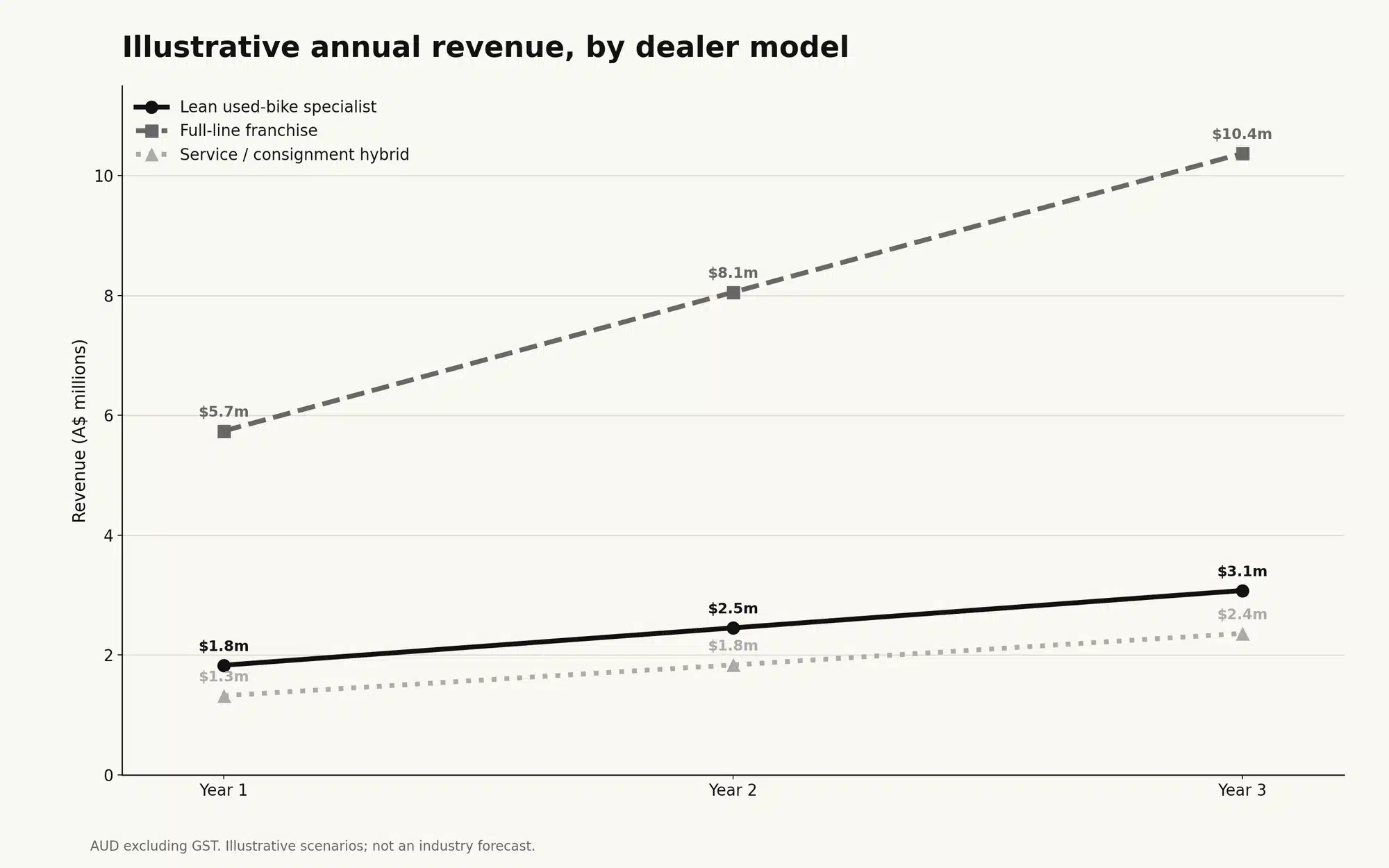
I built three models in Australian dollars, excluding GST: a lean used-bike specialist, a full-line franchise, and a service/consignment hybrid. Each model pays the owner-manager a market salary in fixed costs. Owned motorcycles appear as gross revenue; consigned bikes appear only as dealer fees, because the customer’s bike is not the dealer’s revenue.
| Year-one assumption | Lean used-bike specialist | Full-line franchise | Service / consignment hybrid |
|---|---|---|---|
| Bikes per month | 12 owned used | 25 sold; 80% new | 8 consigned |
| Bike price or dealer fee | A$11,000 average sale | A$15,000 new; A$12,000 used | A$1,300 fee on A$13,000 GMV |
| Bike or fee margin | 14% | 7% new; 13% used | 90% of fee |
| Workshop billable hours/month | 70 | 350 | 350 |
| Fixed operating cost/month | A$25,000 | A$100,000 | A$58,000 |
| Average owned inventory | A$227,000 | A$1.01 million | A$39,000 of parts |
The full-line franchise produces the impressive top line. It also needs the most stock, staff and floor space, and its thin assumed new-bike margin leaves little room for a slow month. The hybrid records the least revenue because it does not pretend the customer’s consigned motorcycle belongs in its sales figure.
| Model | Year | Revenue | EBITDA | Floorplan interest | Cash operating result | Equity/cash tied up |
|---|---|---|---|---|---|---|
| Lean used | 1 | A$1.83m | A$66k | — | A$66k | A$280k |
| Lean used | 2 | A$2.45m | A$167k | — | A$167k | A$364k |
| Lean used | 3 | A$3.08m | A$255k | — | A$255k | A$450k |
| Full-line franchise | 1 | A$5.74m | -A$92k | A$54k | -A$145k | A$538k |
| Full-line franchise | 2 | A$8.06m | A$185k | A$75k | A$110k | A$706k |
| Full-line franchise | 3 | A$10.37m | A$401k | A$96k | A$305k | A$886k |
| Service / consignment | 1 | A$1.32m | A$79k | — | A$79k | A$151k |
| Service / consignment | 2 | A$1.84m | A$239k | — | A$239k | A$195k |
| Service / consignment | 3 | A$2.36m | A$366k | — | A$366k | A$245k |
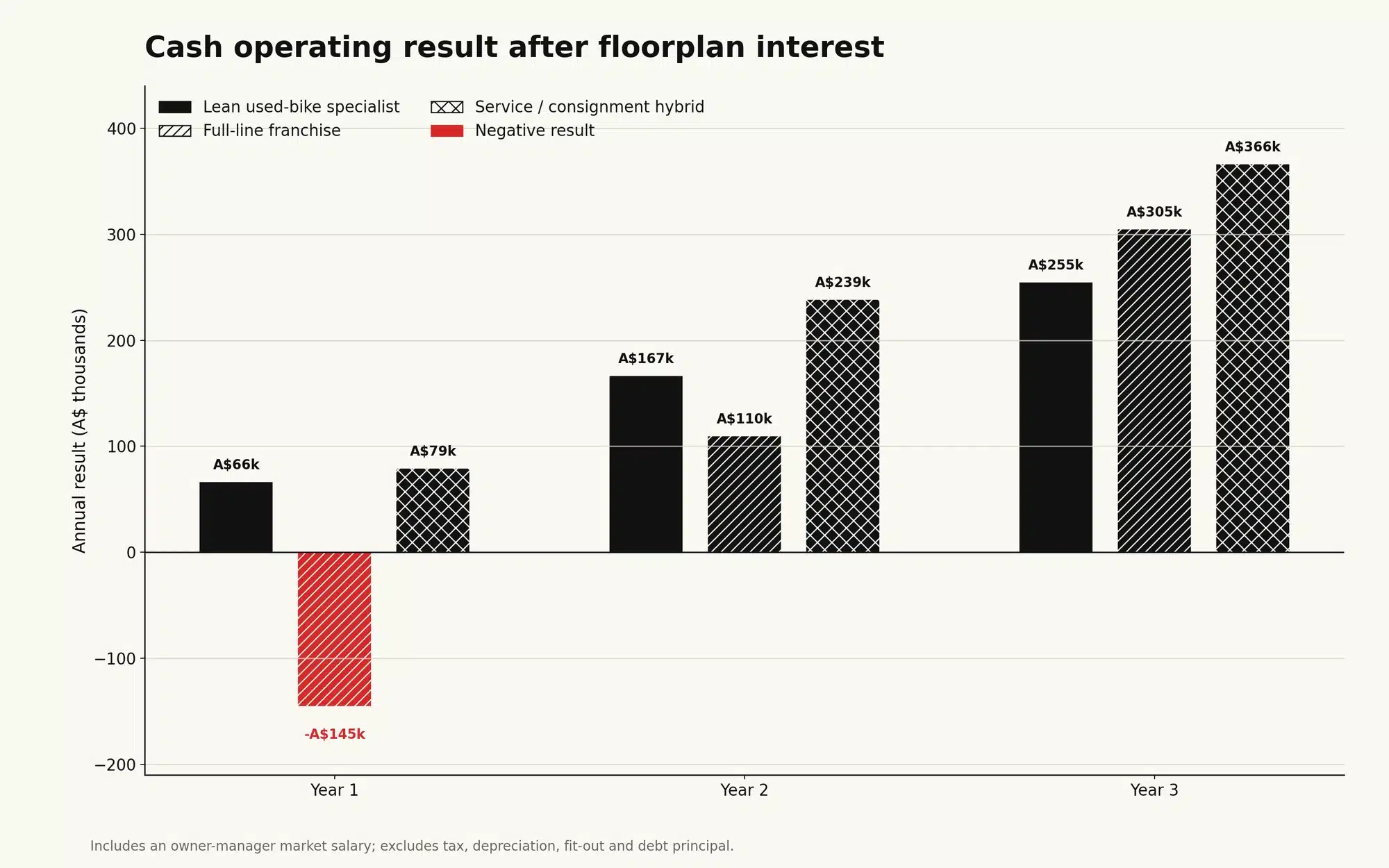
The model’s year-one break-even points are about 9.2 bikes a month for the lean used dealer, 30.2 for the franchise, and 2.4 consigned bikes for the hybrid. By year two, the hybrid’s assumed workshop, parts and detailing contribution covers its overhead before it sells a bike. The workshop carries the business, but it still needs the sales as part of the model.
You might look at the above and think the answer is obviously to run a service / consignment business. Well, the scale is important — you’ll never be huge that way.
Capital Requirements: Your Inventory Is Eating
A motorcycle sitting on a showroom floor looks valuable. It is also consuming rent, insurance, cleaning time and financing capacity while a newer model or a discounted competitor can make it less valuable. The distinction between an asset and available cash becomes important on payday. This is why there’s a case for moving inventory.
Dealers commonly fund stock with floorplan finance. The lender pays for each unit, takes security over it, charges interest or fees while it sits, and expects repayment when it sells. AFC’s explainer describes it as inventory-backed credit. The arrangement preserves cash at purchase, but it puts a clock on every motorcycle.
A simple first pass is:
Average inventory ≈ annual inventory cost ÷ stock turnsAnnual floorplan cost ≈ average financed inventory × interest rate
The maths is easy. Buying the right bikes at the right price and turning them on schedule is the hard part. A stale bike first loses its expected margin through interest, then through discounting, and may finally need wholesale disposal. This is also why investing in motorcycles is usually poor financial maths: storage, capital and liquidity count even when our brains leave them out.
Franchises add fit-out, signage, demonstrators, special tools, diagnostic subscriptions, training, minimum stock, lease deposits and sometimes bank guarantees. Suzuki’s published US dealer requirements, for example, ask for operating capital equal to three months of projected expenses, at least US$200,000 in Suzuki inventory-financing capacity, 465 m² (5,000 sq ft) of Suzuki floor space, an experienced technician and a compliant service department. A government licence lets you trade. It does not oblige a manufacturer to give you a franchise.
Regulation and Paperwork
There are some advantages to running a dealership as a company. You get better tax treatment (you can claim more expenses, and often pay a lower marginal rate), better deals on registrations and insurance (as you don’t have to register them to yourself or insure them for personal use), and of course, you can scale — in many places, once you start flipping more than a few a year, the tax office comes a-questioning.
But of course, there are significant difficulties. Lots and lots of paperwork, record keeping, paperwork, crunch situations, and paperwork.
The rules change by country and state, but the general shape of papership requirements for running a motorcycle dealership is consistent: prove who controls the business, show suitable premises and money, keep transaction records, advertise correctly, handle customer funds, check title, collect tax or duty, protect personal data and maintain insurance.
Victoria gives a concrete Australian example. Consumer Affairs Victoria asks a motor-car-trader applicant to show sufficient funds, lawful premises, effective control, fitness and knowledge of the Act and Regulations. For 2026–27, a company application costs A$1,184.70 plus a A$1,780.50 first annual fee. Dealers must keep a dealings book and use prescribed data sheets for used motorcycles. The licence fee is small next to the inventory, rent, wages and compliance work it permits you to take on.
Texas offers a useful US comparison. Its August 2026 retail-dealer checklist requires an independent motorcycle dealer to obtain a motorcycle GDN, post a US$50,000 surety bond, meet zoning rules, hold a lease covering the two-year licence term, operate from a permanent commercial office, and have an exclusive display area for at least five vehicles. Selling new motorcycles also requires a franchise licence tied to a manufacturer agreement.
And then there are the transactions themselves: licence checks, deposits, trade-ins, finance payouts, cooling-off rights, clear title, registration, roadworthy requirements and consumer-law claims. A casual “take it around the block” approach becomes an insurance problem as soon as you own the stock; I have a separate motorcycle test-ride process and waiver template for that part.
Major Costs and Failure Modes
Most dealer problems are ordinary business problems with motorcycles parked on top of them. The major costs are easy to name and hard to keep aligned with sales:
- People: sales, technicians, service advisers, parts staff, detailing, administration and payroll on-cost.
- Premises: rent, outgoings, fit-out, signage, cleaning, utilities, security and unused showroom area.
- Inventory: purchase cost, floorplan interest, preparation, damage, ageing, theft and discounting.
- Customer acquisition: advertising, marketplaces, photography, events, lead handling and follow-up.
- Risk and compliance: insurance, professional fees, record-keeping, duty, consumer claims and employment compliance.
- Systems: dealer management, accounting, CRM, websites, finance integrations and workshop diagnostics.
The dangerous combination is fixed overhead plus variable gross profit. Rent and payroll arrive at full price in a slow month. Your vehicle margin does not.
Case Studies
Private dealers rarely publish audited accounts, so “success” here means longevity, visible operating scale and external recognition rather than a claim about undisclosed profit. The cautionary cases have public filings or administrator reports. Together, they show two sensible starts and two ways scale can become a burden.
Australia, Success: Adelaide Harley-Davidson Bike Works
Blair Freeth started Adelaide Bike Works as a workshop in Edwardstown in 2010 after 17 years in the motorcycle trade. The business became an authorised Harley-Davidson dealership in October 2015. Its current self-reported figures say it employs 14 people, services more than 25 motorcycles a week and delivers more than 250 new and used motorcycles a year.
It sells parts, accessories and apparel, arranges finance and insurance, takes trade-ins and does custom work. In 2025, Harley-Davidson named it the CXI Champion in its inaugural international dealer awards for markets outside North America, based on customer-recommendation scores. None of that gives us audited profit. It does show a credible sequence: learn the trade, build workshop cash flow and customers, add the franchise later, then keep earning after the initial sale.
Australia, Caution: Peter Stevens Motorcycles
Peter Stevens grew from a Melbourne business founded in 1970 to 15 dealerships in four states and about 400 employees. The retail group entered voluntary administration on 19 May 2025. “Bankruptcy” is the wrong Australian term for a company, and much of the viable business was sold rather than liquidated, but the old ownership structure failed.
Documents lodged with ASIC and reported by AMCN put group liabilities at A$65.9 million: A$26.5 million of floorplan finance, A$15.1 million of lease obligations, A$7.6 million owed to Westpac, A$2.13 million in customer deposits and A$1.6 million in employee entitlements. The group listed about A$42 million in inventory and A$1.2 million in cash.
The administrators said operating profit fell from A$8.6 million in FY2023 to A$3.6 million in FY2024, then became a A$3.9 million operating loss for the year to March 2025. They identified tighter margins, rising staff and selling costs, acquisition expense, high occupancy costs, inefficient operations and capital-heavy decisions. Seven outlets and the Peter Stevens and Harley-Heaven brand rights went to MotorCycle Holdings, while another buyer took four Victorian stores. A recognisable brand and saleable dealerships survived. The financing structure did not.
United States, Success: National Powersports Distributors
Nate and Amy Sanel began in a garage after 9/11, restoring vintage motorcycles and selling them online. Remote buyers could not inspect the bikes themselves, so the Sanels built a repeatable condition-check, servicing, detailing and photography process. The company later added modern stock and moved into a 5,110 m² (55,000 sq ft) site.
A 2017 trade profile reported that it normally held 500–900 motorcycles, employed three dedicated buyers, and had 15 service lifts, six wash/detail lifts and an in-house photo studio. It uses fixed prices and non-commissioned sales staff, buys dealer trade-ins, accepts smaller margins and aims to turn stock faster. The motorcycles are the inventory. Inspection, disclosure, procurement and turnover are the business.
United States, Caution: Motos America
Motos America pursued the other route: buy scale quickly. It adopted an acquisition-led dealership strategy in 2021 and said in a 2022 SEC filing that it had acquired four premium-brand dealers, wanted to raise another US$40 million and targeted 45 dealerships within three years.
Its last audited year produced US$20.2 million in revenue and US$4.4 million in gross profit, but US$6.5 million in operating expenses, a US$2.1 million net loss and US$1.8 million of operating cash outflow. It held US$4.2 million of inventory, recorded US$350,000 of inventory impairment and carried US$2.6 million of floorplan debt at disclosed rates of 7–15%. Its auditor raised substantial doubt about its ability to continue.
The SEC revoked the company’s securities registration in November 2024 after it stopped filing periodic reports. The parent entered Chapter 11 on 31 December 2025. Its four separately incorporated dealership subsidiaries did not file and continued trading, so this was a holding-company bankruptcy rather than the closure of every showroom. The warning still holds: sales and footprint can grow while working capital, financed inventory and corporate overhead make the parent less secure.
Running Leaner — A Few Ideas
So you’re probably not going to build a giant showroom with an espresso bar and bottles of sparkling water. You’re smarter — you’ll sell online from a cheap warehouse, use a small transporter and show bikes by appointment. Fair enough. That plan reduces rent and staff, but the business still needs lawful premises, insurance, secure storage, title checks, inspections, photography, transport and a place for test rides.
The stronger lean models reduce owned inventory rather than simply moving it to a cheaper shed. Consignment, brokerage and auctions let customers supply the bikes. A workshop-first dealer earns before buying much stock. A used specialist can narrow procurement to models they understand and price well. An online dealer can invest in condition reports and fast responses instead of polished tiles. There are also motorcycle businesses that need less inventory capital than a conventional dealership.
Consignment shifts capital risk but adds custody risk. In my hybrid model, the dealer owns only A$39,000 of parts in year one but may hold about A$156,000 of customer motorcycles at any time. Security, condition records, insurance and payout controls matter even though those bikes never appear as dealer inventory.
What’s Your Wedge?
“We love motorcycles and treat people well” might sound nice because it can seem rare, but it is a minimum standard and pretty easy to duplicate. You have to think of what your “wedge” is against competition. A useful wedge changes an economic variable — it helps you buy below market, turn stock faster, earn more per customer or keep overhead lower without making the transaction worse.
Your advantage might be unusually good procurement (special contacts or a tech strategy), a strong learner-bike niche, trusted inspections for interstate buyers, fixed and transparent pricing, same-day finance and trade-in decisions, a workshop with a waiting list, or a content system that makes every bike easy to understand remotely.
The best wedge often sits on the buying side. Plenty of people can sell a desirable motorcycle at a fair price. Consistently finding the right motorcycles, identifying their faults and agreeing on a purchase price that leaves room for preparation, finance cost and error is a rarer, and much more complex skill.
Who Should Start a Motorcycle Dealership?
The acid test, I think is: Do you like deals themselves?
A promising motorcycle dealer likes the deal itself. They enjoy negotiating with a seller, checking the paperwork, spotting the expensive noise, setting a price, presenting the bike honestly, following up a lead, managing the handover and watching aged-stock reports.
Of course, you can like motorcycles too. That helps with judgement and customer trust, and it will help you get through the inevitable tough times. It cannot substitute for the work.
If you love riding, modifying and talking about motorcycles but hate sales, paperwork, inventory and staff management, keep motorcycles as the reward rather than making them the stock. Work in a specialist service, teach, build, create parts, run tours, or simply earn money elsewhere and ride after work.
If you already flip bikes well (or think you’d do better at scale or with dealer advantages), count your time honestly and completely. Include transport, inspections, preparation, advertising, storage, failed deals, tax and the return your capital could earn elsewhere. If the numbers still work at a repeatable volume, and the process remains enjoyable after the fifth lowballer of the day, you may have the beginning of a dealership.
Just remember what you are signing up for. You will spend some time around motorcycles. You will spend much more time running a retail, finance, workshop, logistics and compliance operation. The people who love that combination are the ones who should open the doors.