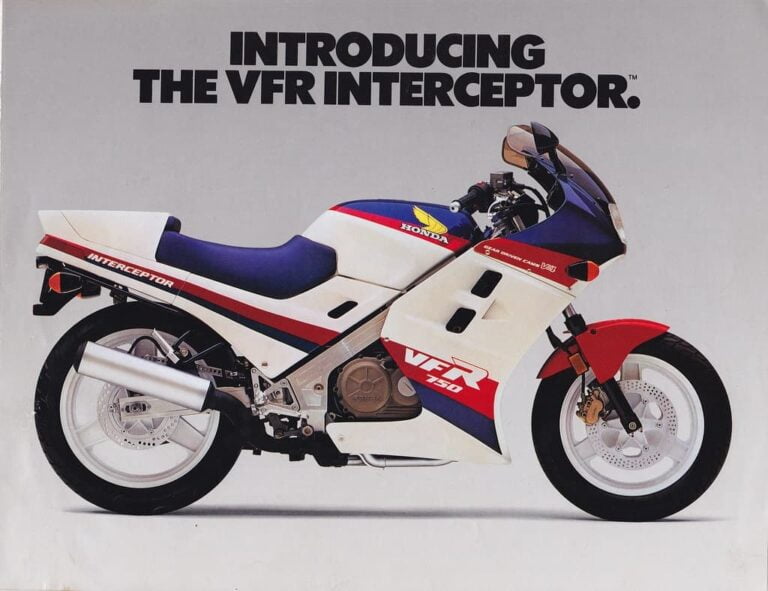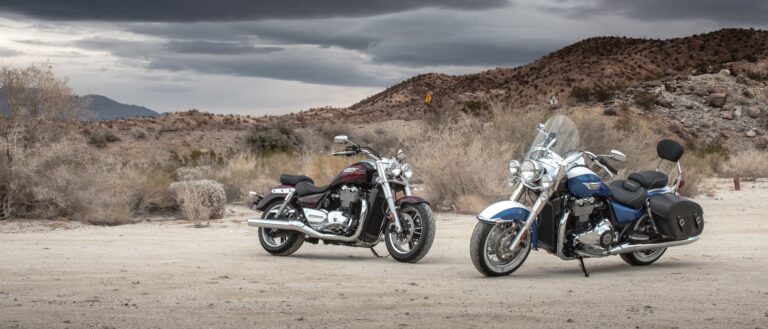

I have a weakness for 1980s Japanese sportbikes. The fairings are broad, the graphics are loud, the headlights look borrowed from an endurance racer, and you can see the engineers working out what a road-going superbike should be in real time.
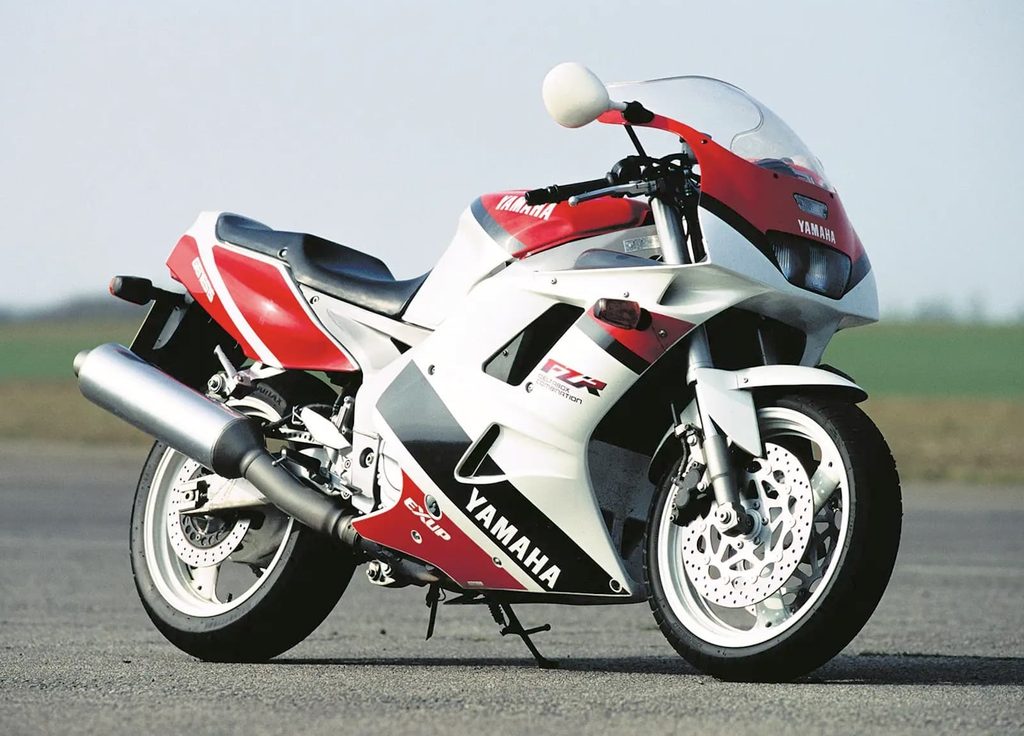
The Yamaha FZR1000 is one of my favourites. A clean first-generation Genesis still looks hot: twin round lamps, white wheels, acres of red-and-white bodywork, and a 20-valve inline four that carries on like a toolbox falling down a metal staircase until the exhaust takes over.
Modern superbikes are faster, lighter, easier to manage, and much better at protecting riders from a bad throttle hand. That, and age and availability of parts, have made the FZR1000 rare in ordinary traffic. Most surviving examples live in collections, wait for restoration, or appear briefly in classifieds with cracked fairings and a story.
This retrospective looks at why the FZR1000 mattered, what Yamaha’s Genesis and Deltabox ideas actually meant, how EXUP changed it, and why a well-preserved one can still stop us in our tracks.
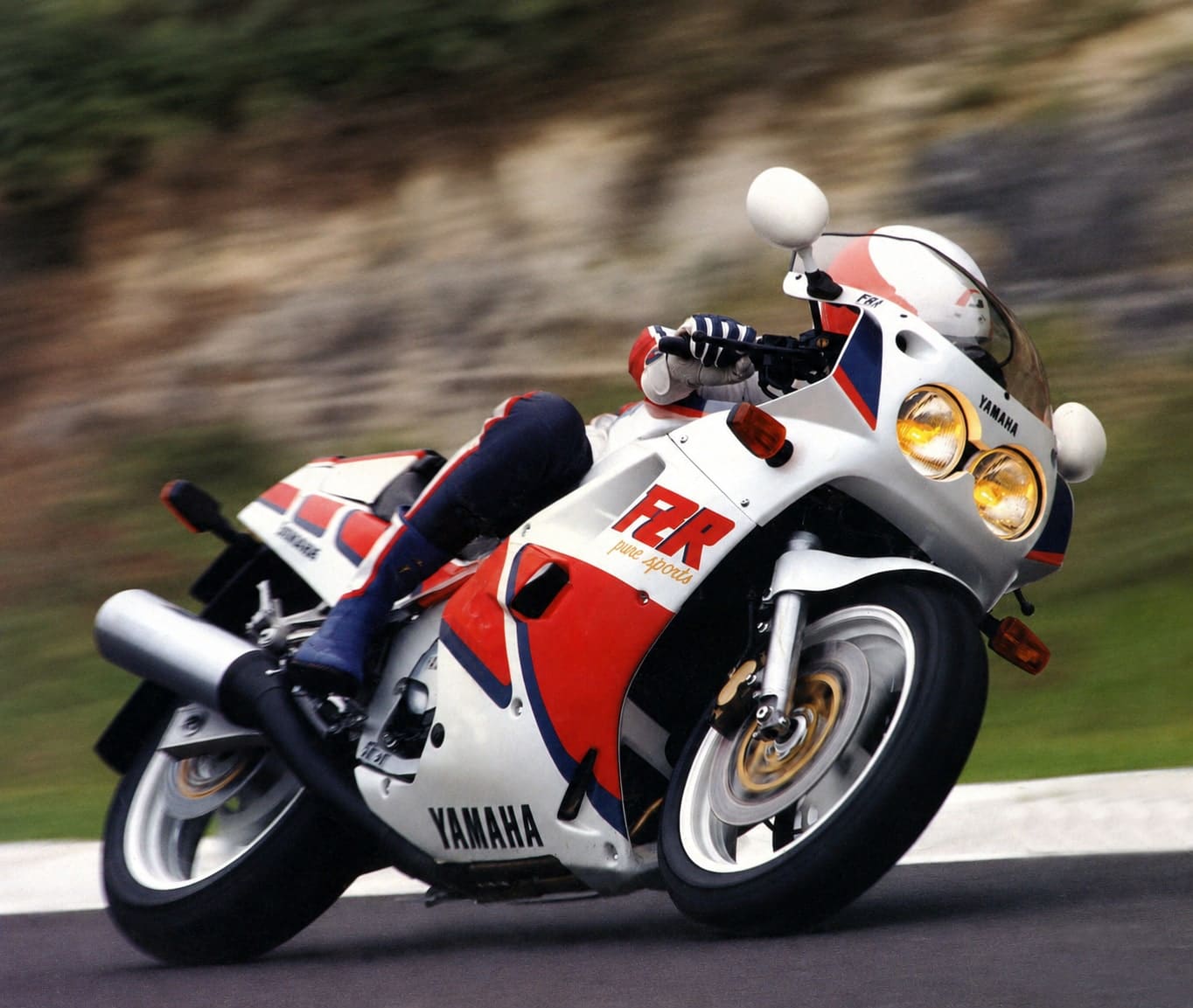
The TL;DR: The 1987 FZR1000 put a 989 cc, twenty-valve four-cylinder engine into an aluminium Deltabox chassis and gave litre-bike riders handling that no longer felt like steering a high-speed sofa. The 1989 EXUP model added a broader midrange and a better-balanced chassis. Later bikes became more capable, but if you don’t like twin round headlights, may I politely show you the door?
Are you obsessed with motorcycles?
Well, I am. That’s why I created this site — as an outlet. I love learning and sharing what others might find useful. If you like what you read here, and you’re a fraction as obsessed as I am, you might like to know when I’ve published more. (Check the latest for an idea of what you’ll see.)
Where the Yamaha FZR1000 fits
Yamaha launched the FZR1000 in Europe for the 1987 model year, after showing it at the Cologne motorcycle show in late 1986. It sat above the FZR400 and FZR750 as the flagship expression of Yamaha’s Genesis development idea.
The timing mattered because Suzuki had already shown that the GSX-R750 and GSX-R1100 could give a large motorcycle an aluminium frame, race-replica bodywork, and steering that belonged on an interesting road rather than only an autobahn. Yamaha’s answer had to be fast enough for the open-class arms race and reassuring enough for a normal rider to use.
Yamaha’s own chassis history puts the original FZR1000’s claimed top speed at 270 km/h (168 mph). But the development team was against the possibility of nervous, excessively sharp steering. They tuned the bike for a natural first movement into a turn and stable behaviour on bumpy public roads. That concern for balance is what kept the FZR1000 accessible, and was a thread among all the FZR models.
| FZR1000 version | How to identify it | Main mechanical change | Why it matters now |
|---|---|---|---|
| 1987–1988 Genesis | Twin round headlights, angular bodywork, conventional fork | 989 cc 20-valve engine, 45-degree cylinder inclination, aluminium Deltabox frame | The clearest 1980s design and the version I want to stare at |
| 1989–1990 Genesis EXUP | Twin headlights with smoother, fuller bodywork | 1002 cc engine, EXUP exhaust valve, revised frame rigidity and 35-degree cylinders | The big performance step and the most historically important update |
| 1991–1993 EXUP | Single headlight (boo), more modern nose, upside-down fork | Chassis, fork and detail revisions | A better rider if you value control more than the early look |
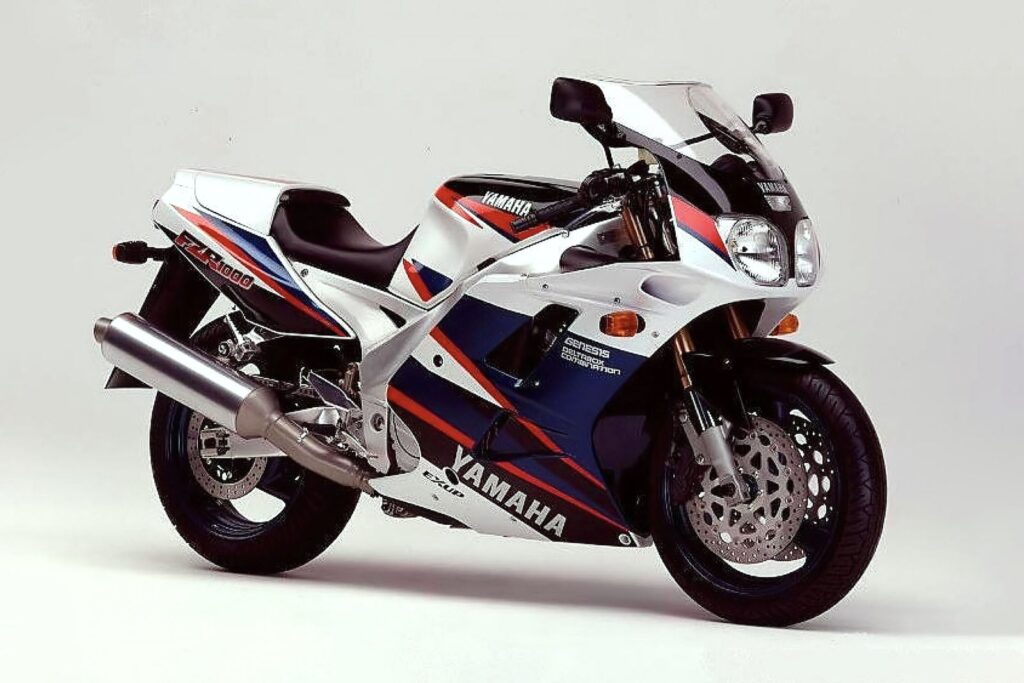
| 1994–1995 EXUP | Twin fox-eye headlights, final-generation bodywork | Six-piston front calipers and late chassis detail changes | The most developed FZR1000, sitting close to Thunderace territory |
Period specifications are less consistent than current press kits, especially for mass and power. Yamaha’s FZR1000 archive lists the 1987 bike at 229 kg (505 lb), with 99.3 kW (135 PS / 133 hp) at 10,000 rpm and 102 Nm (75 lb-ft) at 8,500 rpm. Yamaha did not always state fuel and fluids on the same basis, so take that as ballpark and meaning “heavier than today’s bikes and not as powerful”.
The 20-valve Genesis engine
“Genesis” was Yamaha’s name for a whole-engine and chassis layout that spanned a generation. The FZR1000 inherited the FZ750’s design concepts: incline the cylinder bank sharply forward, use downdraft carburettors and straight intake paths, and package the engine so the rest of the motorcycle could sit around it more intelligently.
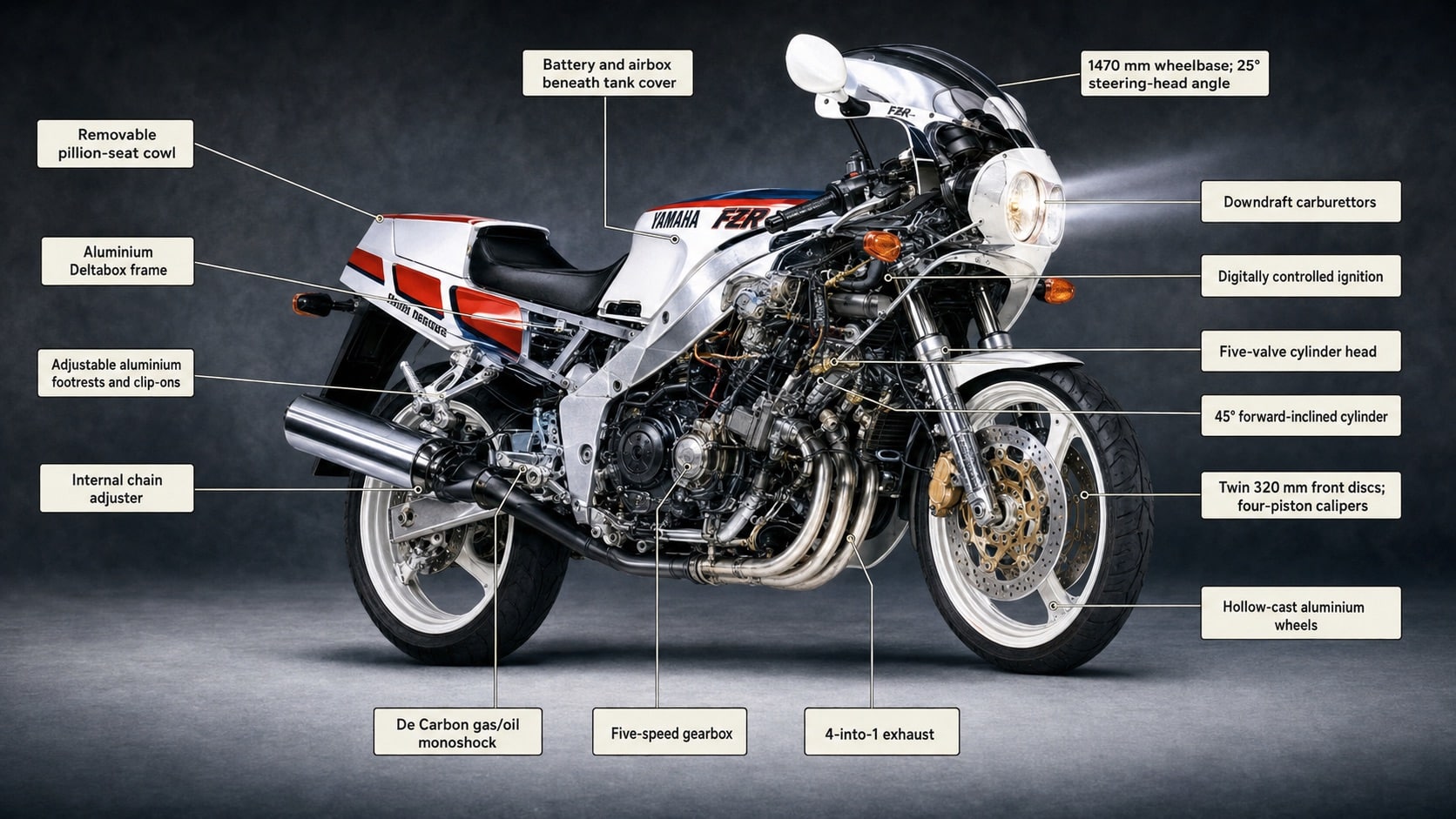
But five valves per cylinder?? Is that really necessary? Ducati was making do with two. Others had four, adn it came at a cost of more bits that move around. Regardless, this is what Yamaha decidd to do.
In a five-valve-per-cylinder engine, each cylinder has three intake valves and two exhaust valves. Twenty valves gave Yamaha plenty of valve area while keeping each valve small and light, ensuring smoother airflow. The narrow included valve angle also helped form a compact combustion chamber and allowed a relatively high compression ratio for the period.
The five-valve layout later became a Yamaha calling card. It survived through the FZR1000’s successor, the YZF1000R Thunderace, and into early generations of the YZF-R1. Four-valve heads eventually won because they could match the required flow with less complexity, but the 20-valve badge looked wonderfully serious on a 1980s fairing.
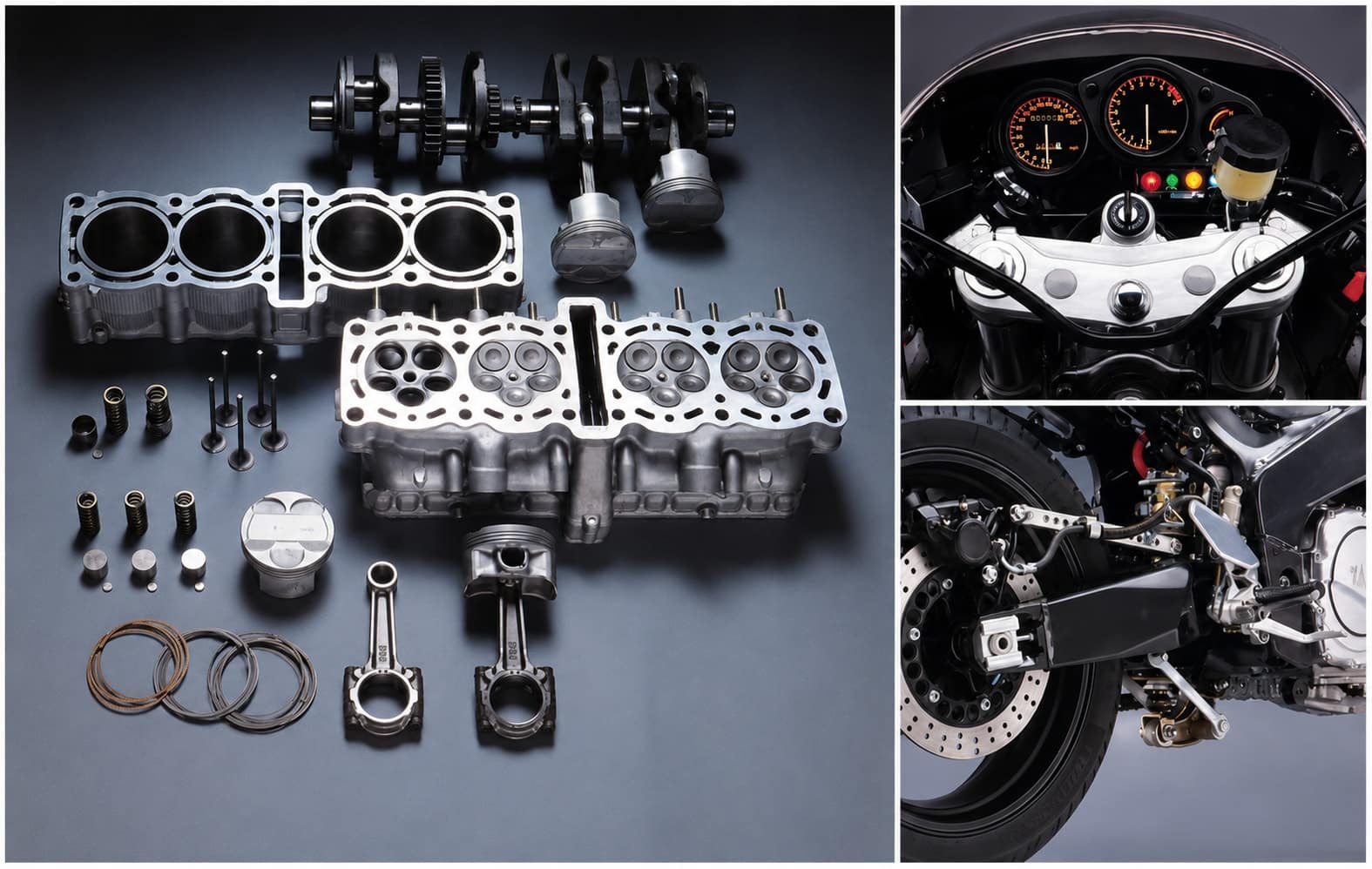
The engine’s appeal now has as much to do with texture as output. A contemporary litre bike can make another 50–70 kW while idling cleanly, fuelling perfectly and filtering most mechanical clatter. The FZR has carburettor induction noise, straight-cut and chain-driven sounds, and the busy rustle of a large old inline four. Some noises mean an engine needs attention; a healthy one still sounds far more mechanical than a new bike.
“Deltabox”? Sounds cool, what is it?
There are so many names for frames it can be quite confusing to a newcomer. In this case, “delta” means “triangular” (like the Greek letter “Δ”… see, a triangle!) and “box” means “box”.
A Deltabox frame uses large-section beams running in a direct line from the steering head towards the swingarm pivot. Seen from above or the side, the main structure forms triangular load paths. The short, broad route gives engineers a stiff and relatively light structure around the engine.
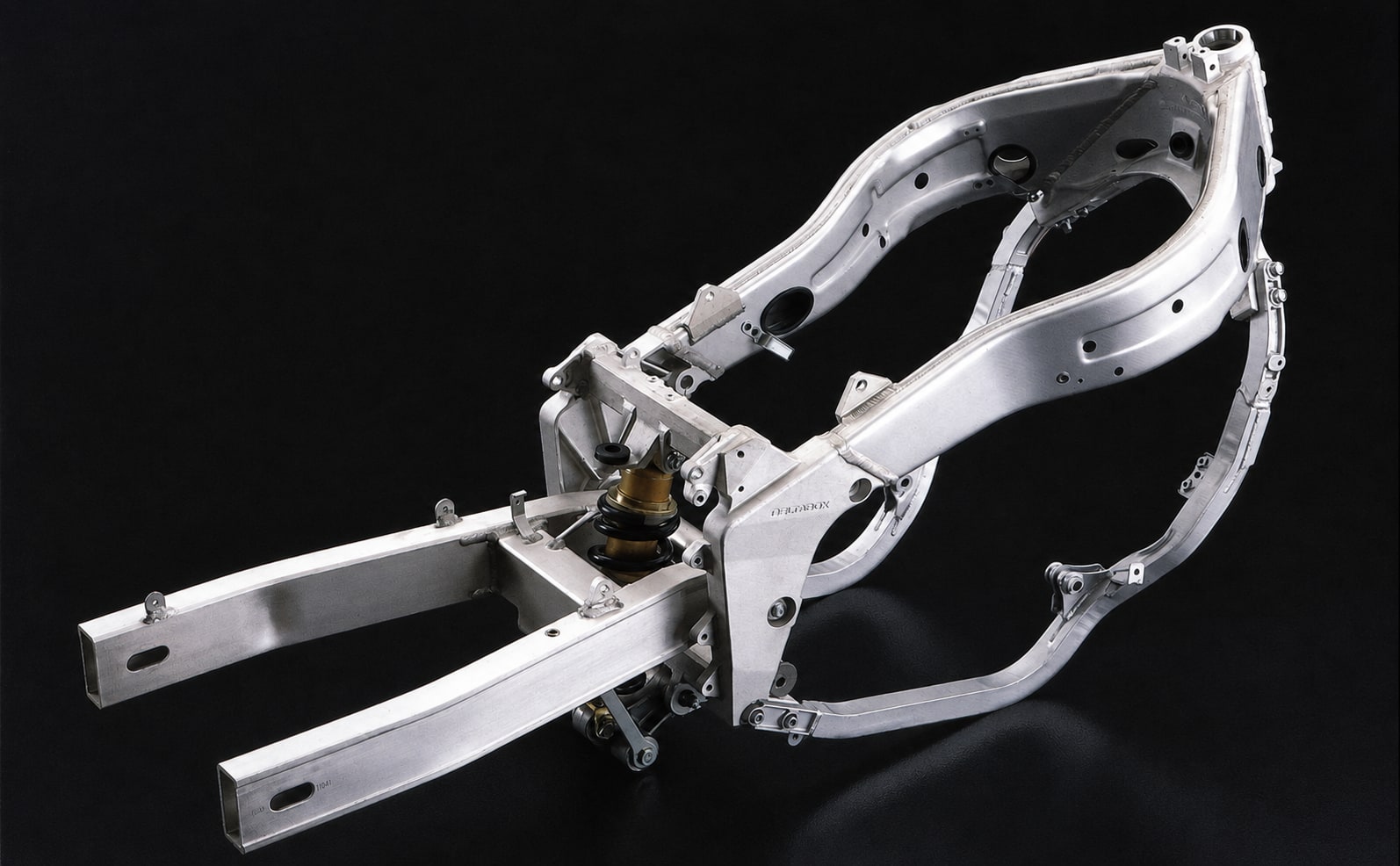
The interesting bit is that more frame stiffness is never the complete answer. Anyone who has danced with a partner (anyone?) knows that if they’re too loose, you can’t engage with them, and if they’re too stiff, you can’t have any fun. The answer is always balance, balance, balance.
In ride testing, Yamaha found that a frame can feel heavy and reluctant if its rigidity is excessive in every direction. For the 1989 redesign, improved stress analysis let the team increase lateral rigidity while reducing torsional rigidity. Yamaha also cut about 2 kg (4.4 lb) from the frame.
That sounds abstract until you translate it into a corner. The frame has to keep the wheels aligned under braking and acceleration, while giving the tyres and suspension enough help to maintain contact and communicate grip. Yamaha described the second-generation EXUP chassis as a major step in overall balance, and period testers praised it as one of the best-handling litre bikes available.
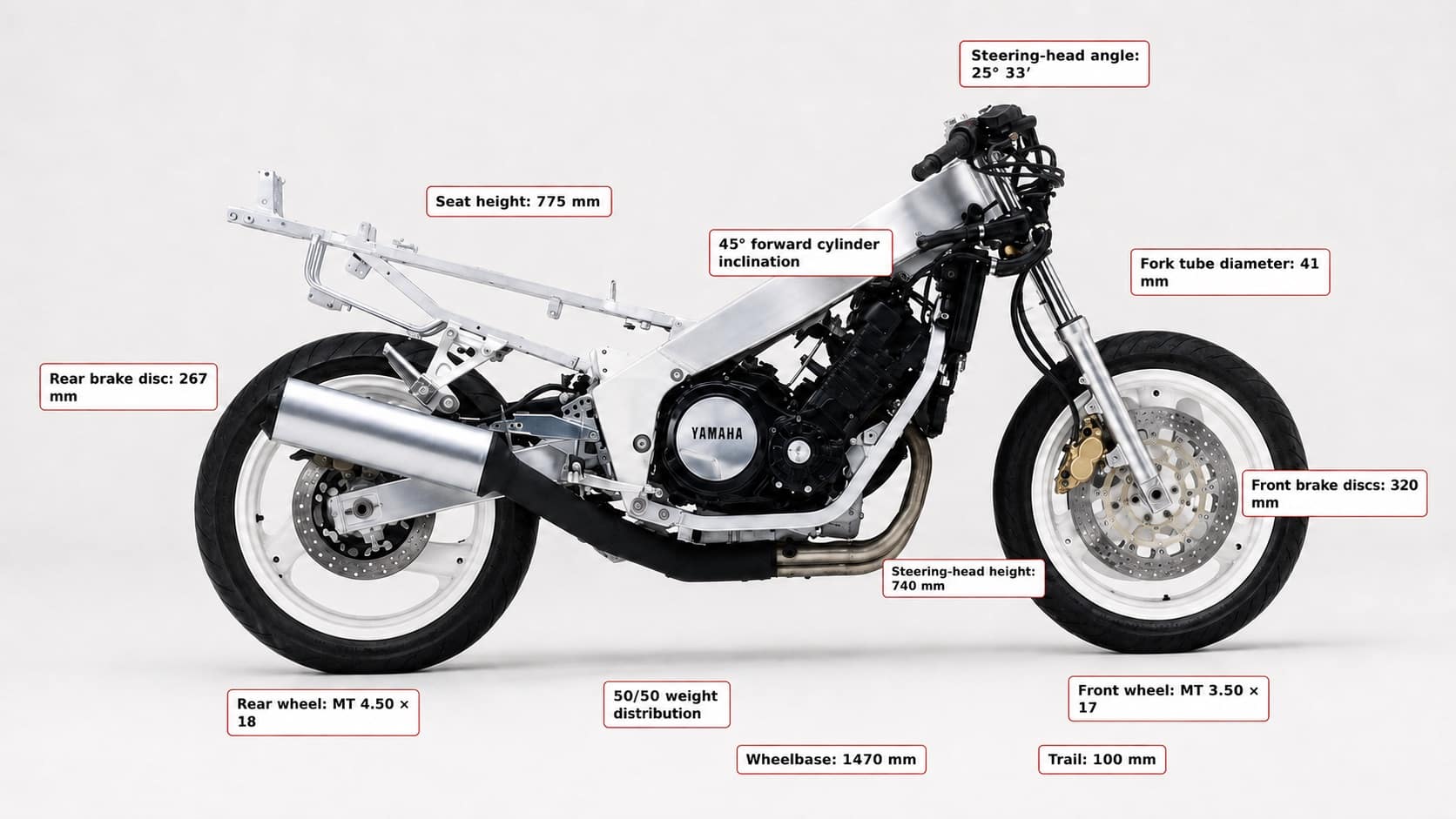
The early bike still looks long beside a modern superbike: a 1,470 mm (57.9 in) wheelbase, 25-degree steering-head angle, and an 18-inch rear wheel. Those dimensions favour stability. The FZR1000 made its progress by letting a large, very fast motorcycle turn naturally without giving up the assurance riders expected at autobahn speeds.
What EXUP changed in 1989
For 1989, Yamaha enlarged the engine from 989 to 1002 cc and added EXUP, short for Exhaust Ultimate Power Valve, which was also the name for a move in Street Fighter, if I recall correctly (I do not). Anyway, Yamaha was not feeling shy about the way it named things.
The system puts a servo-controlled butterfly valve in the exhaust collector. At lower engine speeds and loads, the valve reduces the effective exhaust area and changes the pressure-wave behaviour in the system. That helps maintain gas speed and cylinder filling. At high rpm it opens so the engine can breathe without the same restriction.
The practical result is more useful torque through the middle without choking peak power. This is more accurate than saying that an engine simply “needs back pressure”. Engines need the exhaust dimensions and pressure waves to suit the rpm range. EXUP gave Yamaha a way to vary part of that relationship while the engine was running.
The EXUP valve became important enough that owners use the word as shorthand for the whole 1989-on FZR1000. It also adds one more old-bike job: the valve and cables need to move freely, and neglected collectors can corrode or seize.
What an FZR1000 asks of its rider
The FZR1000 could still perform at speeds well beyond sensible public-road speeds, even in the 90s before speed cameras were widespread. But the FZR was still accessible. The difference, at various speeds, is in how much motorcycle you feel while accessing it. The controls are heavier, the steering takes more commitment, and the chassis moves around more than a current R1 on modern tyres and suspension.
Low-speed work is where the age shows first. A roughly 230 kg motorcycle with a long wheelbase, a broad fairing and a tall centre of mass needs deliberate inputs in car parks and tight traffic. Modern superbikes feel almost tiny by comparison, even when their riding positions are less friendly.
Once the road opens, the old Yamaha makes more sense. The roomy bodywork gives useful wind protection, the five-speed gearbox does not demand constant shifting, and the engine has enough capacity to pull without living near redline. The 1989 EXUP model made that midrange behaviour better again.
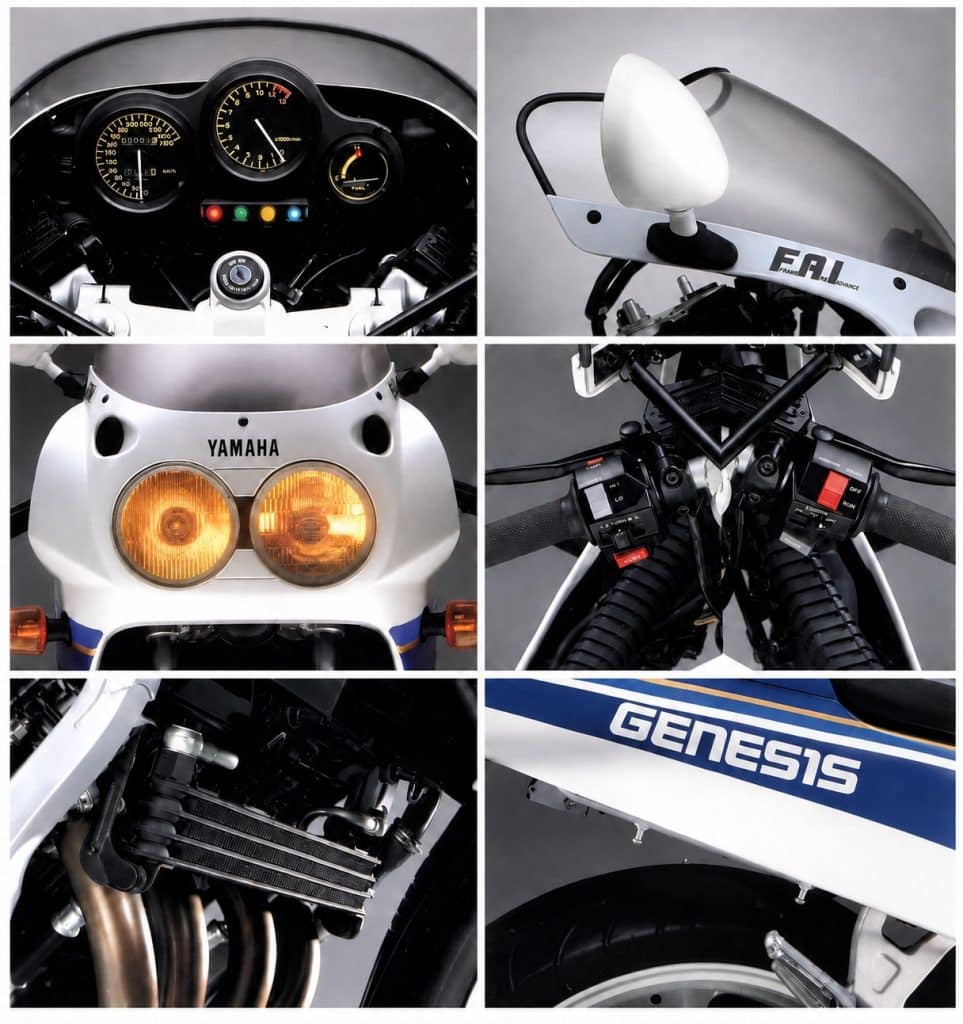
The cockpit is part of the appeal. You look through a real windscreen at three simple analogue dials, warning lamps and an ignition barrel. There are no riding modes to configure while wearing gloves. Your right hand, the carburettors and the rear tyre negotiate the throttle setting among themselves.
Brakes and tyres deserve respect rather than nostalgia. Fresh pads, lines, fluid, bearings and suitable modern tyres can make a sound FZR far better than a neglected example. But still, you need to plan earlier and to be smoother than you would on a modern machine.
Why the FZR1000 disappeared
The FZR1000 helped establish the formula that made it obsolete. Once manufacturers knew how to put a powerful litre-class engine into a light aluminium chassis, the next target was obvious: make the whole thing smaller and lighter.
Honda accelerated that change with the CBR900RR FireBlade in 1992. It gave away some capacity and peak power to early FZR1000s, then changed the class with a much lower mass and compact dimensions. The question stopped being how much engine a big chassis could carry. Riders began asking how little motorcycle could contain superbike performance.
Yamaha let the FZR1000 evolve through 1995 in some markets, then moved its engine into the more road-oriented YZF1000R Thunderace. In 1998, the original R1 compressed Yamaha’s litre-bike thinking into a 177 kg dry package with a short wheelbase and an unusually long swingarm. The FZR suddenly looked like the previous century, even though the first one was only eleven years old.
For riders who wanted comfort and speed, machines such as the Honda CBR1000F, Kawasaki ZZ-R1100 and later Honda Blackbird did the long-distance job with clearer touring intent. The FZR1000 was caught between two classes that were becoming more specialised.
Which FZR1000 would I want?
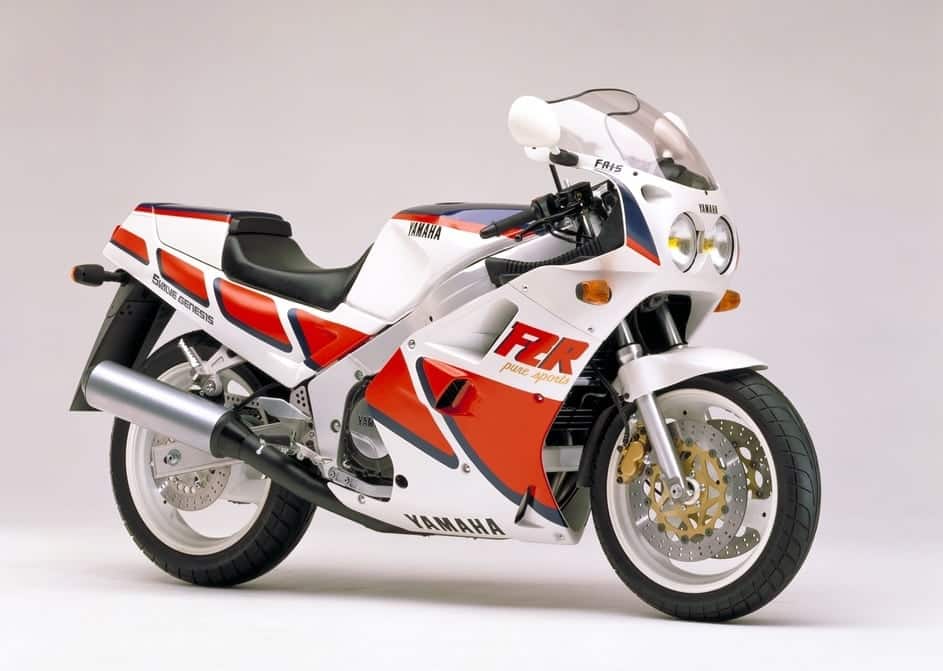
My answer is the 1987–1988 Genesis in white, red and blue. The twin round headlights, blocky tail, white wheels and enormous FZR graphics capture the decade better than the later bikes. I would accept its conventional fork, 18-inch rear wheel and weaker midrange because the attraction begins before the engine starts.
If I were buying one to ride regularly, I might also look hard at a 1989–1990 EXUP. It keeps the twin-headlight shape while gaining the 1002 cc engine, broader torque and major chassis work.
The final fox-eye bike suits someone who wants the most developed FZR1000 and does not mind its visual overlap with the 1990s. At that point I would also compare it with the Thunderace, an early R1, a GSX-R1100 and the other machines in my guide to big four-cylinder motorcycles. There’s something for everyone.
A clean FZR1000 matters more than the year
Any FZR1000 is now an old motorcycle. The best purchase is a complete, well-kept example with original bodywork, evidence of regular use, and an owner who can explain what has been serviced. A cheaper bike with missing panels, a rusty tank and silent history can absorb the price difference very quickly.
- Bodywork and graphics: Check every mounting tab, seam and fastener. Original fairings and correct decals are difficult to replace and have a large effect on value.
- Fuel system: Look inside the tank for corrosion, confirm the carburettors respond cleanly, and ask when they were last cleaned and synchronised.
- EXUP hardware: On 1989-on bikes, make sure the valve, pulley, cables and servo complete their movement without binding.
- Ageing chassis parts: Inspect fork tubes and seals, steering-head and wheel bearings, brake pistons and hoses, shock damping, swingarm bearings and chain adjusters.
- Cooling and charging: Old hoses, radiator corrosion, fan operation, connectors, regulator/rectifier health and charging voltage all deserve attention.
- Cold start and engine condition: Hear it start from cold, watch for smoke, and distinguish normal mechanical bustle from persistent knocks or cam-chain noise.
Use the full used-motorcycle inspection checklist as the baseline. On a collector-grade FZR1000, originality and cosmetic completeness deserve as much scrutiny as the engine.
Still a sight to behold
A current superbike — or even a 20-year-old R1! — wins every performance argument. It weighs less, accelerates harder, stops better, turns with less effort and gives you an electronic safety net the FZR1000 can’t imitate (though one that many wouldn’t want)
But there are few bikes these days with the twin lamps, angular fairing, and the orchestra of the carburetted inline four that the FZR has.
Of course, maintenance and cost of ownership are huge for a bike like these, even after the sticker price.
I would choose a newer motorcycle for a fast ride on an unfamiliar road. But I would still cross a car park to look closely at a clean FZR1000, and I suspect I always will.