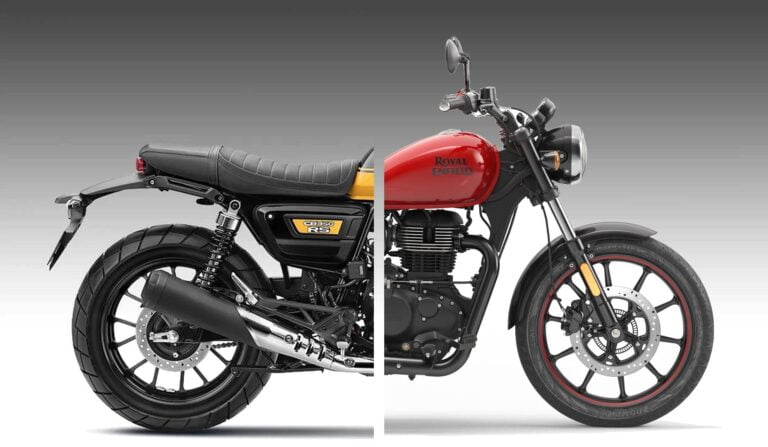

There was a dark period when nobody could get a Daytona. It wasn’t long ago!
These days, we do have a Daytona 660, plus an exotic model I’ve only ever seen in person, not even touched. But the Daytona name has meant many things to Triumph, back in the Hinckley era as well as in the current Bloor dynasty.
So yeah, the current Daytona 660 is a friendly, road-focused middleweight. But the Daytona 675 was a narrow, committed supersport. The Daytona 1200 was a big 1990s four-cylinder bruiser, and the first production Daytona was a 500 cc parallel twin. Is that enough?
This guide covers the production Daytona family from the 1967 T100R through the updated 2026 Daytona 660.
Are you obsessed with motorcycles?
Well, I am. That’s why I created this site — as an outlet. I love learning and sharing what others might find useful. If you like what you read here, and you’re a fraction as obsessed as I am, you might like to know when I’ve published more. (Check the latest for an idea of what you’ll see.)
Triumph Daytona History in Brief
Triumph has used Daytona for three broad kinds of motorcycle: a sporting version of an existing road bike, a full supersport built around lap times, and a limited model tied to racing. The 675 era is the exception that now defines the name for many riders, and brings the Daytona to everyone.
| Years | Model | Engine | What changed |
|---|---|---|---|
| 1967-1974 | T100T / T100R Daytona | 490 cc parallel twin | The first production Daytona, named after Triumph’s 1966 Daytona 200 win |
| 1991-1992 | Daytona 750 / 1000 | 749 cc triple / 998 cc four | The Daytona returned with Triumph’s modular T300 platform |
| 1993-1997 | Daytona 900 / 1200 | 885 cc triple / 1,180 cc four | Longer-stroke engines added much more road torque; the 900 ended in 1996 |
| 1994-1996 | Daytona Super III | 885 cc triple | Cosworth-assisted engine work, Alcon brakes, and carbon parts |
| 1998 | Daytona 1200 SE | 1,180 cc four | A final numbered run of 250 bikes |
| 1997-2000 | T595 / early 955i | 955 cc triple | Fuel injection, an aluminium frame, and a single-sided swingarm |
| 2001-2006 | Revised Daytona 955i | 955 cc triple | More power, less weight, then a final facelift for 2005 |
| 2003-2005 | Daytona 600 / 650 | 599 / 646 cc inline four | Triumph’s last production four-cylinder motorcycles |
| 2006-2012 | Daytona 675 / 675R | 675 cc triple | The Daytona became a true middleweight supersport |
| 2013-2017 | Daytona 675 / 675R | 675 cc triple | A new short-stroke engine, chassis, ABS, and under-engine exhaust |
| 2020 | Daytona Moto2 765 | 765 cc triple | A numbered, carbon-bodied limited edition with top-shelf chassis parts |
| 2024-2025 | Daytona 660 | 660 cc triple | A more comfortable, less expensive road-sports Daytona |
| 2026 onward | Updated Daytona 660 | 660 cc triple | Adjustable fork, standard quickshifter, and Metzeler M9RR tyres |
The engine story moves back and forth between triples and fours. Triumph’s first Hinckley Daytonas used both layouts, the 600 and 650 followed the Japanese inline-four supersport formula, and the 675 established the triple as the Daytona engine most riders now expect.
Where the Daytona Name Came From
Buddy Elmore gave Triumph the name with one of the company’s most famous race wins. He started the 1966 Daytona 200 from 46th on the grid and won on a works Triumph Tiger 100 at an average of about 155 km/h (96.6 mph). Gary Nixon won again for Triumph in 1967.
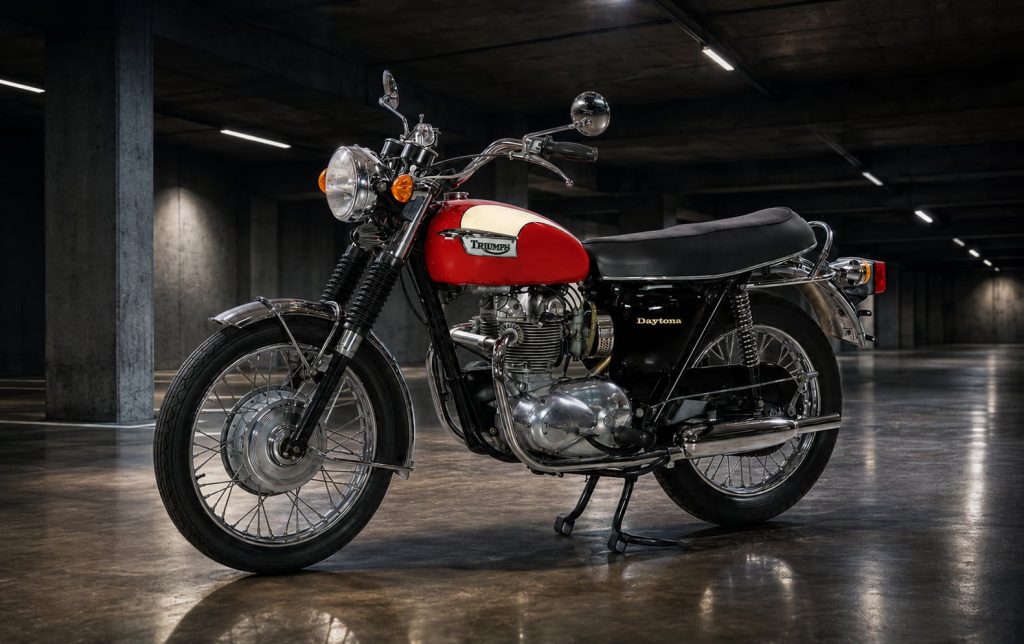
Triumph turned the race connection into a production model for 1967. The T100T in the UK and T100R in the US used a 490 cc air-cooled parallel twin with twin carburettors and a claimed 31 kW (41 hp). It was a light, fast roadster for its day rather than a fully faired sports bike in the modern sense.
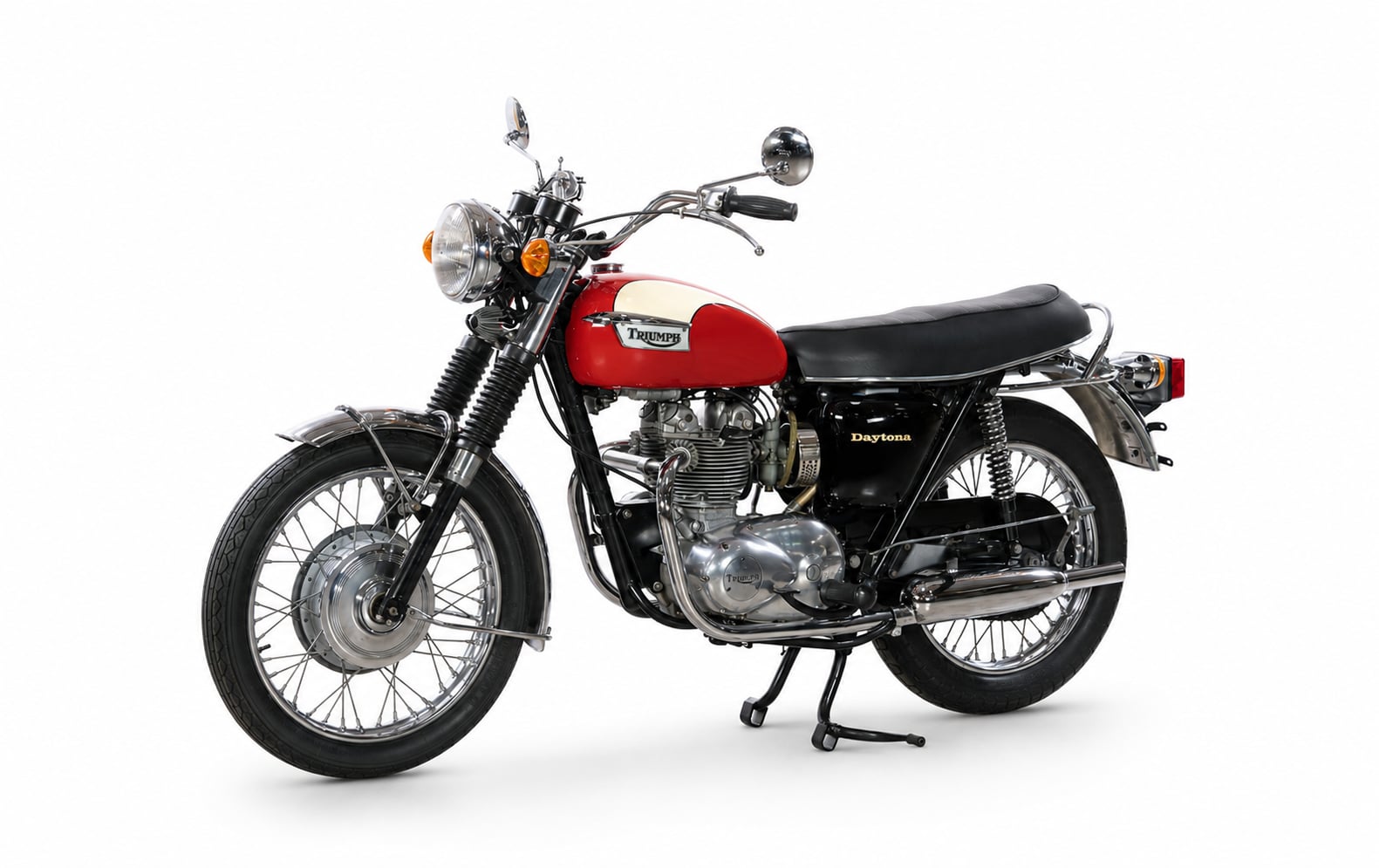
The original Daytona stayed in production through 1974. The name then disappeared from regular production until John Bloor’s revived Triumph launched its first range of Hinckley-built motorcycles.
The T300 Daytona Family: 750, 1000, 900, and 1200
Triumph relaunched in the early 1990s with a modular range. The same basic liquid-cooled engine architecture could use three or four cylinders and a short or long stroke, while several models shared the tall steel spine frame and many chassis parts. This let a small manufacturer field a broad range quickly.
The trade-off was mass and height. These Daytonas were fast, well finished road bikes, but even the smaller versions felt substantial beside the rapidly improving Japanese sports bikes of the period.
1991-1992 Triumph Daytona 750 and Daytona 1000
The first Hinckley Daytonas arrived as the three-cylinder 750 and four-cylinder 1000. Both used carburettors, six-speed gearboxes, adjustable 43 mm conventional forks, and full bodywork over the shared T300 platform.
The 749 cc triple made a claimed 74 kW (97 hp) and 66 Nm (49 lb-ft). The 998 cc four was quoted at up to 88 kW (120 hp) and 88 Nm (65 lb-ft), although period figures vary by market. The 1000 had more speed, but the short-stroke engines did not have the easy midrange that made the later 900 triple so popular.
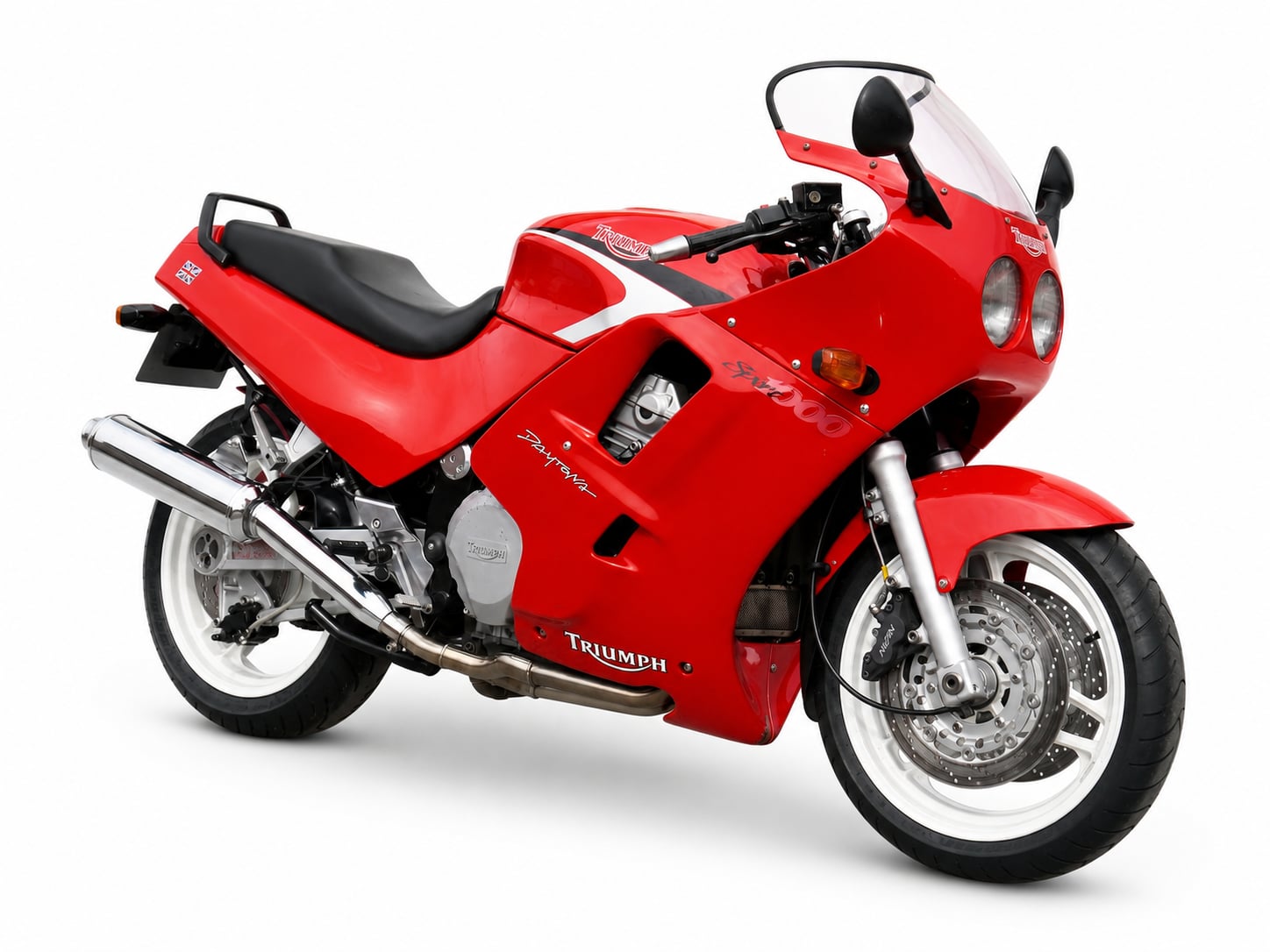
1993-1996 Triumph Daytona 900 and 1993-1997 Daytona 1200
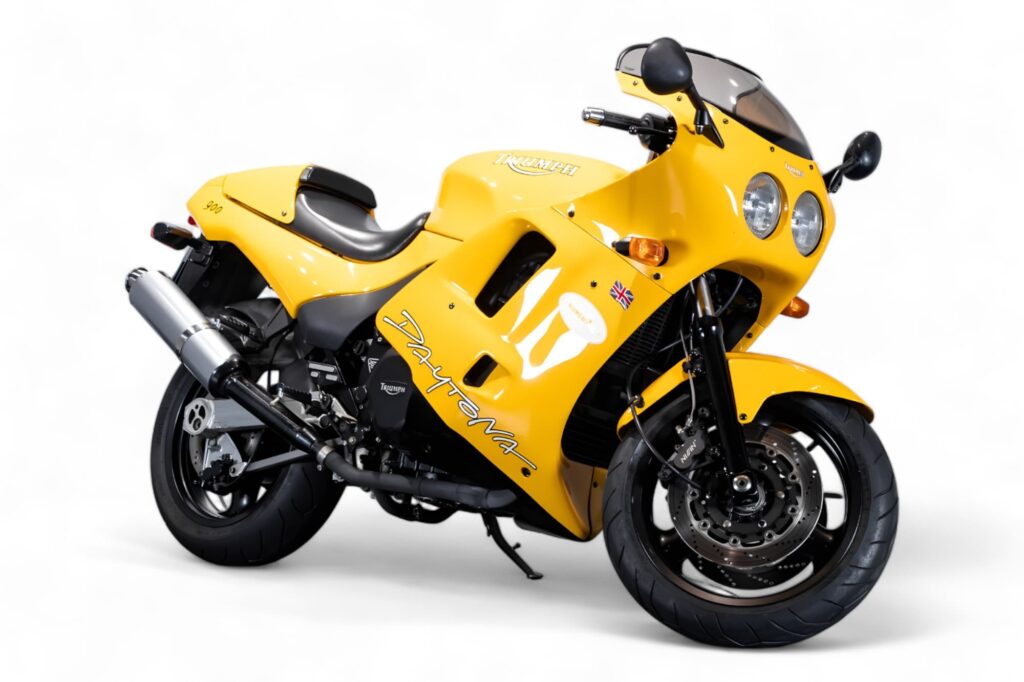
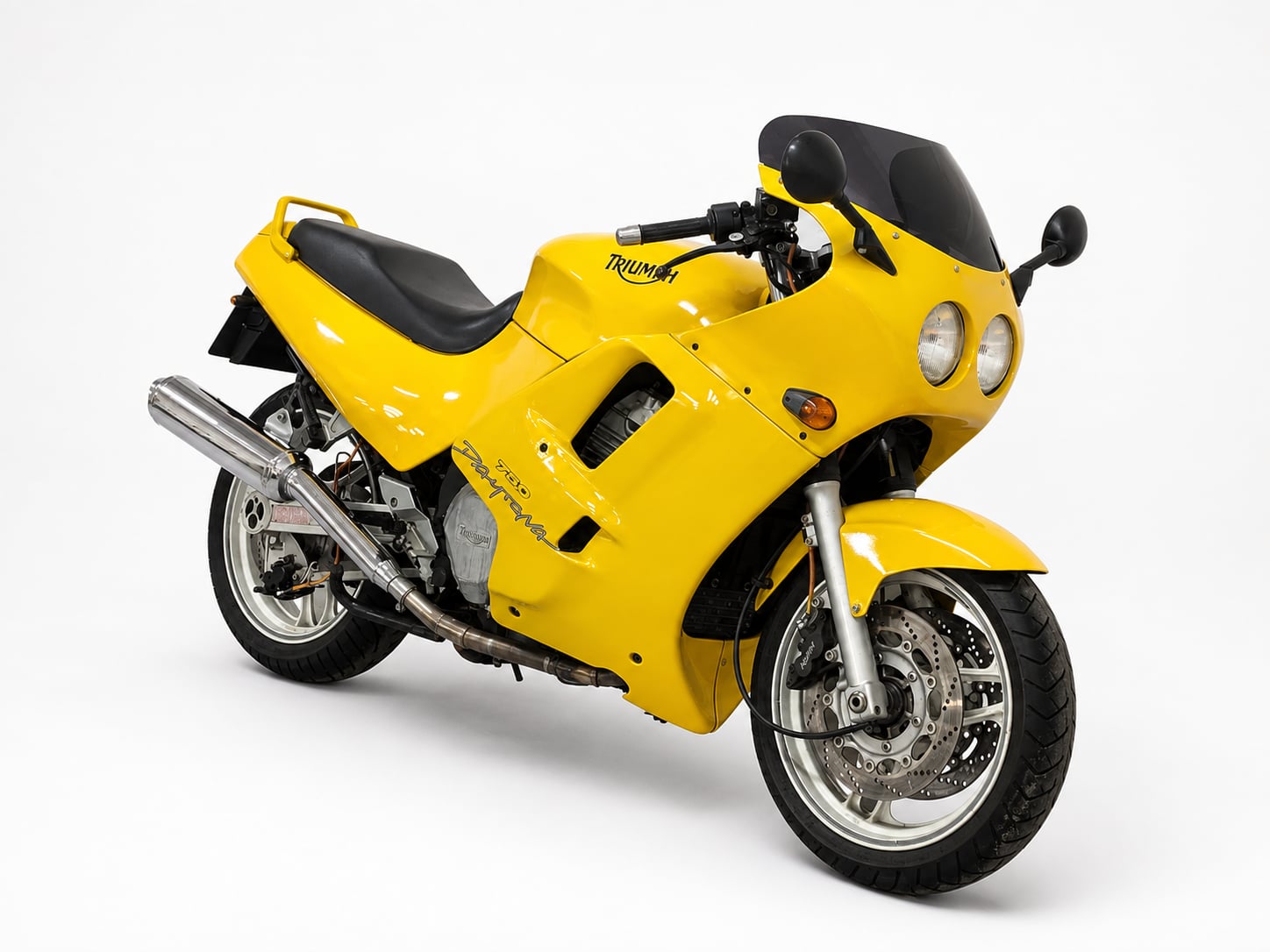
Triumph replaced both short-stroke engines for 1993. The Daytona 900 used the 885 cc long-stroke triple and made a claimed 72 kW (98 hp) and 83 Nm (61 lb-ft). That output looks modest now, but the stronger midrange made the 900 easier to ride quickly than the 750.
If you’re paying attention, the 885 cc might sound familiar. If it doesn’t, you might be due to brush up on the Triumph Speed Triple Buyer’s Guide.
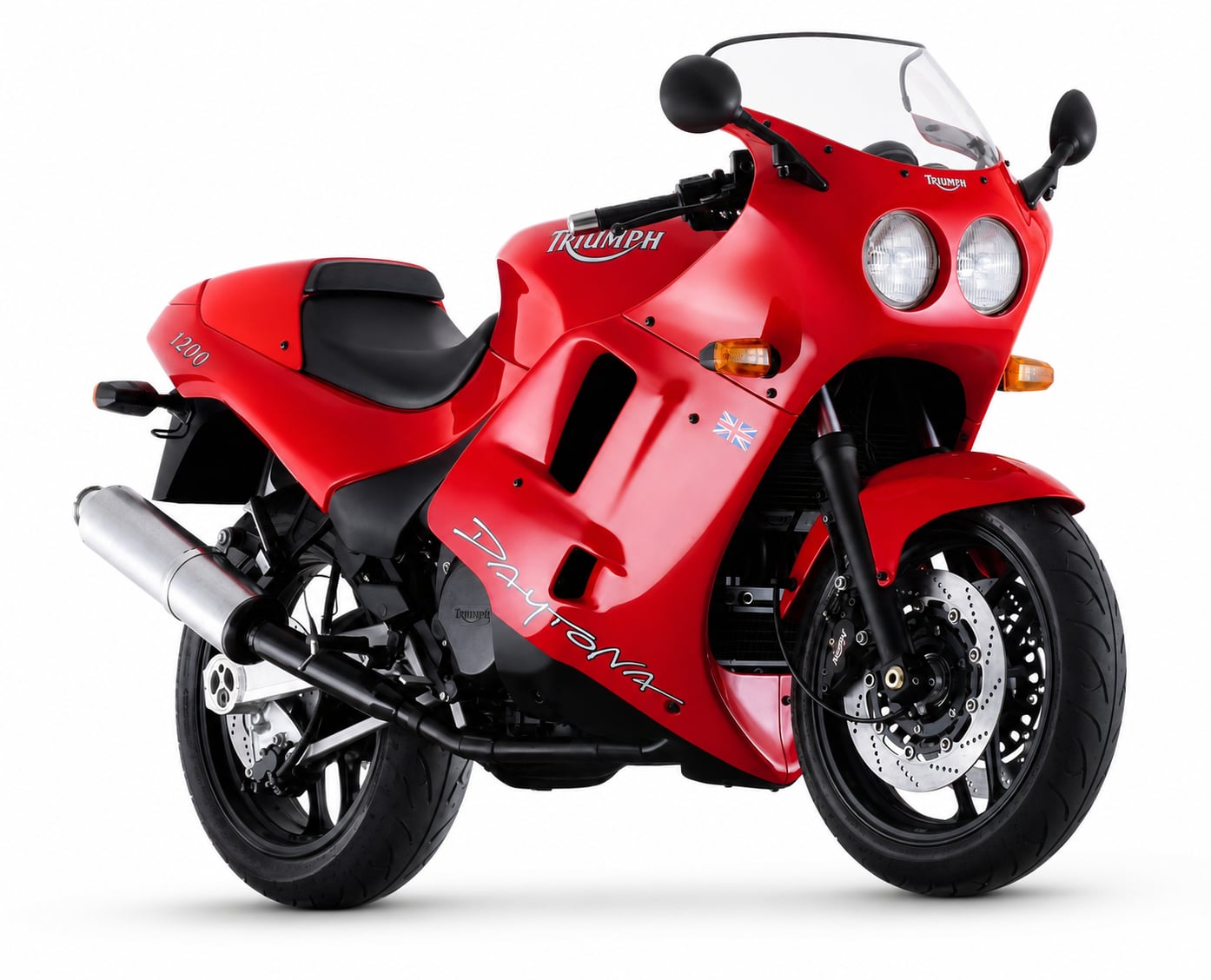
The Daytona 1200 used a 1,180 cc four with 12:1 compression, a claimed 107 kW (147 hp), and 115 Nm (85 lb-ft). It was tall and heavy, with a 25 L (6.6 US gal) tank, and it could reach roughly 270 km/h (168 mph) in favourable conditions. Buyers who want the strangest and most muscular T300 Daytona usually end up here.
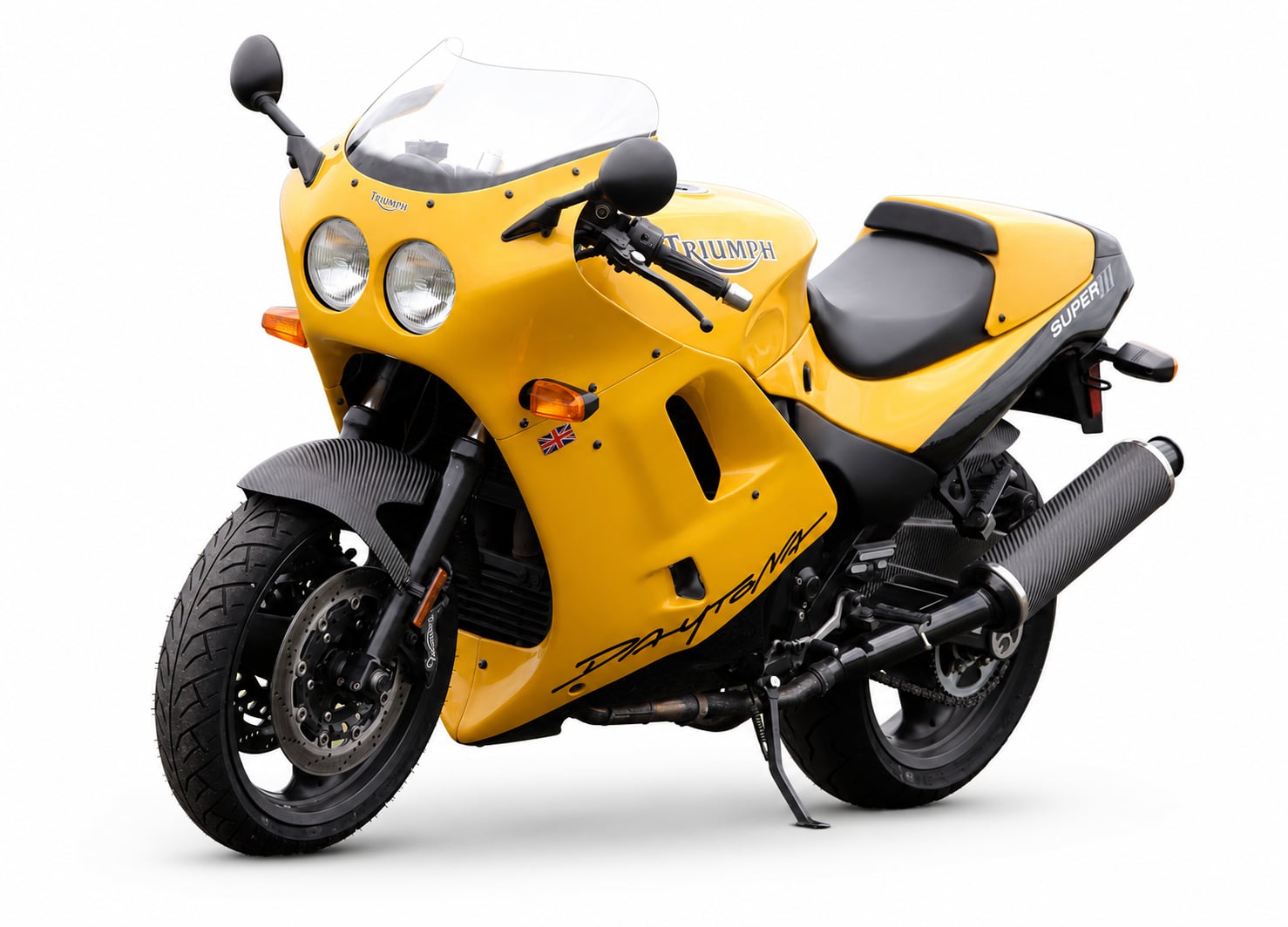
1994-1996 Triumph Daytona Super III
The Super III was the serious three-cylinder T300. Triumph worked with Cosworth on the 885 cc engine, raising compression and revising the cams and ignition. Claimed output rose to about 86 kW (115 hp).
Triumph also fitted six-piston Alcon front calipers and carbon-fibre mudguards, chainguard, headlight surround, and silencer covers. The National Motor Museum records 805 Super IIIs built through 1996. That small production run, the Cosworth connection, and the yellow paint make it one of the more collectible Hinckley-era Daytonas.
1998 Triumph Daytona 1200 SE
Triumph brought the 1200 back for one last numbered run after regular production ended. The 1998 Daytona 1200 SE was limited to 250 bikes and used the Super III’s six-piston Alcon front calipers. Its appeal is rarity and T300 excess rather than a major performance step over the standard 1200.
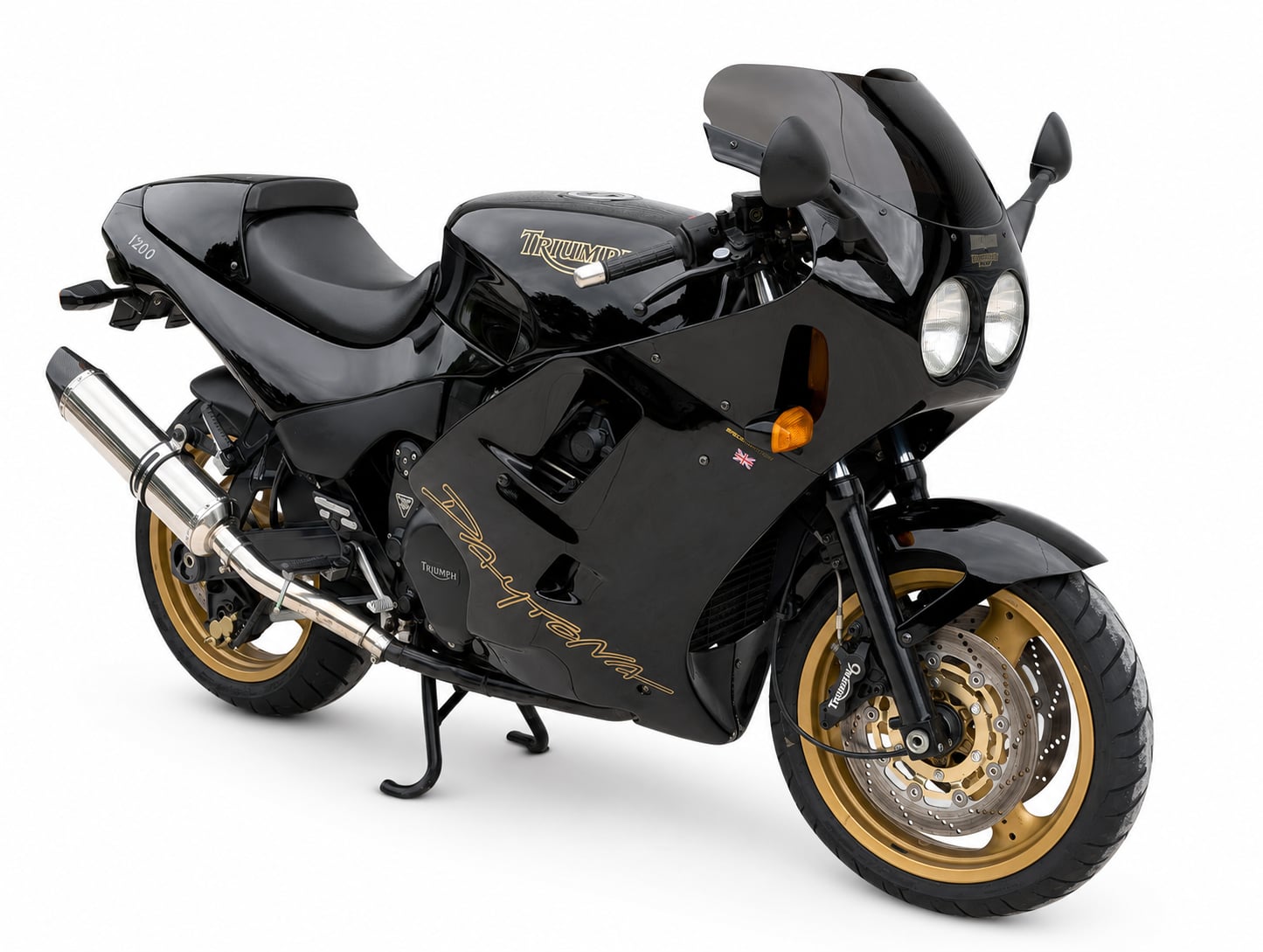
Triumph T595 and Daytona 955i: 1997-2006
The T595 replaced the modular T300 Daytona with a motorcycle designed to compete directly with contemporary superbikes. Triumph gave it a new 955 cc fuel-injected triple, an aluminium perimeter frame, and a single-sided swingarm. The result was much lower and lighter than the T300 family, although still heavier and less powerful than the Yamaha YZF-R1 that arrived a year later.
1997-1998 Triumph T595 Daytona and 1999-2000 Daytona 955i
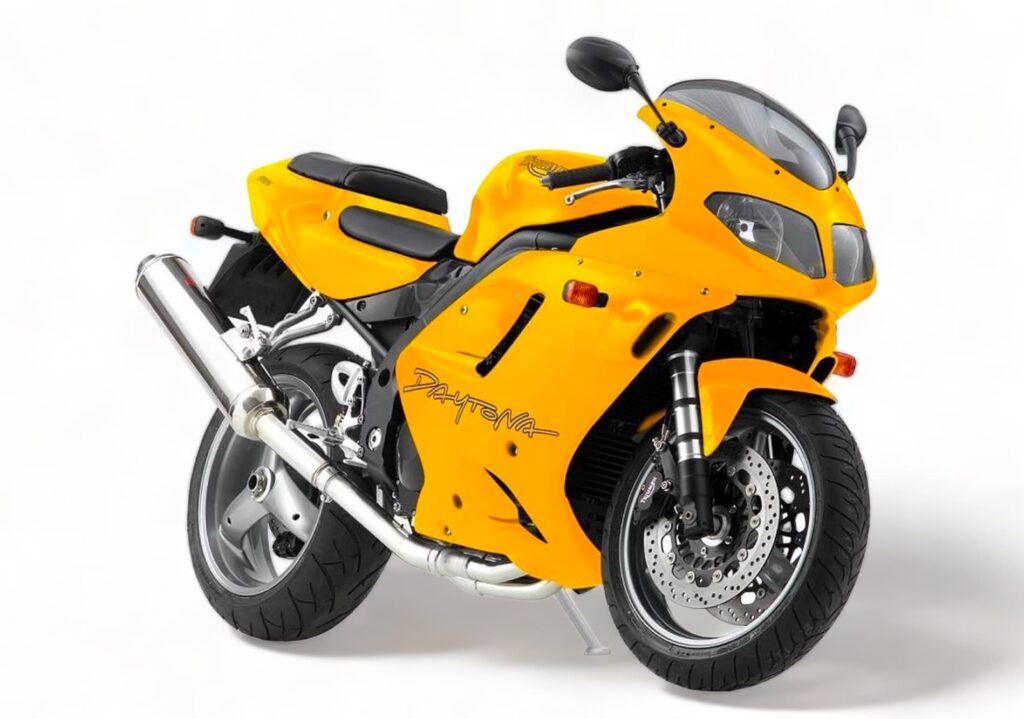
The T595 name caused immediate confusion because buyers read it as a 595 cc capacity. Triumph had combined its T5 engine-family code with the first two digits of 955 cc. The company renamed the motorcycle Daytona 955i for 1999, while keeping the same basic bike and adding smaller engine and injection updates.
Triumph claimed 95 kW (128 hp) and 100 Nm (74 lb-ft). Period dyno tests produced much lower rear-wheel numbers, but the broad midrange and short gearing made the Daytona fast on the road. The soft curves, polished aluminium frame, three-spoke wheels, and single-sided swingarm now identify this generation immediately.
2001/2002-2004 Triumph Daytona 955i: More Engine, Less Mass
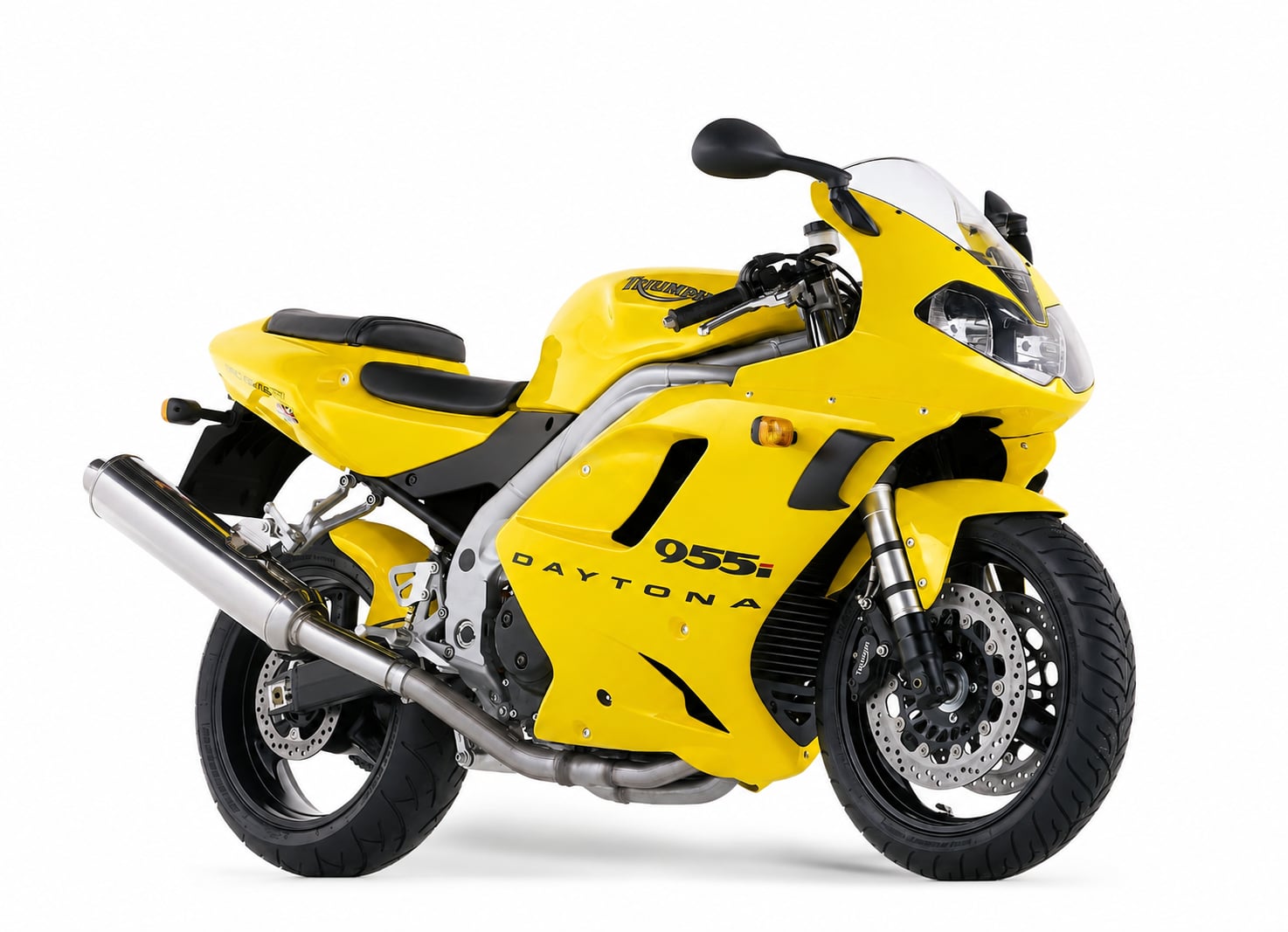
The next 955i arrived during the 2001-2002 model-year transition, depending on market. Triumph revised the bodywork and engine, using forged internal parts and a higher compression ratio to lift claimed power to about 108 kW (147 hp). The standard bike also moved to a lighter double-sided swingarm for a period.
The green 2002 Centennial Edition and a red Special Edition restored the single-sided swingarm and added carbon trim. These are the versions to seek if you value the original Daytona silhouette, although condition and a complete service history matter more than the badge.
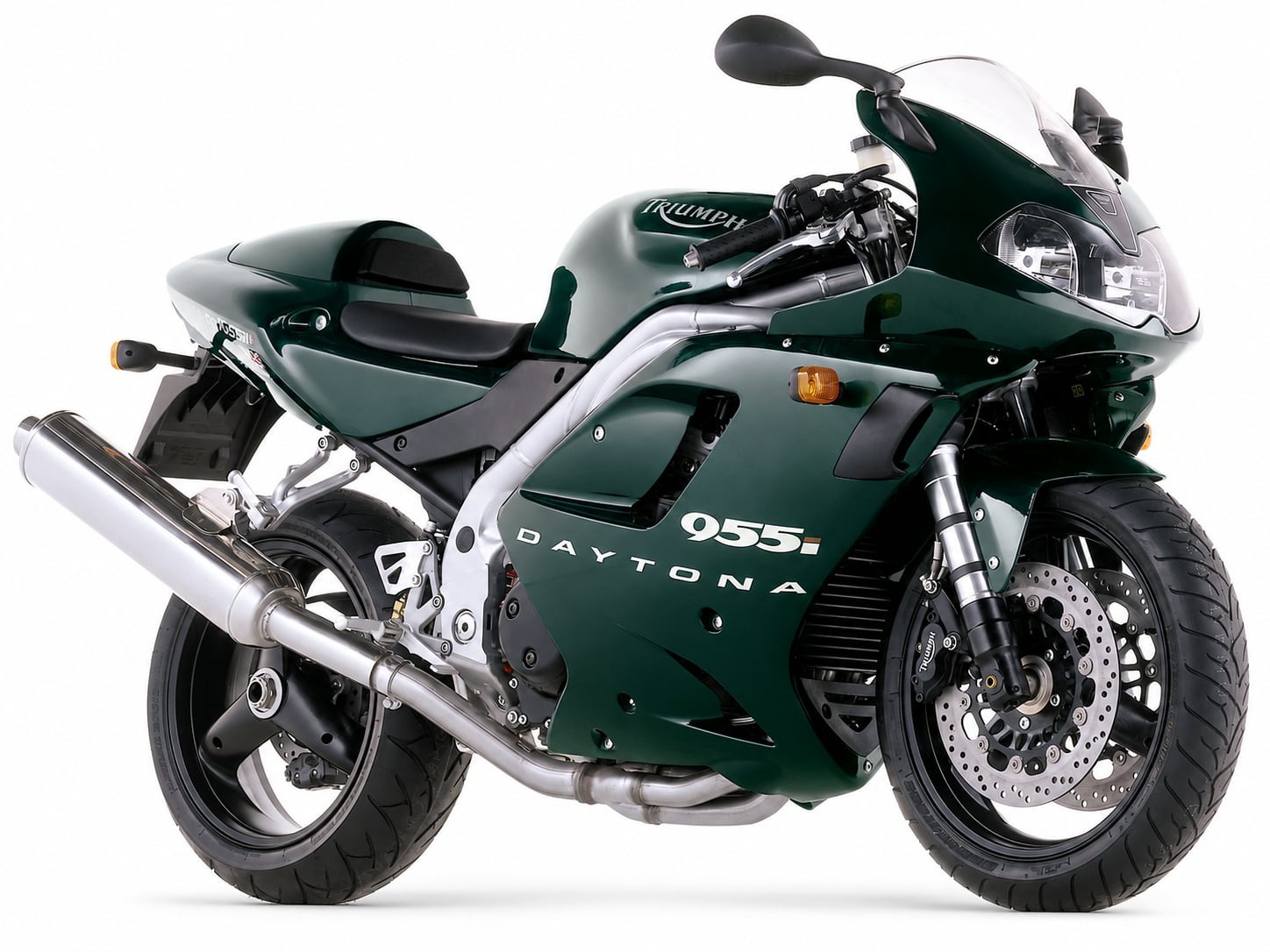
2005-2006 Triumph Daytona 955i: The Final Facelift
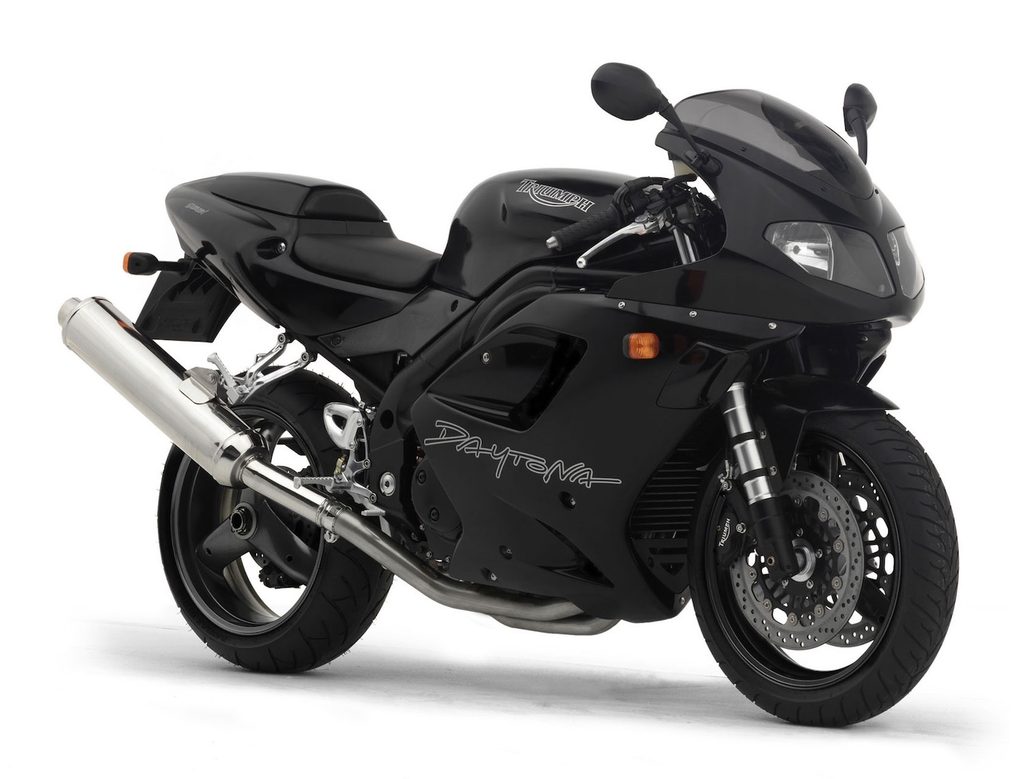
Triumph gave the 955i one last visual update for 2005. The final bikes have a horizontally divided headlight, a neater upper fairing, a lower tail hump, a black frame, and revised fuel delivery. They kept the strong later engine and returned to the single-sided swingarm.
This is the most developed 955i, but the earlier T595 has the more distinctive 1990s styling and the special editions have stronger collector interest.
Triumph Daytona 600 and 650: 2003-2005
Triumph’s first attempt at a modern 600-class supersport was the TT600. Its chassis was good, but early fuel injection gave it a poor reputation. The Daytona 600 arrived for 2003 with revised fuelling, new bodywork, and chassis changes that turned the basic package into a credible road-going supersport.
2003-2004 Triumph Daytona 600
The 599 cc inline four made a claimed 82 kW (112 hp) and 68 Nm (50 lb-ft). It was down on peak power beside the newest Japanese 600s, but the engine worked well on the road and the riding position gave larger riders more room than a Honda CBR600RR or Yamaha YZF-R6.
The conventional fork and aluminium frame also delivered stable, compliant handling on bumpy roads. The 600’s vague, clunky gear change is its main dynamic weakness, so a test ride should include deliberate shifts under load.
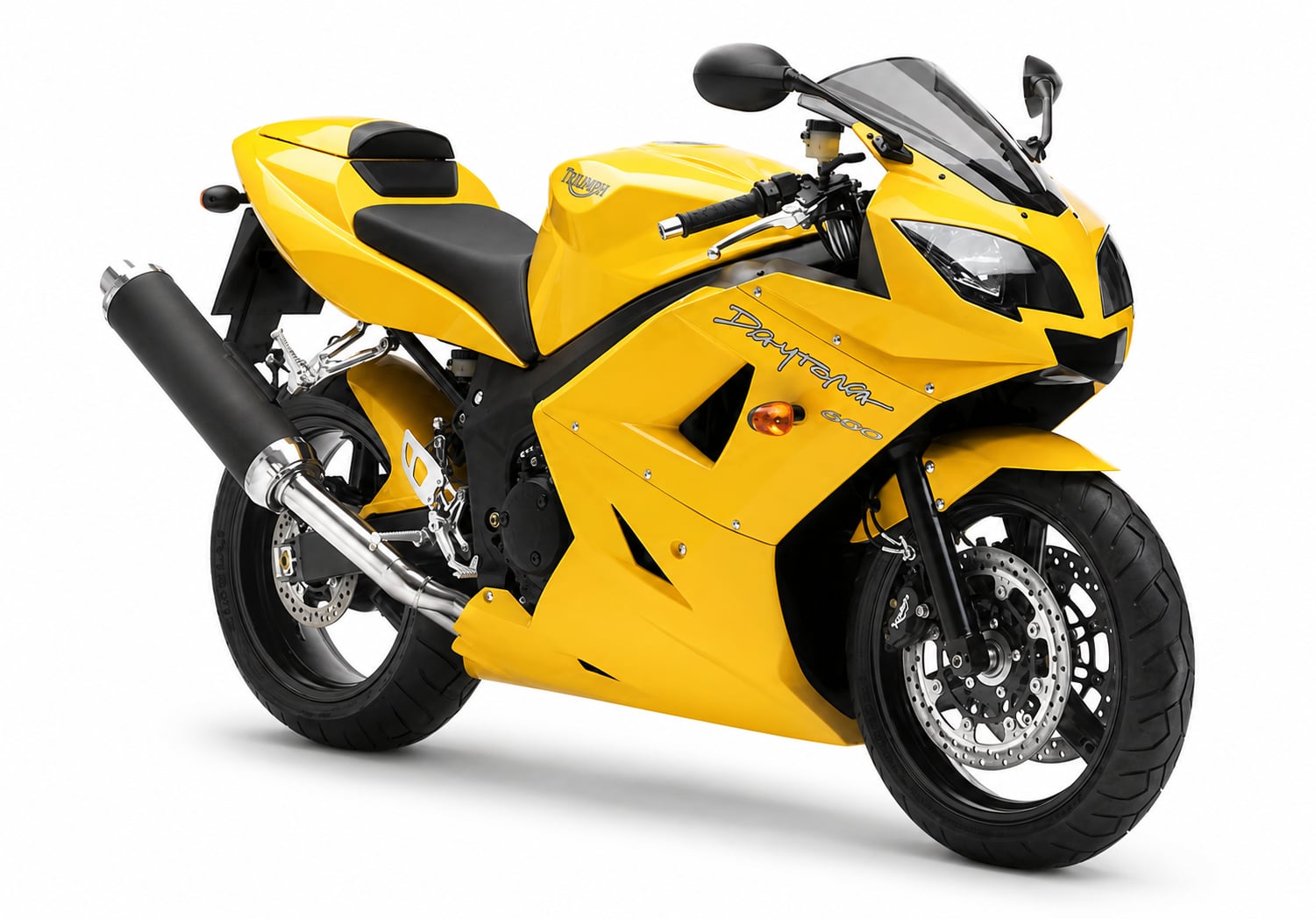
2005 Triumph Daytona 650
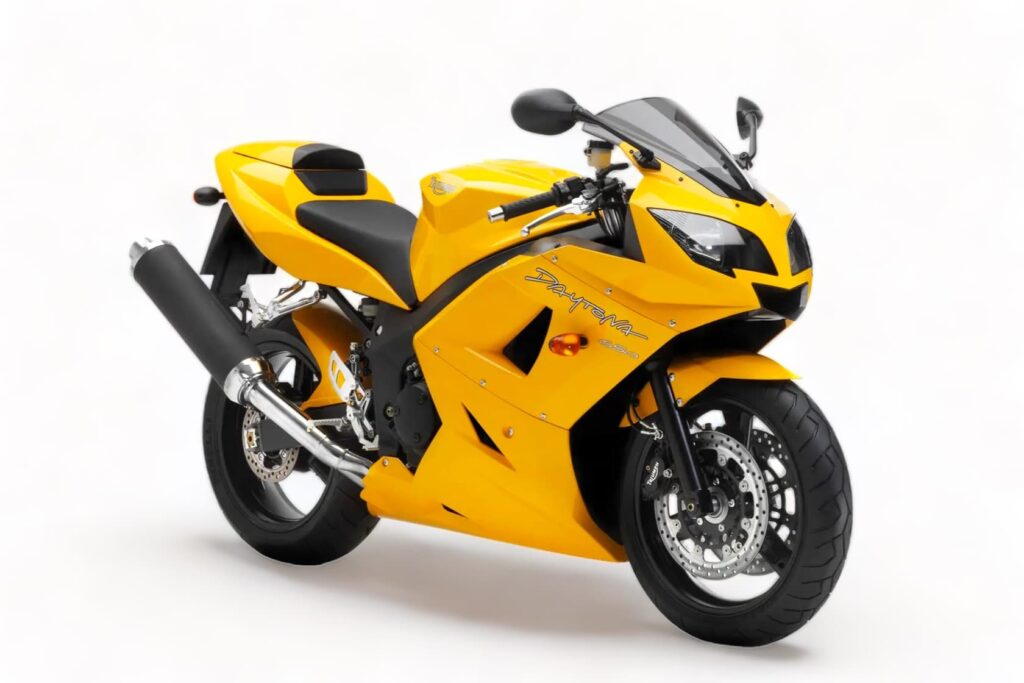
Triumph lengthened the stroke for 2005, taking capacity to 646 cc. Claimed output rose only slightly to 84 kW (114 hp), while the useful improvement came in midrange drive. Triumph also revised the gear linkage and clutch, giving the 650 a cleaner shift than the 600.
The 650 lasted for one model year, with some bikes registered or sold into 2006. It was Triumph’s last production four-cylinder motorcycle. For a used buyer, it is the better version of this platform unless rarity has pushed the price well above a comparable 600.
First-Generation Triumph Daytona 675: 2006-2012
The Daytona 675 changed Triumph’s position in the middleweight class. Triumph stopped following the 599 cc inline-four formula and built a compact 675 cc triple with an aluminium twin-spar frame and a narrow frontal area. The extra capacity and three-cylinder layout gave it stronger corner-exit drive than a typical 600, while the top end still rewarded high revs.
2006-2008 Triumph Daytona 675: The Original Triple Supersport
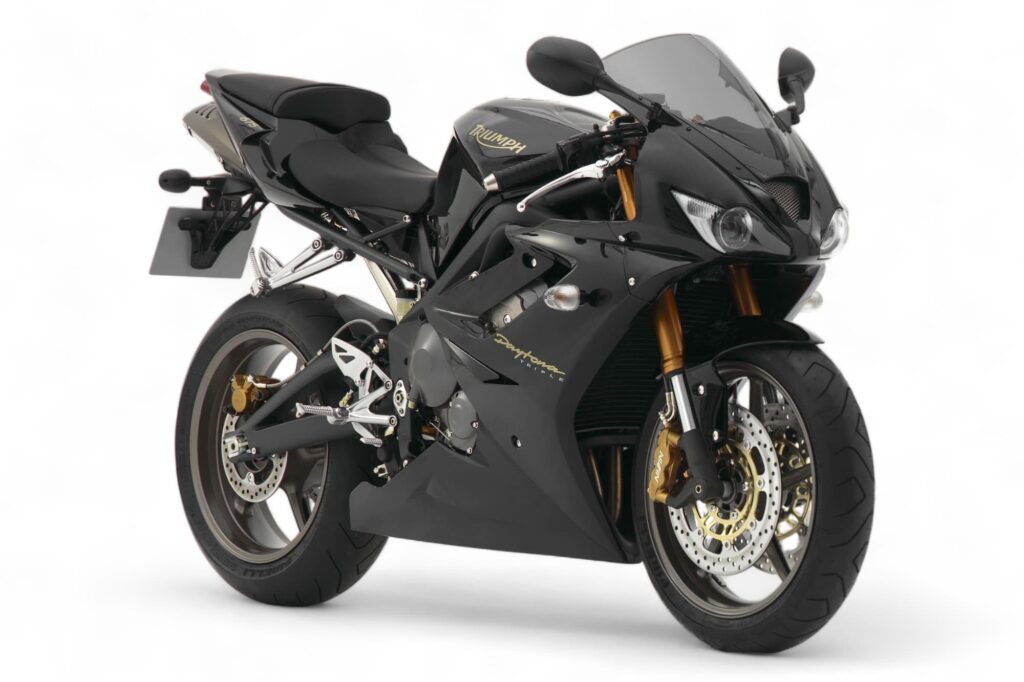
The first 675 made a claimed 92 kW (123 hp) and 72 Nm (53 lb-ft), with a ready-to-ride mass around 185 kg (408 lb). Fully adjustable suspension, radial Nissin front calipers, braided lines, and a steep, compact riding position made its purpose clear.
On the road, the engine is the reason to choose it over a contemporary Japanese 600. You can carry a gear through a corner and still get useful drive without waiting for the last few thousand rpm. The seat is high, the bars are low, and the under-seat exhaust puts heat near the rider, so this is still a committed supersport.
2009-2012 Triumph Daytona 675: The Useful Refinement
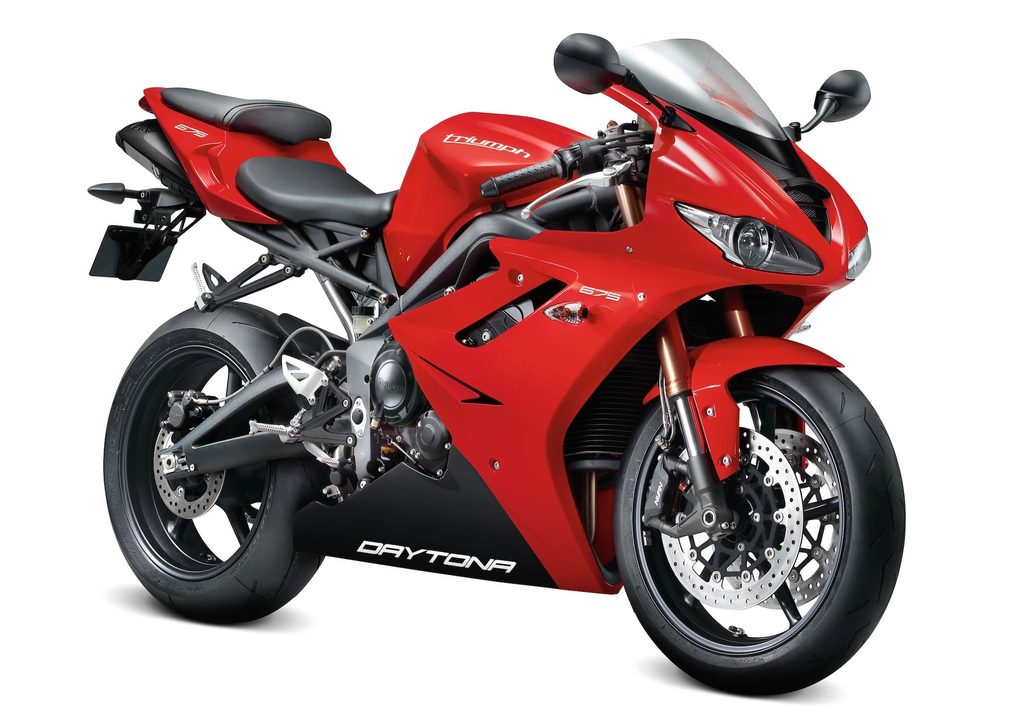
Triumph revised the 675 for 2009 with a new cylinder head, higher compression, lighter engine parts, revised fuelling, and a higher redline. Claimed power rose to 94 kW (126 hp). Suspension and brake changes sharpened the chassis, and the revised fairing has a vented central intake that makes the generation easy to spot.
The performance increase is small on the road. The value lies in the accumulated detail changes and the wider availability of Triumph’s accessory quickshifter. If prices are close, I would take a clean 2009-2012 bike over an early one. A well-maintained 2006-2008 example still beats a neglected facelift.
2011-2012 Triumph Daytona 675R
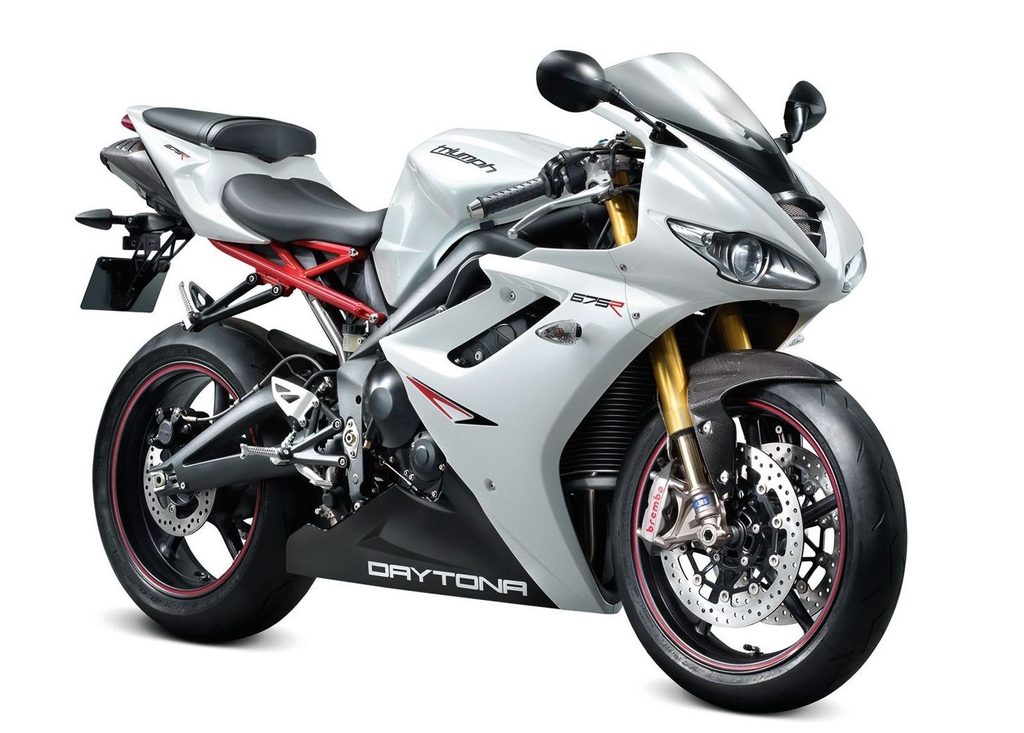
The first 675R kept the standard engine and added 43 mm Öhlins NIX30 forks, an Öhlins TTX36 shock, Brembo monobloc front calipers, a quickshifter, and carbon trim. The suspension and brakes matter on a track or a smooth, fast road. The R badge did not bring extra engine power.
Buy the R when you will use the chassis parts or when the premium over a standard 675 is modest. Rebuilding worn Öhlins components can erase the value of buying the higher-spec bike, so service receipts matter.
Second-Generation Triumph Daytona 675 and 675R: 2013-2017
Triumph redesigned almost the entire Daytona for 2013. The new engine had a wider bore and shorter stroke, titanium valves, twin injectors per cylinder, a slipper clutch, and a higher redline. The exhaust moved from under the seat to below the engine, helping Triumph move mass down and forward.
Triumph also revised the frame, swingarm, wheels, suspension, brakes, and bodywork. Claimed output reached 94 kW (126 hp) and 74 Nm (55 lb-ft). Switchable ABS became available, including a circuit setting that reduced intervention at the rear.
2013-2016 Triumph Daytona 675
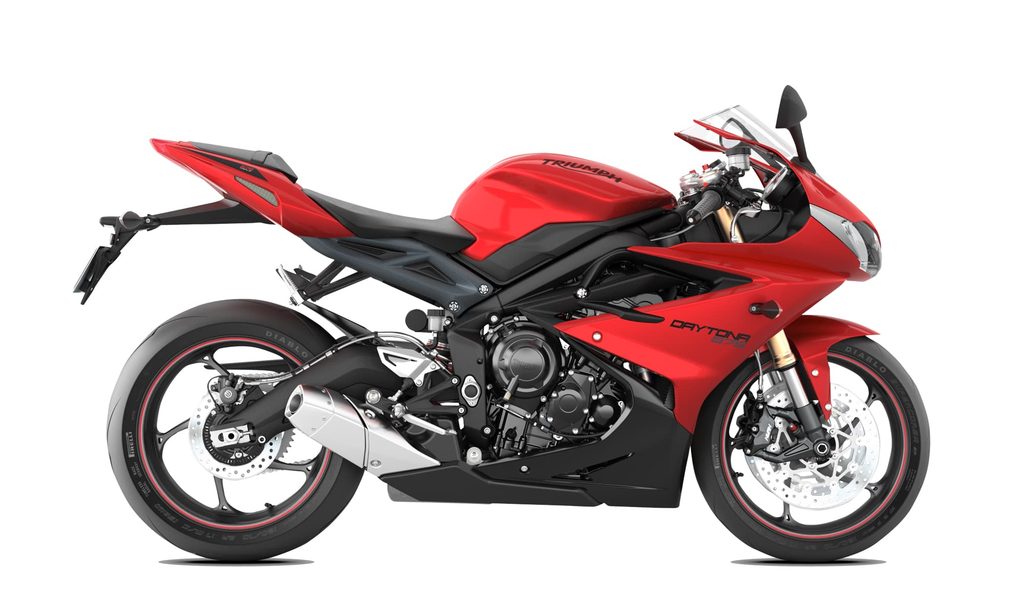
The standard second-generation bike used fully adjustable KYB suspension and Nissin radial front calipers. It is lighter on its feet than the earlier model and has a more modern safety net if you find an ABS-equipped example.
Some riders prefer the longer-stroke feel and under-seat exhaust of the 2009-2012 generation. Others prefer the sharper 2013 chassis and shorter-stroke engine. The difference is large enough to justify riding both before paying a premium for the newer bike.
2013-2017 Triumph Daytona 675R
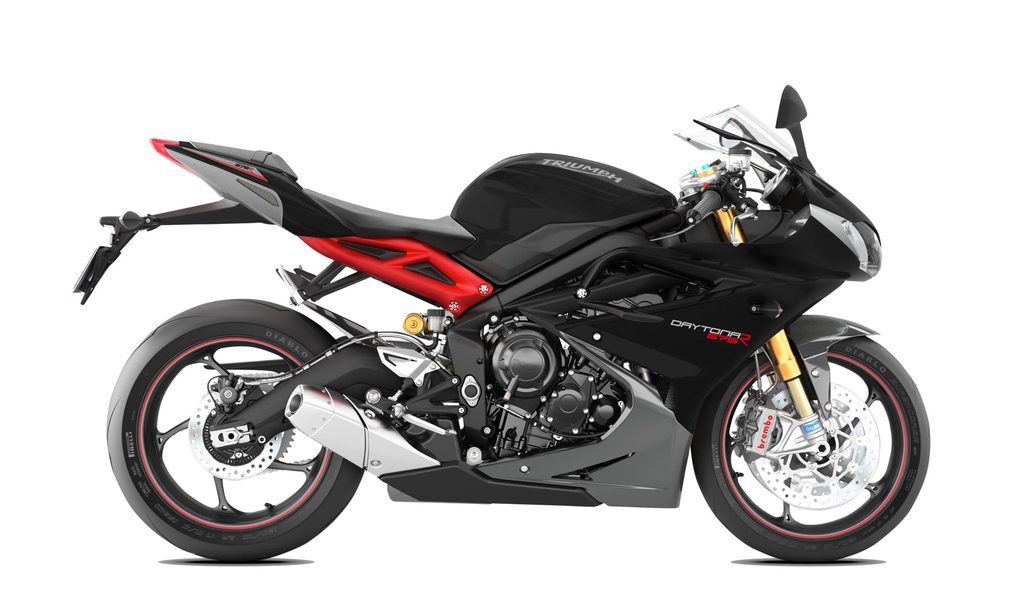
The 675R again added Öhlins NIX30 forks, a TTX36 shock, Brembo monobloc calipers, a quickshifter, and carbon parts. Triumph stopped regular production of the base 675 after 2016, while the R continued into 2017 in several markets.
This is the Daytona to buy for regular track use if you want a factory road bike rather than a converted race machine. Check that the expensive suspension, brakes, wheels, and bodywork are genuine and straight. Many have spent time on track, which is fine when the seller can show careful preparation and servicing.
2020 Triumph Daytona Moto2 765 Limited Edition
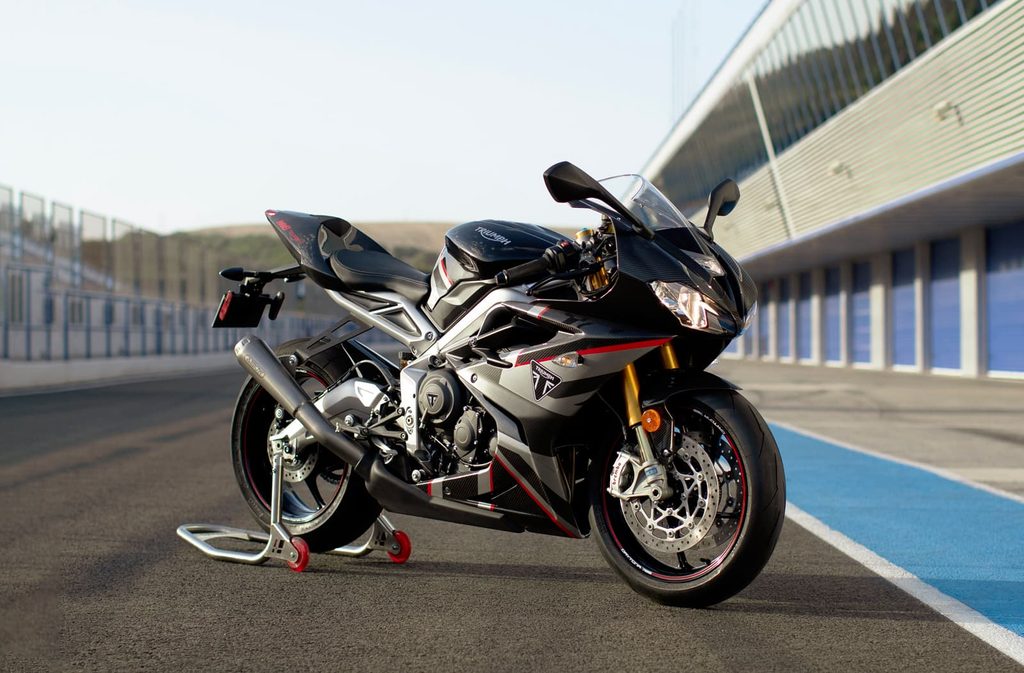
Triumph returned to the Daytona name for a numbered limited edition tied to its role as Moto2 engine supplier. The road bike used a highly tuned version of the Street Triple RS engine, making 95.6 kW (128 hp) at 12,250 rpm and 80 Nm (59 lb-ft) at 9,750 rpm.
The Moto2 765 also had full carbon-fibre bodywork, an Arrow titanium silencer, Öhlins NIX30 forks and TTX36 shock, Brembo Stylema calipers, a TFT display, five riding modes, and an up-and-down quickshifter. ABS and traction control were adjustable but did not use an IMU, so neither system was lean-angle sensitive.
Triumph built 765 numbered bikes for the US and Canada and another 765 for Europe, Asia, and the rest of the world. That made 1,530 in total, with different top-yoke numbering sequences for the two markets.
The Moto2 is faster and more polished than a 675R, but rarity and condition now matter as much as lap-time potential. Its carbon bodywork is expensive to replace, and track conversion can remove the parts that support its collector value.
Triumph Daytona 660: 2024 to Today
The production Daytona returned for 2024 with a different brief. Triumph based the 660 on the same engine family as the Trident 660 and Tiger Sport 660, then changed the airbox, throttle bodies, cylinder head, cam timing, valves, pistons, crankshaft, cooling, and exhaust to let it rev to 12,650 rpm.
The result is 70 kW (94 hp) at 11,250 rpm and 69 Nm (51 lb-ft) at 8,250 rpm, with Triumph claiming at least 80 per cent of peak torque from 3,125 to 11,750 rpm. A restrictor kit cuts output to 35 kW (47 hp) for A2-licence markets.
2024-2025 Triumph Daytona 660
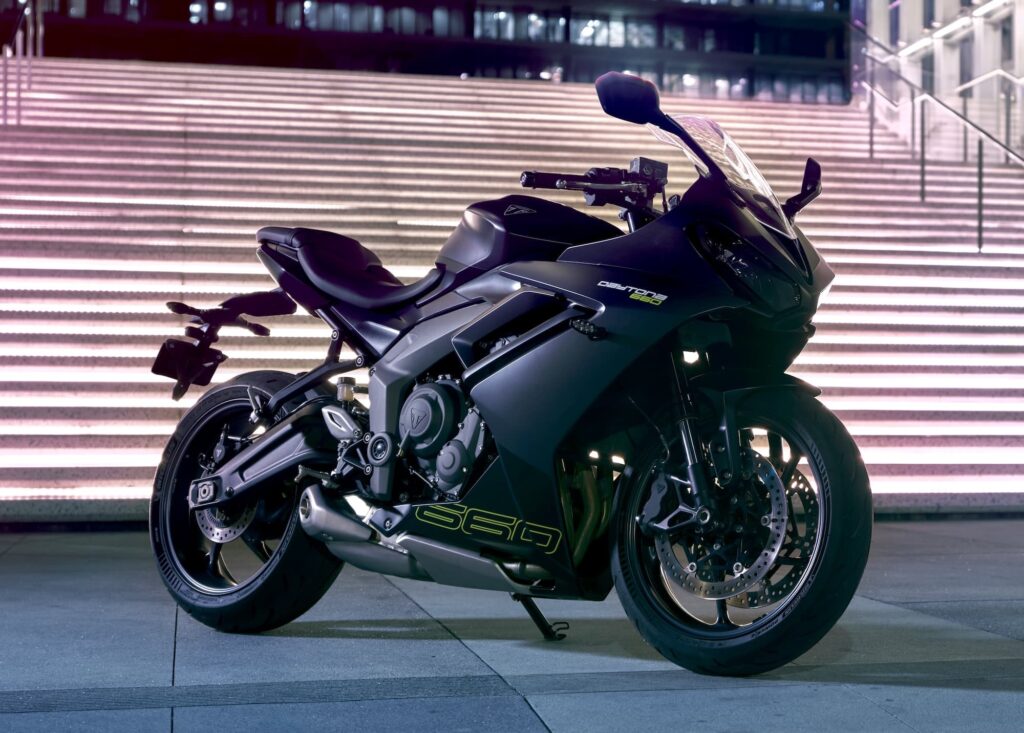
The first Daytona 660 used a steel perimeter frame, non-adjustable 41 mm Showa SFF-BP fork, preload-adjustable Showa shock, twin 310 mm front discs with radial four-piston calipers, and a 201 kg (443 lb) wet weight. It also had Road, Rain, and Sport riding modes, switchable traction control, and ABS, but no IMU or cornering functions.
Its 810 mm (31.9 in) seat and high-mounted clip-ons put the rider in a much friendlier position than the 675. The 14 L (3.7 US gal) tank and 16,000 km (10,000 mile) service interval also suit regular road use. The quickshifter was an accessory on these early bikes.
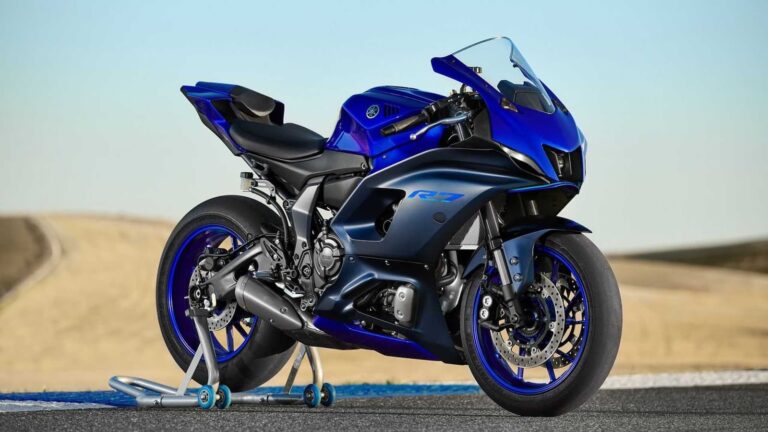
The 660 makes sense beside the Honda CBR650R, Suzuki GSX-8R, Yamaha YZF-R7, and Aprilia RS 660. A 675 belongs beside the Yamaha YZF-R6 and Kawasaki ZX-6R. Comparing the two Daytonas by power alone misses their different jobs.
2026 Triumph Daytona 660: Adjustable Fork and Standard Quickshifter
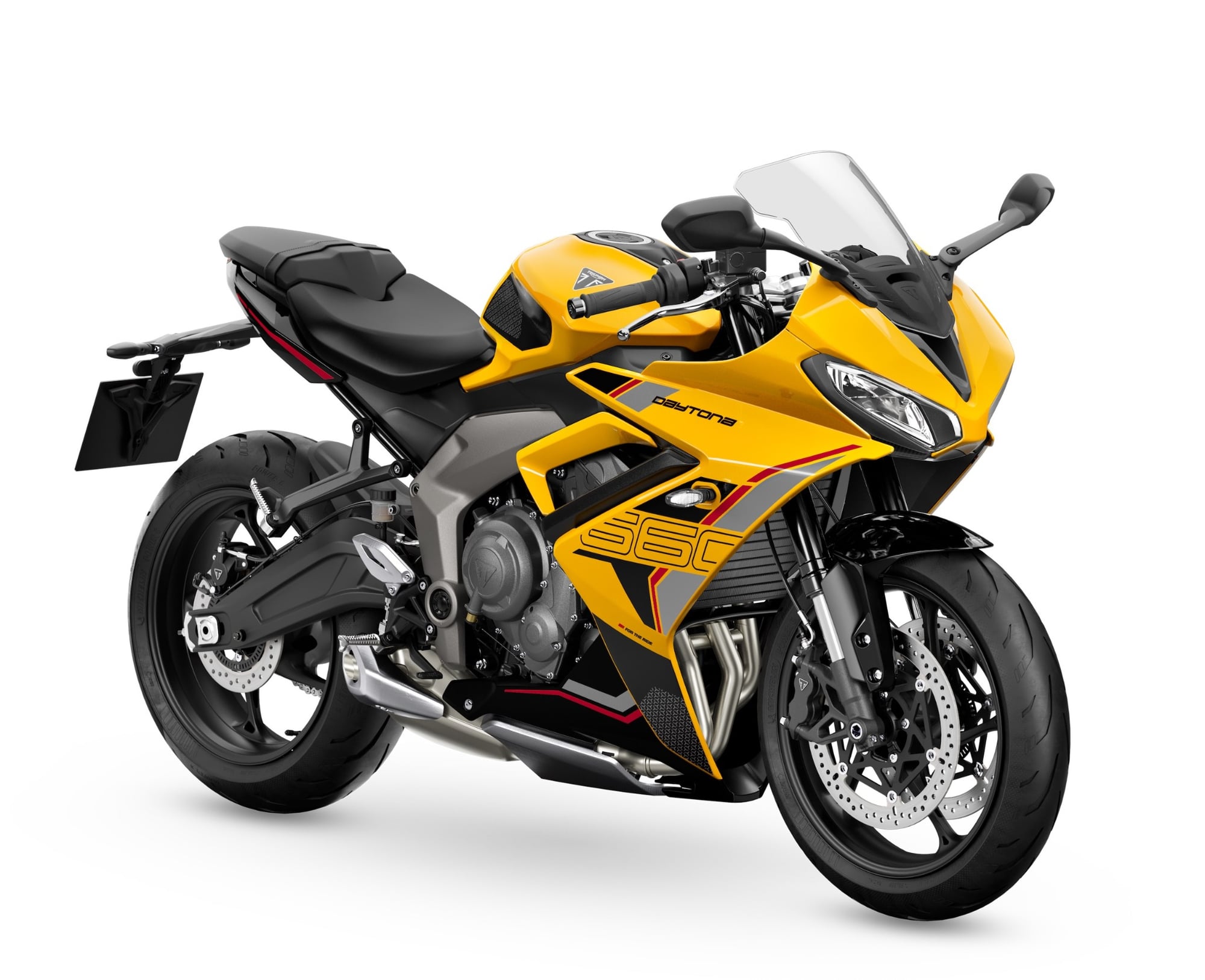
Triumph updated the Daytona 660 for 2026 without changing the engine output, chassis, or basic purpose. The 41 mm Showa fork gained separate compression and rebound damping adjustment, Triumph Shift Assist became standard, and Metzeler M9RR supersport tyres replaced the earlier Michelin Power 6 fitment.
Those changes address two easy criticisms of the original. Faster riders can now tune the front end, and buyers no longer need to pay extra for clutchless upshifts and downshifts. The rear shock still offers preload adjustment only, and the electronics still lack an IMU.
How the Main Daytona Generations Compare
Claimed peak power tells only part of this history. Engine layout, mass, riding position, and chassis intent changed enough that two Daytonas with similar output can feel unrelated.
| Model | Claimed output | Character | Best fit |
|---|---|---|---|
| Daytona 900 | 72 kW (98 hp), 83 Nm (61 lb-ft) | Large, torquey 1990s road sports bike | Early Hinckley character without 1200 weight and power |
| Daytona 1200 | 107 kW (147 hp), 115 Nm (85 lb-ft) | Fast, tall, heavy, and physical | Collectors and riders who want the biggest T300 |
| T595 / early 955i | 95 kW (128 hp), 100 Nm (74 lb-ft) | Broad midrange and distinctive 1990s styling | Road riding and modern-classic appeal |
| Daytona 650 | 84 kW (114 hp), 68 Nm (50 lb-ft) | Roomy inline-four middleweight | Affordable road use and larger riders |
| 2009-2012 Daytona 675 | 94 kW (126 hp), 72 Nm (53 lb-ft) | Narrow, rev-happy triple with useful midrange | Best-value classic Daytona supersport |
| 2013-2017 Daytona 675R | 94 kW (126 hp), 74 Nm (55 lb-ft) | Sharper chassis with premium suspension and brakes | Track days and committed fast-road riding |
| Daytona Moto2 765 | 95.6 kW (128 hp), 80 Nm (59 lb-ft) | Limited, highly specified, and expensive to repair | Collectors who still intend to ride the bike |
| 2026 Daytona 660 | 70 kW (94 hp), 69 Nm (51 lb-ft) | Accessible road-sports bike with a broad powerband | Daily use, newer riders, and occasional track days |
The 675 and Moto2 765 put the rider farthest forward and carry the least unnecessary mass. The 955i and 660 work better when road comfort matters. The T300 bikes suit someone who enjoys the weight, mechanical feel, and maintenance demands of a 30-year-old motorcycle.
What to Check When Buying a Used Triumph Daytona
Start with evidence of care. A clean service record, cold start, correct fluids, straight controls, matching paint, and unrounded fasteners tell you more than a low odometer. Fully faired sports bikes also hide crash repairs well, so inspect engine cases, bar ends, fork bottoms, wheels, steering stops, subframes, and fairing mounts.
T300 Daytona 750, 1000, 900, and 1200 Checks
Age is now the main issue. Check carburettor condition, coolant hoses, seals, charging voltage, suspension movement, brake pistons, and every rubber part. Listen for the starter sprag clutch slipping or kicking back, especially if the battery is weak. Body panels, decals, exhaust parts, and model-specific trim can take longer to find than mechanical service parts.
T595 and Daytona 955i Checks
On very early T595s, confirm that the revised fourth-gear parts and frame recall work were completed. Listen to the starter sprag, check that the bike idles cleanly, and inspect the idle-control hoses. The plastic fuel tank can swell after prolonged exposure to ethanol-blended fuel.
Inspect the single-sided rear hub and suspension pivots for seizure, and budget for a suspension refresh if the bike still has its original components. Charging problems and corroded connectors become more likely on later 955i models. Use Triumph’s VIN lookup or the relevant national recall database rather than assuming every bike in a model year was affected.
Daytona 600 and 650 Checks
Test the clutch and sidestand cut-out switches, which can cause intermittent starting problems. Shift through every gear under load and watch for false neutrals, especially on the 600. Check for oil around the gear-selector shaft, rough running from neglected throttle-body balancing, and corrosion behind the fairings.
Daytona 675 and 675R Checks
Early 675s can use oil, particularly after hard track use. Check the level, look for smoke, and ask how often the owner checked it. Warning lights can point to failed sensors, while the exhaust valve can seize or stretch its cables. Regulator/rectifier failures are also reported on early bikes.
Inspect the rear suspension linkage for free movement and proof of greasing. Treat an aftermarket quickshifter on an early bike cautiously, and make sure exhaust changes have a suitable ECU map. On R models, look for leaking Öhlins suspension, worn Brembo calipers, and expensive original carbon or body parts that disappeared during a track conversion.
Moto2 765 and Daytona 660 Checks
The Moto2’s value depends heavily on completeness. Confirm the number, keys, books, original carbon bodywork, Arrow silencer, controls, and road equipment. A carefully prepared track bike can be mechanically excellent, but missing limited-edition parts reduce collector value.
The Daytona 660 is still young enough that condition, warranty history, crash damage, and correct servicing matter more than any established fault pattern. Check whether a 2024-2025 bike has the accessory quickshifter before comparing its price with a 2026 model, which includes it as standard.
For detailed service schedules, see the separate guides for the T595 and Daytona 955i, 2013-2017 Daytona 675, 2013-2017 Daytona 675R, Daytona Moto2 765, and Daytona 660.
Triumph Daytona Alternatives
The right alternative depends on which Daytona you mean. A 955i buyer usually wants a characterful litre-class road bike from the late 1990s. A 675 buyer wants a focused middleweight supersport. A 660 buyer wants a newer, more forgiving fully faired road bike.
| Alternative | Compare it with | Choose it when | Choose the Daytona when |
|---|---|---|---|
| Honda CBR900RR / FireBlade | T595 / 955i | You want lower mass, more parts support, and the era’s reference superbike | You prefer triple midrange, comfort, and British styling |
| Yamaha YZF-R6 | Daytona 675 / 675R | You want a harder top-end rush and a huge track-parts market | You want more drive below the redline and a narrower triple |
| Kawasaki Ninja ZX-6R 636 | Daytona 675 / 675R | You want a current 600-class bike, strong parts supply, and more engine capacity | You value lower mass, compact dimensions, and triple character |
| Honda CBR600RR | Daytona 675 / 675R | You prioritise finish, familiarity, and Honda ownership | You want stronger midrange and the Daytona’s more unusual engine |
| Aprilia RS 660 | Daytona 660 | You want an IMU, cornering electronics, and a lighter parallel twin | You prefer the smoother triple, simpler electronics, and longer service interval |
| Yamaha YZF-R7 | Daytona 660 | You want a simpler twin and a more committed chassis | You want more peak power, a broader rev range, and friendlier road ergonomics |
| Honda CBR650R | Daytona 660 | You want four-cylinder smoothness or the E-Clutch option | You want less mass and stronger low-to-midrange response |
| Suzuki GSX-8R | Daytona 660 | You want stronger low-rpm torque and a standard quickshifter on early model years | You want a revvier engine and the sound and feel of a triple |
If you like the 675 engine but no longer want supersport ergonomics, the Triumph Street Triple buyer’s guide covers the naked models derived from it. The Speed Triple model history does the same for Triumph’s larger roadster family.
Wrap Up
So, you want to buy a Daytona. But which one?
I’d probably point most people at a 2013-2017 Daytona 675R. The later chassis, slipper clutch, available ABS, Öhlins suspension, and Brembo brakes make it the most complete regular-production supersport Daytona.
Newer riders would probably prefer the 2026 Daytona 660. The updated fork, standard quickshifter, comfortable riding position, and 16,000 km (10,000 mile) service interval make it the sensible current choice. You might opt for an earlier 660 when the price saving covers the quickshifter and you do not need fork adjustment.
It’s odd, to me, that the Daytona 660 doesn’t have cornering ABS or cruise control, when the Trident 660 does. They’re both aimed at basically the same kind of rider!
The classic bike I like is the 955i. I just like the look of it. I’m not entirely sure why — maybe I just saw too many magazines with it back in the day (“What’s a magazine?”).
But anyway, they’re all good. As usual, I’ll keep this updated if/when new models enter the fray.