
For riders who enjoy manual control, the idea of an electronic clutch can be anathema. The clutch and the unintuitive but now standardised down/up/up/up/up shifting pattern are part of the motorcycling experience. Having a clutch means you can learn all the fun stuff like matching revs when shifting, enjoying the dance of gear shifts as you approach or exit corners, and popping the throttle at the lights (why? Because it sounds cool! Embarrassing, but true). And wheelies, for those who indulge.
But the reality is you don’t really need to work a clutch lever. You can change gears without touching one, and removing that step makes fast, consistent shifts easier. Some riders also cannot work a clutch lever comfortably or at all. E-Clutch keeps a manual gearbox accessible without making left-hand control mandatory.
Honda E-Clutch looks like a quickshifter from the saddle. Leave the clutch lever alone, tap the gear pedal, and the bike changes gear. But that description misses the two things that make it much more useful: you can also pull away and stop without touching the lever, and the system physically operates a conventional clutch instead of relying only on a momentary interruption in engine torque.
You still choose every gear with your left foot. The gearbox is still a conventional six-speed manual, and the handlebar still has a clutch lever that works whenever you want it. E-Clutch simply gives the clutch its own electronic hand.
The TL;DR: E-Clutch fills the gap between a quickshifter and an automated manual transmission. It does more than a quickshifter, but it does not choose gears like Honda DCT, Yamaha Y-AMT or BMW ASA can.
Are you obsessed with motorcycles?
Well, I am. That’s why I created this site — as an outlet. I love learning and sharing what others might find useful. If you like what you read here, and you’re a fraction as obsessed as I am, you might like to know when I’ve published more. (Check the latest for an idea of what you’ll see.)
What Honda E-Clutch actually does
A manual motorcycle transmission asks the rider to control two separate things. The gear pedal selects a ratio inside the gearbox; the clutch connects or separates the engine and gearbox. A quickshifter helps with the first process by briefly unloading the gears, but it normally leaves the clutch alone.
Honda E-Clutch automates the clutch side. With the system switched on, you can select first gear at a standstill, open the throttle and let the bike feed in the clutch. You can change up or down using only the gear pedal. When you stop, the clutch disengages before the engine stalls. You must still select the appropriate gear yourself.
The manual lever stays connected. Pull it and E-Clutch pauses while you control the clutch; release it and automatic control resumes after a short delay. On most full-size models you can also turn the system off through the display and ride the bike as a normal manual. Some small Japanese-market versions, including the Rebel 250 and CL250 E-Clutch, do not offer a permanently-off setting, although the lever still provides a temporary manual override.
How Honda E-Clutch works
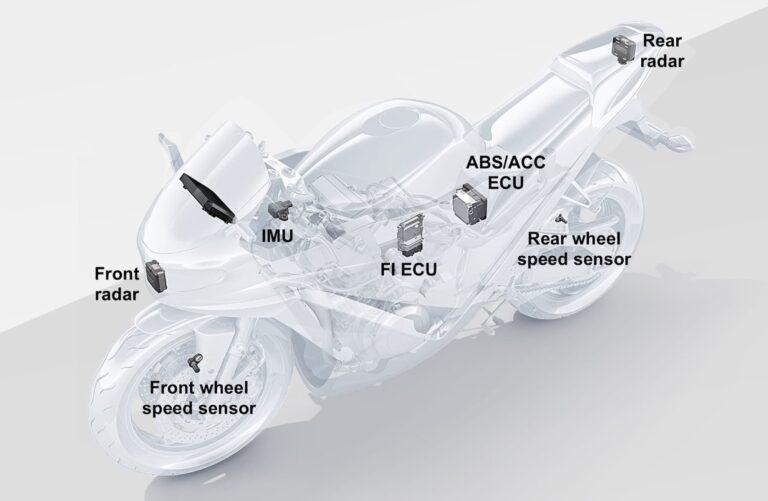
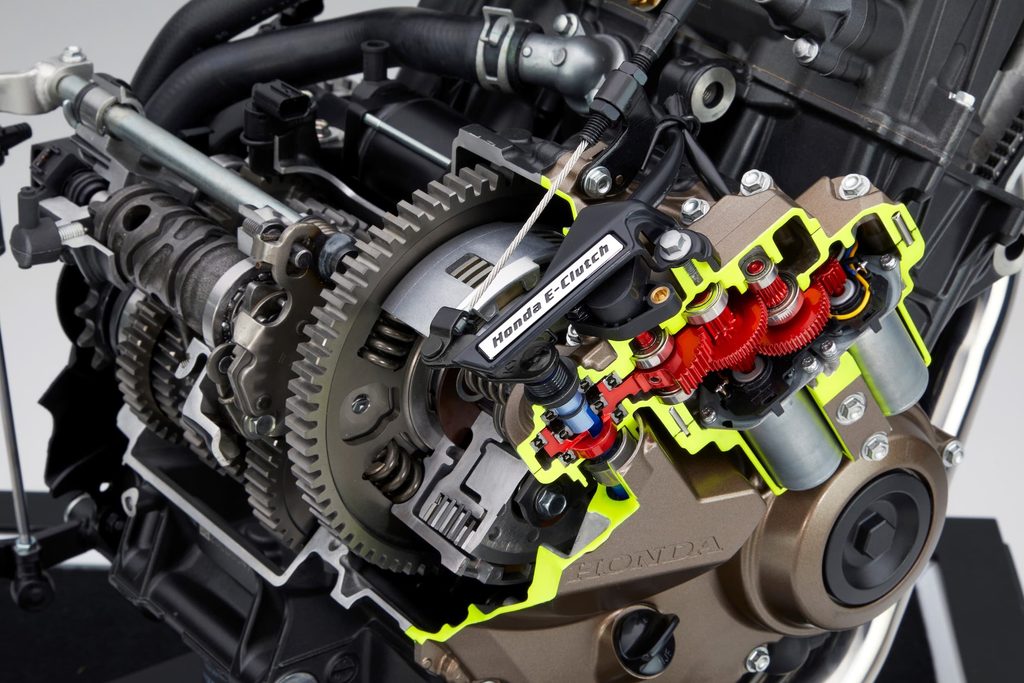
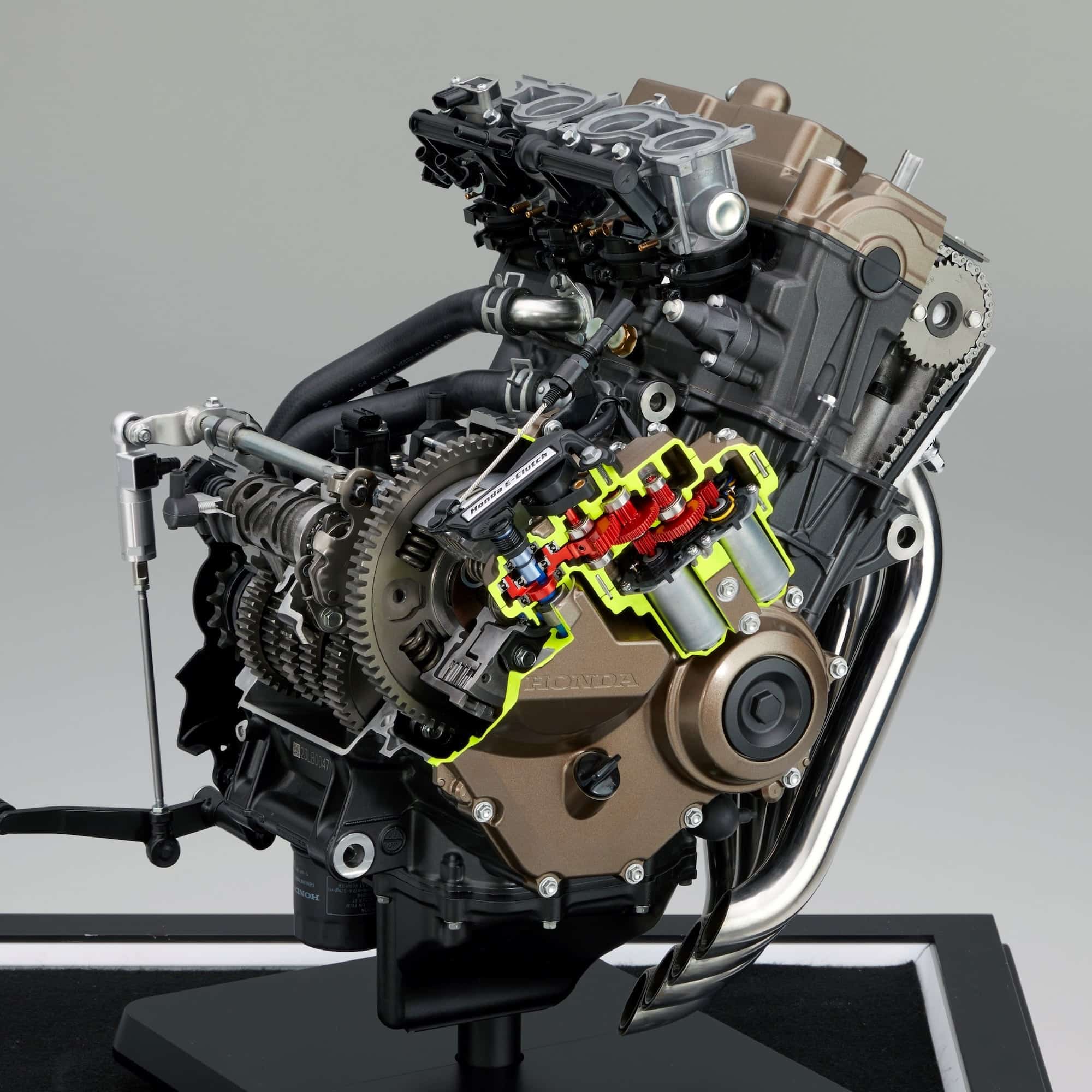
The clutch pack and gearbox are conventional. Honda adds a compact actuator unit inside or beside the right-hand engine cover, a motor control unit, sensors, and software that talks to the engine ECU.
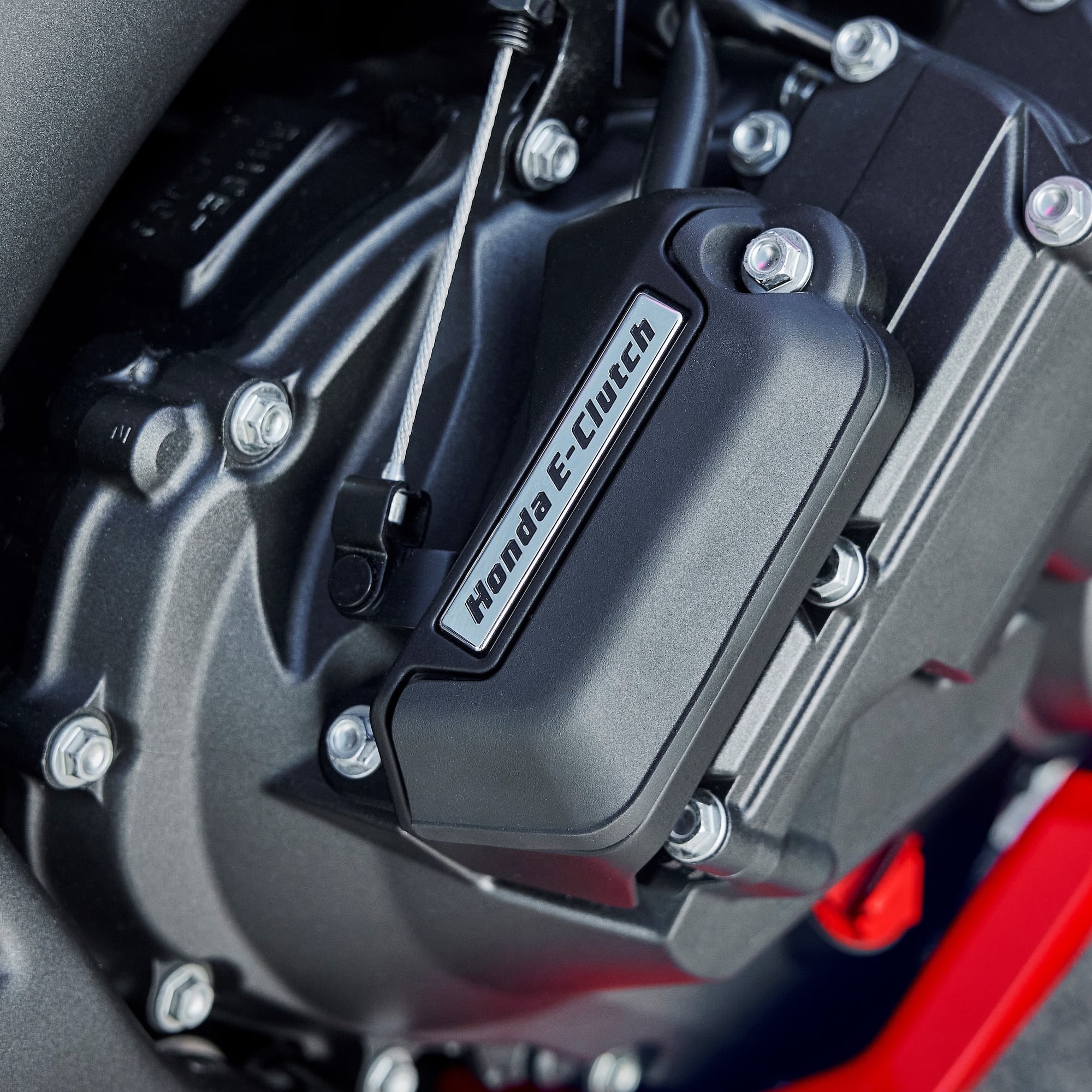
Two small electric motors turn reduction gears that move the clutch lifter. Honda uses two 32 mm motors side by side because they fit into a compact cover while producing enough combined torque to work the clutch quickly. A three-part actuator shaft lets the motors and the hand lever operate the same clutch independently.
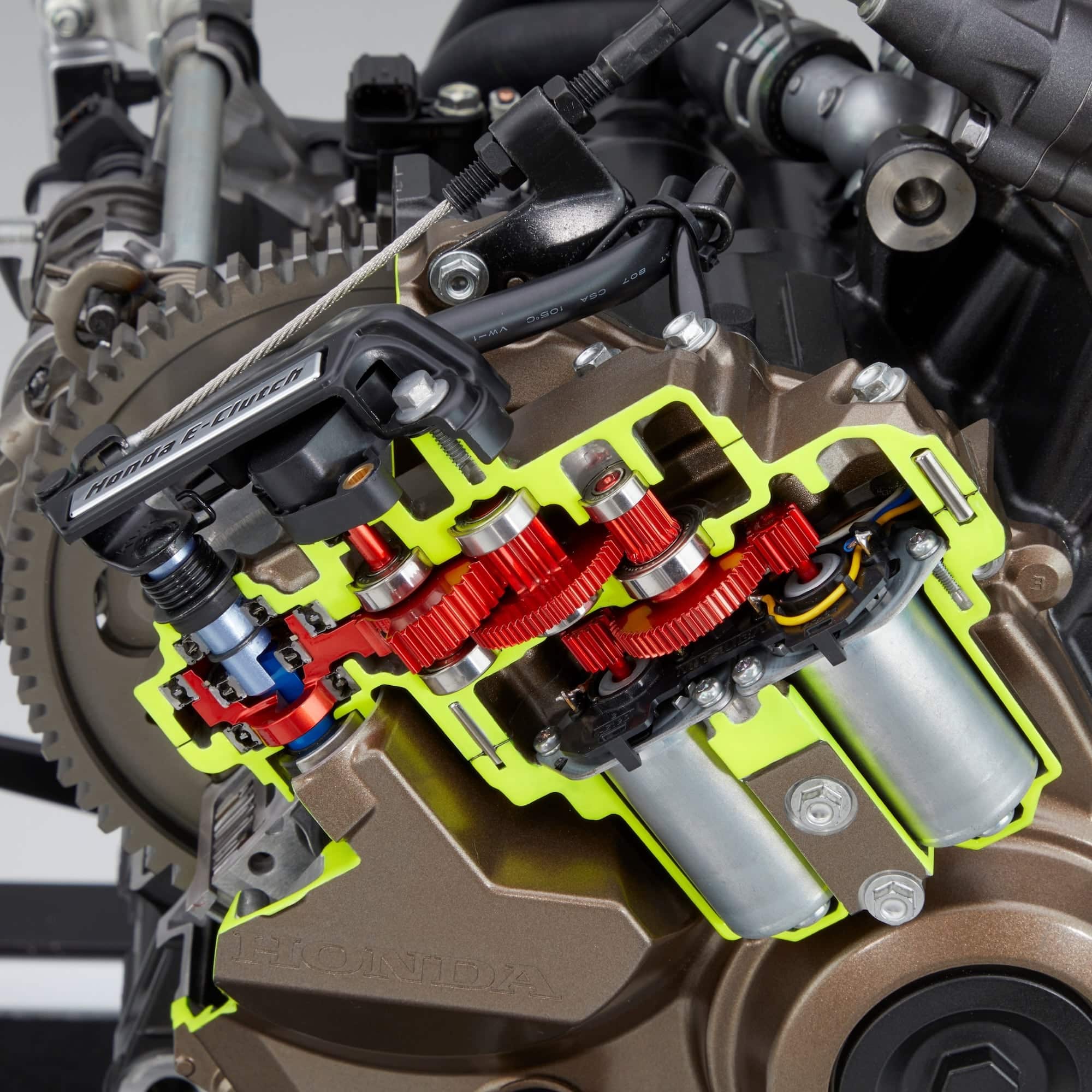
The controller watches engine speed, throttle position, road speed, gear position, load on the shift pedal and clutch position. When it detects a shift request, it coordinates clutch movement with fuel and ignition control. For a pull-away it progressively engages the clutch; for a stop it disengages it. During a gear change it can use partial clutch engagement to soften the change in rear-wheel torque.
That last point explains why Honda describes E-Clutch as a performance system rather than only an anti-stall aid. A well-programmed half-clutch can smooth the first-to-second shift and low-rpm changes that expose the limits of an ordinary quickshifter.
Honda’s newer 750-series version also works with throttle-by-wire.
On the 2026 CB750 Hornet and XL750 Transalp the E-Clutch system can add a controlled throttle blip on downshifts and coordinate the response with the selected ride mode. The 500 and 650 systems still control the clutch, fuel, and ignition, but they don’t have that same throttle-by-wire layer.
Honda E-Clutch vs a quickshifter
A conventional up-quickshifter senses pressure on the gear pedal, then cuts fuel or ignition for a few milliseconds. That removes torque from the gearbox dogs so the next ratio can engage. An up-and-down system adds an automatic throttle blip for downshifts. In either case, the rider normally uses the clutch to pull away, stop and perform awkward low-speed changes.
E-Clutch detects the same kind of pedal request, but it can physically disengage and re-engage the clutch as part of the shift. It also manages starts and stops. That broader control makes it more tolerant of low engine speed, a small throttle opening and the large ratio gap between first and second.
| Function | Quickshifter | Honda E-Clutch |
|---|---|---|
| Rider selects the gear | Yes, with the foot pedal | Yes, with the foot pedal |
| Works the clutch during shifts | Usually no | Yes |
| Clutch-free pull-away | No | Yes |
| Clutch-free stop | No | Yes |
| Automatic gear selection | No | No |
| Manual clutch lever | Yes | Yes, with instant override |
| Low-rpm behaviour | Often the weakest area | Broader operating range because it can slip the clutch |
So the title is only half serious. From the rider’s perspective, E-Clutch can feel like a very good quickshifter. Mechanically, it is an automatic clutch with quickshifter-style engine control.
E-Clutch vs Y-AMT, BMW ASA, Honda DCT and a scooter CVT
The easiest way to place these systems is to ask two questions: who operates the clutch, and who chooses the gear?
| System | Clutch control | Gear selection | Rider controls | Basic transmission |
|---|---|---|---|---|
| Honda E-Clutch | Automatic, with manual override | Always rider | Foot pedal and clutch lever | Conventional manual |
| Yamaha Y-AMT | Automatic | Rider or computer | Handlebar shift buttons; no clutch lever or foot shifter | Automated manual |
| BMW ASA | Automatic | Rider or computer | Foot pedal; no clutch lever | Automated manual |
| Honda DCT | Automatic | Rider or computer | Handlebar buttons; no clutch lever | Dual-clutch transmission |
| Scooter CVT | Automatic centrifugal clutch | No stepped gears to select | Throttle and brakes | Belt variator/CVT |
| MV Agusta SCS/Rekluse | Automatic near idle, with manual override | Rider | Foot pedal and clutch lever | Manual with centrifugal auto-clutch |
Yamaha Y-AMT uses one actuator for the clutch and another for the shift mechanism. In manual MT mode, the rider selects gears with a finger-operated switch on the left handlebar. In AT mode, the bike chooses shift points. Yamaha removes both the clutch lever and foot gear pedal. E-Clutch keeps both familiar manual controls and never chooses a ratio.
BMW Automated Shift Assistant (ASA) also has separate clutch and gearshift actuators. It offers an M mode in which the rider shifts with a conventional foot lever and a D mode that changes automatically. There is no clutch lever. ASA is therefore closer to Y-AMT than to E-Clutch, although BMW keeps foot shifting instead of moving it to the handlebar.
Honda DCT is a complete transmission rather than an add-on clutch actuator. It has two clutches and two input shafts, with one clutch carrying odd gears and the other carrying even gears. DCT prepares the next ratio before shifting. It can change automatically or accept button commands, but it is heavier and more mechanically complex than E-Clutch.
A typical scooter CVT uses a belt running between variable-diameter pulleys, plus a centrifugal clutch that engages as engine speed rises. There is no sequence of first through sixth gears. The CVT continuously changes its ratio, so the rider only opens the throttle. E-Clutch preserves the direct ratios, engine braking and shift decisions of a manual motorcycle.
MV Agusta SCS combines a Rekluse centrifugal auto-clutch with electronics and an up/down quickshifter. As engine speed rises, weighted wedges press the clutch pack together; near idle, the clutch releases so you can stop in gear and pull away without the lever. The rider still chooses gears with the foot pedal and can use the conventional clutch lever at any time.
Honda motorcycles available with E-Clutch
Honda introduced E-Clutch on the 2024 CB650R and CBR650R. The range expanded sharply for the 2026 model year. Availability varies by country, and in some markets Honda sells only the E-Clutch version while others list it as an option.
| Model family | First model year | Where it is sold or announced | Useful detail |
|---|---|---|---|
| CB650R | 2024 | Europe, Australia, New Zealand, North America and other markets | Original 649 cc four-cylinder application |
| CBR650R | 2024 | Europe, Australia, New Zealand, North America and other markets | Same first-generation system as CB650R |
| CB500 Hornet | 2026 | Europe and selected markets | 471 cc A2-friendly twin |
| CBR500R | 2026 | Europe and selected markets | 471 cc A2-friendly twin |
| NX500 | 2026 | Europe and selected markets | Adventure-style 471 cc twin |
| CB750 Hornet | 2026 | Europe, Japan and selected markets | Throttle-by-wire integration and downshift blipping |
| XL750 Transalp | 2026 | Europe, Japan and selected markets | Throttle-by-wire integration tuned for road and dirt |
| Rebel 250 / S Edition | 2025 | Japan and selected Asian markets | Single-cylinder small-capacity application |
| CL250 | 2026 | Japan | Small-capacity scrambler |
| CBR400R and NX400 | 2026 | Japan | Japanese-market versions of the 500 platform |
| CB400 Super Four and CBR400R Four | 2026 | Japan | New four-cylinder 400 models listed with E-Clutch |
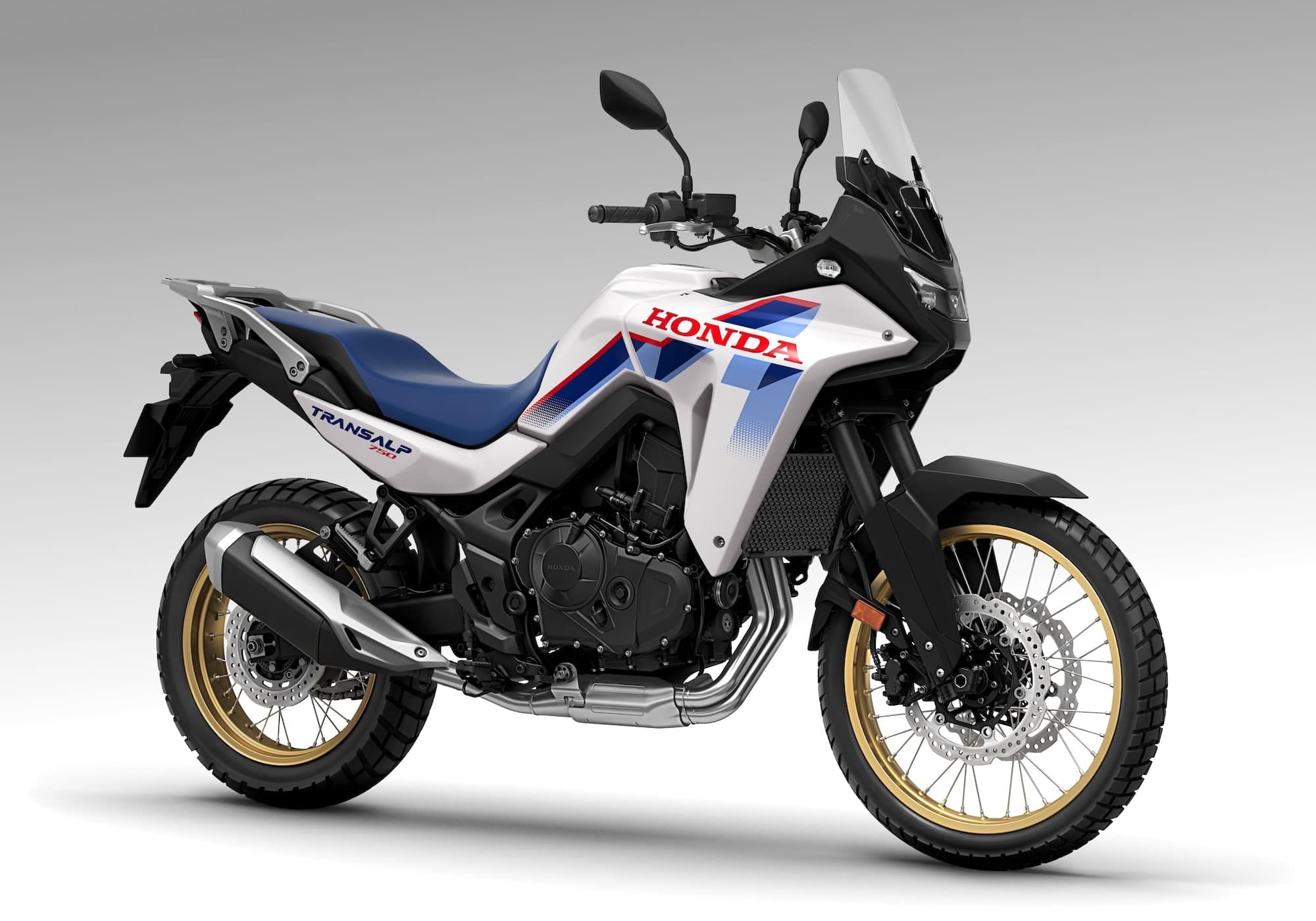
If you are comparing the middleweight Hondas, see the full CBR600F, CBR650F and CBR650R buyer’s guide. The Honda Hornet history covers the CB750’s place in that family, while the Transalp history and buyer’s guide follows the XL750 back to the original 1980s V-twin.
Advantages of E-Clutch in real riding
Traffic is the clearest win. Your left hand no longer repeats the same pull-hold-release cycle, and the bike cannot stall because you forgot to disengage the clutch. Hill starts become simpler because the controller meters engagement while you balance throttle and brakes.
Shifts stay consistent across a wider operating range. A quickshifter normally feels best when the engine is pulling. E-Clutch can use partial clutch movement when the engine is loafing, during the large first-to-second change, or when a downshift would otherwise disturb the chassis.
The familiar controls stay in place. A rider who wants to feather the clutch during a U-turn, loft the front wheel over an obstacle or make a deliberate launch can simply pull the lever. That makes E-Clutch easier to accept than a system that removes the lever and pedal.
It can help off-road. Automatic anti-stall control leaves more attention for line choice, standing balance and braking. The Transalp’s throttle-by-wire version can also smooth downshifts over rough ground. Experienced dirt riders may still prefer the lever for precise traction control, and they can still use it.
The weight penalty is small. Honda says the current systems add about 2 kg (4.4 lb), far less than converting the bike to a dual-clutch transmission. The main gearbox, final drive and general riding character stay the same as on the manual model.
Disadvantages and limits
You still have to think about gears. E-Clutch will stop the engine stalling, but it will not bring the bike from sixth to first for you. If you stop in a high gear, you must tap back down before pulling away. Anyone who wants true twist-and-go operation needs Y-AMT, ASA, DCT or a scooter CVT.
Low-speed control feels different. With your left hand parked, the throttle becomes the main request for clutch engagement. Honda’s calibration is smooth, but a rider used to holding steady revs and varying drive only with the friction zone may need time to trust it. The manual lever solves the problem when you want exact control.
It adds cost and components. The clutch itself is familiar, but the motors, gears, position sensing and controller create more possible failure points and more expense after a crash or out-of-warranty fault. Long-term reliability data is still limited because the first production bikes only arrived for 2024.
The first-generation system cannot command the throttle. On the cable-throttle 650s, E-Clutch coordinates the clutch, ignition and fuelling but cannot deliver the same active downshift blip as the throttle-by-wire 750s. It still changes down without lever input; the newer system has more control over how the engine and rear wheel meet again.
Some riders simply enjoy clutch work. A clean launch, a rev-matched downshift and delicate low-speed control are satisfying skills. E-Clutch lets you keep using them, but paying for an assistance system you plan to disable makes little sense unless the E-Clutch version is the only one available.
Who E-Clutch suits
E-Clutch makes the strongest case for commuters, riders with hand fatigue or limited grip strength, and anyone who wants quickshifter convenience without giving up a normal gear pedal and clutch lever. It also makes sense on the Transalp, where anti-stall help and a manual override can both earn their keep on the same ride.
E-Clutch is less convincing if you want the motorcycle to choose gears, or if working the clutch is a central part of why you ride. Yamaha Y-AMT, BMW ASA and Honda DCT go further towards automation. On bikes offered both ways, the manual version is usually cheaper and mechanically simpler.
For many riders, the useful part is the lack of commitment. Ignore the lever in traffic, tap through the box on a fast road, then grab the lever for a tight U-turn or a rough climb. That flexibility is what separates Honda E-Clutch from both a quickshifter and a fully automated transmission.