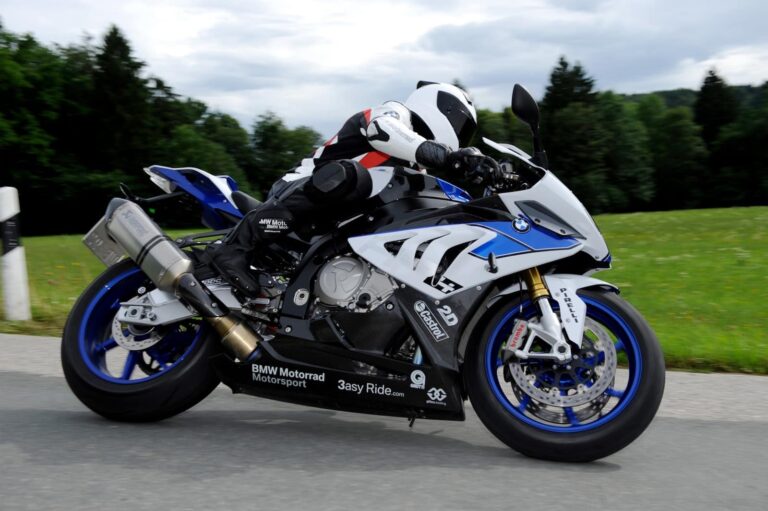

“Airbags?? On a motorcycle???“
That’s the reaction I had — and that I bet many people would have — about hearing that such a thing exists. I was filled with confusion and wonder.
- Do they actually work?
- Do I have to keep wearing all this gear, then?
- Are they expensive?
- Will they go off by accident? (Funny how I have this thought, even though they never do in my car…)
- Do I need a special bike?
The long and short of it is that motorcycle airbag vests are specifically designed for a limited use case — to cushion torso impacts, and yes, they do work, per independent crash tests. They’re inflatable protectors you wear over or beneath compatible riding gear, so you still need to sort out a good helmet and abrasion-resistant clothing.
How and where to buy one is less obvious. A tethered vest needs you to clip into the bike; an electronic vest needs power and correct arming. You have to consider what you want, and then price, fit, appearance, and how much they cost after they’re deployed the first time.
I’ll try to cover all of that below.
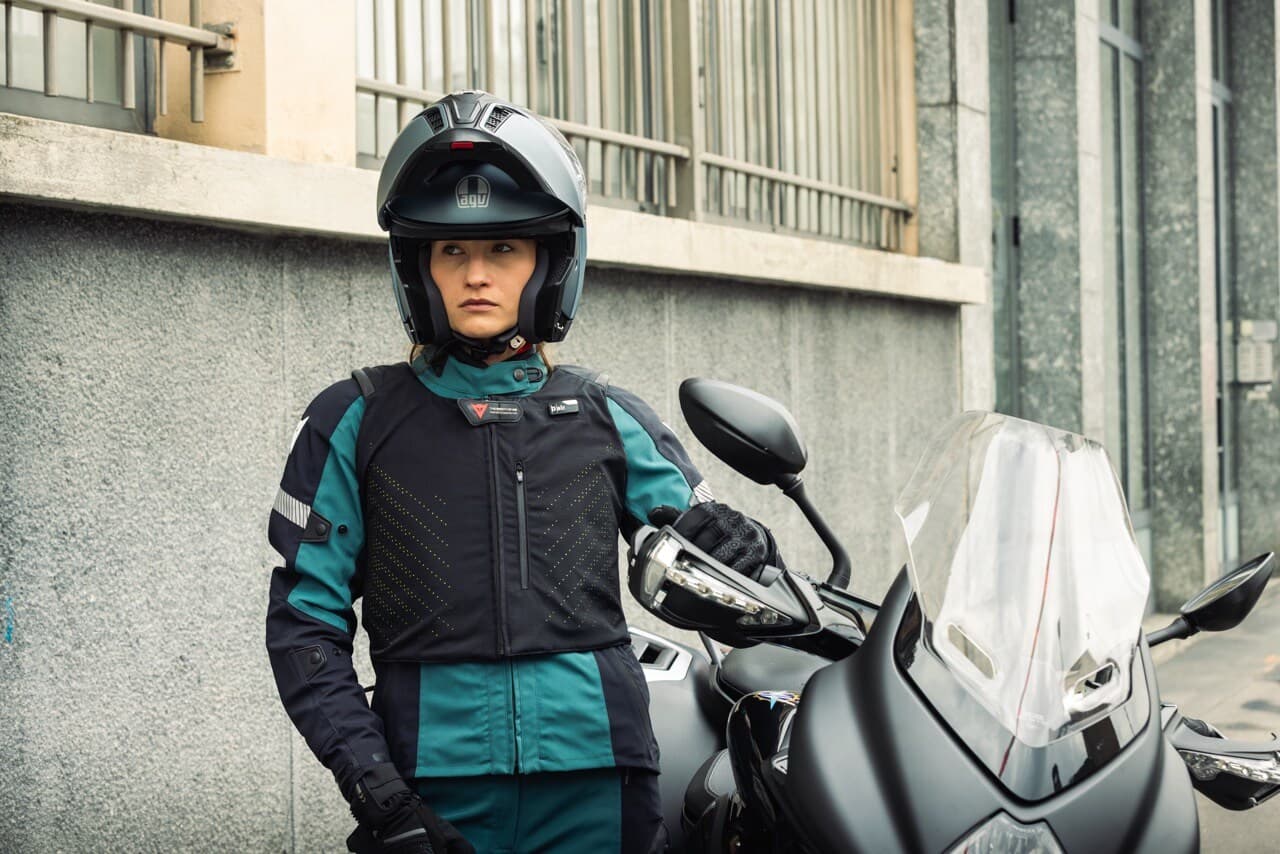
My shortlist: Hit-Air MLV2-C or Helite Turtle 2 if you want a mechanical vest without charging or annual fees; Dainese Smart Air or Alpinestars Tech-Air 3 V2 if you want an electronic road system without a subscription. Try them with your riding gear before buying. A wearable airbag usually lets you keep your current motorcycle.
Are you obsessed with motorcycles?
Well, I am. That’s why I created this site — as an outlet. I love learning and sharing what others might find useful. If you like what you read here, and you’re a fraction as obsessed as I am, you might like to know when I’ve published more. (Check the latest for an idea of what you’ll see.)
How do motorcycle airbag vests work?
The first question is: How do the bloody things work?
All major types of airbag vests work by releasing gas into a folded airbag to create an inflated cushion around the covered parts of your torso. They solve a limitation of ordinary armour: a relatively thin protector has less room to absorb an impact. The crucial difference is what tells the inflator to fire.
- Detect the crash. A mechanical vest triggers when rider separation pulls the tether tight. An electronic vest uses motion sensors and programmed crash-detection rules.
- Inflate the bag. The trigger activates the gas inflator, filling the airbag chambers.
- Cushion the impact. The inflated chambers spread the load across the covered parts of your torso.
The bag must inflate before the impact it’s meant to cushion. That’s why trigger timing matters as much as the speed at which gas fills the chambers.
Tethered, standalone electronic and bike-linked systems
| System | How it fires | What you live with |
|---|---|---|
| Mechanical, tethered vest | Separation pulls a tether connected to the motorcycle, releasing the inflator. | Clip in before riding and unclip before dismounting. No battery or subscription; correct anchor position and tether length matter. |
| Standalone electronic vest | Sensors and an algorithm recognise a crash and trigger an inflator. | Charge it, fasten it correctly and confirm it’s armed. Use a detection mode approved for your riding. Usually no bike installation. |
| Bike-linked wearable system | Sensors on the motorcycle communicate with a compatible garment. | Legacy Ducati D-Air is an example. Compatibility between the motorcycle and garment matters. |
| Airbag built into the bike | Motorcycle crash sensors fire a motorcycle-mounted airbag. | Certain Honda Gold Wings. It cushions the rider in the frontal scenarios it was designed for. |
A mechanical tether has a specific limitation: it needs enough separation and tension to trigger. If your torso hits an obstacle before that happens, or you fall while staying close to the motorcycle, inflation may come too late or not occur. Hit-Air explicitly discusses this in its manual.
An electronic system can detect some crashes before a rider separates from the bike. Its limitations instead include the algorithm’s operating conditions, battery, arming procedure and chosen riding mode. A road mode, track mode and off-road mode aren’t interchangeable promises.
I’d be wary of ranking systems by an advertised inflation time alone. The entire sequence is detection, triggering and filling. A figure measured after an inflator fires leaves out the time spent deciding to fire it — or pulling a tether tight. Comparable tests need a common starting point.
Do motorcycle airbags work? What’s actually been tested?
Yes, independent testing supports the ability of airbags to cushion torso impacts. The protection in a particular crash depends on coverage, impact force and whether the bag is inflated in time. But certification isn’t the same as actual crash testing.
Independent crash tests: encouraging, with limits
ADAC’s airbag-vest test, conducted by the German motoring club, included the Alpinestars Tech-Air Street-e, Dainese Smart Jacket and Held eVest. Its full-scale motorcycle crash test used a Suzuki Bandit and a rider dummy striking the side of a stationary car at 50 km/h (31 mph). All three systems received a good overall rating.
In that scenario, the airbags were fully inflated roughly 80 milliseconds after the motorcycle’s first impact, before the dummy’s torso struck the car.
ADAC tested those models in 2020 and updated its report in March 2024. Smart Air and Tech-Air 3 V2 are newer products; the ADAC results apply to the tested models.
Real crashes: the French EFFIGAM study
France’s EFFIGAM research combined laboratory work with investigation of 27 crashes involving riders wearing airbags. It found protection was more apparent in falls and sliding crashes than impacts against obstacles. Laboratory testing also showed greater torso energy absorption and coverage than conventional back protectors.
Seven of those riders were uninjured but 20 were injured. Bear in mind though that without a comparison group of riders wearing no airbag, the study couldn’t calculate a percentage reduction in injuries, nor compare the reduction in severity.
Crash geometry matters. Sliding at 80 km/h (50 mph) and striking a rigid object squarely at that speed put very different loads through your body. An airbag’s cushioning capacity is finite.
Certification: check the exact model and protected area
Look for the model’s declaration of conformity and protection label, rather than relying on a generic CE logo, the mark declaring conformity with applicable European requirements. EN 1621-4 is a European airbag-protector standard you’ll encounter; electronic systems can also have assessments under other stated protocols. Read what was certified.
Hit-Air’s MLV2-C declares EN 1621-4:2013 certification, with a Level 1 full-back designation in its motorcycle manual. Dainese describes Smart Air as Level 2 for central-back and divided-chest protection. Central-back and full-back are different coverage categories; a higher level number alone doesn’t settle the whole comparison.
Also separate the inflatable protector from any conventional protector inside the vest. Helite’s Turtle 2 includes a Level 2 passive back protector — a conventional protector that works without inflation. That label doesn’t automatically describe the airbag’s performance. The same caution applies to an RST vest advertised with a Level 2 D3O back protector, named for its impact-protection material.
The products below have documented testing or certification, but the assessments use different methods and coverage categories. Compare the protected areas, trigger system and fit alongside the impact-protection rating.
How much do motorcycle airbag vests cost?
They’re a substantial gear purchase: A$940.50 for the lower-priced of the two Australian mechanical vests below. Electronic pricing depends on whether you’re buying a complete system or a garment that needs a separately paid control unit. Include the cost after deployment.
| Model and market | Listed purchase price | Trigger and main cost catch |
|---|---|---|
| Hit-Air MLV2-C — Australia | A$940.50, base black listing | Mechanical tether; no subscription. Correct replacement cartridge and inspection/rearming requirements after deployment; sizes can change the price. |
| Helite Turtle 2 — Australia | A$1,125, black | Mechanical tether; no subscription. Replacement carbon dioxide (CO₂) cartridge starts at A$59, with the correct size required. |
| Dainese Smart Air — Europe | €499 | Standalone electronic; no subscription. New gas generator after each inflation; service required after three inflations of an undamaged bag. |
| Alpinestars Tech-Air 3 V2 — Europe | €599.95 | Standalone electronic; no subscription. Confirm the V2’s local post-deployment procedure and costs with the supplier. |
| Alpinestars Tech-Air 5 Plasma — USA | US$869.95 | Standalone electronic; no subscription. Replaceable inflator; the listed replacement is US$139.95. |
| RST D3O Essential Airbag Vest — UK listing | £299.99 for the vest | Requires an active In&box control unit, with a separate purchase or subscription plan. The garment price isn’t the complete operating cost. |
The “In&box” (almost as awful to type as it is to read, by the way) is In&motion’s sensor and control unit, used in garments from several brands. Its European pricing illustrates the ownership calculation: €120 a year to lease the In&box, or €400 to buy it, with one detection mode included. Over five years, that’s €600 in annual lease payments versus €400 to buy the box, before the garment, inflators or optional modes.
With a lease, keep the plan active for the box to operate. If you buy the box outright, check what’s included and which optional services cost extra. The cheaper vest on the shelf can become the more expensive system to own.
For every model, ask the shop for the cost and turnaround time after one deployment, the point at which the bag needs factory service, and the procedure after a damaging crash. Owner-replaceable inflators don’t make a torn, abraded or otherwise damaged airbag safe to reuse.
Which affordable airbag vests would I shortlist?
I’d shortlist Hit-Air MLV2-C and Helite Turtle 2 for a mechanical system, or Smart Air and Tech-Air 3 V2 for an electronic road system without annual fees. The trade-off is the routine: clipping in with a mechanical vest, or charging and arming an electronic one.
For a mechanical vest: compare Hit-Air and Helite locally
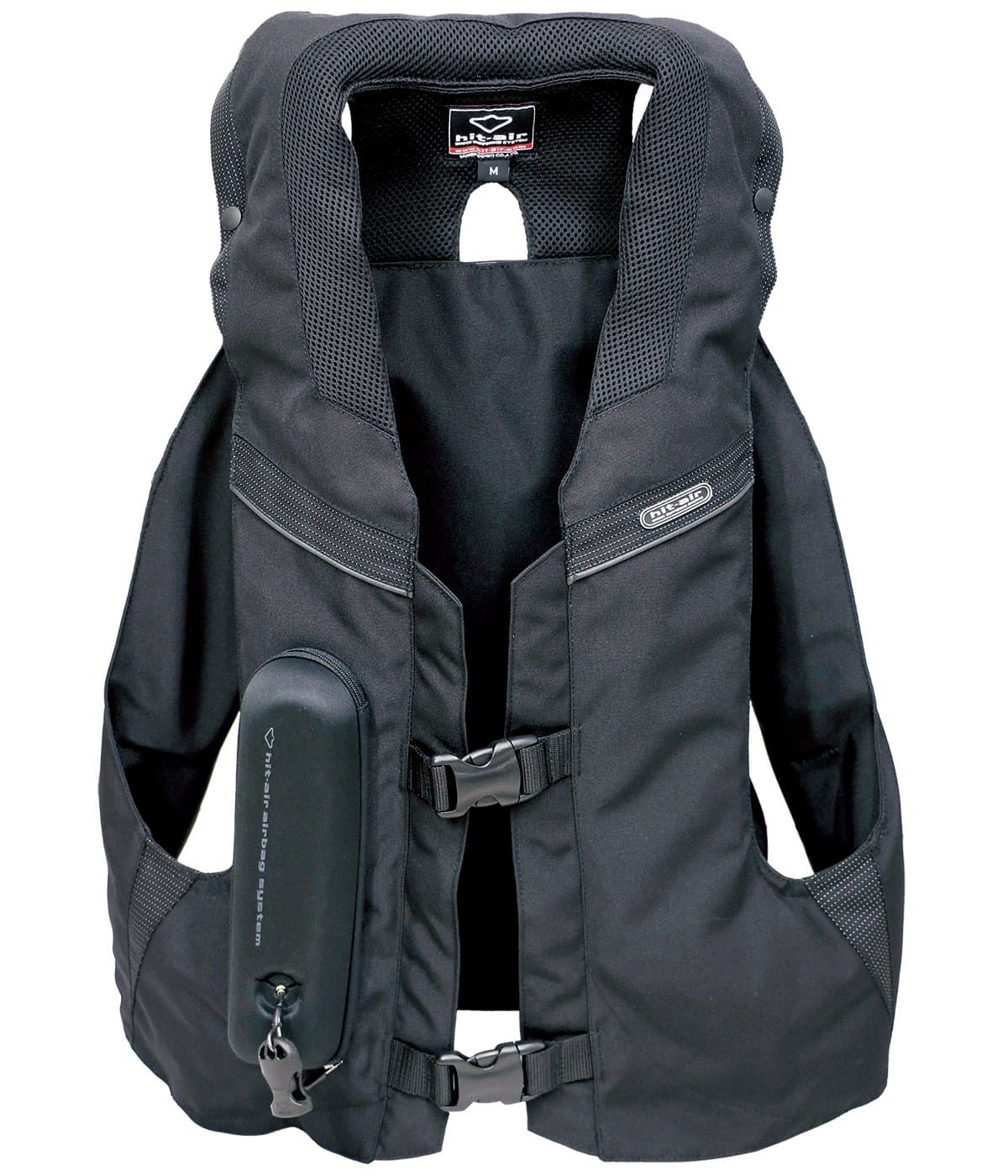
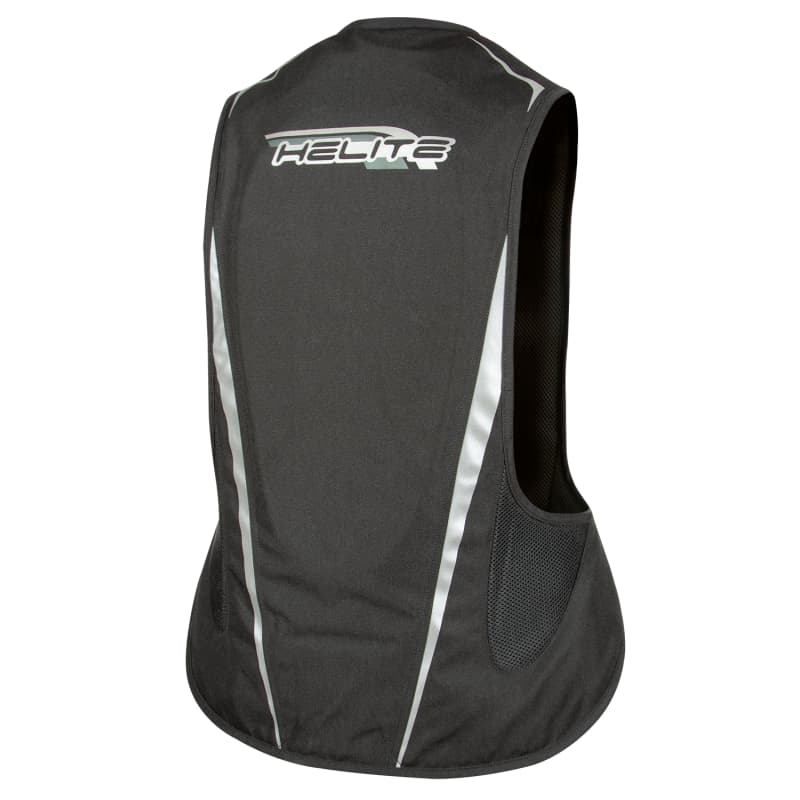
At the Australian prices above, Hit-Air MLV2-C costs A$184.50 less upfront than Turtle 2. It has a harness-like appearance and the certification discussed above. Helite Turtle 2 costs more and has a more enclosed waistcoat shape, plus its conventional back protector. Neither needs charging or an annual plan.
Both suit riders prepared to clip in every time. If you’re unlikely to remember that step, compare an electronic system instead. Try either mechanical vest over your actual jacket, in a riding position. Check freedom to turn your head, reach the bars and move on the seat. Then have the supplier identify a suitable anchor on your motorcycle. The lower price is only an advantage if the vest fits and the tether can be installed correctly.
For electronic road riding: Smart Air or Tech-Air 3 V2
Smart Air suits road riders prioritising a complete electronic system at the €499 European price quoted above, without a subscription. Dainese allows it over or beneath a compatible garment. Its gas generator is replaceable, but each inflation uses a new generator; three permitted inflations don’t mean three firings from one cartridge.
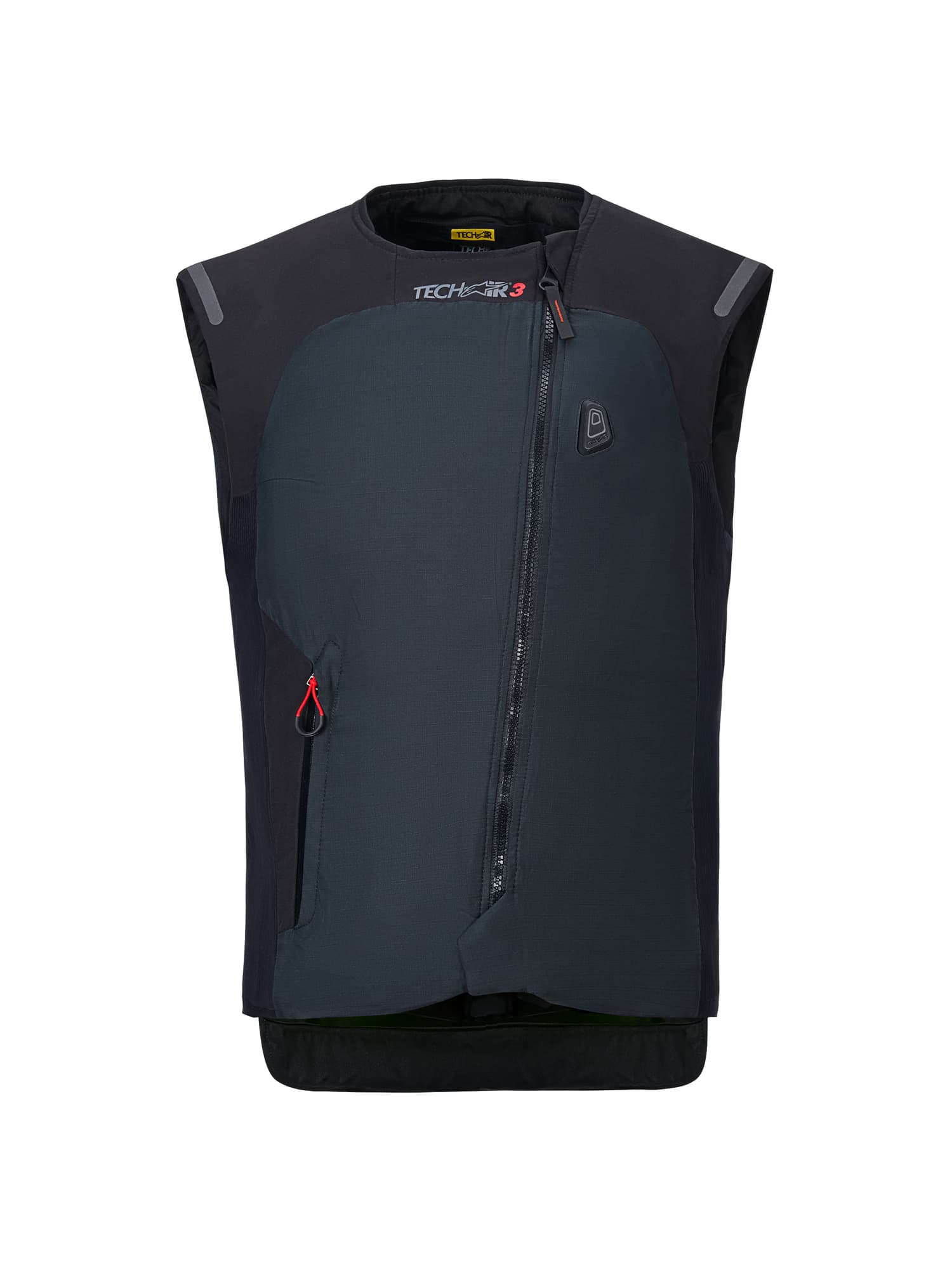
Tech-Air 3 V2 suits road riders who prefer its fit and over/under-jacket flexibility at a higher complete-system European price. Alpinestars reports first-impact testing under a stated protocol, but that isn’t the ADAC test of the older Tech-Air Street-e. Check the precise model when shopping: a discounted original Tech-Air 3 isn’t automatically the V2.
Tech-Air 5 Plasma costs more and adds shoulder coverage to its chest, ribs and back coverage. That’s a reason to consider spending more if those areas matter to you; it isn’t proof that a more expensive vest wins every impact test.
RST/In&motion can make sense if you like the garment fit and control-unit plan. Compare the whole package across several years. I wouldn’t choose it solely because the initial vest price is the smallest number.
What about a used vest or an anonymous cheap one?
Yes, you can buy a used airbag vest. Just like you can buy a car with a used, undeployed airbag.
For a used airbag, you have to ask for its deployment and service history, check for the correct inflator, an intact bladder and garment, and confirm that the control unit can be transferred and activated where applicable. You can’t just check the shell.
Skip an unknown brand that can’t provide the exact model’s conformity documents, test results and servicing arrangements. A discounted previous-generation vest from a supported range is a better place to look for savings.
Do airbag vests look dorky?
The million-dollar question, for most. Is it like wearing high-viz?
Yep, some do have a strong “I’m about to direct traffic” look. A bright external vest over a slim leather jacket changes the silhouette; a harness adds straps and visible hardware. If that bothers you, take the appearance seriously enough to choose something you’ll keep wearing.
The Dainese rider photo above shows the other end of the spectrum: a plain black vest over a jacket. Tech-Air 3 V2 also has a fairly ordinary waistcoat shape. Systems approved for under-jacket use can be largely hidden, though they add bulk and need room to inflate.
After deployment, all of them look inflated. That’s the point. For everyday appearance, the better question is how they look before deployment, fitted to your body and your riding jacket.
Try the combination seated on the bike. A vest that looks tidy standing up can bunch at the neck, press into the abdomen or restrict movement when you lean forward. Wear it long enough to notice heat, pressure and restricted movement.
At the end of the day, none of them looks like a biker’s leather jacket. So you have to be comfortable going in the direction of practicality (in which case, one starts to wonder: “Do I just take the Toyota?”)
Do you still have to wear all your regular riding gear?
Another great question. I wear gear, but I usualy don’t love it. It takes ages, I get hot, and I sweat in it and then have to wonder about cleaning it.
Unfortunately, yes: keep your helmet, gloves, motorcycle boots, abrasion-resistant jacket and trousers, and the armour required for areas the airbag doesn’t cover. A vest cushions certain impacts. It doesn’t turn ordinary jeans or a T-shirt into riding gear, and it doesn’t protect your hands, feet or head.
My Shoei RF-1200 review discusses the helmet side of the kit, while the Earmold earplug review covers hearing protection. Adding an airbag still leaves those jobs to other equipment.
Back and chest armour need a model-specific answer. Dainese says Smart Air can replace conventional back and chest protectors. Other systems include a passive back protector or specify a particular arrangement. In&motion’s manual warns against wearing an additional back protector with its system. Follow the complete system’s instructions rather than stacking protectors by instinct.
Leave the expansion room your system requires
In&motion’s user manual also gives garment and accessory compatibility rules. Check backpacks, chest straps, neck braces and tightly fitted outerwear against your own system’s instructions. An airbag needs its specified expansion space.
Don’t put an over-jacket-only vest beneath a tight jacket to hide it. Hit-Air specifies outermost wear for MLV2-C. Even systems approved for under-jacket use need suitable clearance or an expressly compatible garment. An integrated airbag jacket can perform the outer-jacket role only according to its own abrasion and armour certification.
Neck coverage varies, and neck injuries also involve bending and twisting forces. Keep the rest of your riding gear.
Which motorcycle manufacturers support tethered airbags?
Your motorcycle needs a suitable structural anchor because mechanical vests use an aftermarket tether. A new or used bike can carry one without connecting to its electronic control unit (ECU), the computer controlling motorcycle systems.
Helite’s installation guide specifies a substantial attachment point near the seat/tank area, with enough strength to withstand the required pull. Plastic trim and handlebars aren’t substitutes. Route the strap clear of sharp edges and heat, and set its length according to the manual so normal movement is possible without unnecessary slack.
Frame layout and seat access determine where you can attach the tether. If you can’t identify a suitable anchor, have the vest supplier inspect the bike.
Hit-Air publishes illustrated tether-fitting examples for several brands. Its examples include:
| Brand | Examples in Hit-Air’s fitting guide |
|---|---|
| Honda | CB400; PCX125/PCX150; XL200R |
| Yamaha | WR250R; Majesty |
| Kawasaki | Ninja 250 |
| Suzuki | Address V50 |
| Ducati | Multistrada 1000 DS |
| BMW | F650GS |
Scooters, dual-sports and ordinary used road bikes can all carry tethered vests. Follow the mounting instructions for your bike’s frame and model year. A passenger needs their own vest and attachment arrangement.
The installation is simpler than adding aftermarket electronic cruise control: there’s no integration with the motorcycle’s throttle or electronics. But you still need to get the physical installation right.
Which new and used motorcycles have factory airbags?
I always buy used bikes (so far!) — so I’d be curious about used bikes, in particular.
Certain new and used Honda Gold Wing trims have a motorcycle-mounted airbag. Older Ducati Multistrada D-Air models instead communicate with a compatible wearable airbag. Check which arrangement you’re buying: the two protect the rider differently.
| Motorcycle | Where you’ll find it | What the system is |
|---|---|---|
| Honda GL1800 Gold Wing Airbag | Used airbag-equipped bikes from 2006–2017 in relevant markets; verify the actual trim. | Airbag built into the motorcycle ahead of the rider. It wasn’t standard on every Gold Wing. |
| Honda Gold Wing Tour airbag variants, 2018 onward | Used examples and current new-bike variants. US 2026 name: Gold Wing Tour Airbag Automatic DCT. Honda Australia markets the airbag on Tour Premium. | Motorcycle-mounted frontal airbag. A Tour or DCT badge alone doesn’t identify the airbag variant. |
| Ducati Multistrada 1200 Touring D-Air / later 1200 S D-Air | Used 2014-era Touring D-Air and later 1200 S D-Air versions; verify model year, market and equipment. | Bike sensors communicate with a compatible Dainese wearable airbag. There’s no Gold Wing-style airbag built into the bike. |
Honda introduced the production Gold Wing airbag in North America and Europe in 2006. Its technical explanation describes a system intended to reduce the rider’s forward motion in severe frontal collisions. It isn’t equivalent to a wearable vest in a slide, and the front airbag doesn’t provide the pillion with the rider’s protection.
For a new bike, check the current US trim specification or local Honda listing. For a used one, confirm the build specification and airbag equipment against the vehicle identification number (VIN); check the warning-light self-test, service records and any previous deployment. The motorcycling acronym glossary explains the other equipment abbreviations you’ll meet in used-bike listings.
Also check outstanding recalls with Honda. Gold Wing airbag inflators have been subject to Takata-related recalls; a seller’s description of “airbag model” doesn’t establish that recall work was completed. Resolve outstanding work before you settle the price; the motorcycle price negotiation guide covers how inspection findings affect your offer.
Ducati’s history of its electronic systems describes the Multistrada’s D-Air connection. On a used D-Air bike, confirm with Ducati and Dainese that the particular compatible garment can still be supplied or serviced. Don’t assume the old bike transmitter will operate an arbitrary modern electronic vest.
For most riders, a wearable system gives a much broader choice of motorcycle. You can add a correctly mounted mechanical vest or an appropriate standalone electronic vest without replacing the bike. A factory airbag is a separate purchasing consideration.
Which airbag system suits you?
Choose the operating routine you’ll follow on every ride, then compare fit and local ownership costs. This is how I’d narrow the options:
| Your priority | My starting shortlist | Choose another option if… |
|---|---|---|
| No battery or annual plan | Hit-Air MLV2-C and Helite Turtle 2. Try both over your jacket and confirm the anchor. | You won’t consistently clip in, or the bike has no suitable mounting point: consider a standalone electronic vest. |
| Electronic road protection without an annual fee | Smart Air and Tech-Air 3 V2. Compare local prices, fit and reset costs. | You need shoulder coverage: investigate Tech-Air 5 Plasma. Check the approved mode before choosing for track or off-road riding. |
| Lower initial garment price | RST D3O Essential, after pricing the complete In&box package over your ownership period. | You want a single complete-system price: compare Dainese or Alpinestars locally. |
A mechanical vest suits riders who want to avoid charging and will clip in reliably. A standalone electronic vest suits riders who want to avoid the tether and will keep the system charged and armed. You can usually add either system to the bike you already own.
If buying an airbag means postponing a properly fitting helmet or abrasion-resistant riding gear, buy the basic kit first. Once that’s covered, pay for documented protection, compatible fit and a servicing route you can use. An airbag adds protection to that kit; its inflated shape is a poor reason to leave it at home.