
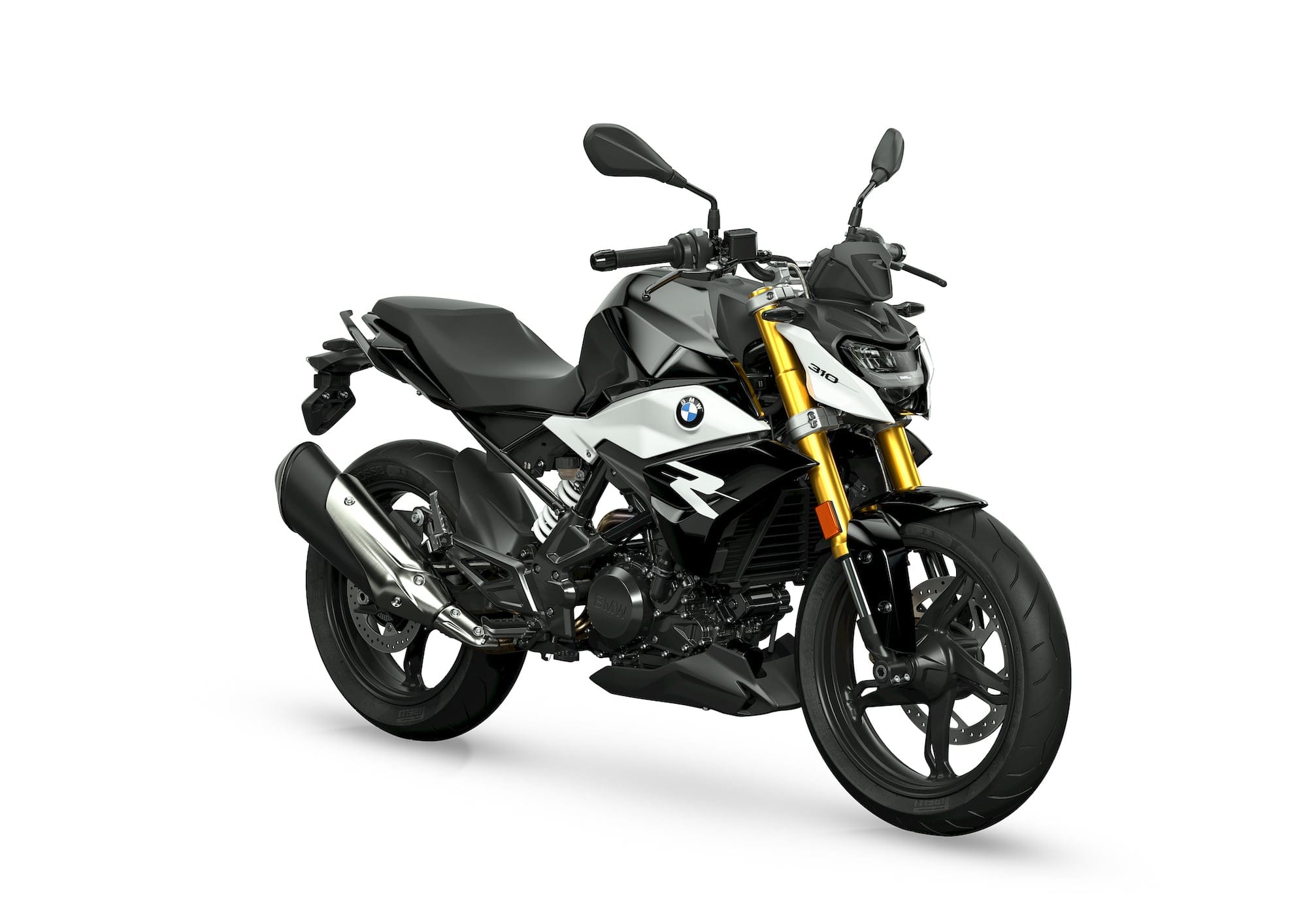
If you like small bikes and you like BMWs, then you’ll no doubt have heard of the G 310 R. It’s the diminutive roadster that looks like a BMW, has some appealing hardware… but keeps the equipment fairly basic.
BMW has had the G 310 R in its stable for roughly a decade. For the 2027 model year, the F 450 R takes over its role as the small BMW roadster I’d expect new riders and city commuters to consider.
Sure, there’s an F instead of a G, and a parallel twin replaces the single-cylinder engine. But it’s still a compact, everyday motorcycle, with a low seat and a riding position that doesn’t demand you fold yourself around the fuel tank.
The change is bigger than the extra cylinder. BMW gives the F 450 R substantially more torque, cornering ABS and a much broader choice of equipment. Below, I’ll go over what’s different and how I’d choose between a new F and a used G.
Updates
- 19 October 2026: Added the F 450 RR, with its differences from the F 450 R and a link to the complete BMW 450 model guide.
In this guide
- The short answer
- Where the F 450 R fits in BMW’s range
- What about the F 450 RR?
- BMW F 450 R vs G 310 R: Specs compared
- How the engines make their power
- Torque curves: G 310 R vs F 450 R
- Who each bike suits: City riding, learning and longer trips
- Brakes, suspension and electronics
- Reliability and maintenance: What we know, and what I’d expect
- Which would I buy?
Are you obsessed with motorcycles?
Well, I am. That’s why I created this site — as an outlet. I love learning and sharing what others might find useful. If you like what you read here, and you’re a fraction as obsessed as I am, you might like to know when I’ve published more. (Check the latest for an idea of what you’ll see.)
The short answer
The F 450 R suits you if you want a small BMW with more room to grow. Its extra torque gives it a stronger case for riding beyond city streets, and its standard cornering ABS brings braking assistance that the G doesn’t have.
The G 310 R still makes sense if the used price is right. It’s lighter, has a slightly lower standard seat and has fewer systems to learn. If your riding mainly involves getting across town, you may get more value from a well-maintained G than from paying for all the F’s extra equipment.
I’d favour a 2021-onward G 310 R when comparing used bikes in similar condition. BMW added a slipper clutch, electronic throttle and stall-reducing idle control for that update. Those changes directly affect the sort of riding a small roadster does most often.
Where the F 450 R fits in BMW’s range
BMW unveiled the original G 310 R in November 2015. It was a considerable departure for a company many riders associated with big boxer twins and expensive touring bikes: a 313 cc single, built with TVS in India, in a small roadster chassis.
The G had proper motorcycle hardware from the start, including an upside-down fork, a radial front brake caliper and ABS. Its modest output also left plenty of room between it and the larger BMW roadsters.
For 2021, BMW kept the engine’s basic layout and output, but added ride-by-wire, an assist/slipper clutch, LED lighting and adjustable hand levers. The automatic idle-speed increase helps prevent stalls when you pull away. BMW explains those changes in its 2021 G 310 R announcement.
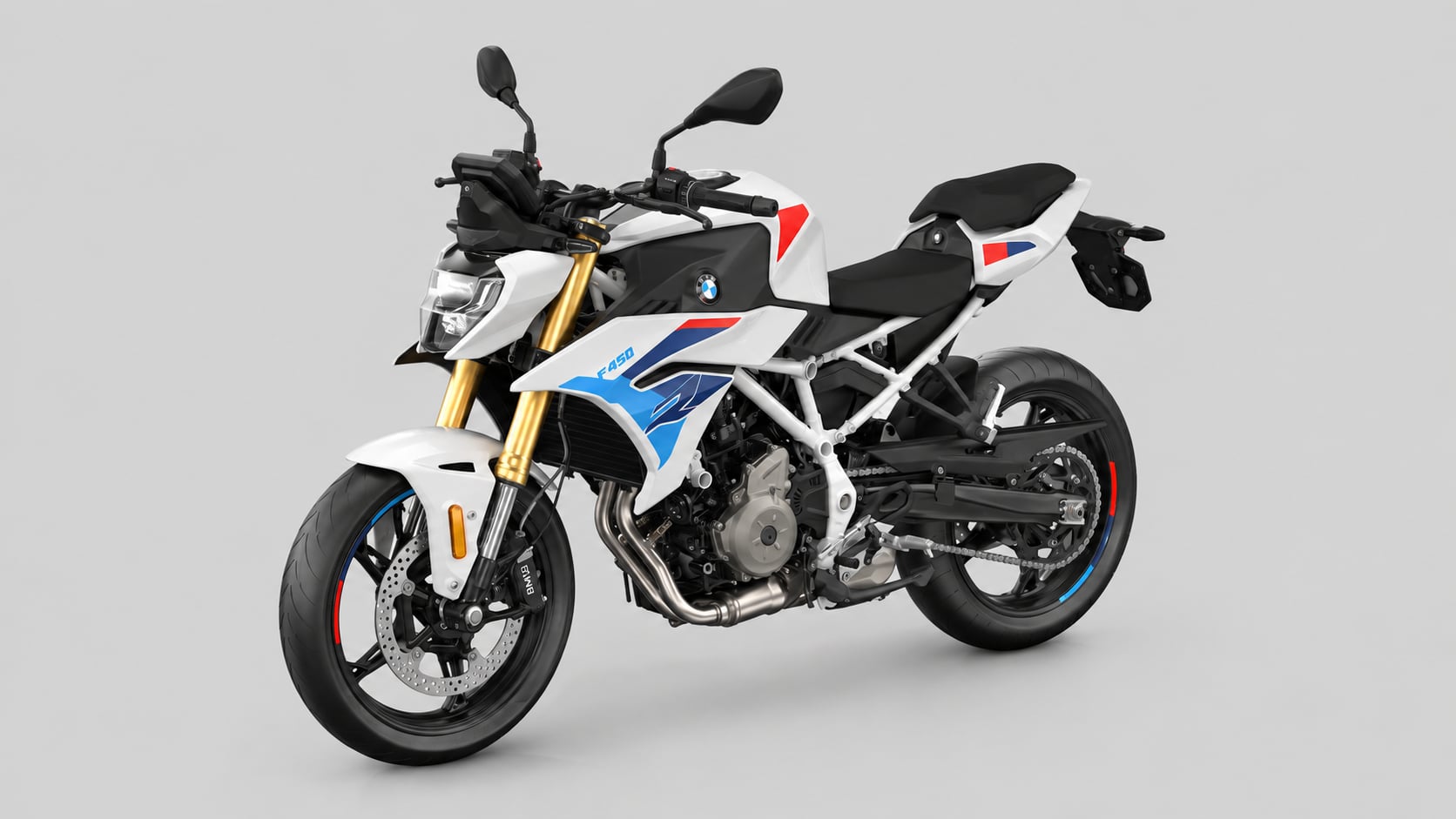
The F 450 R belongs to BMW’s newer 450 twin-cylinder family, whose engine first appeared in the F 450 GS. BMW announced the roadster in October 2026; its French launch announcement gives spring 2027 for local availability.
I think of it as the G’s effective successor when shopping for a small BMW roadster. That doesn’t establish a single worldwide date when every dealer stops selling the G. Availability, remaining stock and equipment packages depend on your market.
What about the BMW F 450 RR?
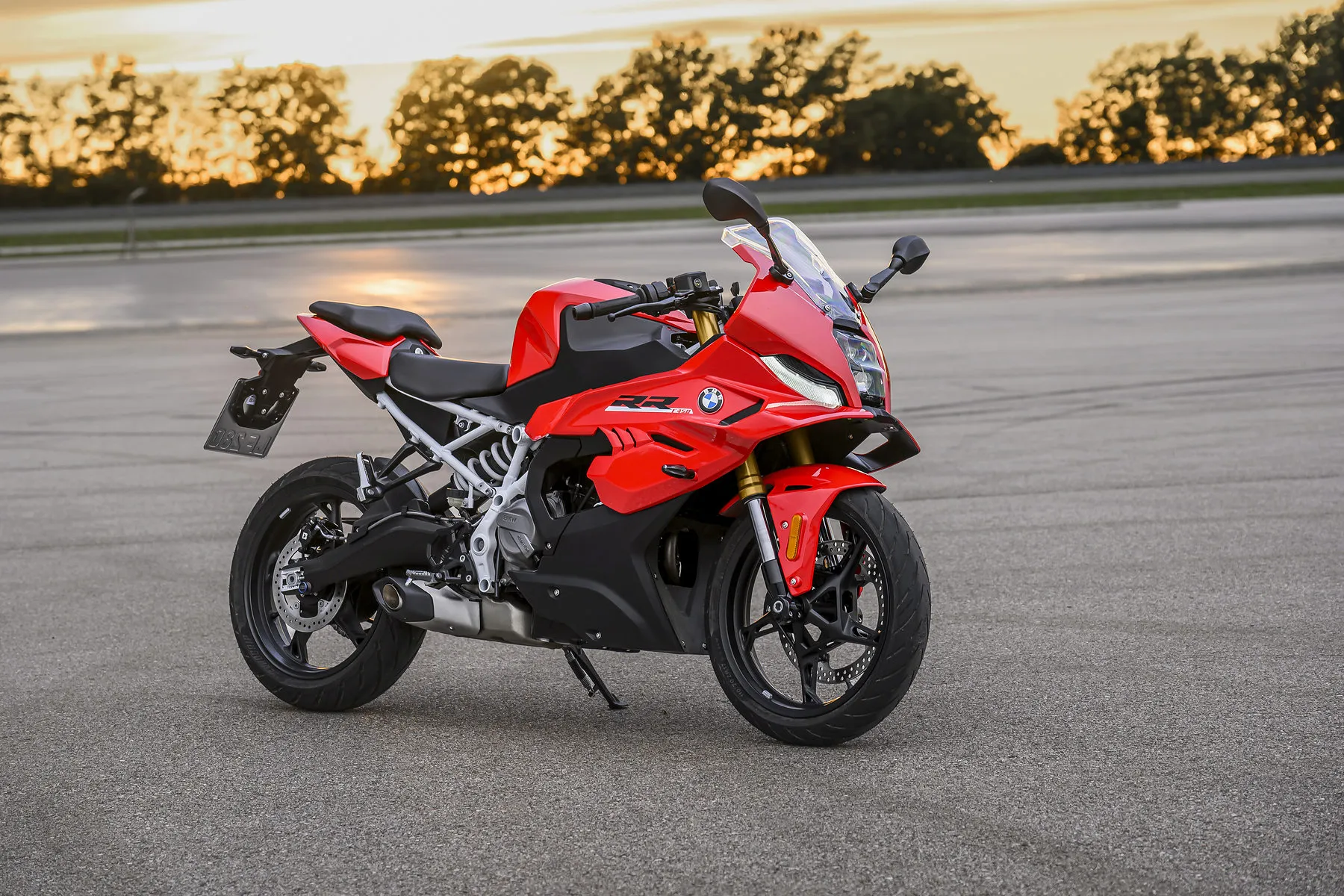
BMW has also announced a fully faired sibling: the 2027 F 450 RR. It shares the R’s 420 cc parallel twin and quoted 35 kW (48 PS) and 43 Nm (32 lb-ft). The RR gives you a full fairing, screen and clip-on handlebars, with a more forward riding position. It doesn’t bring a higher-output engine.
Both road models have 17-inch wheels, 140 mm (5.5 in) suspension travel and a 790 mm (31.1 in) standard seat. BMW quotes 177 kg (390 lb) road-ready for the RR, compared with 175 kg (386 lb) for the R; ERC adds 1 kg (2 lb) to either. The RR has its own sport riding modes — Rain, Road and Race, with configurable Race Pro on the M Sport versions — and a reversible shift pattern for circuit use.
ABS Pro and DTC come standard on both. In the RR range, Sport adds Shift Assistant Pro and fork damping adjustment; M Sport adds Riding Modes Pro, and the Innovation Package adds ERC. For commuting, I’d start with the R’s upright bars. If you want a small faired bike for road rides and occasional track days, try the RR’s riding position. See the BMW 450 motorcycles buyers guide for the GS, R and RR comparison, or BMW’s RR announcement for the launch details.
BMW F 450 R vs G 310 R: Specs compared
This table compares a late-model G 310 R with the F 450 R’s launch specification. The G figures come from BMW Australia’s current technical listing; the F figures come from BMW’s supplied launch technical data.
| Specification | BMW G 310 R (late model) | BMW F 450 R (2027) |
|---|---|---|
| Engine | 313 cc single; DOHC, 4 valves | 420 cc parallel twin; DOHC, 8 valves |
| Peak engine power | 25 kW (34 PS / 34 hp) at 9,250 rpm | 35 kW (48 PS / 47 hp) at 8,750 rpm |
| Peak engine torque | 28 Nm (21 lb-ft) at 7,500 rpm | 43 Nm (32 lb-ft) at 6,750 rpm |
| Bore × stroke | 80 × 62.1 mm (3.15 × 2.44 in) | 72 × 51.6 mm (2.83 × 2.03 in) |
| Compression ratio | 10.9:1 (current listing) | 13:1 |
| Throttle and transmission | Ride-by-wire; 6-speed; chain final drive | Ride-by-wire; 6-speed; chain final drive |
| Road-ready weight | 164 kg (362 lb), current Australian listing | 175 kg (386 lb); 176 kg (388 lb) with ERC |
| Standard seat height | 785 mm (30.9 in) | 790 mm (31.1 in) |
| Optional seat heights | 770 / 800 mm (30.3 / 31.5 in) | 775 / 810 mm (30.5 / 31.9 in) |
| Wheelbase | 1,380 mm (54.3 in), current listing | 1,405 mm (55.3 in) |
| Front suspension | 41 mm (1.61 in) USD fork; no external adjustment | 43 mm (1.69 in) KYB USD fork; damping adjustment with Sport suspension |
| Rear suspension | Monoshock; spring preload adjustment | Monoshock; spring preload and rebound adjustment |
| Suspension travel, front / rear | 140 / 131 mm (5.5 / 5.2 in) | 140 / 140 mm (5.5 / 5.5 in) |
| Front brake | 300 mm (11.8 in) disc; radial 4-piston caliper | 310 mm (12.2 in) disc; Brembo 4-piston monobloc caliper |
| Rear brake | 240 mm (9.4 in) disc; single-piston caliper | 240 mm (9.4 in) disc; ByBre single-piston caliper |
| Tyres, front / rear | 110/70 R17 / 150/60 R17 | 110/70-17 / 150/60-17 |
| ABS | Conventional 2-channel ABS | ABS Pro (cornering ABS), standard |
| Traction control / riding modes | No traction control or riding modes | DTC; Rain, Road, Dynamic; Dynamic Pro on higher trims |
| Display | Monochrome LCD | 6.5-inch colour TFT |
| Quickshifter | None from the factory | Shift Assistant Pro, Exclusive and above in launch trim list |
| Clutch | Assist/slipper clutch, manual operation | Manual clutch; optional Easy Ride Clutch |
| Fuel tank | 11 L (2.9 US gal) | 14 L (3.7 US gal) |
| Stated fuel consumption | 3.5 L/100 km (67 mpg, US) | 3.8 L/100 km (62 mpg, US) |
| Specified fuel | 91 RON (87 AKI) | 95 RON |
| Routine service | 10,000 km (6,200 miles) / annually, G manual | 10,000 km (6,200 miles), launch announcement |
Weight note: older G 310 R press kits quote 158.5 kg (349 lb), while BMW’s current Australian listing quotes 164 kg (362 lb), road-ready with at least 90% fuel. I’ve used that current figure here. BMW gives the F’s weight as DIN road-ready. Equipment and market specification can change the actual weight of either bike.
Using those current listed weights, the F adds 11 kg (24 lb). In return, its factory peak power rises by 40%, and peak torque rises by about 54%. Those percentages compare BMW’s engine-output figures with each other.
The low standard seat survives the change. The F’s seat is only 5 mm (0.2 in) taller, although you still need to sit on it: seat width, suspension sag and how the tank meets your knees affect how easily you reach the ground.
How the engines make their power
G 310 R: A small single that rewards revs
The G’s 313 cc engine has one cylinder, two overhead camshafts and four valves. BMW tilts the cylinder backwards and rotates the cylinder head so the intake faces forwards and the exhaust exits behind it. That arrangement helps package the engine and intake into a short motorcycle.
It’s a single-cylinder engine, but that doesn’t automatically mean a big shove at low rpm. Its factory torque peak of 28 Nm (21 lb-ft) arrives at 7,500 rpm, and the current technical listing puts peak power at 9,250 rpm. You get the most from it by letting it rev and using the gearbox.
For a learner, that gives you time to practise picking a gear and carrying speed. For a faster overtake, you need to think ahead and select a gear that puts the engine closer to its stronger rev range. Having a sixth gear doesn’t create extra acceleration when the engine is turning too slowly.
The 2021 update’s slipper clutch also helps manage rear-wheel disturbance from abrupt downshifts, while the assist mechanism reduces clutch-lever effort. I’d count both changes as worthwhile on a first motorcycle.
F 450 R: More torque much earlier
The F’s engine displaces 420 cc despite the 450 badge. It has two cylinders, two overhead camshafts and eight valves, with a 72 mm (2.83 in) bore and a 51.6 mm (2.03 in) stroke. BMW rates it at 35 kW (48 PS / 47 hp) at 8,750 rpm and 43 Nm (32 lb-ft) at 6,750 rpm.
The part that interests me most is below the peak. BMW says the engine already produces 80% of maximum torque at 3,000 rpm: roughly 34 Nm (25 lb-ft). That’s more than the G’s maximum torque, available much earlier in the rev range.
Based on that curve, I’d expect the F to need fewer downshifts when you accelerate from moderate engine speeds. The exact pull in any gear also depends on gearing, bike weight and rider weight, so the torque figures alone don’t tell us how quickly each bike passes a truck.
BMW gives the twin a 135-degree crankpin offset and a balance shaft. That is its own crank arrangement; don’t assume it has the same firing rhythm as a familiar 270-degree twin. BMW designed it for an uneven exhaust beat and low vibration, but I’ll wait for riding experience before calling it smoother at every cruising speed.
There is a fuel difference, too. The G’s current specification accepts 91 RON petrol (87 AKI in US pump ratings); the F’s launch data specifies 95 RON. The F’s 13:1 compression ratio doesn’t, by itself, predict a short engine life, but it does make following the specified fuel grade part of normal ownership.
Torque curves: G 310 R vs F 450 R
The chart compares the F 450 R’s factory torque curve with the G 310 R’s dyno curve scaled to its published peak torque at the crank. The F makes more torque across the plotted rev range, with its strongest region arriving earlier.
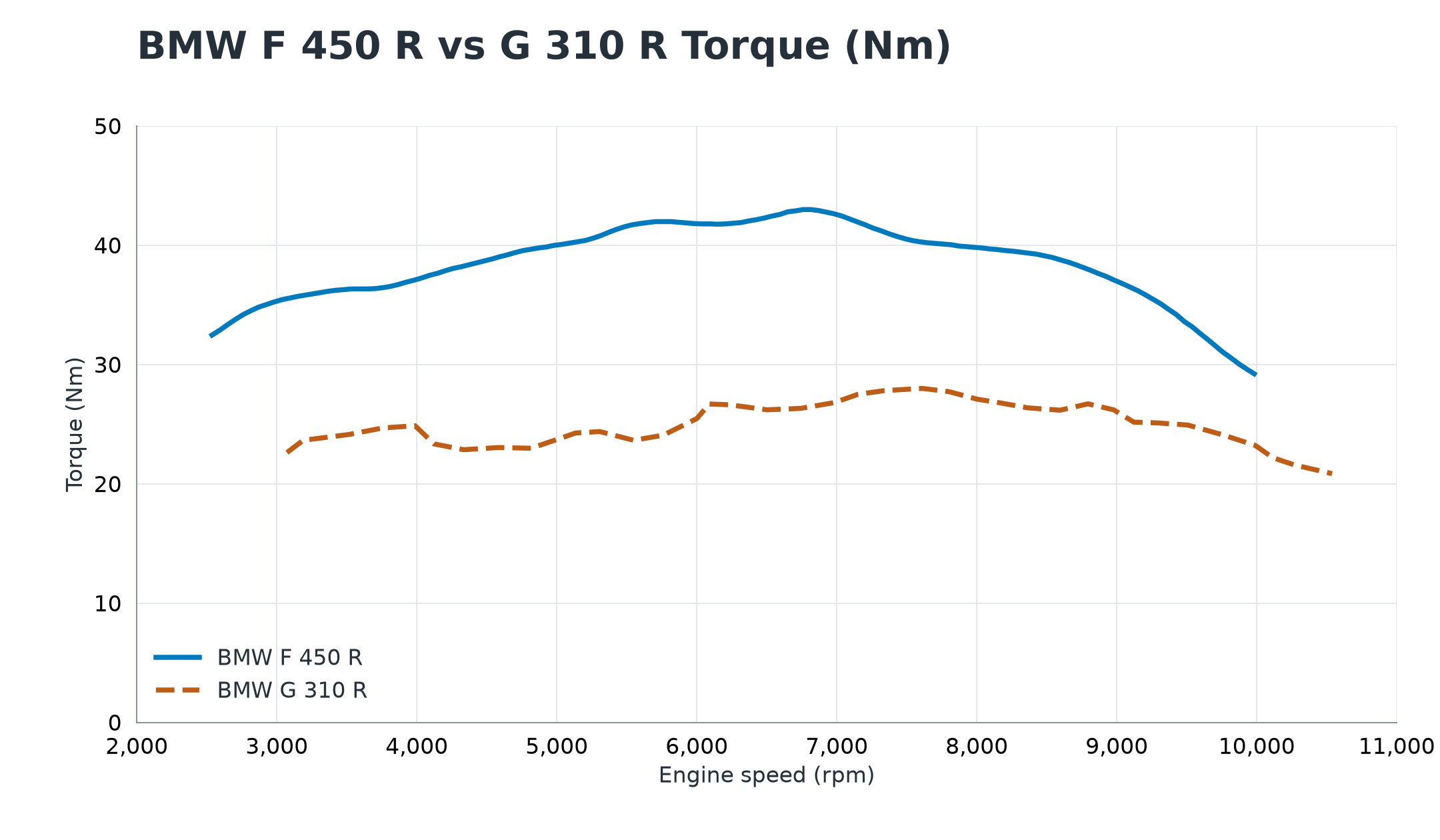
The F curve comes from BMW’s supplied engine-output graph. The G curve comes from Motorcycle Consumer News’ May 2018 rear-wheel dyno test, page 23. I multiplied the digitized G torque values by 1.0527: BMW’s 28 Nm (21 lb-ft) crank peak divided by the plotted 26.60 Nm (20 lb-ft) wheel peak. This estimates the G’s crank torque curve while preserving its shape; it doesn’t measure drivetrain losses at each engine speed.
The F’s broad torque plateau starts early, while the G climbs to its strongest region much later. The published peaks are 43 Nm (32 lb-ft) and 28 Nm (21 lb-ft), a difference of about 54%.
Who each bike suits: City riding, learning and longer trips
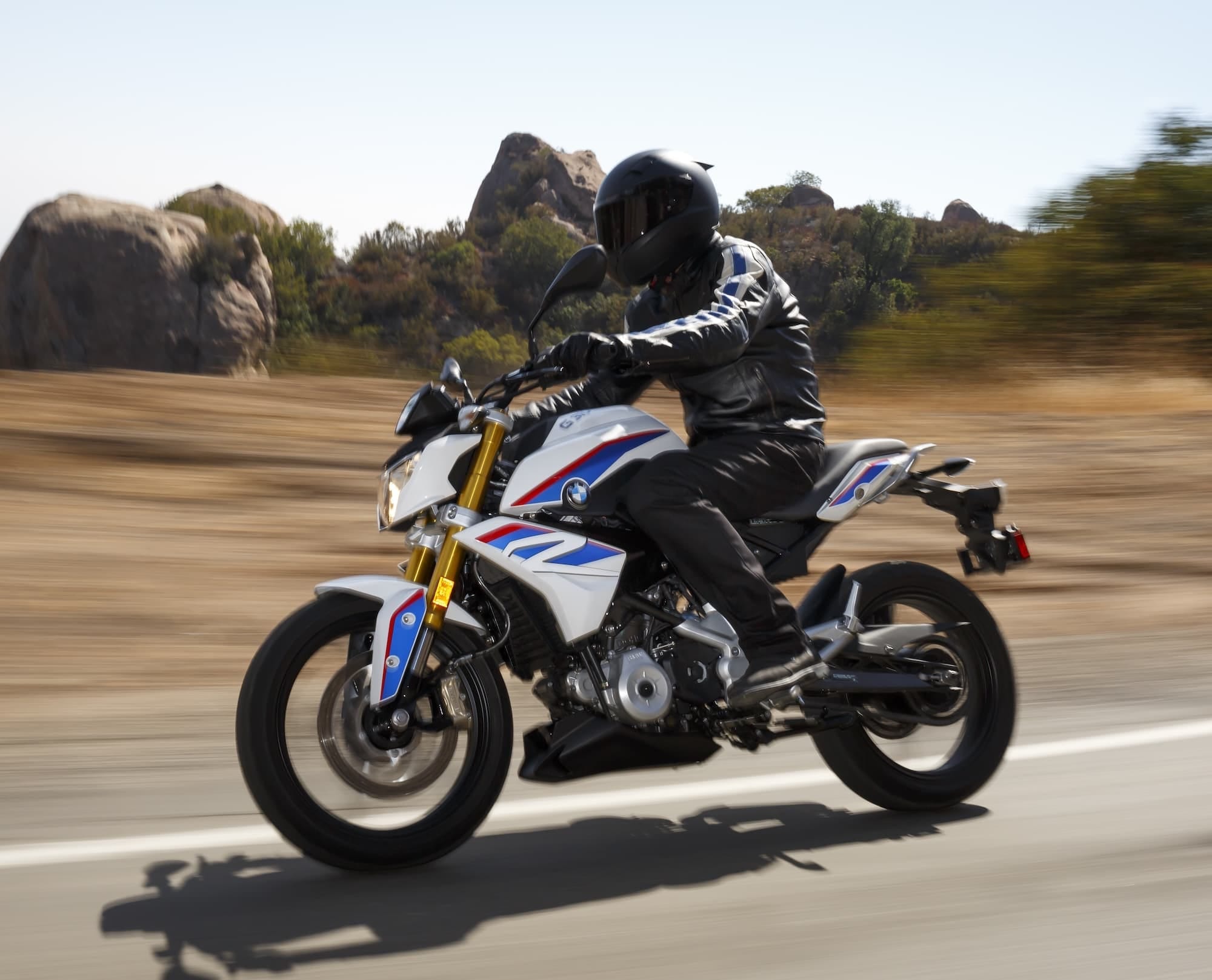
For a first bike, the G’s lighter weight is an advantage when you’re pushing it out of a parking spot or catching a wobble at walking pace. A cheaper used bike can also leave more of your budget for training, riding gear and the first service.
BMW targets the F at the 35 kW European A2 class, so it gives you its full advertised output without a restricted larger engine. Local learner approval is a separate check: confirm the exact model’s eligibility where you ride.
The F’s additional low-rpm torque may make normal riding less busy, while its electronic assistance adds a stronger argument for buying new. More output also asks for a more measured throttle hand. I’d put time spent practising slow-speed control ahead of learning every dash menu.
For city commuting, either has the right basic shape: upright bars, little bodywork and 17-inch road wheels. The F’s optional Easy Ride Clutch is especially relevant if your commute includes constant stops. The G’s conventional clutch may be all you need if traffic keeps moving.
For longer rides, the F has a larger 14 L (3.7 US gal) tank, compared with the G’s 11 L (2.9 US gal). BMW claims more than 350 km (217 miles) from the F at its stated consumption. Wind, speed and how much fuel you leave in reserve will change that.
The F also has more engine output available for acceleration at road speeds. I’d favour it if your regular riding includes faster roads or carrying a passenger. Both remain unfaired motorcycles, so neither engine change nor a larger tank removes the wind load on your chest.
Don’t assume the small rear seat is comfortable just because there’s enough engine to carry a passenger. Try the actual motorcycle together. A G 310 R owner who reported two years of daily riding in Pune liked the rider comfort but found the pillion seat painful even on short rides; that’s an individual experience, but a reason to check before buying.
Brakes, suspension and electronics
The G already has a 300 mm (11.8 in) front disc and a radial four-piston caliper. BMW gives the F a 310 mm (12.2 in) disc and a Brembo four-piston monobloc caliper. The extra 10 mm (0.4 in) of disc diameter alone doesn’t prove a shorter stopping distance: tyres, surface grip and how you apply the brake still matter.
The larger change is standard ABS Pro. BMW’s cornering ABS adjusts intervention for the motorcycle’s lean angle, whereas the G’s ABS has no lean-angle input. I’ve explained BMW’s terminology in Race ABS vs ABS Pro.
BMW also gives the F Dynamic Traction Control, engine drag-torque control and Dynamic Brake Control. Traction control helps manage rear-wheel slip under power; drag-torque control addresses slip during deceleration; brake control reduces unintended throttle input during braking.
Rain, Road and Dynamic modes come standard. Riding Modes Pro adds an individually configurable Dynamic Pro mode on the higher-spec versions. The G has no riding modes or traction control, so there’s considerably less setup to think about.
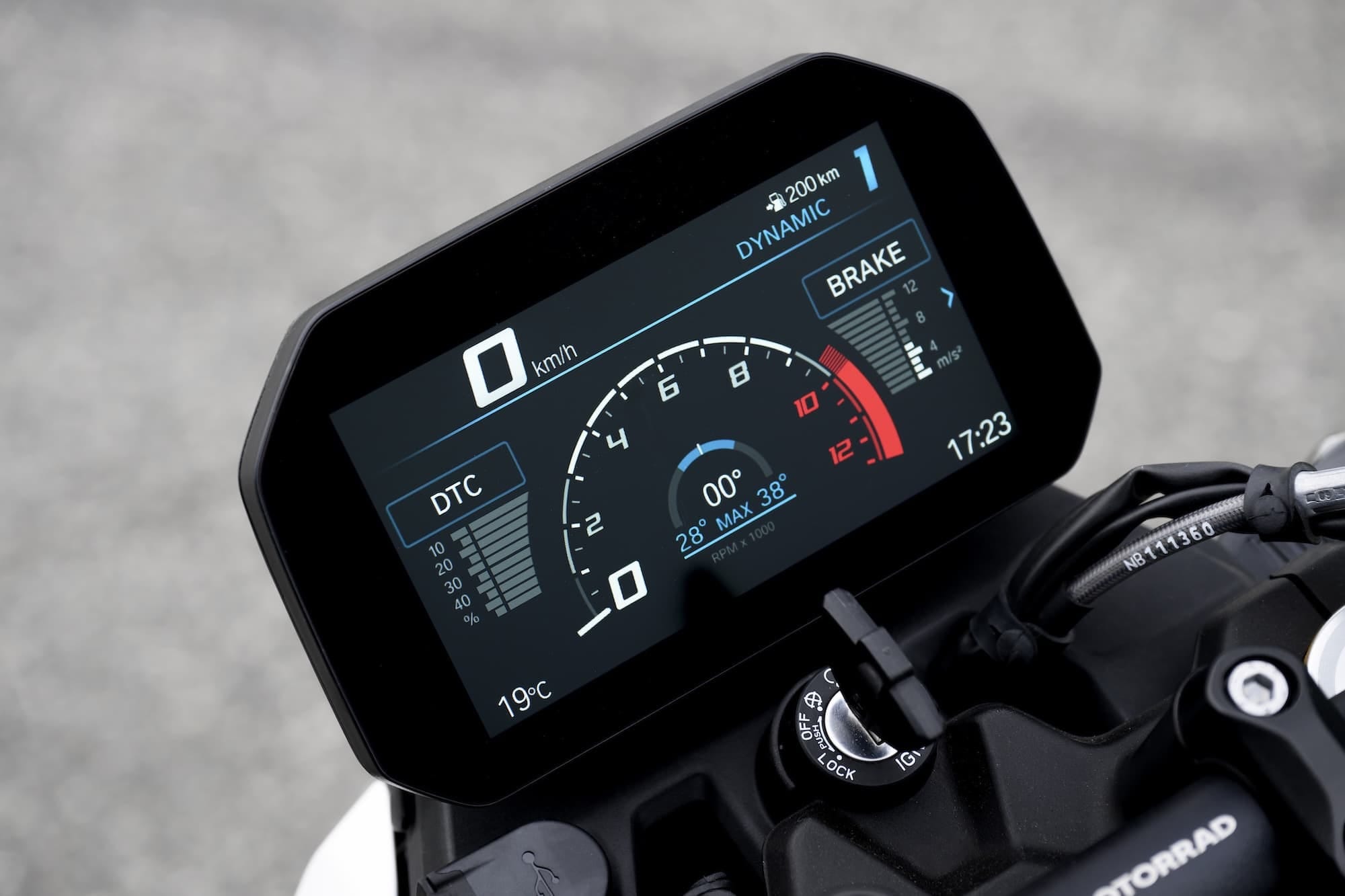
The F’s 6.5-inch TFT replaces the G’s basic LCD. BMW includes heated grips and a USB-C socket in the global launch equipment list. If you commute through cold mornings, I’d put the heated grips ahead of the display’s ability to show your maximum lean angle.
The G’s 41 mm (1.61 in) upside-down fork has no external adjustment; the rear shock lets you adjust spring preload. The F moves to a 43 mm (1.69 in) KYB fork, with adjustable fork damping in the Sport suspension package, and rear spring preload and rebound adjustment. Fork adjusters let you change damping behaviour, but setting them up for your weight and roads takes more than selecting the most expensive version.
Which F 450 R version has what?
BMW offers four F 450 R versions. This table shows the standard equipment and what each higher trim adds.
| F 450 R version | Launch equipment |
|---|---|
| Base | Cosmic Black; standard electronics and display |
| Exclusive | Adds Shift Assistant Pro and Sport suspension |
| M Sport | Adds Riding Modes Pro and M Sport finish; includes quickshifter and Sport suspension |
| M Sport with Innovation Package | Adds Easy Ride Clutch to the M Sport equipment |
Those are the packages in BMW’s global launch summary. Confirm the equipment on the actual bike in your market, especially the quickshifter and Sport suspension. A white M Sport press photo doesn’t represent the equipment of every F 450 R.
Easy Ride Clutch: You still choose the gears
The optional Easy Ride Clutch (ERC) uses a centrifugal mechanism to engage the clutch according to engine speed. You can pull away and stop without working the clutch lever; with Shift Assistant Pro, you can also change gears without using that lever.
You still select gears with the foot lever. The clutch lever stays on the handlebar for manual intervention, and BMW says the system preserves engine braking until shortly before you stop. It’s worth understanding that behaviour before deciding whether it suits your riding.
BMW offers ERC from the factory with the M Sport Innovation Package and lists retrofit availability for other variants. It adds 1 kg (2 lb), bringing the listed road-ready weight to 176 kg (388 lb). I’d consider it for heavy traffic, or if operating a clutch lever makes riding tiring.
Reliability and maintenance: What we know, and what I’d expect
The G has a long enough ownership history to research individual faults and actual service bills. The F 450 R has just been announced, so its reliability case rests on design information and the newer engine family’s early history. I wouldn’t give either bike a reliability score from its badge or cylinder count.
G 310 R: Check recalls and the 20,000 km service
Two documented recalls deserve attention when buying an older G. BMW addressed the side-stand support in US campaign 18V-408, and brake-caliper corrosion in campaign 19V-593, which covered certain 2017–2020 G 310 R motorcycles. BMW’s brake remedy included replacing the calipers.
Ask a BMW dealer to check the VIN and confirm completed work. Those campaigns identify faults on specified bikes; they don’t establish that every G suffers them or tell us how often an unrelated engine problem occurs.
The March 2020 G 310 R rider’s manual schedules oil and filter changes every 10,000 km (6,200 miles) or annually. At 20,000 km (12,400 miles), it calls for checking valve clearances and replacing the spark plug, air filter and fork oil. It also sets time-based brake-fluid and hose requirements.
That makes the service record particularly important on a used bike approaching 20,000 km. A seller saying it has had oil changes doesn’t establish that someone checked the valves. Get a quote for outstanding work and include it in the purchase cost.
Owner reports also warn against treating a small BMW as a cheap motorcycle to service. The Pune owner mentioned above reported first and second services costing ₹7,000 and ₹10,000 in their March 2025 account, while praising their dealer’s service quality. Those are individual historical bills in India, rather than a quote for your dealer.
My used-bike checks would include a cold start, signs of coolant or oil leaks, battery condition, normal brake operation and the chain’s condition. I’d also inspect fork seals and look for damage from falls. Those checks apply to any used motorcycle; the G’s documented recall status belongs on the same list.
F 450 R: A service interval, but no long-term verdict
BMW specifies a 10,000 km (6,200 mile) service interval for the F 450 R. Its launch material doesn’t give the complete maintenance schedule or a confirmed valve-clearance interval. I wouldn’t copy the G’s 20,000 km valve interval into an F ownership budget.
The F has eight valves to the G’s four. My expectation is that checking or adjusting the twin’s valves could involve more labour, but access, the adjustment method and the eventual interval will determine the bill. Twice the valves doesn’t mean twice the total service cost.
Both bikes have chain final drive, so you still have chain cleaning, lubrication and adjustment to do. Both also have coolant, tyres and brake-fluid maintenance. The F’s extra electronics don’t automatically create more scheduled work, though a faulty sensor or display could add repair cost after the warranty.
ERC adds another mechanism to understand and maintain. BMW hasn’t supplied enough long-term owner data to compare its repair costs with the conventional clutch. I’d ask for the official service requirements and warranty coverage before buying that option, especially if I planned to keep the bike for many years.
I expect the F’s broader torque delivery to reduce how often a rider needs to chase high rpm in everyday traffic. That is an expectation from the curve, not evidence that the engine will outlast the G. High revs within an engine’s intended operating range aren’t a fault.
For either bike, I’d get prices for the annual service and the first major service before signing. Our guide to motorcycle maintenance explains the routine checks you can keep on top of between dealer visits.
Which would I buy?
I’d buy a 2021-onward G 310 R if I found a clean example at a substantial saving, mainly rode in town and wanted a straightforward motorcycle to learn on. I’d want service invoices, completed recalls where applicable and enough left in the budget for the next scheduled work.
I’d choose the F 450 R if I wanted to keep a small BMW through several years of mixed riding. The stronger midrange and standard cornering ABS are the changes I’d pay for; I’d choose the trim according to whether I actually wanted a quickshifter, suspension adjustment or ERC.
If you already own a G and mostly ride short city trips, there’s no specification here that obliges you to replace it. If you regularly find yourself planning every overtake around the G’s rev range, the F’s engine addresses that limit directly.
For a first-year F purchase, I’d accept that I’m buying before a long ownership record exists. If that uncertainty bothers you, waiting for the full maintenance schedule and early owners’ reports is a sensible choice. A good used G gives you a way to ride in the meantime.