
So, you’re looking for a motorcycle on which you don’t have to constantly shift gears.
Let’s get one thing out of the way — this is a judgment-free zone. There are tons of vehicles that don’t need shifting. Nearly all cars these days are sold with automatic transmissions, and plenty of them are high performance. Racing vehicles have paddle shifters or some other thing more convenient than a foot actuator. And in motorcycles, quickshifters are considered a notable item.
But “automatic” for a motorcycle can mean different things. On one bike it may operate only the clutch, on another it may operate the clutch and the gearshift, and a third may have a transmission that is fundamentally different from a conventional six-speed gearbox.
What kind of transmission you have determines whether you still use a gear pedal, whether there is a clutch lever, how the bike behaves in a car park, what happens on a steep hill, and which extra parts may eventually need attention. That’s what I’ll go over in this guide.
The short answer: E-Clutch and centrifugal auto-clutches operate the clutch but leave gear choice to you. Yamaha Y-AMT, BMW ASA, KTM AMT, and Honda DCT can choose gears automatically or accept manual requests. A CVT has no fixed gears to choose.
- What counts as an automatic motorcycle transmission?
- Honda E-Clutch
- Rekluse, MV Agusta SCS, BMW ERC, and Honda Cub
- Yamaha Y-AMT, BMW ASA, and KTM AMT
- Honda DCT
- CVTs and earlier automatics
- System-by-system comparison
- What they feel like to ride
- Servicing and possible failure points
- Which system gives you the controls you want?
Are you obsessed with motorcycles?
Well, I am. That’s why I created this site — as an outlet. I love learning and sharing what others might find useful. If you like what you read here, and you’re a fraction as obsessed as I am, you might like to know when I’ve published more. (Check the latest for an idea of what you’ll see.)
What counts as an automatic motorcycle transmission?
A normal manual motorcycle asks the rider to do two separate jobs: control the clutch and choose the gear. A quickshifter helps with one part of a shift by briefly reducing engine torque, but it doesn’t operate the clutch at a stop, nor does it decide when to change gear. It’s still a manual transmission.
| Type | Clutch control | Gear choice | Typical rider controls |
|---|---|---|---|
| Manual + quickshifter | Rider | Rider | Clutch lever and gear pedal |
| Automated clutch | Bike or rider | Rider | Usually clutch lever and gear pedal |
| Centrifugal auto-clutch | Engine speed, with variations by system | Rider | Gear pedal; lever may be retained |
| Automated manual | Bike | Bike or rider | Buttons, paddle, or electronic gear pedal |
| Dual-clutch transmission | Bike | Bike or rider | Buttons or paddle |
| CVT | Bike | Continuously variable | Throttle and brakes |
The first two assisted types still use the familiar clutch, shafts, selector drum, forks, and fixed gear pairs of a normal motorcycle transmission. The automation is attached around that hardware. DCT and CVT change the mechanical layout itself.
Honda E-Clutch: automatic clutch, manual gear choice
Honda E-Clutch is the narrowest form of factory automation in this comparison. The rider still selects every gear with the foot lever. The motorcycle operates the clutch during starts, stops, and shifts, using two electric motors and a reduction-gear mechanism mounted beside a conventional clutch.
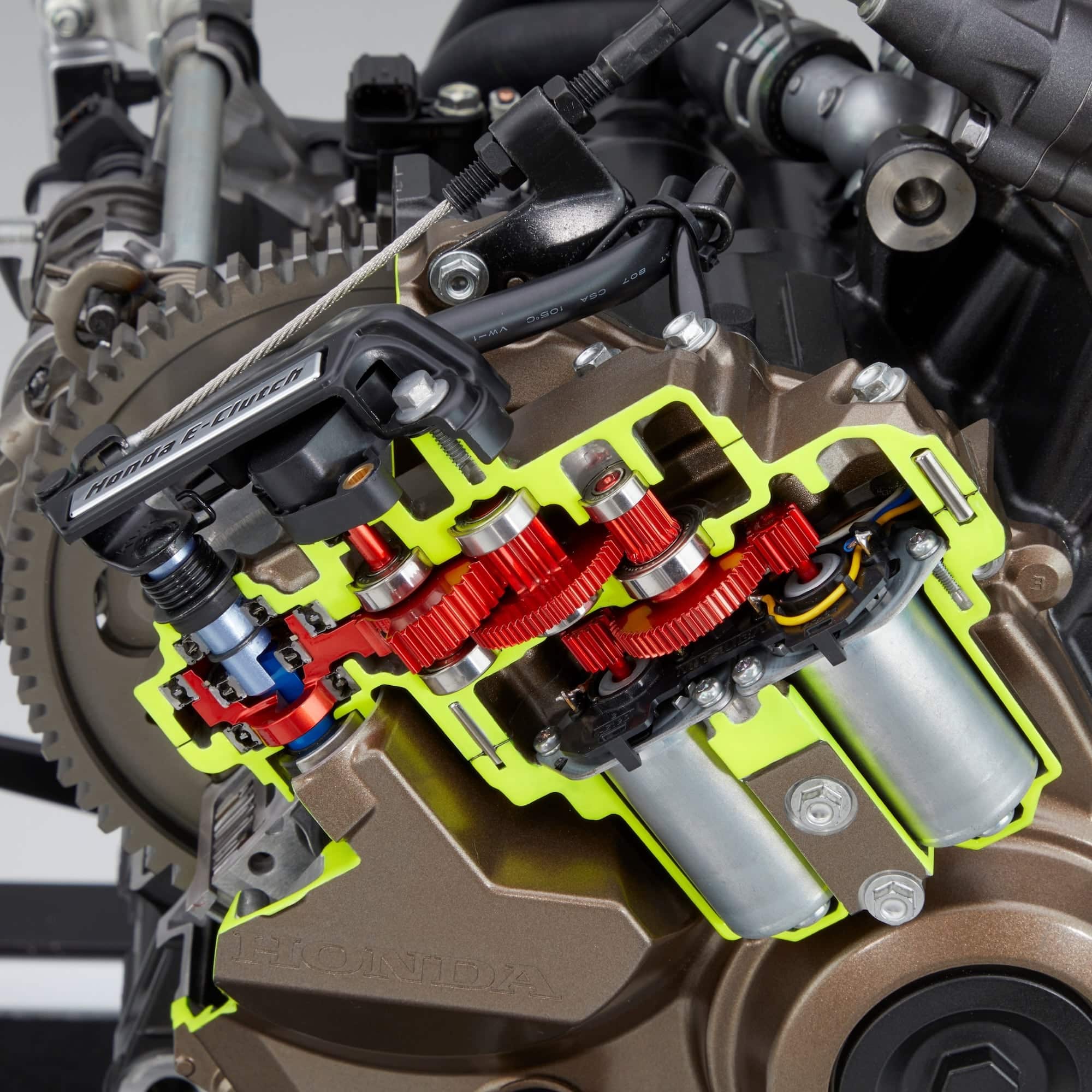
The clutch lever stays connected and takes priority when the rider pulls it. That makes E-Clutch easy to understand if you already ride a manual bike: you can ignore the lever in traffic, but use it for a deliberate launch, a tight turn, or whenever you want direct control. The system also allows the engine to stall if you stop in the wrong gear with the automation switched off, just as a manual bike would.
E-Clutch physically controls the clutch during starts, stops, and shifts; a quickshifter only manages a short torque interruption during a shift. DCT also chooses and executes gear changes, which E-Clutch doesn’t do. Honda’s own technical explanation shows how throttle position, engine speed, wheel speed, gear position, and shift-pedal input inform the clutch control.
Centrifugal auto-clutches: Rekluse, MV Agusta SCS, BMW ERC, and Honda Cub
A centrifugal auto-clutch solves the same basic low-speed problem without electric motors moving the clutch pack. Weighted elements respond to engine speed. At low rpm the clutch can disengage, helping the engine idle without stalling; as rpm rises, the expanding mechanism applies the clutch pack.
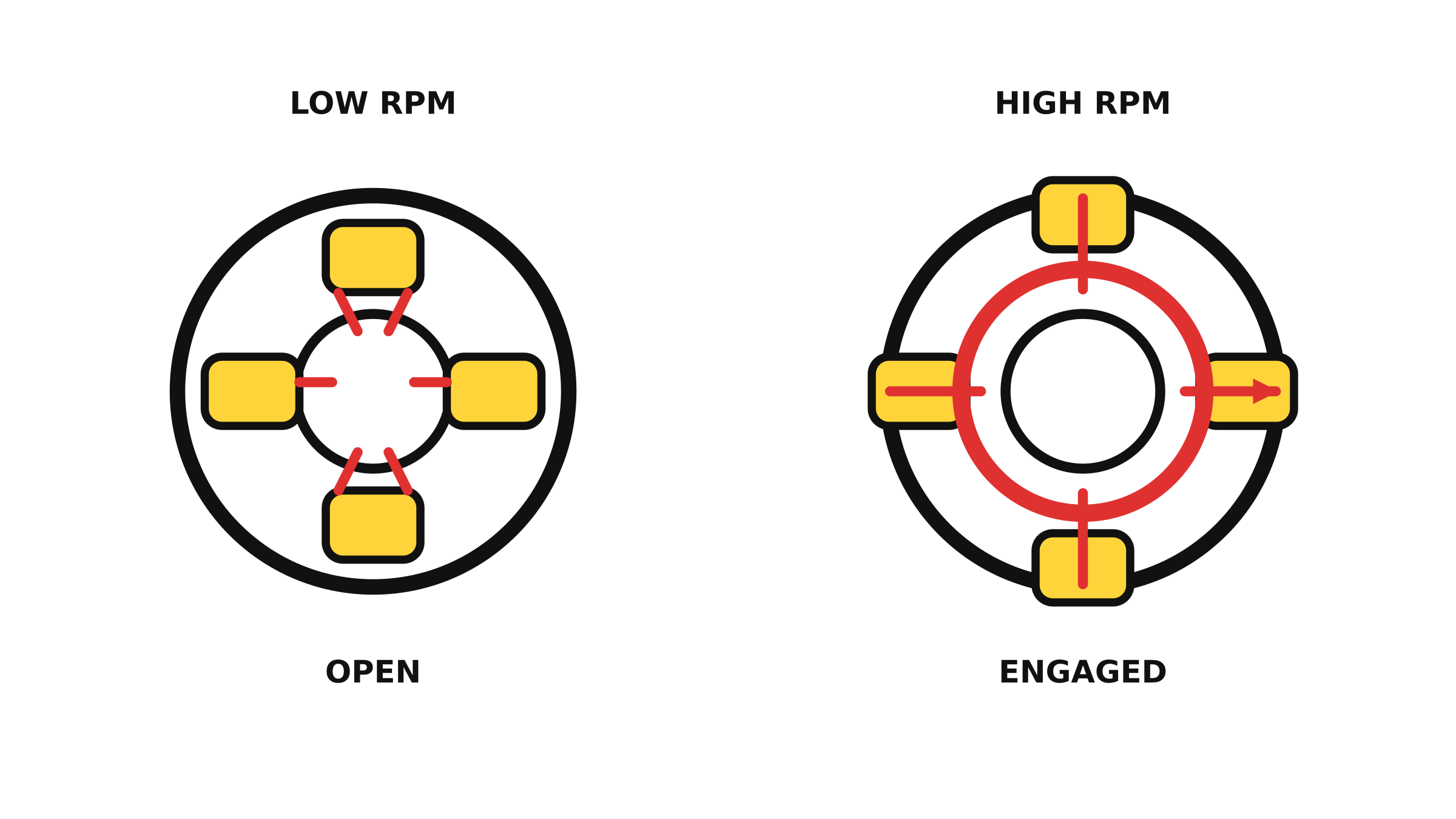
Rekluse is the familiar aftermarket example. Its EXP disk expands with rpm, allowing starts and stops without clutch-lever use while retaining the lever on compatible installations. Engagement speed and feel can be tuned, and correct free-play setup is important. Rekluse explains the mechanism in its auto-clutch technical guide.
MV Agusta SCS integrates a Rekluse-derived centrifugal clutch into a factory package. The rider still chooses gears with the pedal, while the quickshifter handles clutchless changes once moving. SCS therefore belongs beside E-Clutch in a control chart—automatic clutch, manual gear choice—even though it reaches that result mechanically rather than through clutch actuators.
BMW Easy Ride Clutch (ERC) is another factory centrifugal design, introduced on the F 450 GS. BMW says it stays engaged on overrun to retain engine braking until speed approaches idle, and it keeps a clutch lever for manual override. That detail is important: “centrifugal clutch” describes a family, not one identical response in every bike.
Honda Super Cub shows how old the idea is. Its automatic centrifugal clutch removes the lever, but the rider still steps through four gears. The original Super Cub brought this easy-to-use arrangement to mass production in 1958. It is an automatic clutch motorcycle, not a twist-and-go CVT scooter.
Yamaha Y-AMT, BMW ASA, and KTM AMT: automated manuals
An automated manual transmission keeps a conventional set of fixed gears, but actuators take over both clutch operation and gear selection. The control unit can choose shift timing in an automatic mode, or accept a request from the rider in a manual mode.
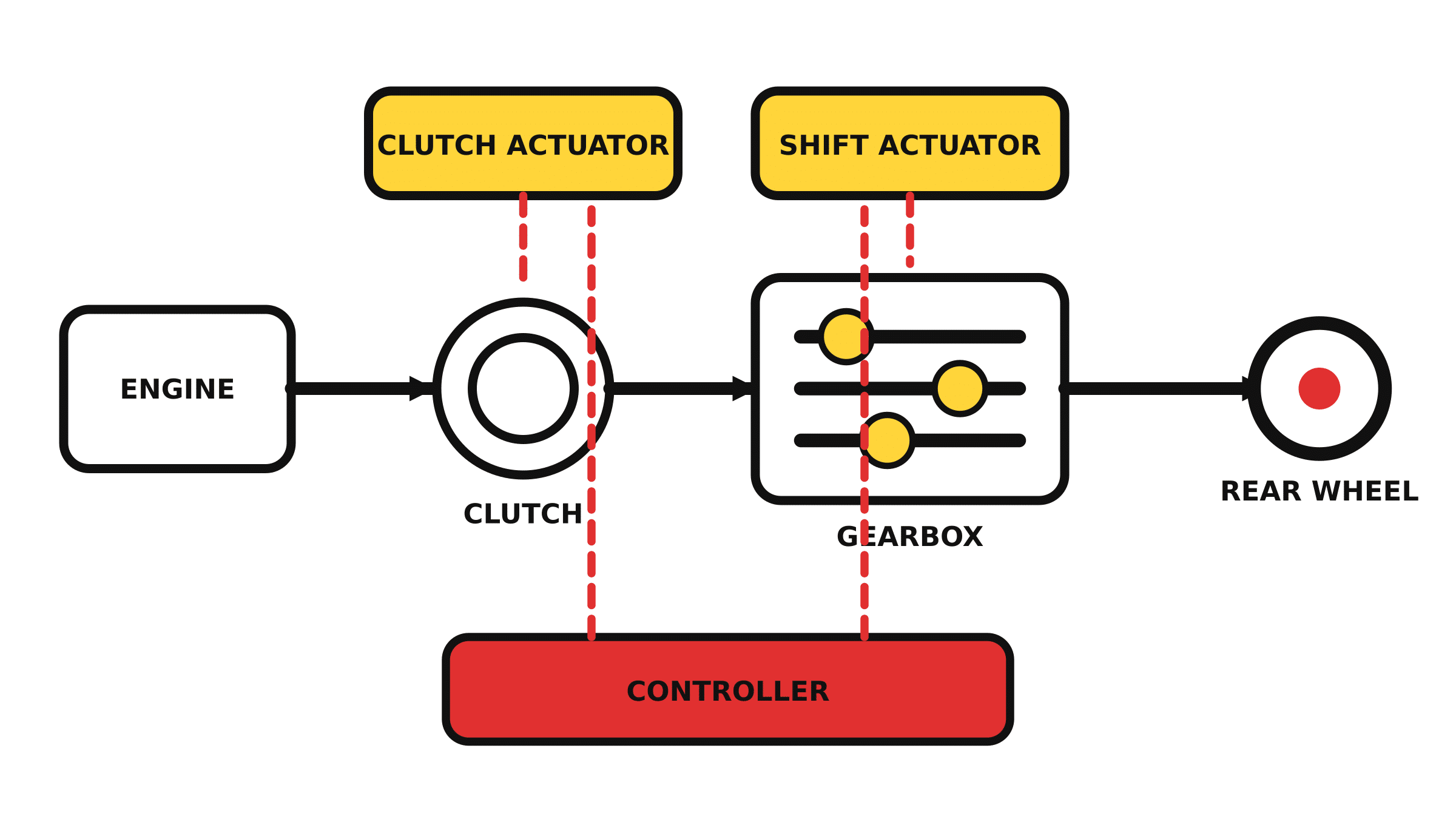
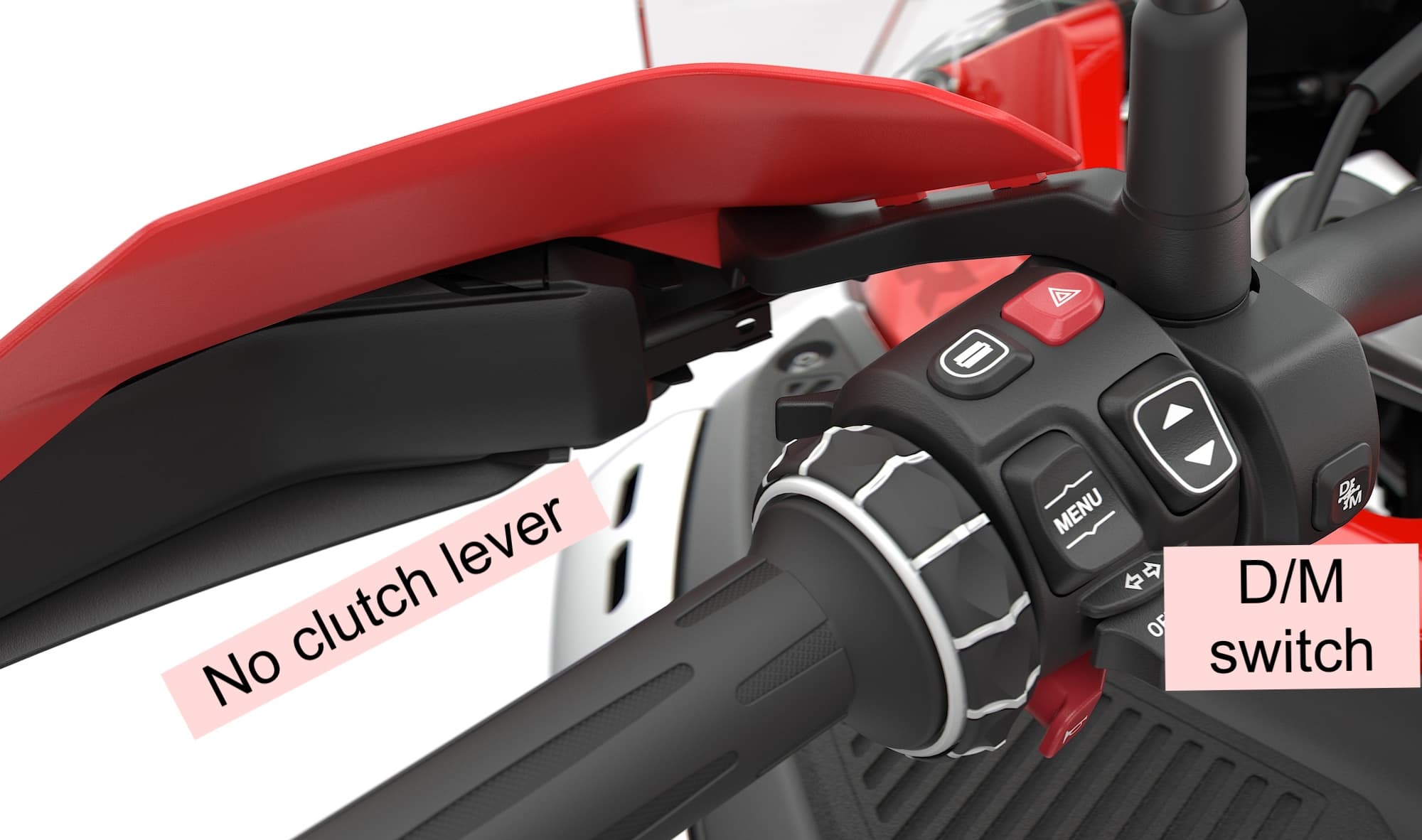
Yamaha Y-AMT uses one actuator for the clutch and another for the shift mechanism. There is no clutch lever or foot shifter. The rider can request gears with a handlebar-mounted finger-and-thumb switch in MT mode, or let the bike choose in AT mode. Yamaha developed it from the earlier YCC-S system, but Y-AMT uses a more compact actuator arrangement and current electronic inputs. The current application also brings the system into the orbit of Yamaha’s familiar CP3 engine and Tracer 9.
BMW Automated Shift Assistant (ASA) also uses two electromechanical actuators. One works through a hydraulic circuit to control the clutch; the other moves the transmission selector. There is no clutch lever, but BMW retains a foot lever. It is an electronic request input rather than a direct mechanical connection to the shift drum. M mode follows the rider’s requests, while D mode chooses gears automatically.
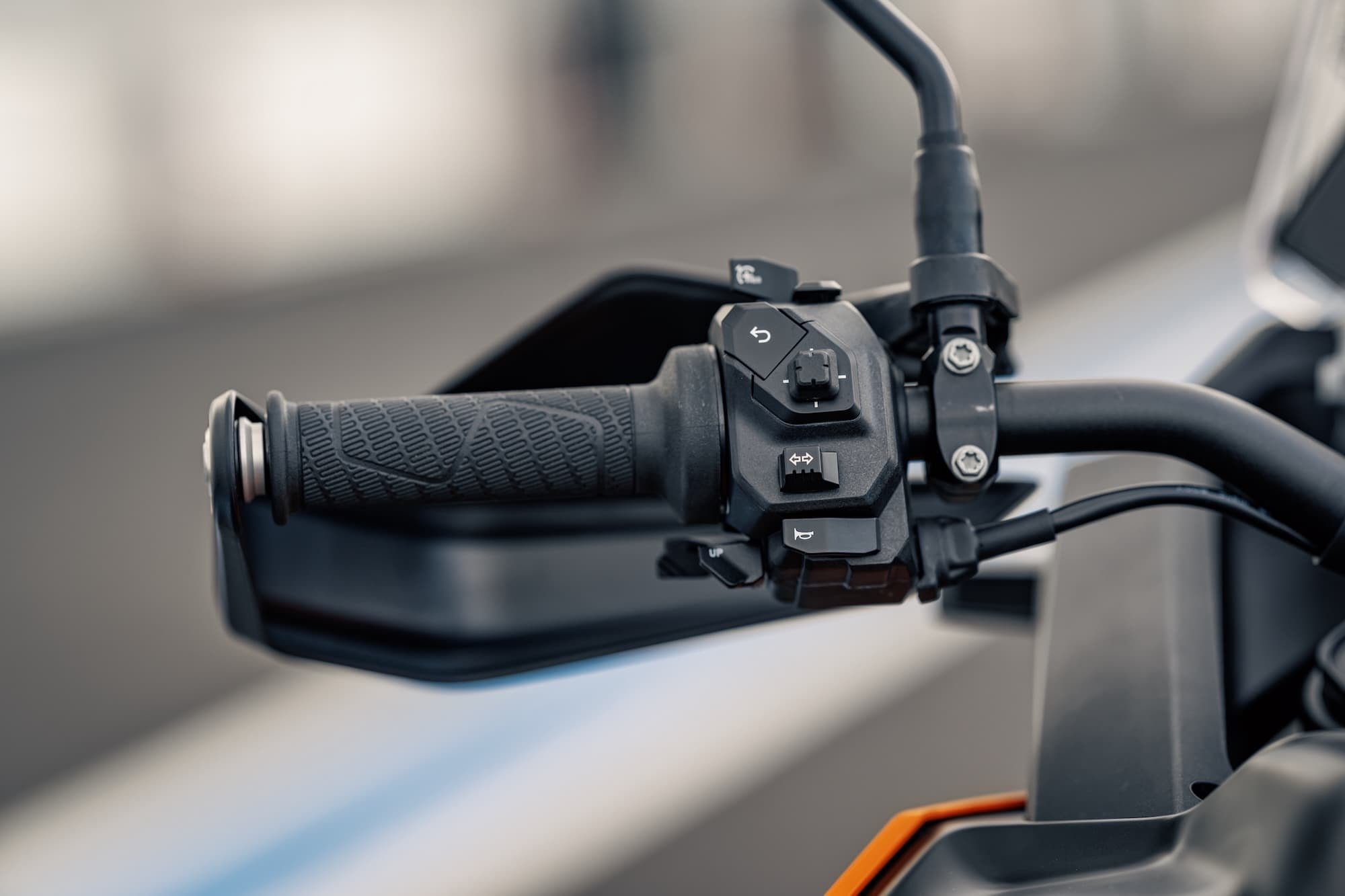
KTM AMT is grouped with those systems because it can choose and execute shifts, but its clutch hardware is different. A centrifugal clutch handles starts and stops, while an electromechanical actuator moves the gearbox. The rider can use handlebar paddles or a foot lever, or choose an automatic mode. KTM quotes a 50-millisecond shift operation under suitable conditions.
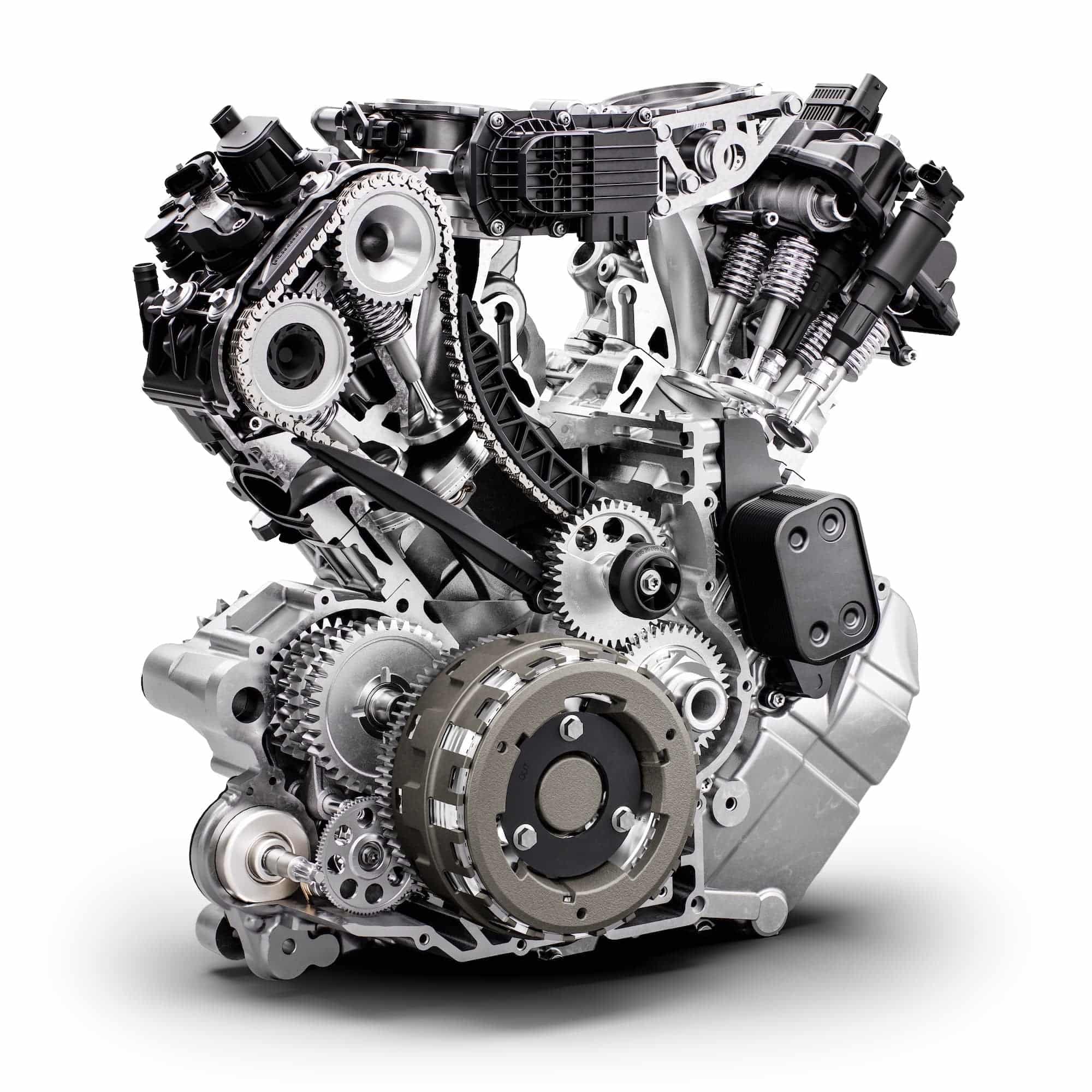
KTM also adds a Park position and locking pawl for a mechanical reason. The centrifugal clutch is open when the engine is stopped, so leaving the transmission in gear wouldn’t reliably hold the motorcycle on a slope. The shift order is P–N–1–2–3–4–5–6.
Honda DCT: the different mechanical solution
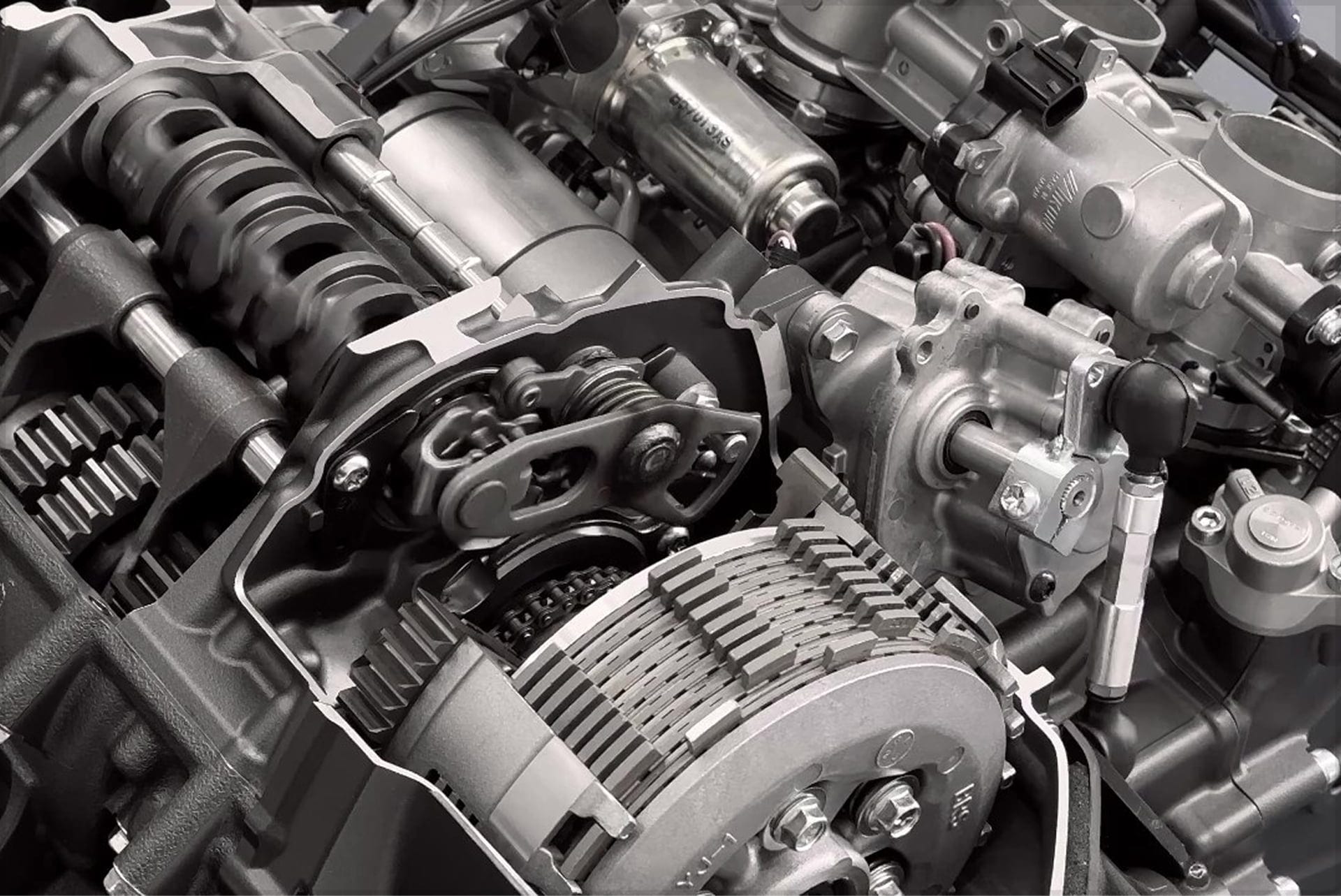
Honda Dual Clutch Transmission uses two clutches and two concentric input shafts rather than adding actuators around a conventional gearbox. One path carries odd-numbered gears and the other carries even-numbered gears, allowing the transmission to prepare the next ratio on the shaft that isn’t driving the rear wheel.
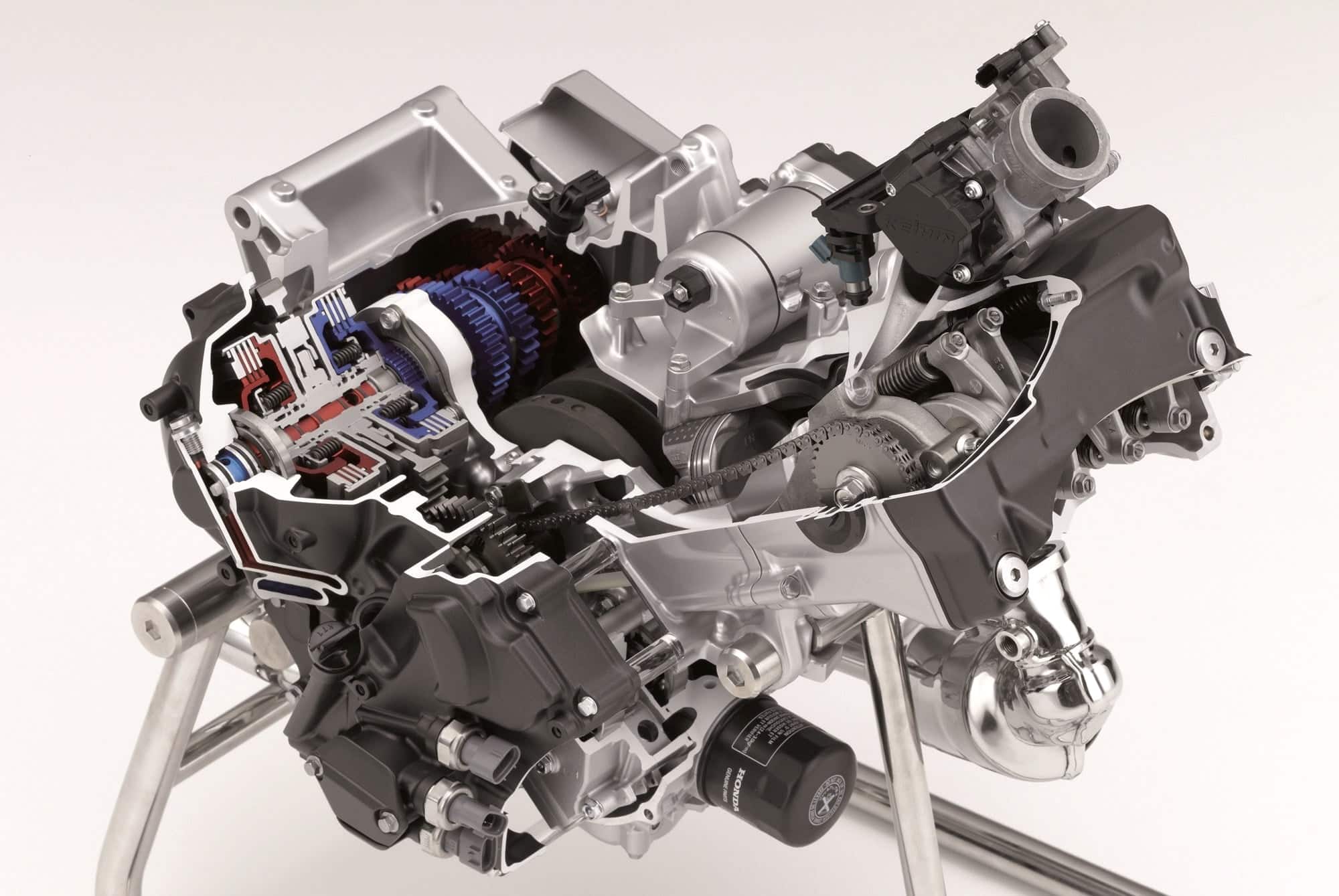
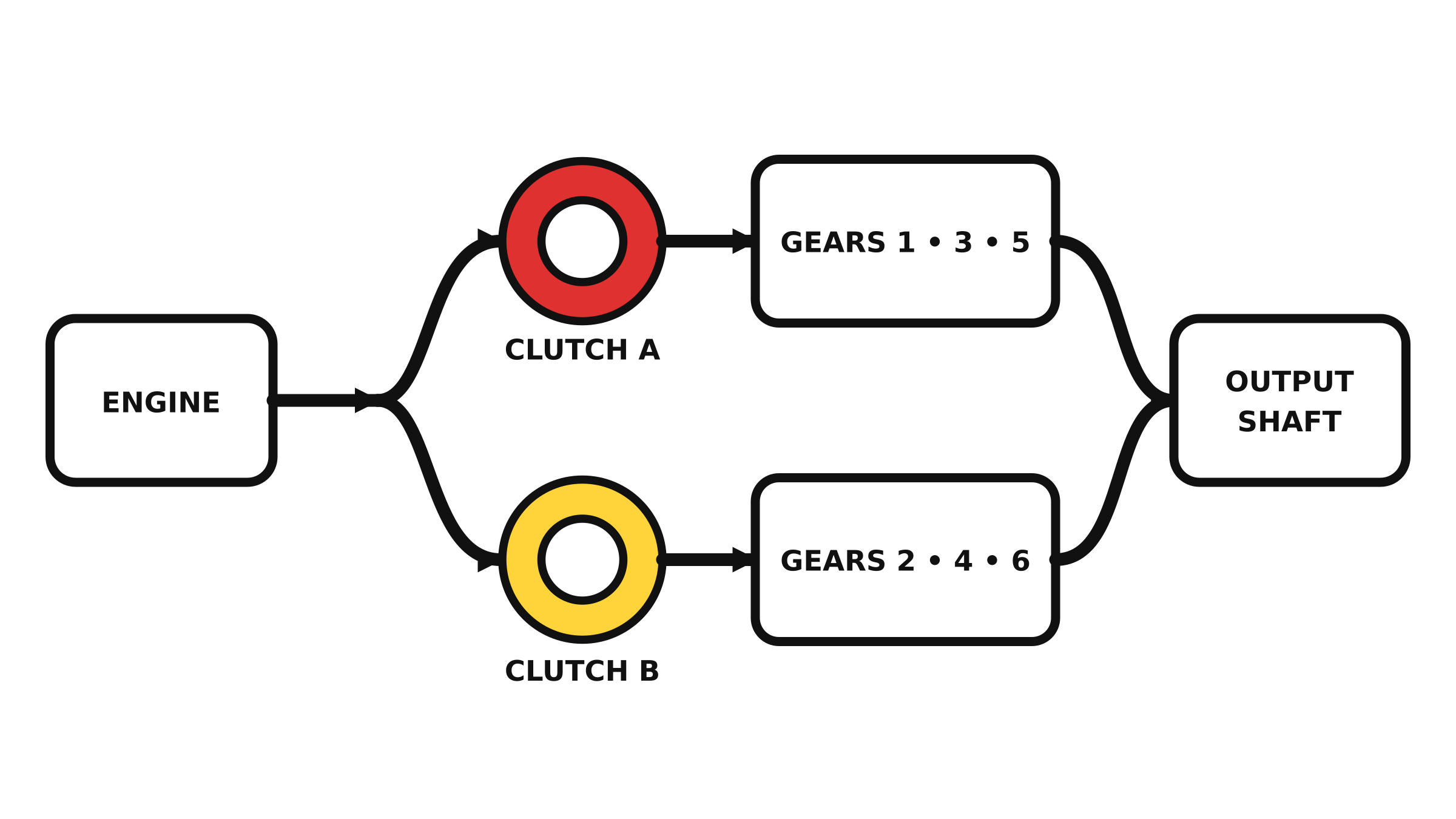
During a change, one clutch releases as the other engages. That overlap gives DCT its characteristic smooth, uninterrupted-feeling acceleration. The rider can select an automatic program or request gears with handlebar switches. There is no clutch lever and normally no foot shifter, although Honda has offered a foot-control accessory on some models.
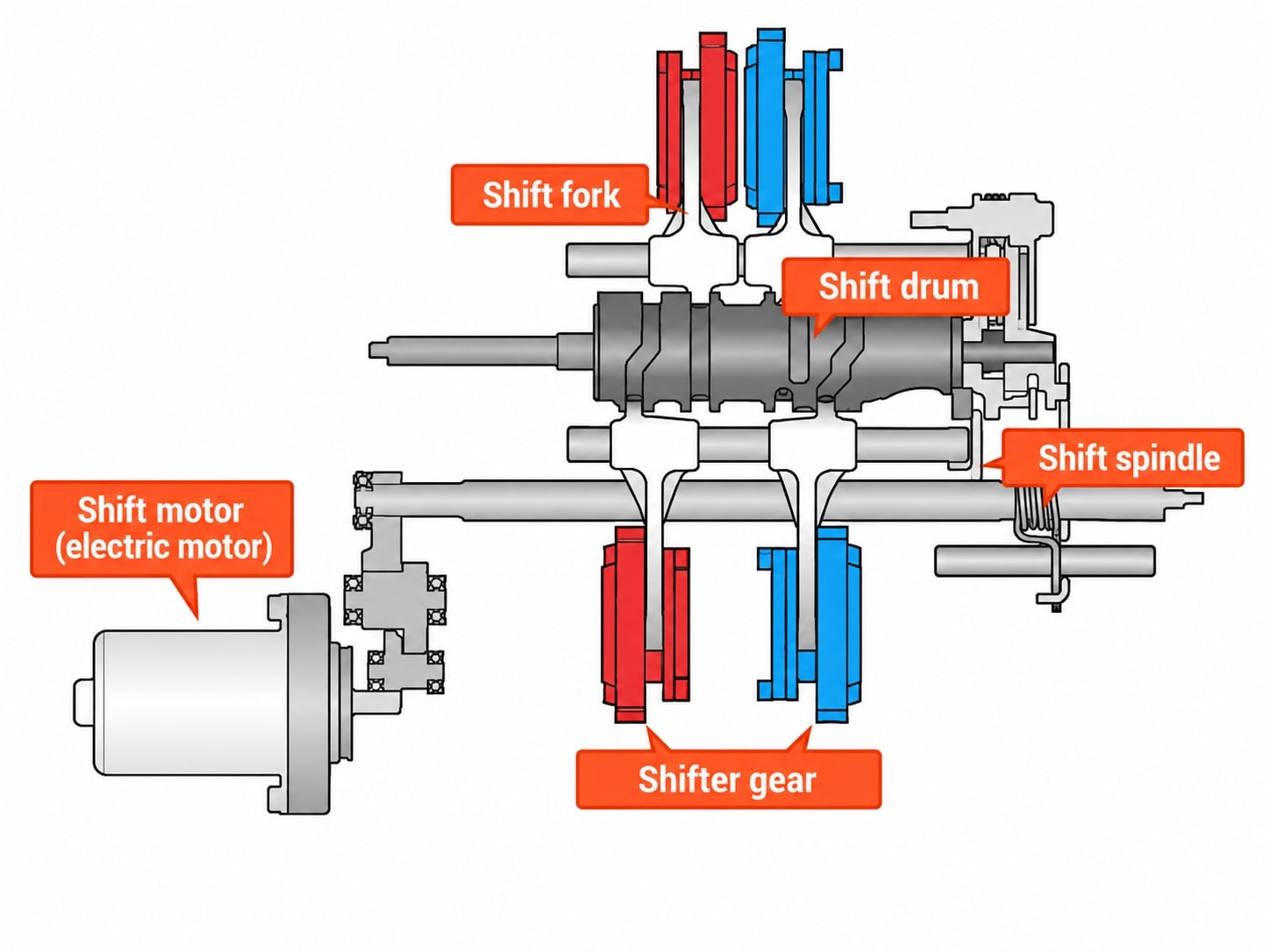
The cutaway below shows the same selector parts packaged beside the gearbox.
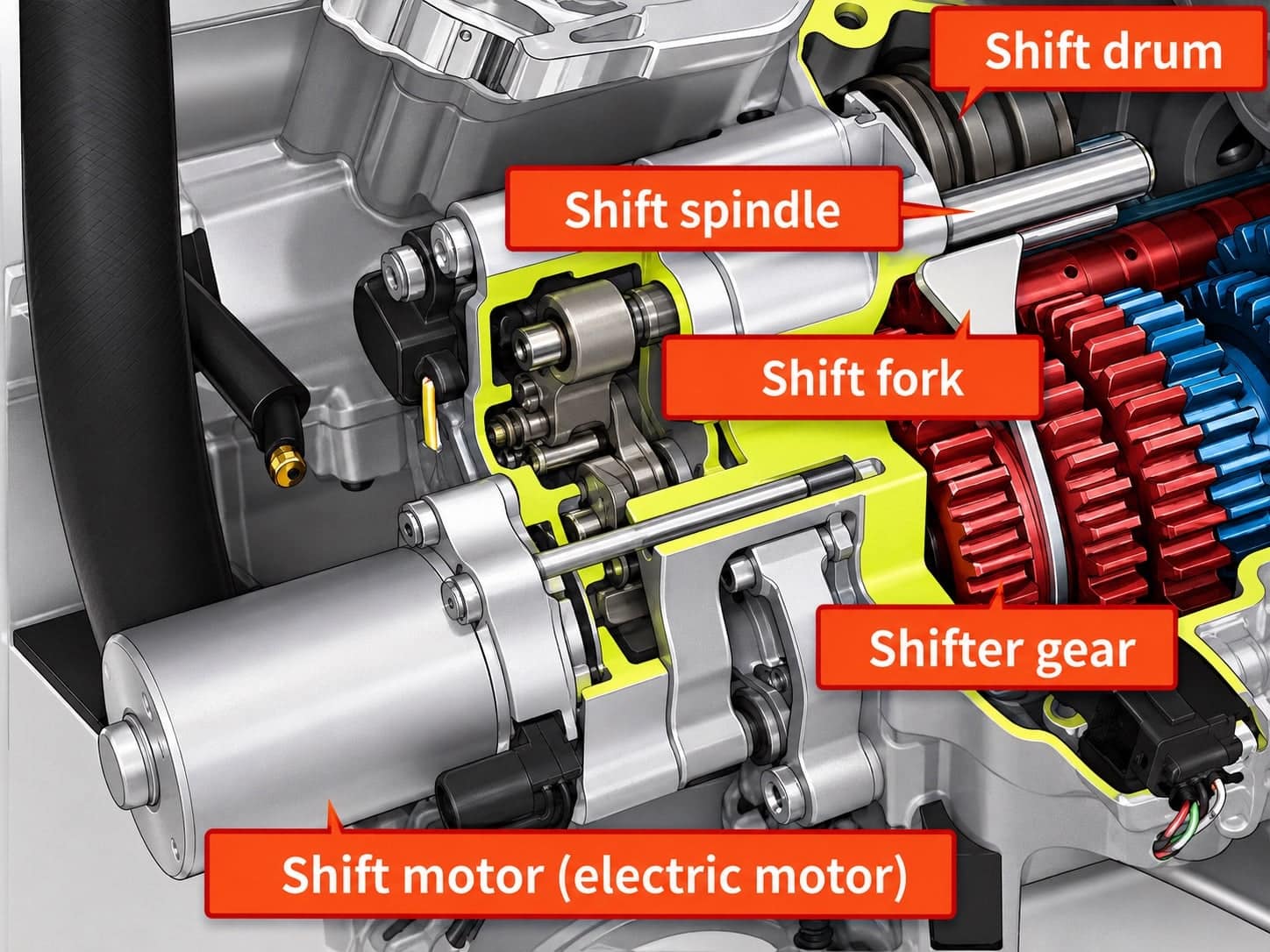
Honda put the first production motorcycle DCT in the VFR1200F for 2010—one of the more unusual branches in the Honda VFR family—and has since used the design across touring, adventure, cruiser, and commuter models. If you are tracing Honda’s other unconventional engine layouts, our guides to Honda Unicam and motorcycle valve-train types explain two more areas where similar-looking engines can work differently inside.
CVTs, Hondamatic, and other genuine automatics
A scooter-style continuously variable transmission doesn’t automagically select first, second, or third. A belt runs between variable-diameter pulleys, changing the drive ratio as the pulley faces move. A separate centrifugal clutch usually connects drive near idle. The engine can stay near an efficient or powerful speed while road speed changes.
That gives the cleanest twist-and-go experience, but its feel and maintenance are unlike a geared motorcycle. Belts, rollers or sliders, pulley faces, and the centrifugal clutch are service items. The Aprilia Mana 850 was a notable large motorcycle with a belt CVT and selectable simulated ratios, while most current examples are scooters.
Motorcycle makers have tried other routes. Honda’s 1960s Juno M used a hydraulic-mechanical continuously variable system. The late-1970s CB750A and CB400A Hondamatic used a torque converter with a manually selected two-speed transmission. The DN-01 later used Honda’s hydraulic HFT system. None is mechanically equivalent to DCT, despite all being described as automatic.
Most electric motorcycles add one more category: a fixed reduction gear with no shiftable transmission. The motor’s wide operating range removes the need for multiple ratios, so “automatic” is technically a loose description.
Automatic motorcycle systems compared
The following table compares what the rider actually controls, rather than grouping every clutch-free launch under one label.
| System | Clutch | Gear decision | Rider input | Mechanical core |
|---|---|---|---|---|
| Honda E-Clutch | Electric actuators or rider | Rider | Gear pedal; optional clutch lever use | Single clutch, conventional gearbox |
| Rekluse auto-clutch | Centrifugal mechanism or rider | Rider | Gear pedal; lever retained | Modified conventional clutch |
| MV Agusta SCS | Centrifugal mechanism | Rider | Gear pedal; quickshifter | Rekluse-derived clutch, conventional gearbox |
| BMW ERC | Centrifugal mechanism or rider | Rider | Gear pedal; lever retained | Factory auto-clutch, conventional gearbox |
| Honda Super Cub | Centrifugal mechanism | Rider | Gear pedal; no clutch lever | Four-speed gearbox |
| Yamaha Y-AMT | Electric actuator | Bike or rider | Handlebar switch | Single clutch, automated selector |
| BMW ASA | Electromechanical/hydraulic actuator | Bike or rider | Electronic foot lever | Single clutch, automated selector |
| KTM AMT | Centrifugal mechanism | Bike or rider | Paddles or electronic foot lever | Auto-clutch, automated selector, Park pawl |
| Honda DCT | Hydraulically controlled dual clutches | Bike or rider | Handlebar switches | Two clutches and two input shafts |
| Scooter CVT | Usually centrifugal | Ratio varies automatically | Throttle only | Belt and variable pulleys |
The main dividing line is who chooses the gear. E-Clutch and centrifugal auto-clutches leave that job to the rider; Y-AMT, ASA, KTM AMT, and DCT can take it over; a CVT removes fixed gear choices entirely.
What each system feels like to ride
In traffic, every assisted system removes repeated clutch-lever work, but only Y-AMT, ASA, AMT, DCT, and CVT can remove gear decisions as well. E-Clutch or a centrifugal auto-clutch feels closer to a normal manual because your left foot still sets the rhythm.
At walking speed, clutch calibration matters more than shift speed. E-Clutch keeps a lever available for precise manual slipping. Rekluse and BMW ERC also retain override levers. On systems without one, the rider controls creep mainly with throttle and rear brake, relying on the software or centrifugal mechanism to meter engagement.
On a winding road, E-Clutch, SCS, and Rekluse leave every gear decision with the rider. Automated manuals and DCT let you choose between manual requests and automatic logic. A good automatic mode can reduce workload; an untimely change can feel more intrusive than a shift you chose yourself. Sport settings generally hold gears longer and react more strongly to throttle position.
Off road, the lever question is personal. Some riders value anti-stall help and fewer control tasks. Others use the clutch lever to adjust rear-wheel torque over a log, soften a hit, or balance at very low speed. An E-Clutch, Rekluse, or ERC arrangement preserves that option. KTM’s AMT foot control may feel familiar, but the pedal sends an electronic request and the centrifugal clutch still decides engagement.
With a passenger, smooth clutch take-up and clean shifts matter more than the label. DCT’s clutch-to-clutch handover is a strong fit for touring. A single-clutch automated manual must briefly unload one gear, select another, and reapply drive; calibration determines how polished that sequence feels.
Weight, servicing, and possible failure points
Sadly, automation doesn’t make the basic gearbox maintenance-free. Oil condition, clutch wear, shift linkage, chain or shaft-drive maintenance, and correct adjustment still matter. It adds hardware and, in most factory systems, software diagnostics.
Here’s a quick overview of the hardware and the maintenance requirement:
- E-Clutch: two motors, reduction gears, sensors, wiring, and a control unit sit around a conventional clutch. Honda quotes roughly 2 kg of added mass for the original system. The mechanical lever provides direct clutch control, but fault behaviour and reset procedures should be checked in the model’s service information rather than assumed.
- Centrifugal auto-clutches: plate condition, heat, engagement setup, and free-play gain can affect behaviour. A bad Rekluse adjustment can cause drag or slip. Factory systems may have their own inspection procedure, and engine-braking behaviour differs by design.
- Y-AMT and BMW ASA: clutch and shift actuators add motors, position feedback, sensors, wiring, and control software. Manual mode still depends on those actuators; the switch or pedal is an electronic command, not a mechanical fallback.
- KTM AMT: the shift actuator and its sensors are added to a centrifugal clutch. The Park mechanism is another mechanical assembly, though it solves the specific problem of holding a stopped bike whose clutch is open.
- DCT: two clutch packs, hydraulic control, shift hardware, sensors, and model-specific filters make it the most mechanically elaborate system here. Follow the service schedule for the exact motorcycle, including any DCT filter and oil procedures.
- CVT: belt, rollers or sliders, pulley surfaces, and clutch shoes or pads are normal wear areas. Service intervals and acceptable belt width are model-specific.
A conventional manual has fewer automation-specific parts, but “more complex” doesn’t necessarily mean “unreliable”. Production volume, software maturity, access to diagnostic tools, parts prices, and previous maintenance all influence ownership. Honda DCT, for example, has been in production since 2010; newer systems have shorter public track records.
Which system gives you the controls you want?
The easiest way to choose is to start with what you want your left hand and left foot to do.
Want your motorcycle to do all the shifting for you? Look for Honda DCT, Yamaha Y-AMT, BMW ASA, KTM AMT, or a CVT. The first four can choose fixed gears automatically and also offer some form of manual selection. A CVT has no fixed gears for either you or the motorcycle to select.
Still want to choose every gear with your foot? Honda E-Clutch, Rekluse, MV Agusta SCS, BMW Easy Ride Clutch, and the Honda Super Cub all leave gear choice to the rider. They automate clutch engagement to different degrees, but they do not decide when to shift.
Want to shift manually with your hands, but have a full automatic mode as well? Honda DCT and Yamaha Y-AMT use handlebar controls for manual requests. KTM AMT adds handlebar paddles and also accepts shifts from a foot lever.
Want to shift with your foot, but let the motorcycle take over when you feel like it? BMW ASA and KTM AMT are the clearest matches. BMW keeps an electronic foot lever, while KTM gives you both foot and paddle controls. Some Honda DCT models can also take an accessory foot shifter.
Want a clutch lever available for direct control? Honda E-Clutch, compatible Rekluse installations, and BMW Easy Ride Clutch retain one. They remove most routine clutch work without taking the lever away. A conventional manual with a quickshifter is the simpler answer if you want to operate the clutch at every start and stop.
Want no gear changes at all? A scooter-style CVT is the conventional twist-and-go answer. Most electric motorcycles go one step further with a fixed reduction ratio and no shiftable transmission.
That control map is more useful than the word “automatic” on its own. Decide who should choose the gear, then decide whether your manual input should come from your hand, your foot, or both.