
Every now and then, Ducati hits a home run in aesthetics.
Ducati can be a bit like Harley-Davidson, or Fender and Gibson in the guitar world. Omega does it with the Speedmaster and Seamaster; Tudor and Seiko play the same game in watches. Take a design people already love, build it around current mechanical parts, and give anyone who remembers the original an excuse to plonk money down on something new.
I am aware of what is happening. I want the Ducati Formula 73 anyway. Or at least to look at one…
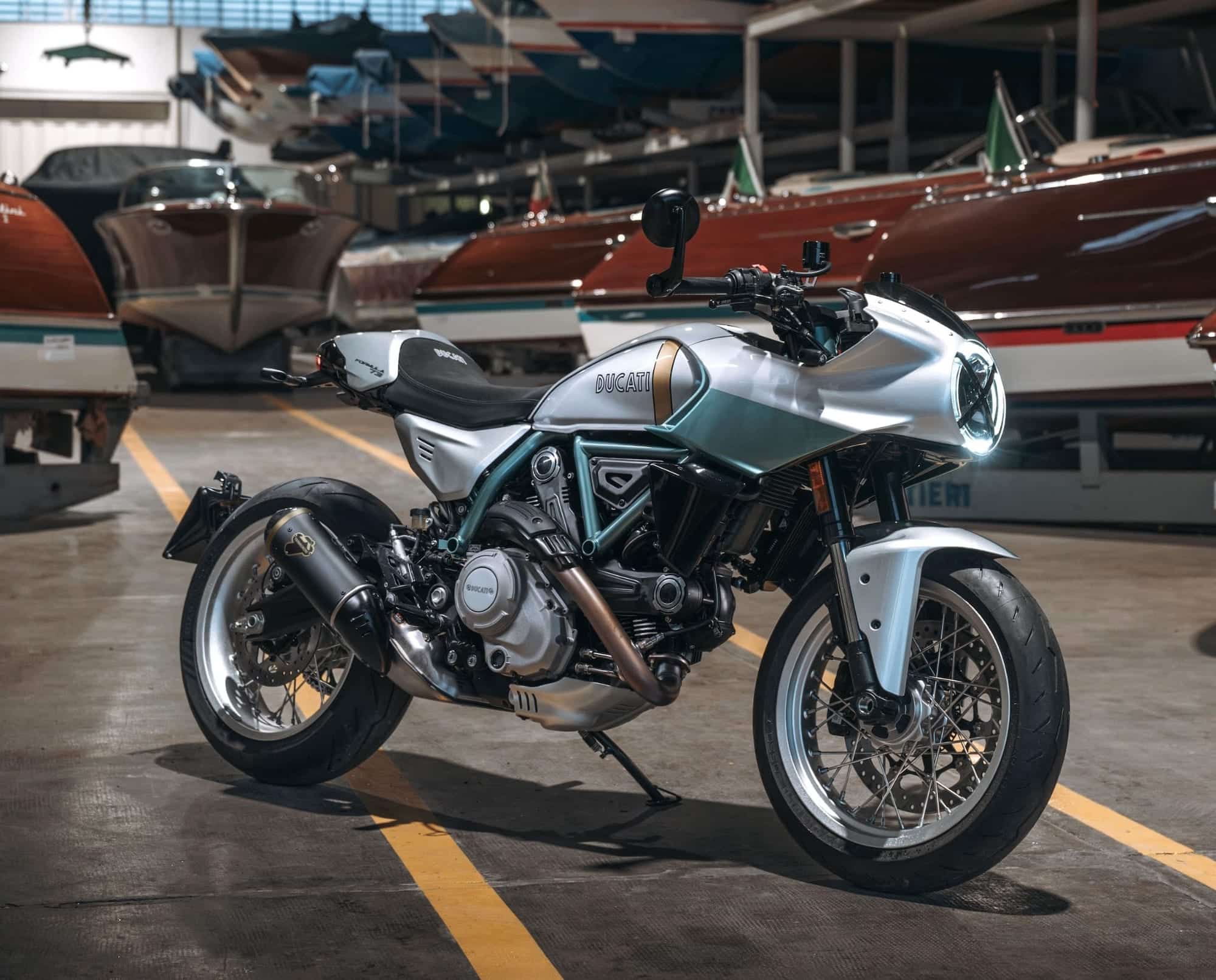
Underneath the silver bodywork, the Formula 73 is basically a second-generation Ducati Scrambler 800. It has the same 803 cc air-cooled Desmodue engine, familiar steel trellis frame, one front brake disc, long-travel KYB suspension, and modern Scrambler electronics.
But what a shiny exterior.
Are you obsessed with motorcycles?
Well, I am. That’s why I created this site — as an outlet. I love learning and sharing what others might find useful. If you like what you read here, and you’re a fraction as obsessed as I am, you might like to know when I’ve published more. (Check the latest for an idea of what you’ll see.)
What is the Ducati Formula 73?
The Formula 73 is a limited-production café racer for Ducati’s centenary year. Ducati will make 873 individually numbered bikes, with European deliveries beginning in spring 2026 and other markets following by the end of the northern summer.
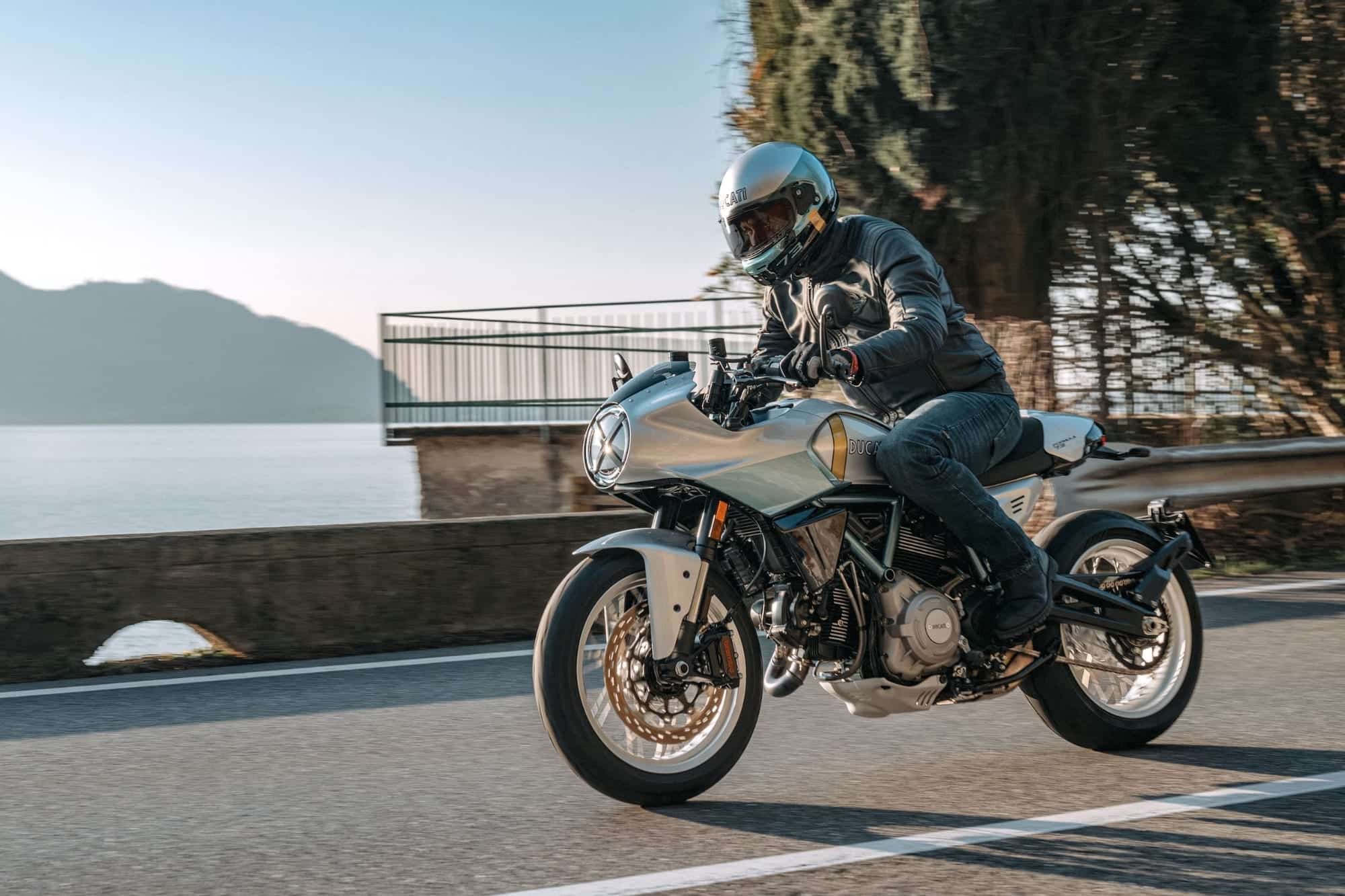
The number and exclusivity matter, but the aesthetics are why we’re here. Ducati has taken the current Scrambler platform and given it a compact frame-mounted fairing, clip-on handlebars, bar-end mirrors, a short single-seat tail, spoked aluminium wheels, and a silver-and-aqua-green colour scheme.
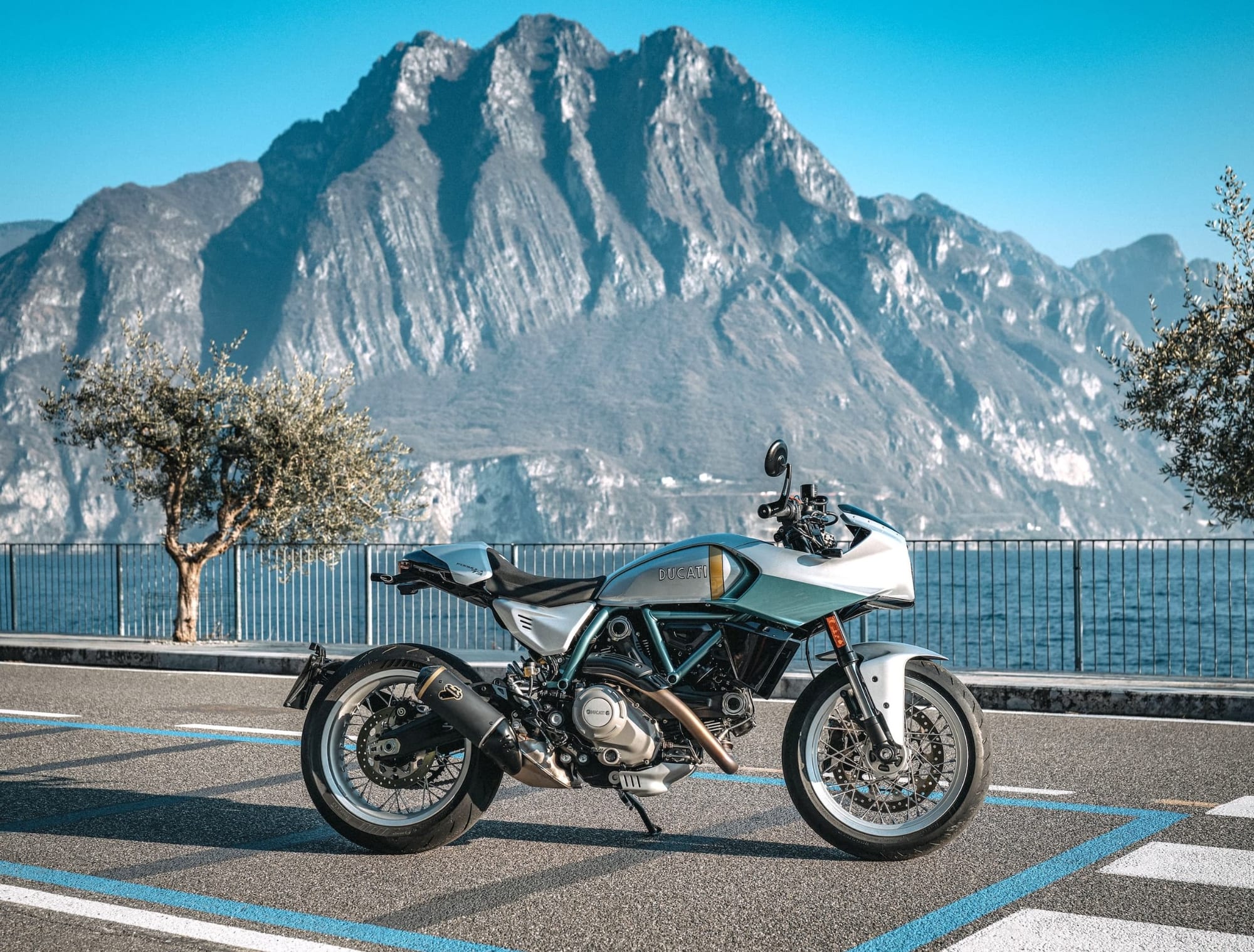
The result looks far more expensive than the Scrambler on which it is based. It also looks finished in a way that many retro motorcycles do not. The tank, fairing and tail form one clean line, while the aqua-green frame turns a structural part into a deliberate piece of the livery.
The heritage story: Imola, the 750 Super Sport Desmo, and Paul Smart
The Formula 73’s immediate reference is the Ducati 750 Super Sport Desmo. More precisely, it is not a tribute to the regular 750 Sport. Ducati is pointing to the road-going desmodromic model that followed its famous result at the 1972 Imola 200.
Paul Smart won that race on the 750 Imola Desmo, with Bruno Spaggiari finishing second on the other works Ducati. The road-going 750 Super Sport Desmo appeared the following year and reached customers in 1974. Ducati describes it as its first V-twin road bike with desmodromic valve operation. That explains the “73” in the new bike’s name.

The vertical gold stripe on the Formula 73’s tank also comes from the Imola race bike. On the original, an unpainted strip let the team see the fuel level through the fibreglass tank without adding a gauge. The new stripe does no such work, but it is a thoughtful reference rather than a random flourish.
Most riders will probably make a more recent connection. The Formula 73 looks very much like the Ducati Paul Smart 1000 L.E., the most desirable (subjective, probably… but a widely-held opinion, backed by high resale prices on BringATrailer.com) member of the Ducati SportClassic range.
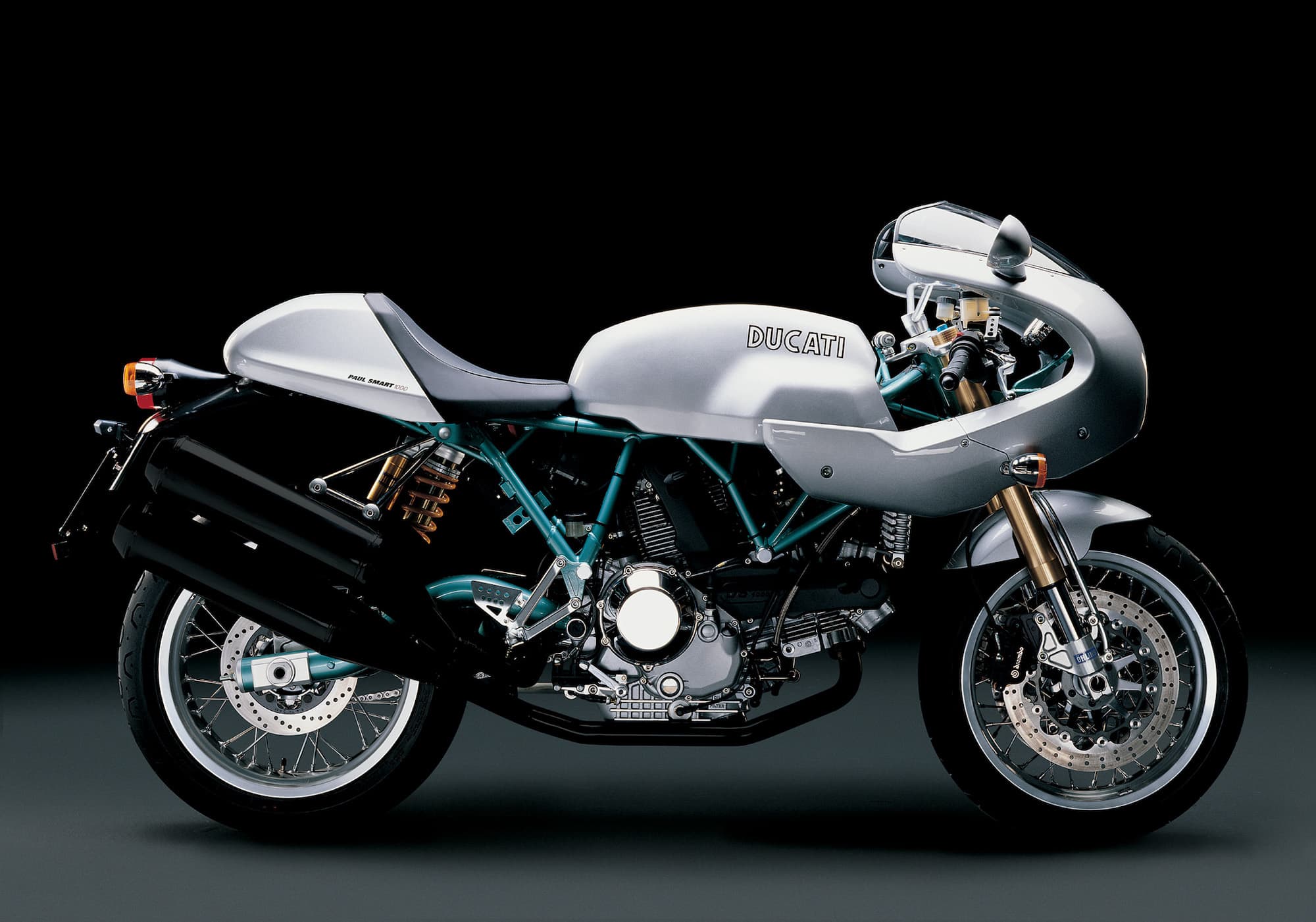
The 2006 Paul Smart 1000 L.E. had the same silver bodywork and sea-green frame, and its name tied the road bike directly to Smart’s Imola victory. It used the 992 cc 1000 DS Desmodue engine from the SportClassic range, making around 92 CV (68 kW / 91 hp) and 91 Nm (67 lb-ft). It also had fully adjustable Öhlins suspension and twin front brake discs.
The Formula 73 follows the same visual recipe, but its mechanical starting point is humbler. The current 803 cc Scrambler motor makes less power and torque, the suspension is basic, and the front wheel has one disc. Ducati is selling the design and the story here, not a new performance benchmark.
Ducati Formula 73 specifications
| Item | Ducati Formula 73 specification | What it means |
|---|---|---|
| Engine | 803 cc (49 cu in) air-cooled Desmodue L-twin; two valves per cylinder | The familiar Scrambler 800 engine, tuned for usable road torque rather than top-end power |
| Power | 73 CV (53.7 kW / 72 hp) at 8,250 rpm | Enough for a light road bike, but no more than the regular Scrambler |
| Torque | 65.2 Nm (48 lb-ft) at 7,000 rpm | Its best work sits in the middle and upper part of the rev range |
| Transmission | Six-speed; hydraulic wet slipper clutch; up/down quickshifter | Current controls beneath the old-fashioned bodywork |
| Weight | 183 kg (403 lb) wet without fuel | Manageable, though the Formula bodywork adds visual and physical substance |
| Seat height | 808 mm (31.8 in) | Low enough for a wide range of riders |
| Fuel capacity | 14.5 L (3.8 US gal) | Reasonable for weekend road use; claimed consumption is 5.2 L/100 km (45 mpg, US) |
| Suspension | 41 mm KYB inverted fork; KYB rear shock adjustable for preload; 150 mm (5.9 in) travel at both ends | Scrambler-like travel, but little adjustment |
| Front brake | Single 330 mm disc with radial four-piston Brembo caliper | Good road hardware, but less serious than the twin-disc Paul Smart setup |
| Wheels and tyres | 17-inch spoked aluminium wheels; Pirelli Diablo Rosso IV tyres in 120/70 and 180/55 sizes | Modern road tyre sizes despite the period appearance |
| Rider aids | Cornering ABS, traction control, two riding modes, power modes | A six-axis IMU supports the main safety systems |
| Seats | One | Your passenger needs another motorcycle |
The old Desmodue in modern clothes
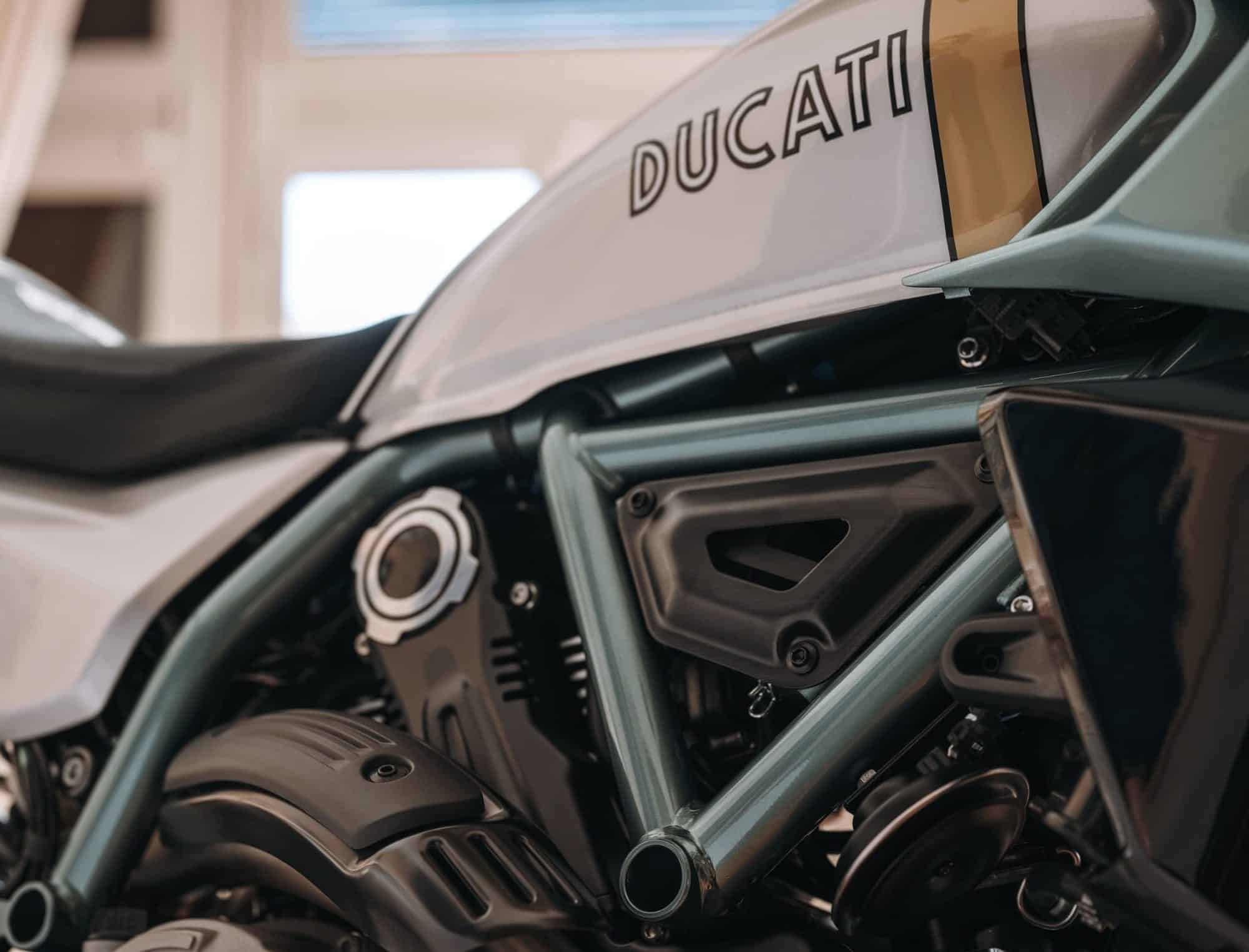
The 803 cc engine belongs to Ducati’s long-running Desmodue family. It has one camshaft and two desmodromically operated valves per cylinder, with belts driving the cams. Air cools the cylinders and oil helps manage heat.
Ducati has updated this motor with ride-by-wire and Euro 5+ compliance, but the basic architecture is old-school Ducati. Peak output of 73 CV at 8,250 rpm and 65.2 Nm at 7,000 rpm will not overwhelm the chassis. It suits back roads, regular city use, and the occasional ride past a shop window so you can look at your reflection. So handsome!
A model-specific Termignoni silencer is standard. It’s not for performance, but rather for sound and appearance.
Modern electronics, ordinary suspension
The Formula 73 has most of the electronics I want on a modern road bike: cornering ABS, Ducati Traction Control, Sport and Road riding modes, selectable power modes, and an up/down quickshifter. It also has a 4.3-inch TFT display, full LED lighting, self-cancelling indicators, and a USB port.
It still doesn’t have everything you can get on a modern sport bike. There’s no cruise control (“Who needs it?” you cry. Some people, and it’s easy, so why not?), keyless ignition (I mean, chipped keys are halfway there, why are we splitting hairs), or in-built espresso machine. You may think I’m boring and ugly for mentioning those, but I’m just saying that some other brands do.
The Formula 73 is ready for Ducati’s multimedia system, turn-by-turn navigation, heated grips, and an anti-theft system. You can add all those things if you want.
The suspension exposes the Scrambler underneath. The 41 mm KYB fork has no adjustment, and the KYB rear shock only lets you change spring preload. There is plenty of travel at 150 mm (5.9 in) front and rear, so this is not a committed low-slung sport bike. Riders paying for the numbered plate may still wonder why Ducati did not fit more adjustable parts.
What makes each Formula 73 special?
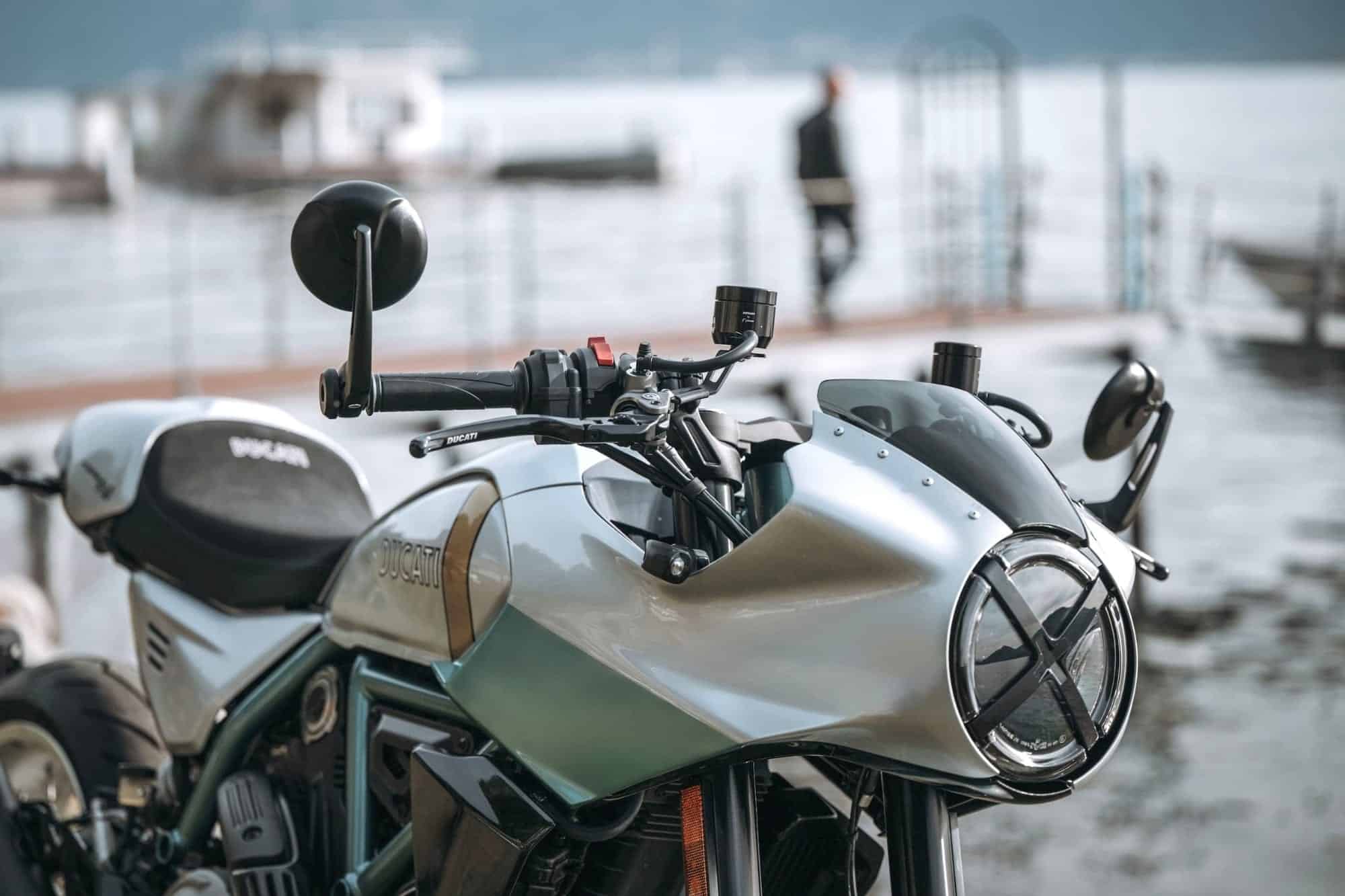
Every Formula 73 has its production number on the steering plate. Ducati also supplies a certificate of authenticity and a boxed collection of period photographs and Ducati Style Centre sketches.
The small details carry a lot of the expensive feel: billet-aluminium brake and clutch levers, separate fluid reservoirs, machined footpegs, and a Rizoma fuel cap. Details that are easy on the eye while in the garage.
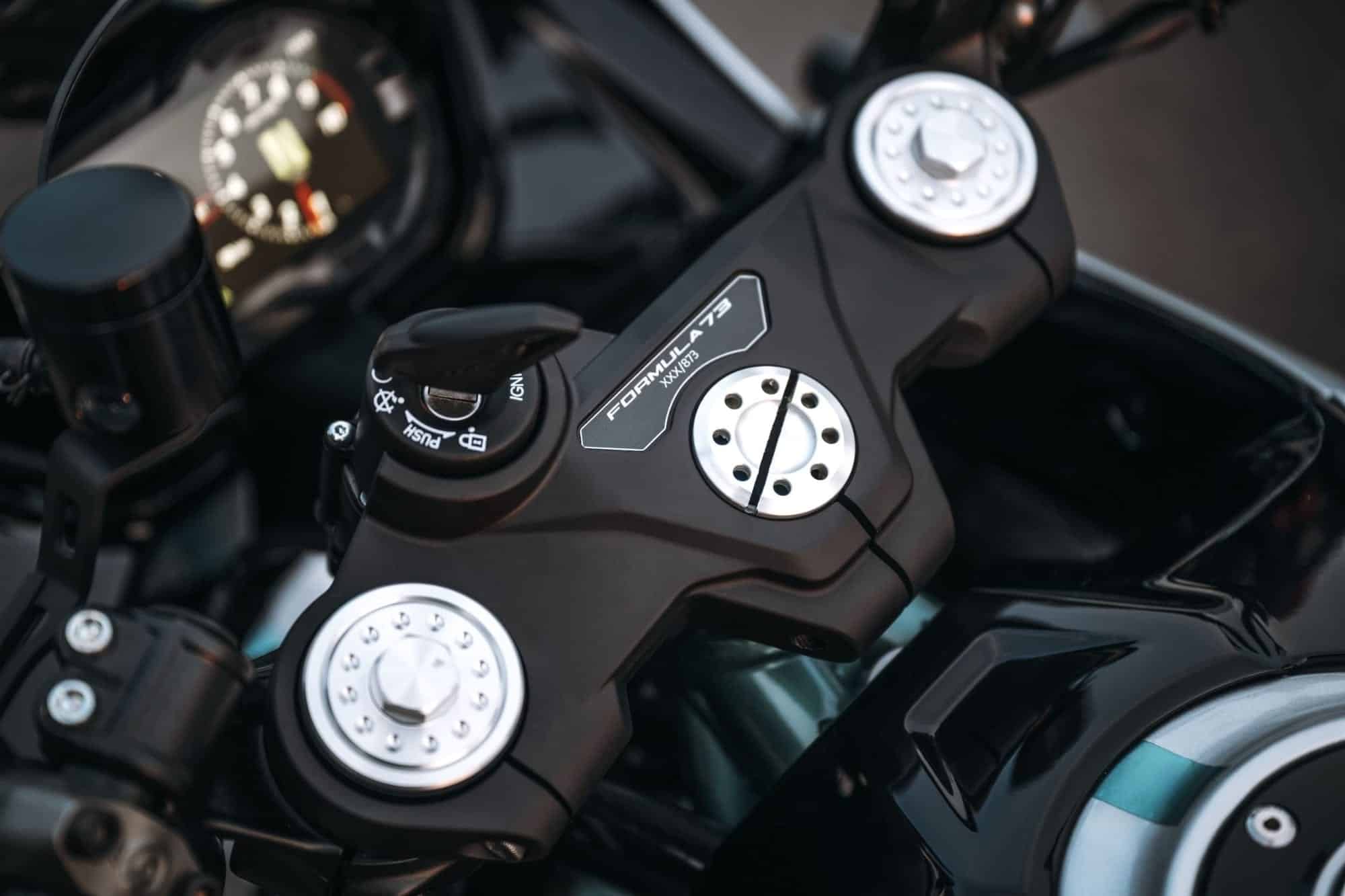
Ducati will also sell a matching Arai helmet and sports jacket. I would normally roll my eyes at matching branded gear, but the silver, gold and aqua-green treatment is strong enough that I understand the temptation.
The maintenance caveat
The Formula 73 looks like a collector’s object, but mechanically it is still an air-cooled Ducati with timing belts and desmodromic valves.
Ducati’s technical sheet lists an annual service, an oil-service interval of 12,000 km (7,500 miles) or 24 months, and valve-clearance checks every 12,000 km (7,500 miles). Belt replacement is another scheduled job to budget for according to Ducati’s market-specific maintenance schedule. This is not a Japanese parallel twin that asks for fuel and occasional attention.
That matters if someone actually rides it. If the bike spends its life beside an Eames chair in a climate-controlled living room, the main maintenance task may be dusting it.
So, do I want one?
Kinda. I already put the Formula 73 on my list of the best-looking motorcycles of 2026, and a longer look has not cured me. Maybe a long ride on one will…
The rational part of me sees an 803 cc Scrambler with one front disc, basic suspension, one seat, and a maintenance schedule that includes belts and desmodromic valves. The part of me that likes motorcycles sees the silver fairing, the green frame, the gold stripe and that short tail.
This bike suits someone who already has a sensible motorcycle and wants a beautiful object they can ride. It makes less sense as an only bike, especially if you carry a passenger, travel long distances, or judge value by horsepower and suspension adjustment.
I want to be rich so I can have toys like the Ducati Formula 73. Then I would ride it anyway.