
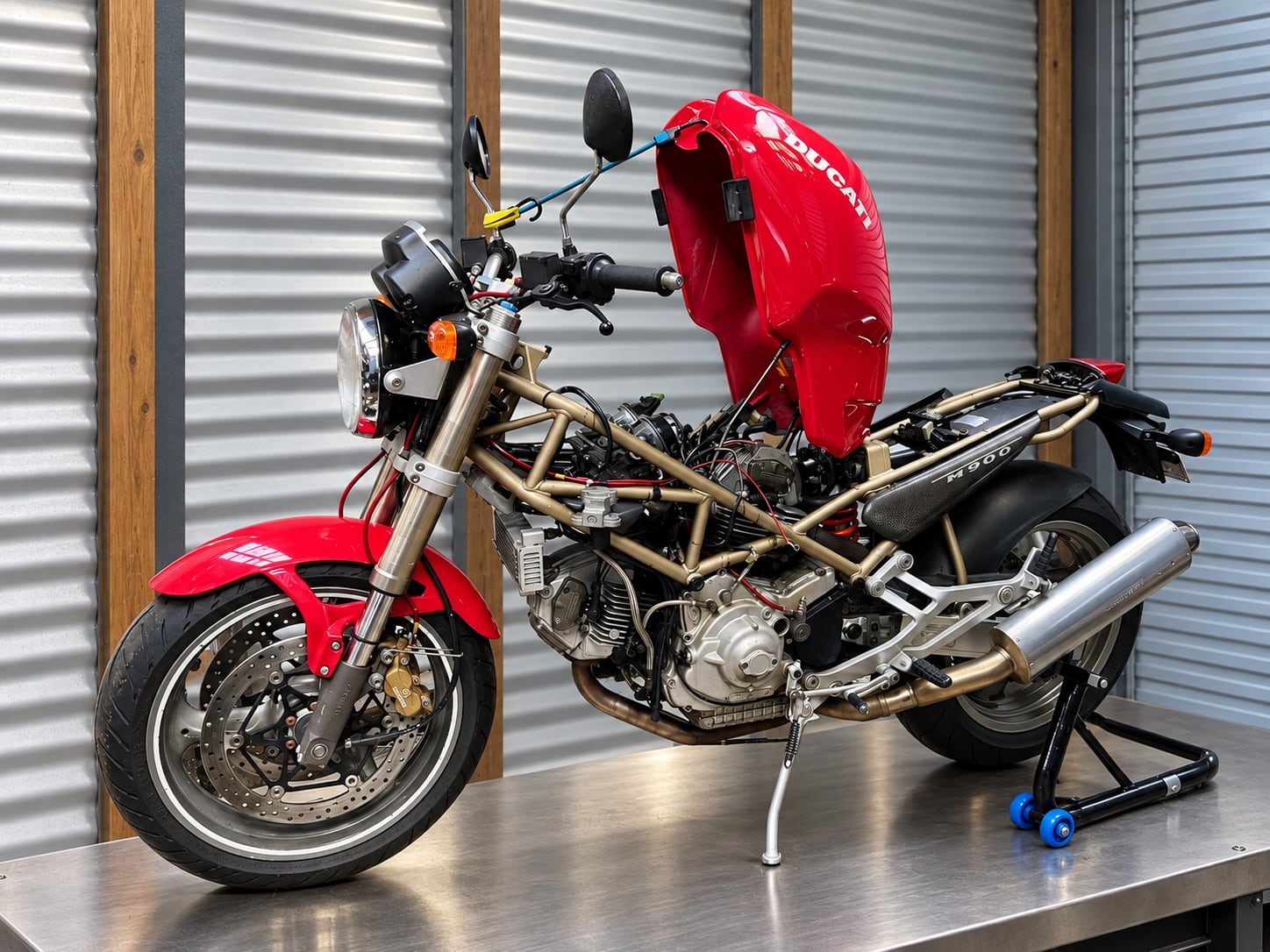
I recently spent far too long working on the Mikuni carburettors in my Ducati Monster 900. I pulled them out, opened them up, checked the floats, cleaned tiny passages, put them back in, and discovered that the bike still had opinions about the whole exercise.
It was a slog. It was also one of the most satisfying jobs I’ve done on a motorcycle.
There’s no question that fuel injection gives you cleaner starts, better fuel control, easier compensation for weather and altitude, and less routine attention. If I had to commute every morning on one motorcycle, I’d choose fuel injection without much hesitation (“hesitation”, cough, cough, get it? Also, “cough, cough” was another accidental joke that I’ll pretend was on purpose).
But I still think carburettors deserve a defence. They let you see, touch, diagnose, and alter the way an engine eats… and don’t try to deny that when you fuel up your bike you feel like you’ve given it a good meal. A good carburetted engine also has a response and induction sound that I enjoy, even though I know the carburettor isn’t solely responsible for either.
Carburettors or carburetors? The first spelling is standard in Australia and Britain; the second is standard in the US. I’m Australian, so I’ll use carburettor. About half of Motofomo’s readers may mentally remove a letter.
Are you obsessed with motorcycles?
Well, I am. That’s why I created this site — as an outlet. I love learning and sharing what others might find useful. If you like what you read here, and you’re a fraction as obsessed as I am, you might like to know when I’ve published more. (Check the latest for an idea of what you’ll see.)
The “I’m Not Reading All That” Version
What’s a carburettor? It’s the part that carburetts. A carburettor uses the airflow entering an engine to draw fuel through calibrated passages. The throttle controls airflow directly, and the carburettor meters fuel through several overlapping “circuits”.
That mechanical link makes a carburettor understandable in a way that a sealed ECU and injector often aren’t, especially in the world of throttle-by-wire. With a carburettor, you can clean it, change a jet, move a needle clip, set a float height, synchronise a bank, and feel what each change did. The cost is that the motorcycle may need a warm-up routine, react to storage or altitude, leak fuel when a seal or float valve fails, and punish careless tuning.
A carburetted bike makes most sense if you enjoy old motorcycles, have somewhere to work, and can tolerate the odd grumpy start (probably because it’s not your only bike). Fuel injection makes more sense if the bike must start and run cleanly every day with as little fuss as possible.
What a motorcycle carburettor actually does
A petrol engine needs air, fuel, compression, and a spark. The carburettor handles the first two. It turns liquid fuel into small droplets, mixes those droplets with incoming air, and sends the mixture towards the intake valve.
The basic trick happens in a narrowed section called a venturi. As air speeds through that restriction, the static pressure falls. The pressure difference between the venturi and the float bowl helps push fuel through a jet and into the airstream. The engine’s intake stroke supplies the airflow that starts the process.
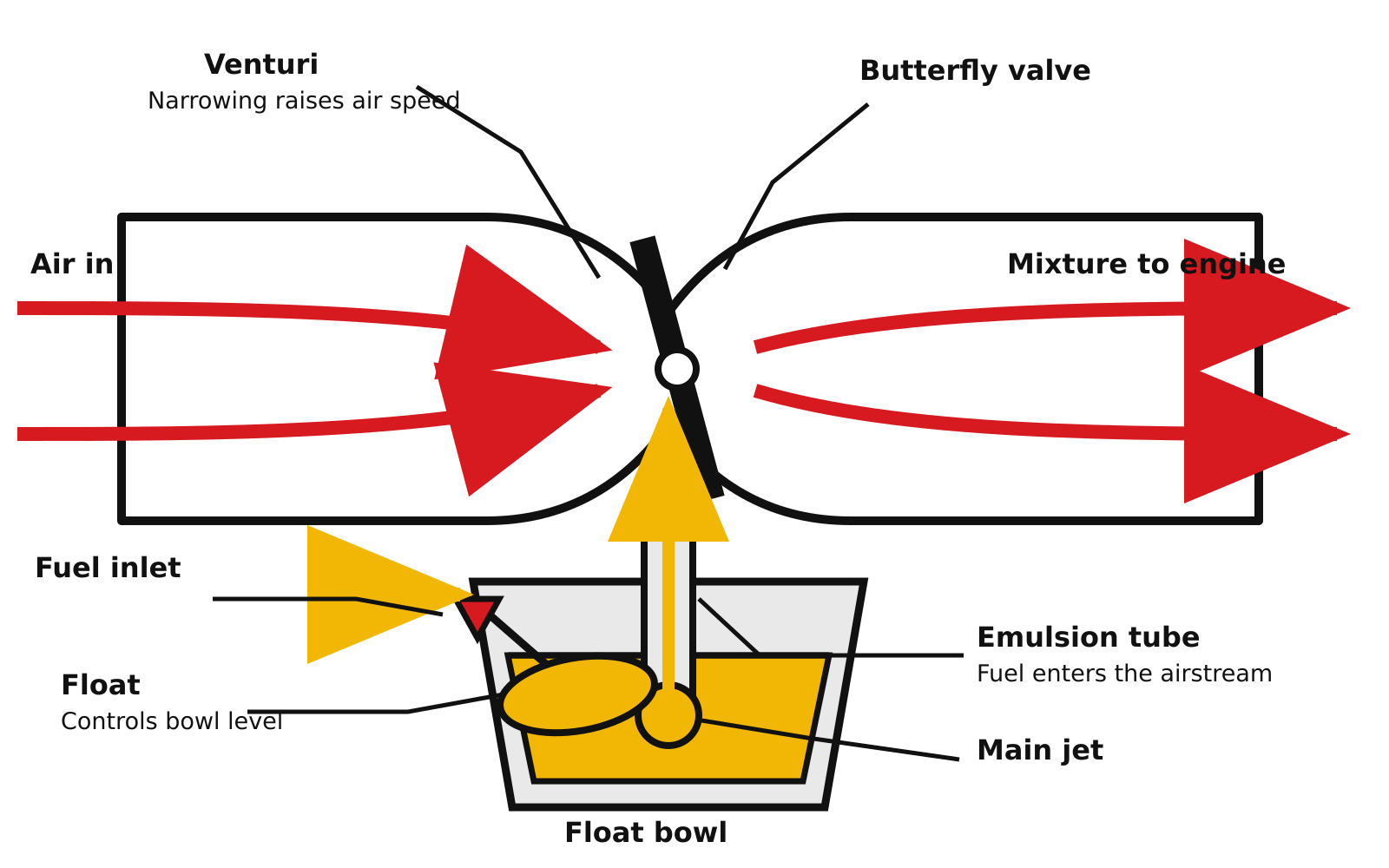
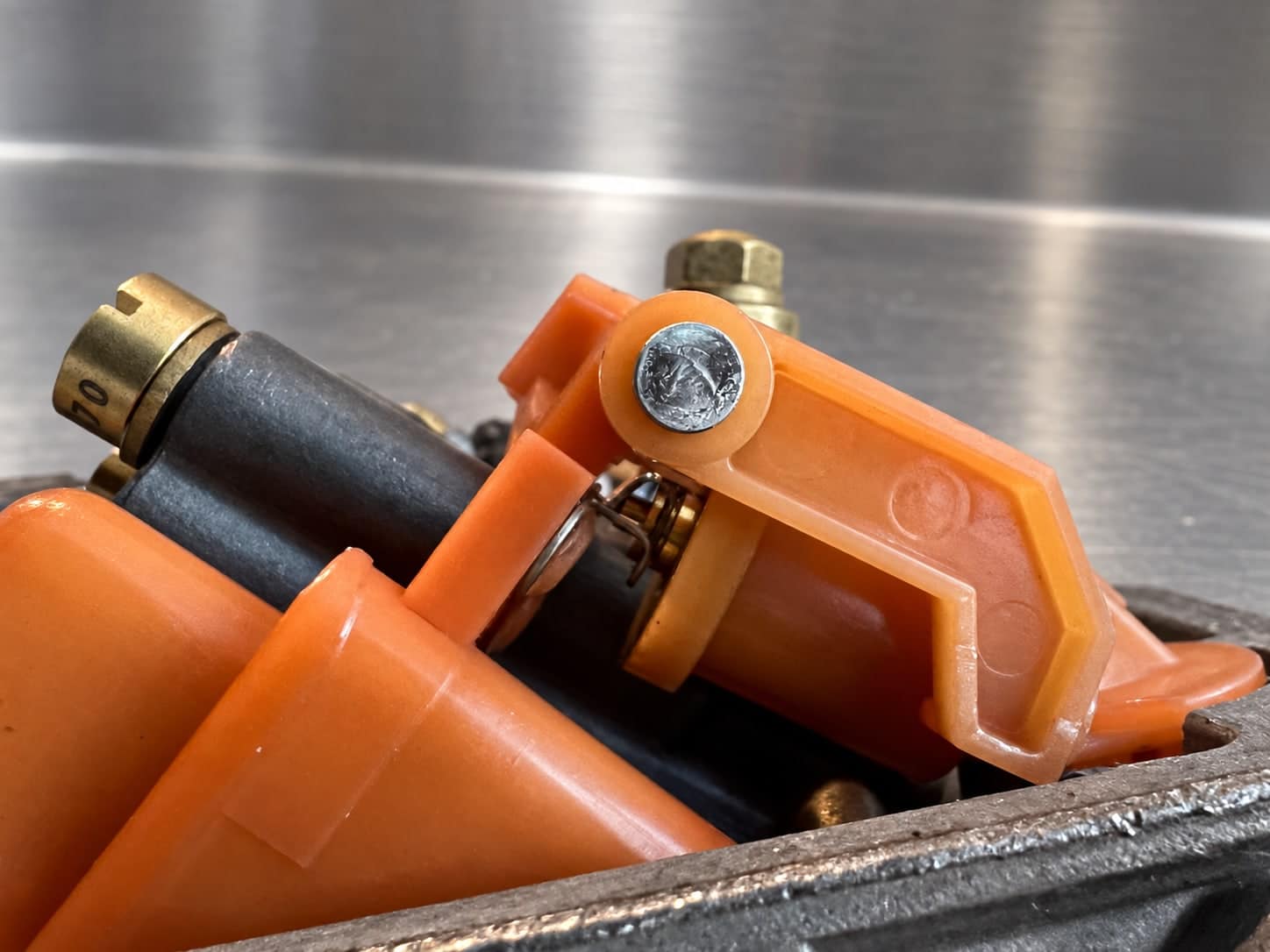
The float bowl is the little reservoir underneath. A float and needle valve try to keep the fuel at a set level, rather like the cistern in a toilet, only smaller and slightly indignant about being described that way. When the level drops, the valve opens and admits more fuel. When the level rises, the float closes it.
Float height isn’t a boring setup detail — it’ll come back to haunt you if you get it very wrong. It affects the fuel level relative to the jets. Set it too high and the mixture may run rich or the carburettor may overflow. Set it too low and the engine may starve under load or hesitate because the carburettor has to pull fuel farther uphill.
The throttle slide and butterfly
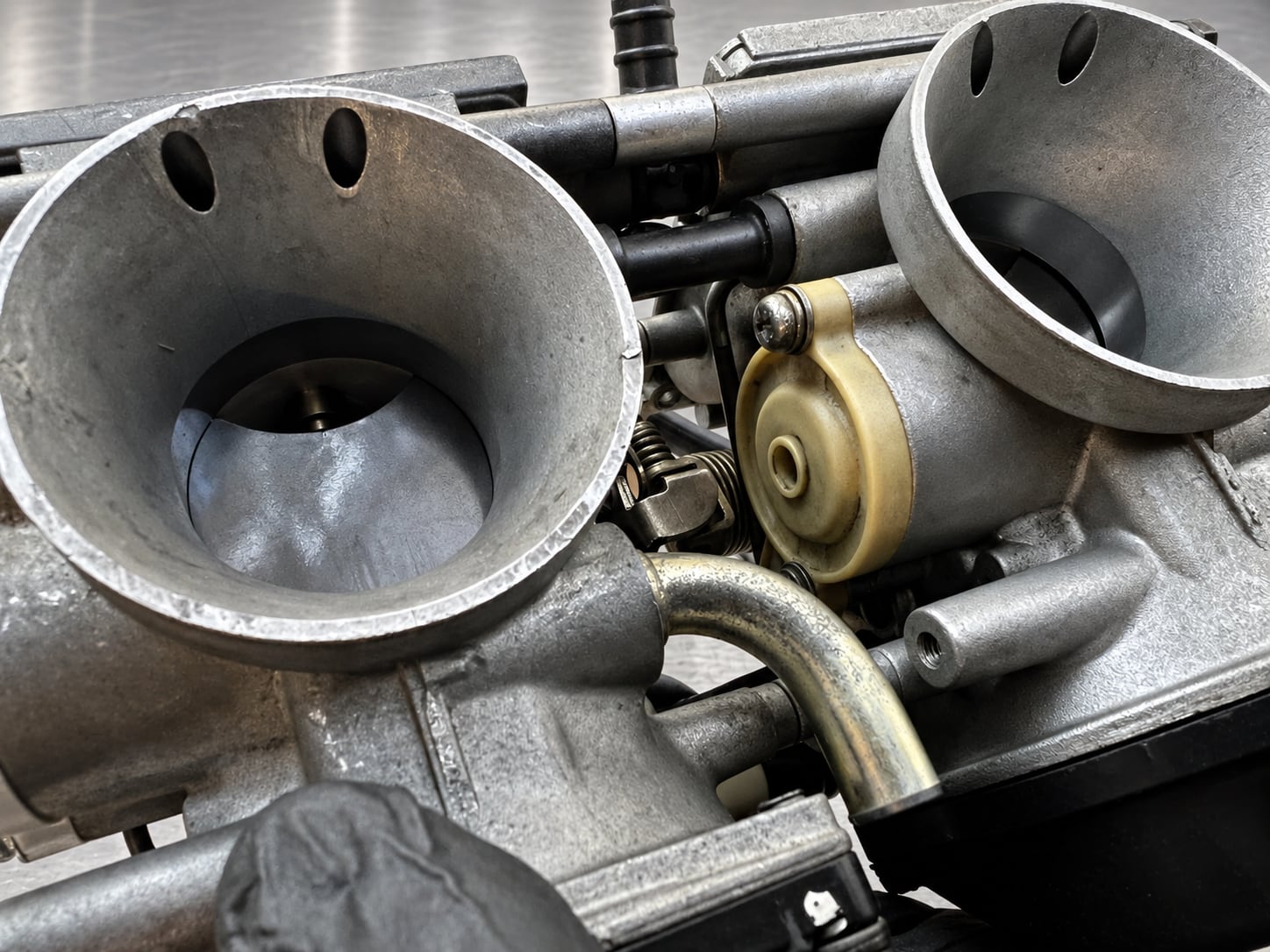
Motorcycle carburettors don’t all control airflow in the same way. On a simple slide carburettor, the throttle cable lifts a slide. Open the grip and you expose more of the carburettor throat.
Many road motorcycles use constant-velocity, or CV, carburettors. Your right hand opens a butterfly valve, while intake vacuum lifts a diaphragm-controlled slide. The arrangement softens abrupt inputs and keeps air speed through the venturi within a workable range. It can make a large carburettor easy to ride, although a torn diaphragm creates its own entertaining diagnostic session.
Some performance carburettors also have accelerator pumps. When you snap the throttle open, the pump squirts extra fuel into the intake to cover the brief lean period before airflow can draw enough fuel through the normal circuits.
A carburettor has several fuel circuits, not one jet
The phrase “rejet the carbs” makes the job sound like replacing one little brass screw. In reality, a motorcycle carburettor uses overlapping systems because the engine’s needs at idle differ from its needs at half throttle or full load.
| Part or circuit | Main job | What you may notice |
|---|---|---|
| Enrichener or choke | Adds fuel or restricts air for a cold start | Hard cold starting, stalling before warm, or a very high cold idle |
| Pilot circuit and mixture screw | Feeds the engine at idle and very small throttle openings | Hanging idle, rough idle, stumble just off idle, or fouled plugs |
| Slide cutaway | Shapes mixture as the slide begins to open | A hesitation during the first part of throttle movement |
| Jet needle and needle jet | Meter much of the low-to-middle throttle range | Surging, flat response, or rich running during normal road use |
| Main jet | Limits fuel near large throttle openings | Weak or rough running when the engine is working hard |
| Float and float valve | Maintain the fuel level in the bowl | Overflow, rich running, starvation, or inconsistent behaviour across several circuits |
Unfortunately, the circuits don’t hand the job from one to the next at neat boundaries — they overlap. At ordinary road throttle, the pilot circuit, needle position, needle taper, air jets, and fuel level can all affect the result. This is why changing three things at once is such a fine way to lose an afternoon.
A methodical tuner changes one variable, records the setup, and tests at the throttle opening where the symptom occurs. Engine speed still matters, but it doesn’t tell you which fuel circuit is in charge by itself. Mikuni’s own HSR tuning manual follows this throttle-position approach.
Why I still like carburettors
Here are a few reasons I like carburettors. I love/hate them, anyway.
You can see the whole shebang
Lift the slide and you can see the airway open. Remove the float bowl and you can hold the pilot and main jets. Move a clip and you can change the needle’s working height. Turn a mixture screw and you can hear the idle change.
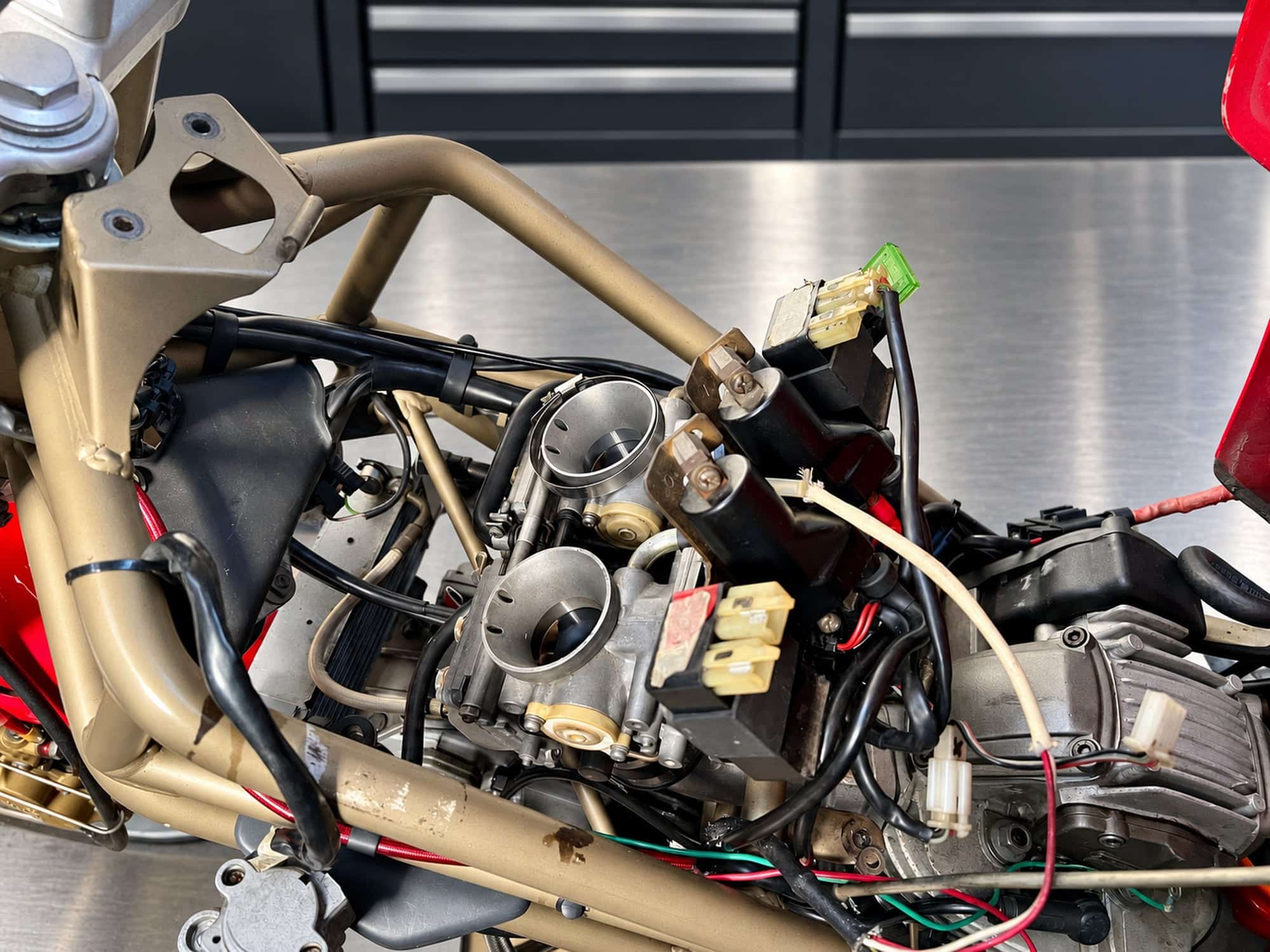
They’re complicated things, though. A bank of four CV carbs has dozens of small parts, rubber seals, diaphragms, springs, and passages. Getting the bank out of a tightly packed motorcycle can take longer than cleaning it — this was definitely the case for the two carburettors in my Ducati. But the logic stays visible. Fuel, air, pressure, and gravity do the metering, and each part has a job you can trace.
The throttle can feel direct
A well-set slide or pumper carb can respond very directly because the cable moves the metering hardware. Good CV carbs trade some of that snap for smoothness. Either can feel excellent.
I wouldn’t claim that carburettors always have better throttle response. A neglected carburetted bike can cough, bog, surge, or take a long pause to consider your request. Mind you, early fuel-injection maps could also feel abrupt because emissions targets, large injectors, and basic mapping made small throttle openings hard to control (early FZ-09, anyone?). Modern ride-by-wire systems can be much smoother than either.
The appeal is the mechanical cause and effect. You pull a cable, airflow changes, pressure changes, and fuel follows. Even when a CV diaphragm mediates the slide, the system still reacts to the engine rather than following a software table.
Tuning involves parts you can hold
Change an exhaust or airbox and a carburetted engine may need different jets or needle settings. The work can be tedious, especially on a multi-cylinder bike, but the adjustment is tangible. A larger main jet has a larger calibrated opening. Raising a tapered needle exposes more area sooner. Adjusting float height changes the fuel level.
Electronic tuning can be far more precise. An ECU can adjust fuel for engine speed, load, temperature, throttle movement, oxygen-sensor feedback, and other inputs. A competent tuner can alter a specific cell instead of accepting the overlap built into a jet and needle. But access may require software, an interface, a piggyback controller, an ECU flash, or a dyno operator who knows that model.
With a carburettor, I can make a modest change at my bench and understand why I made it. I may then take the carburettors out again because I guessed wrong. This is where the romance meets the fasteners.
They give a home mechanic a meaningful job
Servicing motorcycles is part of the pleasure for me. Riding includes traffic, speed limits, weather, and people staring at phones. A workshop gives me a contained problem and enough time to solve it.
A fuel-injected motorcycle still gives you plenty to maintain. You can balance throttle bodies, test fuel pressure, clean injectors, inspect sensors, and diagnose wiring. Yet owners usually leave the fuel map alone. Carburettors invite you into the metering system because age eventually forces the conversation.
Cleaning varnish from a pilot passage or fixing a float valve produces a result you can hear immediately. The engine starts, settles, and accepts throttle again. I like that.
The sound and feel aren’t imaginary, but the carburettor doesn’t get all the credit
Carburetted motorcycles often come from an era of large airboxes, fewer layers of sound control, long throttle cables, heavy flywheels, and less aggressive emissions tuning. Old engines may also have different cam timing, exhausts, compression ratios, and ignition maps. All of those choices change the sound and response.
Still, a bank of open or lightly muffled carburettor throats can make a wonderful intake roar. Slides and butterflies sit close to the rider, and accelerator pumps can add an immediate gulp when the throttle opens. On my Monster 900, the induction noise, dry clutch, air-cooled engine, and exhaust all arrive together. Trying to award the carburettors a precise share of that noise would be silly.
Fuel injection doesn’t prevent a motorcycle from sounding good. It also doesn’t erase character. The fuel-injected Ducati SuperSport 900 i.e. still has the slow, lumpy beat of Ducati’s air-cooled two-valve twin. Carburettors add their own texture, but the engine around them does most of the composing.
Where carburettors become a pain
Cold starting and warm-up
Petrol doesn’t vaporise as readily in a cold intake, and some of it condenses on cold surfaces. A cold engine therefore needs a richer mixture. Depending on the design, a “choke” may restrict air or an enrichener may open a separate fuel passage.
You learn the routine for a particular bike: full enrichener, no throttle; half enrichener and a crack of throttle; or whatever strange ceremony its owner has discovered. Use too much fuel and you can wet the plugs. Use too little and it won’t catch. Fuel injection handles this automatically from sensor inputs and programmed cold-start maps.
Storage and old fuel
Carburettor passages are small, and the float bowls hold a small supply of fuel exposed to heat and air. Leave the motorcycle sitting long enough and the volatile parts evaporate. Deposits can block a pilot jet or make a float valve stick. Ethanol-blended fuel can add water-absorption and material-compatibility problems, especially in an old fuel system.
For a long lay-up, follow the bike’s manual. That often means treating fresh fuel, running it through the system, turning the fuel tap off where fitted, and draining the float bowls. Don’t copy a universal internet ritual without checking the machine: tanks, taps, pumps, seals, and storage conditions differ.
Altitude, temperature, and changing conditions
A fixed jet can’t measure air density. Climb high enough and the air becomes thinner while the jet still meters fuel according to the pressure conditions available at the carburettor. The mixture tends to become richer. Large changes in temperature and humidity also move the tune.
A CV carburettor compensates for some changes in airflow, but it can’t match an EFI system that reads pressure and temperature and corrects fuel delivery. Riders who cross large elevation changes on carburetted dirt bikes sometimes carry jets and accept the workshop stop as part of the trip.
Multiple carburettors need to agree
On a multi-cylinder engine, each cylinder may have its own carburettor. The throttle plates or slides need to open together, and the idle airflow needs to balance. If one cylinder does more work than its neighbours, the engine may idle roughly, vibrate, or respond poorly just off idle.
Synchronising them isn’t mysterious: you compare intake vacuum and adjust the linkage or bypass screws according to the manual. Access, hot engine parts, and a bank that changes slightly when you tighten a screw can still make the job annoying.
Wear, leaks, and previous owners
Needle jets wear. Float valves stop sealing. O-rings flatten. Diaphragms split. Intake boots crack. Throttle shafts develop play. Someone installs pod filters, a loud exhaust, and mystery jets, then sells the bike because it “only needs a tune.”
Age creates most of the trouble that people blame on carburettors. A fresh, standard carburetted motorcycle can start and run consistently. A 30-year-old one may need every rubber part inspected before any amount of jet swapping makes sense.
Carburettors versus fuel injection in everyday use
| Question | Carburettor | Fuel injection |
|---|---|---|
| Cold start | Often needs a manual enrichener and a short warm-up routine | ECU usually adds the required fuel automatically |
| Altitude and weather | Fixed calibration; may drift rich or lean as air density changes | Sensors let the ECU correct fuel delivery |
| Throttle response | Can feel very direct; setup and carb type make a large difference | Can be precise and smooth; mapping and ride-by-wire strategy make a large difference |
| Home tuning | Jets, needles, screws, springs, and float height are physically accessible | Precise changes need software, an interface, or an added controller |
| Storage | Fuel in small passages and float bowls can leave deposits | Pressurised injectors can also clog, but the sealed system usually tolerates storage better |
| Fault finding | Mechanical logic, but many tiny passages and wear points | Diagnostic codes and live data can help, but electrical faults need tools and documentation |
| Emissions and economy | Limited ability to correct mixture across changing conditions | Closed-loop control and precise transient fuelling support cleaner running and lower fuel use |
Fuel injection won because it controls fuel more accurately across starting, warm-up, acceleration, cruising, temperature, altitude, and emissions tests. It also integrates with modern ride modes, traction control, cruise control, quickshifters, and diagnostics. Manufacturers didn’t abandon carburettors because riders failed to appreciate brass jets.
Carburettors retain one practical advantage for the home mechanic: you can often restore the metering system with hand tools, compressed air, cleaning fluid, gauges, and replacement wear parts. “Often” carries a lot of weight. Some parts disappear, castings corrode, screws seize, and a worn carb body may cost more to fix than a replacement bank is worth.
Are carburettors apocalypse-proof?
No. This was the funniest idea in my original notes, so it deserves a fair hearing and a firm qualification.
A carburettor doesn’t need an injector driver, fuel map, oxygen sensor, or electronic throttle body. Many carburetted motorcycles can feed fuel by gravity. If a jet blocks, you can remove it and clean it. Those are real advantages when diagnostic equipment and model-specific electronics aren’t available.
But the motorcycle still needs ignition. Many carburetted bikes have an electronic ignition module, pickup coil, charging system, electric starter, and fuel pump. CV carbs have rubber diaphragms. All carbs need seals, float valves, and correctly sized parts. A random replacement carburettor won’t become a “simple swap” unless its bore, spacing, mounting, throttle linkage, fuel supply, and jetting suit the engine.
So a simple gravity-fed single-cylinder motorcycle with points ignition gets much closer to the wasteland ideal than my Ducati does. My M900 would survive the loss of a laptop. I wouldn’t bet civilisation on its regulator/rectifier.
Carburetted motorcycles that make the case well
The right example depends on what you want from an old bike. I wouldn’t buy a random carburetted motorcycle merely to own carburettors. I’d buy a motorcycle whose engine, chassis, condition, and parts supply make the extra attention worthwhile.
- Ducati Monster 900: The early carburetted M900 combines a lazy air-cooled V-twin, simple bodywork, and enough access to encourage home servicing. My Ducati Monster buyer’s guide explains the carburetted and injected generations.
- Honda CB400 Super Four: The early versions use four small carburettors and reward revs. Later injected versions make an interesting comparison. I wrote about the experience in my Honda CB400 Super Four review.
- Honda CBR1000F: Four carburettors feed a large, smooth sport-touring engine. Condition matters, but a sorted example shows that carburetted doesn’t have to mean temperamental. See the CBR1000F buyer’s guide.
- Early Yamaha YZF-R1: The first-generation R1 used CV carburettors, while Yamaha moved the model to fuel injection for 2002. The Yamaha R1 buyer’s guide shows where that change sits in the model history.
- First-generation Suzuki SV650: The 1999–2002 bikes use carburettors; Suzuki changed to fuel injection with the second generation. Either can be a sensible used bike, and the SV650 history and buyer’s guide covers the differences.
If you’re shopping without a fixed model in mind, the bikes in Classic Motorcycles for Cheapskates include several machines from the carburettor era. Buy on condition. A complete, standard bike with clean fuel and a documented service history usually beats a modified “project” with a box of jets.
What to check before buying a carburetted motorcycle
Ask the seller to leave the engine cold. A pre-warmed engine can hide a weak cold-start circuit, poor compression, or an owner who knows it takes twenty minutes to persuade the bike into life.
- Watch the cold start. Confirm that the enrichener works, the engine catches without an absurd ritual, and the idle settles as it warms.
- Smell and look for fuel. Check float-bowl seams, overflow hoses, fuel lines, the tap, and the area under the bike. Fuel on a hot engine is a repair, not character.
- Open the throttle from idle. A clean engine should accept a progressive opening without a deep bog, hanging revs, or repeated sneezes through the intake.
- Test steady small throttle. Surging at a fixed road speed can point to mixture, intake leaks, synchronisation, or ignition trouble.
- Inspect the intake rubbers and airbox. Cracks admit unmetered air. Missing airbox parts or pod filters tell you to ask exactly who changed the jetting and how they tested it.
- Ask about storage. A bike that sat with old fuel may need more than fresh petrol. Ask when the carburettors were last cleaned and whether the tank has rust.
- Check parts supply. Look for model-specific gaskets, float valves, diaphragms, intake boots, and jets before buying an uncommon machine.
Then do the rest of a normal inspection. Carburettors won’t make damaged forks, old tyres, bad wheel bearings, tired suspension, or a weak charging system cheaper. My used motorcycle inspection checklist covers the whole bike.
Who should choose carburettors?
Choose a carburetted motorcycle if the bike you want happens to have them, you enjoy understanding mechanical systems, and you have enough time and access to deal with age-related faults. They suit a weekend bike, classic, simple trail bike, or second motorcycle particularly well.
Choose fuel injection if the motorcycle is your daily transport, it sits through large changes in weather or elevation, you store it unpredictably, or you want the lowest possible fuelling workload. EFI is also the clear answer when you want current emissions performance, ride-by-wire systems, or tight integration with modern electronics.
My case for carburettors isn’t that they meter fuel better. They generally don’t. The case is that they expose an important process, reward careful hands, and belong to many motorcycles worth owning.
I cursed the pair on my Monster while removing them, but enjoyed understanding them on the bench. And when the engine started cleanly afterwards, I liked them again. That’s a relationship I can defend, even if I keep a screwdriver nearby.