

Everyone — at least, everyone I’ve met in my brief but eventful life who can stand to hear me yabber on about motorcycles — agrees that three-cylinder engines are the bee’s knees. Some get unhinged over twins, and some will go to war for inline fours. But three cylinders is the demilitarised zone where we can all get along.
Few makers do triples at all, and Triumph is one of the most recognised for doing so. Triumph first released the Triumph Speed Triple in 1994. There was no “Hinckley Triumph” Speed Triple, though there was a Speed Twin. Since its launch, it has been one of their premium sports motorcycles, with a unique engine, look, and personality.
See here for more about the Hinckley vs John Bloor Triumph periods.
Originally, the Triumph Speed Triple was the road-going sibling of the Daytona sportbike, sharing an engine. But since 2005 and the advent of the Speed Triple 1050, the Triumph Speed Triple has evolved to become the high-end sport bike that Triumph produces. This is quite rare. Most manufacturers use a motor and chassis from their superbike and modify it for a standard street bike. Not Triumph!
There have been so many models and iterations of the Speed Triple that I wanted to put together a model history from 1994 to today, covering all the generations and variations of the Speed Triple.
In this article, I’ll talk about
- A brief history of the Speed Triple — How did we get here?
- What makes the Triumph Speed Triple unique among standard / naked sportbikes?
- How the Speed Triple has changed over the years
- Some alternatives to the Speed Triple
Plus anything more I can think of. Onward!
Editor’s note: This article took me ages to write. I think I started in 2021, got bamboozled, and left it in draft for ages while my blog got the **** kicked out of it by AI wars. Anyway, here it is!
Are you obsessed with motorcycles?
Well, I am. That’s why I created this site — as an outlet. I love learning and sharing what others might find useful. If you like what you read here, and you’re a fraction as obsessed as I am, you might like to know when I’ve published more. (Check the latest for an idea of what you’ll see.)
History of the Triumph Speed Triple — A Quick Overview
The “fast roadster” was an emerging segment in the 1990s. There were, of course, many fast motorcycles with handlebars before then. In fact, the early “superbikes” (like the original Honda CB750) all had handlebars.
But as fairings became more popular, it generally became accepted that fast sport bikes had fairings, and road-going bikes without fairings weren’t necessarily meant to go as fast. This is what started changing in the 1990s, if I may generalise — manufacturers started taking fairings off sport bikes and saying “look, a fast naked bike with handlebars”.
The era of the sporty naked roadster had been sneaking up on us for many years, but Ducati kicked it into gear again with the Ducati Monster 900. This was a bike that took a sporty engine (though not the fastest engine in Ducati’s stable by a long shot) and shoehorned it into a superbike’s chassis.
The focus of this article is the model history and what has changed over the years.
I’ll try to stay away from other details, including what they were like to ride, reviewers’ notes, opinions on what the best one is, common problems, and so on. That would be the subject of a future buyer’s guide, which this is not — otherwise the article would be too long! (It’s already very long.)
Two main things make the Speed Triple special across every generation
- Its torque-forward three-cylinder engine, and
- Its “streetfighter” riding position with sport bike specs.
There’s also the Speed Triple 1200RR, with clip-ons and a bikini fairing. We might be going full circle!
The Triumph Speed Triple’s Engine
All Speed Triples share an inline three-cylinder engine, or “triple”. This is pretty unique in the motorcycling world.
There are precious few other motorcycles that have been made with triples in the last few decades:
- BMW K75 (1985-1995), a 740cc bike made alongside the K100
- Triumph Daytona, including the big ones up to the 955i, then the 675 (2007-2018)
- Triumph Street Triple (2008-today, 675cc then 765cc). The Street Triple followed a similar trajectory to the Speed Triple, originally being based on the Daytona, and eventually becoming its own thing. See its model history here.
- The Triumph Tiger range (800, 900, 1050, 1200, including various Sport and Adventure models)
- The Triumph 660 range, including the Triumph Trident 660, Daytona 660, and Tiger 660
- MV Agusta F3 and Brutale (2012-today, first 675cc and then the 798cc motor also used in the Stradale, Turismo Veloce, and Rivale models)
- Yamaha CP3 powered bikes, including the Yamaha FZ-09/MT-09 (2014+, first 847cc, now 890cc), the FJ-09 / Tracer 900 / Tracer 9, and the YZF-R9. Oh, and the Niken, how could I forget.
- Some new Chinese pretenders from CFMoto (675 SRR, NK) and maybe some models from QJMotor
- I’ve probably missed some and someone will yell at me (be nice)
That’s a very short list of motorcycles! Even within it, Triumph has positions in multiple lines. It has the longest-running current history with three-cylinder motorcycles in production, and its bikes’ engines are known for having a blaring, howling sound… something that its competitors don’t have in quite the same way.
The Speed Triple’s riding position
The other thing the Speed Triple is known for is its “sporty standard” riding position.
Basically, the Triumph Speed Triple started its life as the “naked” version of the Triumph Daytona 900, back when Triumph used to build sport bikes with clip-ons and fairings (which they still do, but it’s a highly limited and exclusive affair, like the Daytona Moto2 765).
The original Speed Triple T309, also known as the Speed Triple 900, handled adequately and looked good, though not particularly distinctive. It had a single headlight and even had clip-on handlebars until 1997 (the first year of the T509).
From 1998 onward, the Speed Triple has had handlebars. That’s more remarkable because a) Triumph later stopped making the big Daytona sportbikes, and b) the Speed Triple has always had top-shelf suspension components and great handling, rivalling that of other more aggressive track-focused bikes.
So, the Speed Triple, from as early as 1999, became known as a good-handling, powerful standard sportbike, with a comfortable riding position compared to its peers.
Evolution of the Speed Triple
Triumph got the formula with the Speed Triple right very early. As early as 2005, with the launch of the first bike that was independent of the Daytona, it has been a high-spec, high-power, and very torque-heavy sportbike with (usually) handlebars.
Over the years, Triumph has added
- Power to its engine (and more capacity, sometimes), usually as a widening torque curve
- Better suspension and braking components, especially to the R and RS models
- More technology and rider aids (ABS, then RbW, then even cruise control and cornering ABS)
It’s impractical to display one giant table with all the specs. So I’ll break this up into chunks.
Engine evolution
The first Triumph Speed Triple (apart from the 750 version of the T309) was 885 cc. The longest reign of engine displacements was the 1050 cc era, and the latest RS and RR models are now 1160 cc, with a dramatically shorter-stroke engine.
Within these generations, there were incremental improvements.
| Years | 1994-1996 | 1994-1998 | 1997-1998 | 1999-2000 | 1999-2004 | 2005-2015 | 2016-2017 | 2018-2020 | 2021+ |
|---|---|---|---|---|---|---|---|---|---|
| Models | T309 750 | T309 | T509 | 955i | 955i | 1050 | S, R | S, R, RS | 1200 RS / RR |
| Engine capacity | 749cc | 885cc | 885cc | 955cc | 955cc | 1050cc | 1050cc | 1050cc | 1160cc |
| Bore x Stroke (mm) | 76 x 55 | 76 x 65 | 76 x 65 | 79 x 65 | 79 x 65 | 79 x 71.4 | 79 x 71.4 | 79 x 71.4 | 90 x 60.8 |
| Compression ratio | 11.0:1 | 10.6:1 | 11.0:1 | 11.2:1 | 12.0:1 | 12.0:1 | 12.25:1 | 12.92:1 | 13.2:1 |
Engine power
As Triumph has shortened the stroke and increased capacity, so have they increased the peak power of the Speed Triple’s engine.
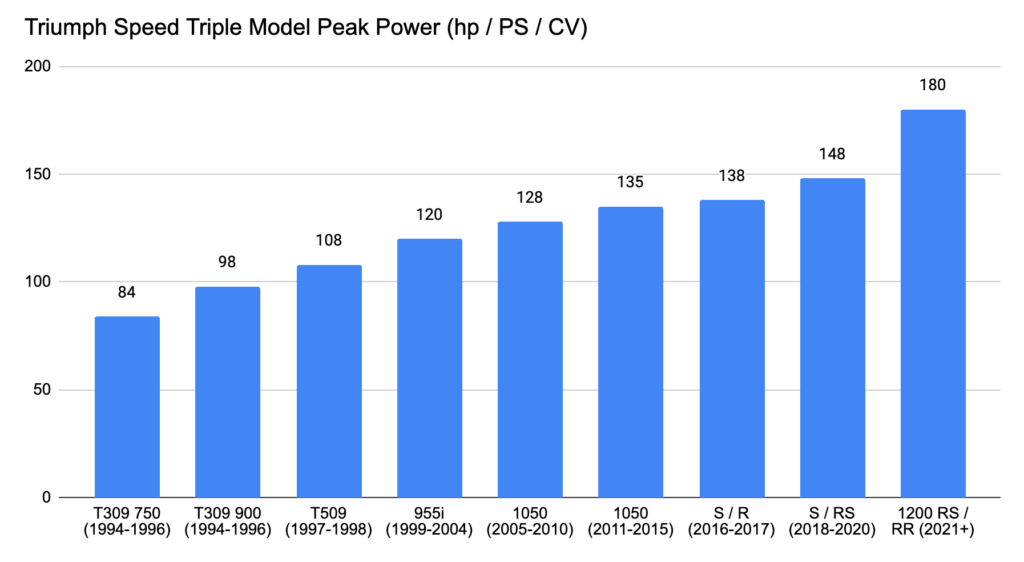
Notes on the above chart:
- The T509 mde 81 hp and 53 lb-ft of torque.
- The 955i was originally released with an engine that made 97 hp, with 61 lb-ft at 5,000 rpm.
Note: Horsepower numbers vary within a ~5% band between sources (I don’t have access to all the original press releases). For example, one will say 103 hp, another 105. Partly this is because people don’t know the difference between PS (metric horsepower, also written CV) and imperial horsepower (hp). But it’s all within margins of error in measurement anyway.
Speed Triple 900 T309 (1994-1996): The Original Café Racer
Triumph announced its first Speed Triple in 1994.
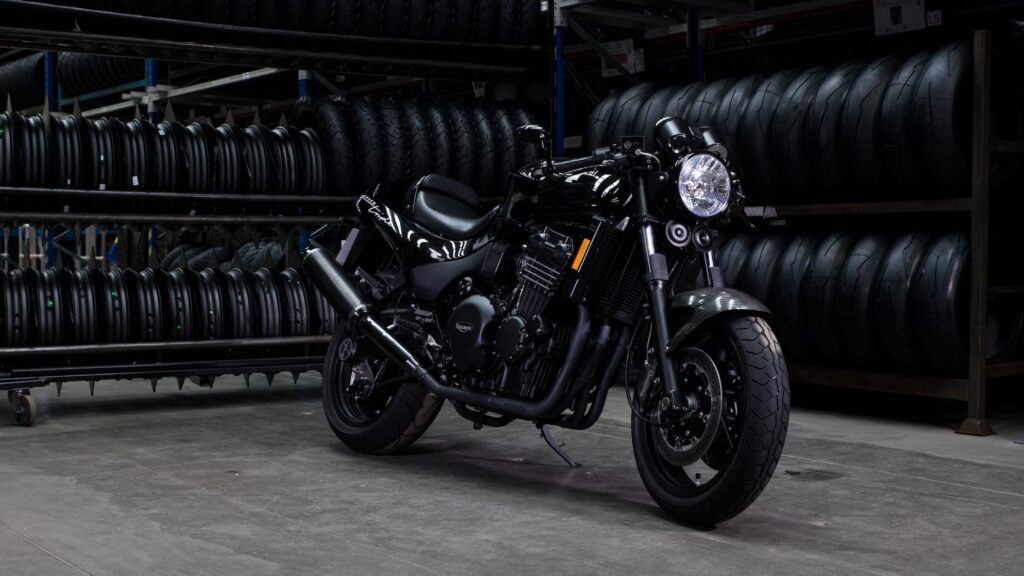
The original Speed Triple could best be described as a naked version of Triumph’s Daytona 900 sport bike. This was a café racer as they originally were. It shared the same engine and the same somewhat heavy steel spine frame that was also used in the Trident 900.
That engine was an 885 cc liquid-cooled carburettor-fed triple that made 73 kW / 98 hp at 9,000 rpm (slightly less in some markets) and had a five-speed transmission. It weighed a hefty 225 kg / 496 lb and had a single round headlight, which was the style at the time.
It wasn’t a high-power sport bike, but nor was it a lazy naked. Look at the low clip-on bars relative to the seat… the seating position is quite aggressive. This is what made this more like a stripped-back superbike rather than a naked sport bike.
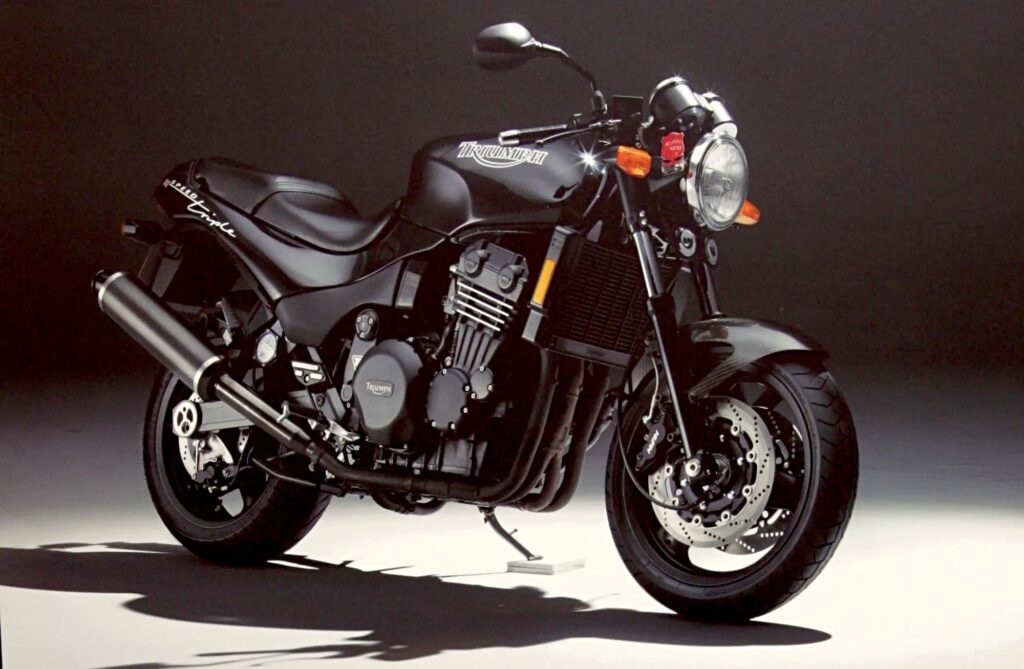
The 1994-1996 Triumph Speed Triple 900 originally had a five-speed transmission, but made up for it with three fewer teeth on the rear sprocket. Later model years got a 6-speed.
It also had a fully adjustable Kayaba fork and a preload- and rebound-adjustable rear shock, which gave it serious setup flexibility for the time, even if damping quality reflected its mid-90s tuning.
While it had dual front disc brakes, they were regarded as adequate rather than outstanding.
It wasn’t an outstanding bike by modern standards — more of a proof of concept. It was a factory-built streetfighter built before that term was widely used. This is what makes the T309 a classic, and they’re in pretty short supply. If you see one in reasonable condition, snap it up!
Speed Triple T309 750 (1994-1996)
Triumph also made a smaller version of the original Speed Triple for a few years. Visually, it looked similar.
Called the Speed Triple 750, the smaller Speedie was based on a 749 cc liquid-cooled triple. It was pretty unsuccessful, having the same chassis but a smaller engine. Visordown describes it as “overweight and underpowered“. Ouch!
Speed Triple 900 T509 (1997-1998): New Frame, Twin Headlights
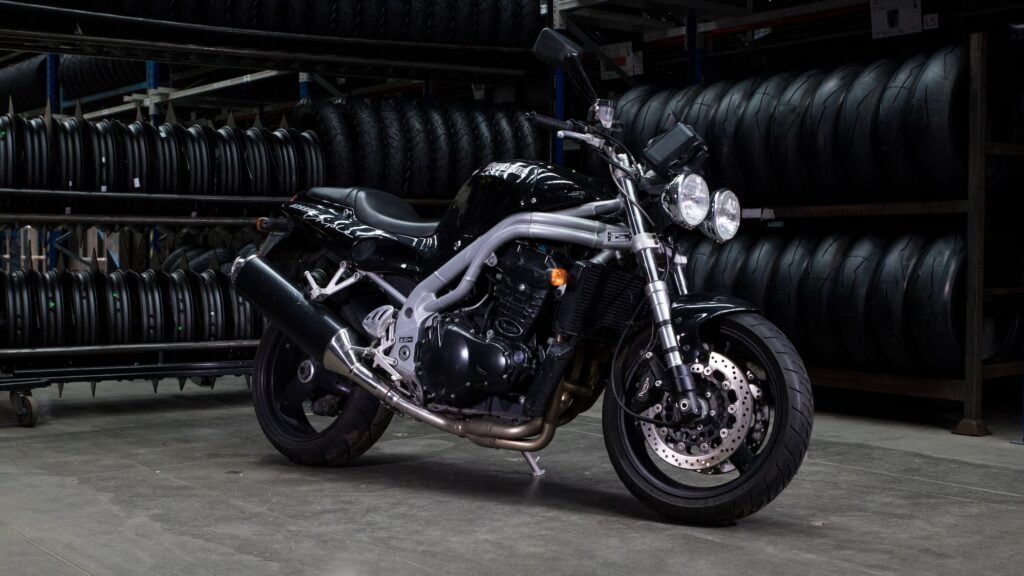
The T509 was a huge redesign of the Speed Triple. It kept the same engine design and capacity of 885 cc, but brought fuel injection.
You’ll also notice from the image above that Triumph introduced a new aluminium twin-spar frame, which was both lighter and stiffer than the earlier steel spine frame. That, combined with the single-sided swingarm, and keeping the double round eyes, made this a very attractive motorcycle!
The riding posture of the T509 was less extreme than the T509, hitting a balance between “sport bike without fairing” and “upright naked”. It’s still aggressive, but comfortable.
The engine in the T509 Speed Triple was based on the fuel-injected T595 Daytona’s engine that made 97 kW (130 hp) at the crank. In the Speed Triple, the detuned motor made peak power of 81 kW (109 hp) at 9,000 rpm, with peak torque of 84 Nm / 62 lb-ft coming on at 6,500 rpm. It’s worth noting this is lower power than modern Street Triple engines, but those do have to rev higher.
The rest of the motorcycle was pretty standard “mid-range sport bike” spec for the time, e.g. 320 mm discs with 4-piston calipers and twin conventional forks with full adjustability.
Speed Triple 955i (1999-2004): Bigger Engine, Improved Fuelling
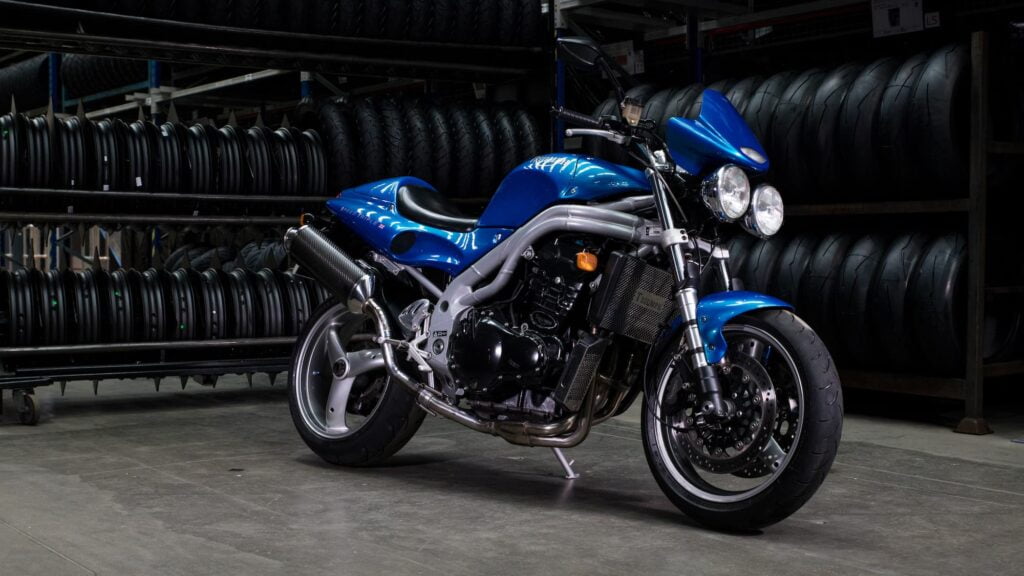
This is where Triumph really came into its own with the Speed Triple. It’s not my favourite model ever, but it’s close.
The Speed Triple 955i was still a sibling of the Daytona 955i and borrowed the same engine — a 955 cc fuel-injected triple. But the Speed Triple was increasingly becoming its own thing. The Sprint 955i with the same engine didn’t have closed-loop fuel injection in the US, but the Speed Triple did.
Specs vary per source, but there’s a consensus that in stock form, the 955i was a noticeable upgrade over the T509 Speed Triple. Triumph didn’t just add fuel injection to the 955i — they also changed the manufacturing process, changing from sand-cast to high-pressure digh-cast cases, giving a cleaner look. Combined with fewer external hoses, Triumph shaved around 5.5 lbs (2.5 kg) off the engine’s weight.
The initial run of the 955i (1999-2001) had a lower compression ratio engine, but Triumph revised that in 2002.
| Spec | 1999–2001 (Early 955i) | 2002–2004 (Late 955i) |
| Max Power | ~81 kW / 110 hp @ 9,200 rpm | ~89 kW / 120 hp @ 9,100 rpm |
| Max Torque | 95 Nm @ 5,800 rpm | 100 Nm @ 5,100 rpm |
| Compression Ratio | 11.2:1 | 12.0:1 |
| Fuel System | Sagem MC2000 | Sagem MC1000 (Closed loop) |
But midrange torque was the real headline — strong, immediate, and available from low revs and well up through the rev range, peaking relatively early. The gearing of the 955i made it easy to ride every day as well as on the highway; this isn’t a highly strung sports bike.
The Speed Triple 955i kept the aluminium twin spar frame, but redesigned the bodywork and the rear wheel. Also kept were the Showa 45 mm conventional forks and monoshock, all fully adjustable. And the twin headlights, hooray! Triumph kept the aggressive-but-comfortable position of the T509 for the 955i.
Triumph got the fuel injection so right on the 955i that it’s unnoticeable. That’s the point, anyway! Manufacturers lose the balance every few years as emissions laws get tighter. But the 955i was smooth at both low loads or rpms and high.
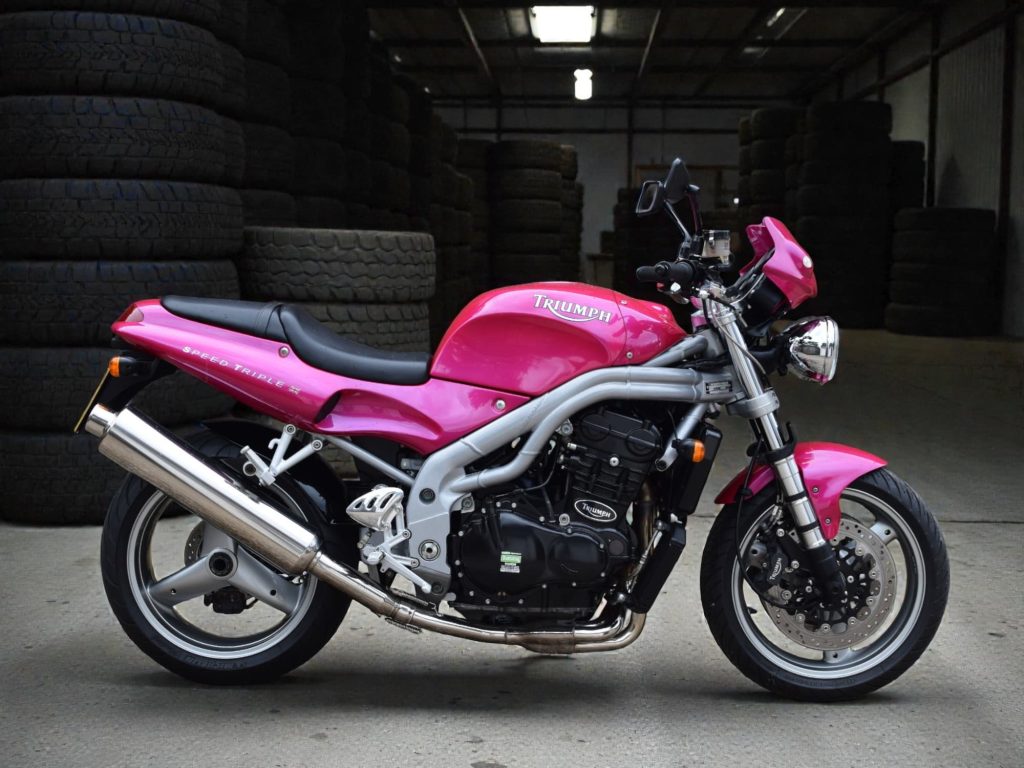
Triumph has occasionally experimented with colours. The Speed Triple 955i came in traditional colours of black and blue, but eventually also green and even a variant of red, “Nuclear Red”, which I don’t think would have been very popular, which would be a unique collector’s item now.
Speed Triple 1050 (2005-2010): Breaking Free of the Daytona
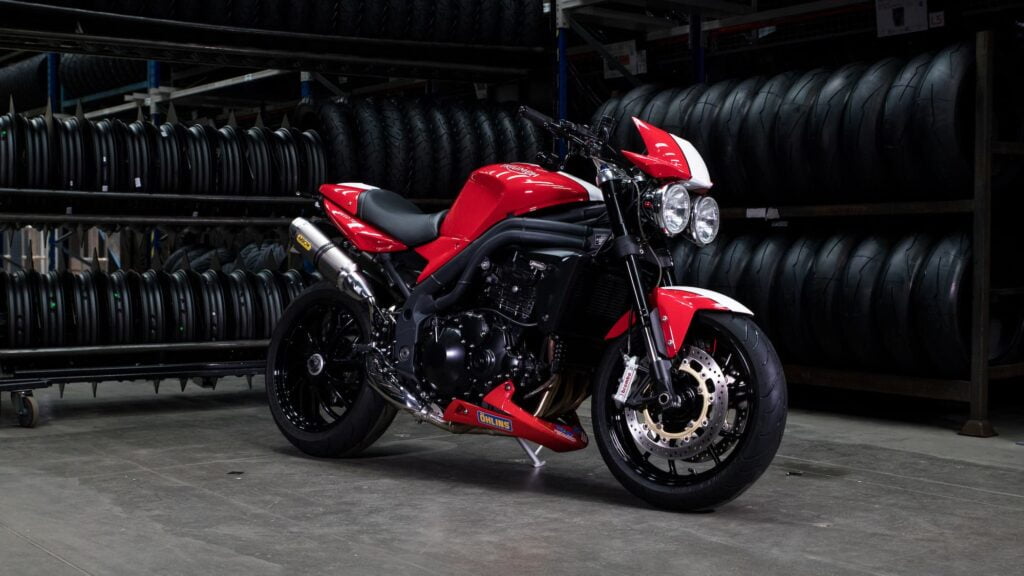
The first-gen Speed Triple 1050 was when Triumph shed its shackles. Triumph had abandoned the consumer-facing Daytona line and was just selling Speed Triples, which is pretty amazing. Most manufacturers use their engines in a fairing-equipped sport bike as well. Even Yamaha has capitulated in recent years and released the YZF-R9 (and we’re all very happy about it). But Triumph has focused on handlebars.
You may be shocked to learn that the Speed Triple 1050 has 95 cc more capacity than the 955. Shocked! And even more shocked to learn that the differences don’t end there. In fact, without further ado, I’ll just say that the 2005 Speed Triple won Cycle World’s designation as the best open-class street bike of the year.
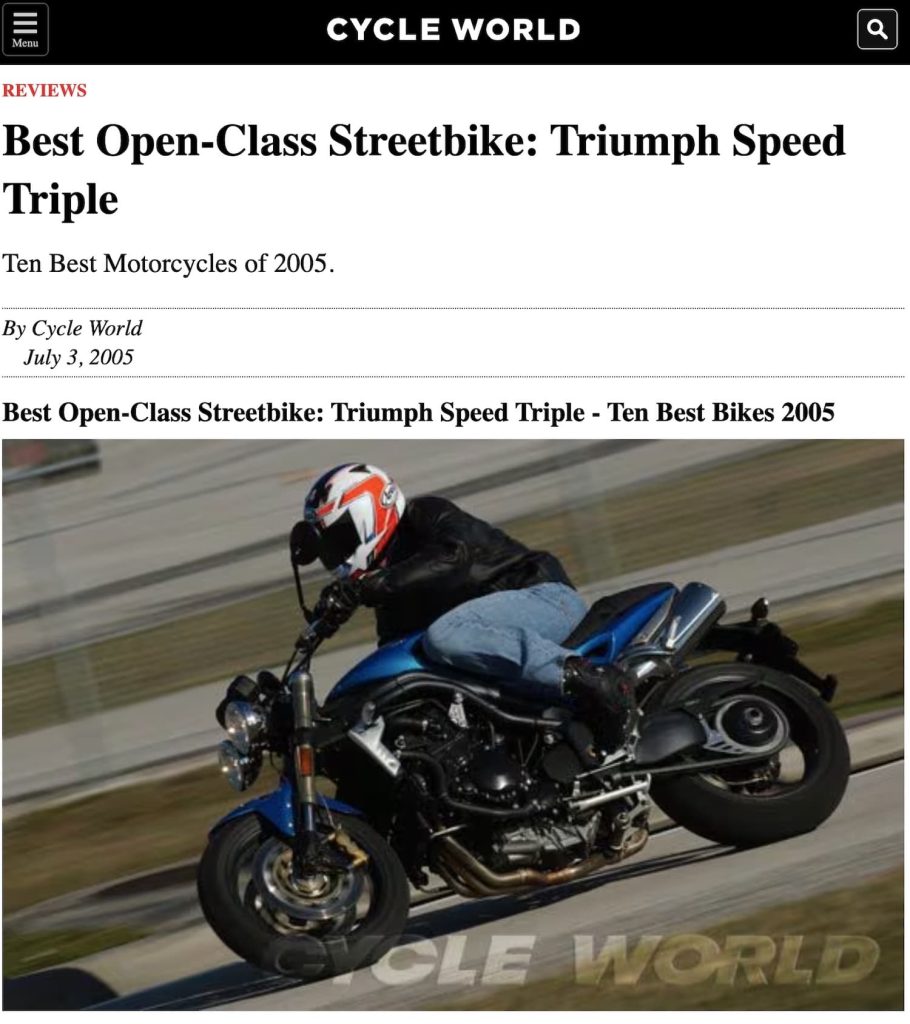
Man, the 2005 Speed Triple really hits a sweet spot. More power, twin headlights, updated rims, that under-seat exhaust… It’s really an “engine with wheels” as Triumph described it.
The crazy thing about the 2005 Speed Triple 1050 is that Triumph managed to squeeze out more power by getting even more midrange out of it. You can hammer this thing from 2000 rpm all the way to the redline. So while Triumph did bless it with around seven more kW or ten more horses, it makes it with a meatier torque curve, not by extending the rpm ceiling.
Per the brochure, the 2005 Speed Triple made 96 kW (130 PS / 128 bhp) at 9,100 rpm, with peak torque of 105 Nm (78 lb-ft) at 5,100 rpm.
The chassis looks similar to that of the earlier gen, but Triumph did make a raft of changes, including:
- Inverted fork with full adjustability (the 955i had a conventional fork) — somewhat stiff but not as much as earlier
- Radial calipers, updated from Nissin in 2005-2007 to Brembo in 2008-2010
- Updated spoked rims, with the 5-spoke in 2005 being updated to a 10-spoke in 2008.
- Slightly shorter wheelbase through a redesigned swingarm
- Narrower 5.5-inch rear rim with a 180 tyre, rather than a 190, lightening up steering and reducing weight
- Plastic fuel tank (which can swell with ethanol!)
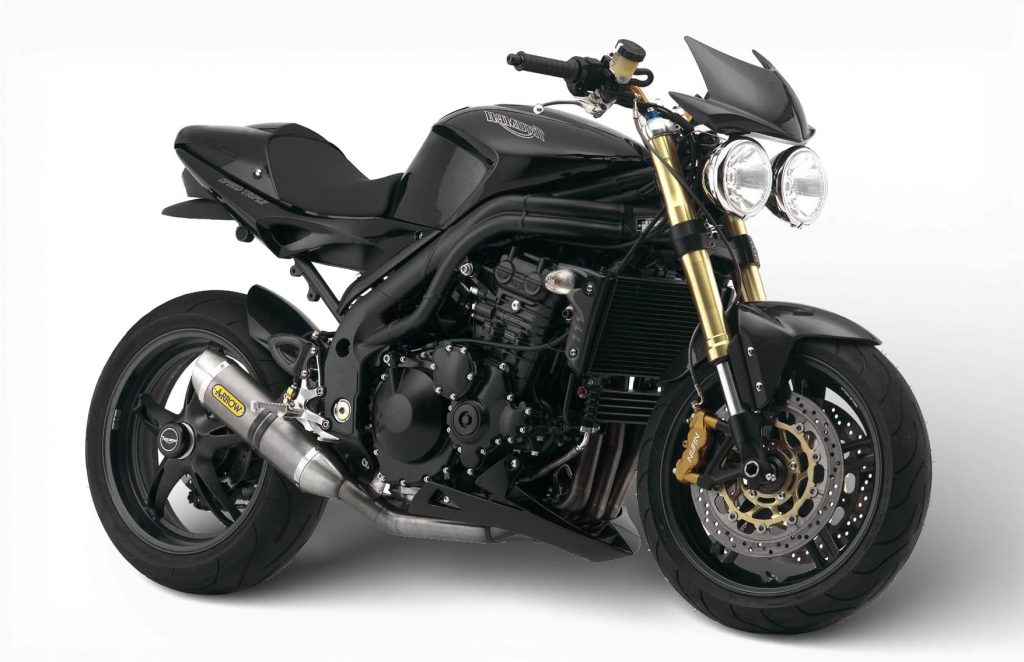
The 2005 Speed Triple 1050 wasn’t just a contender on specs — it was also pretty reasonably priced, positioned between the Yamaha FZ1 and the Ducati Monster 1000 at the time.
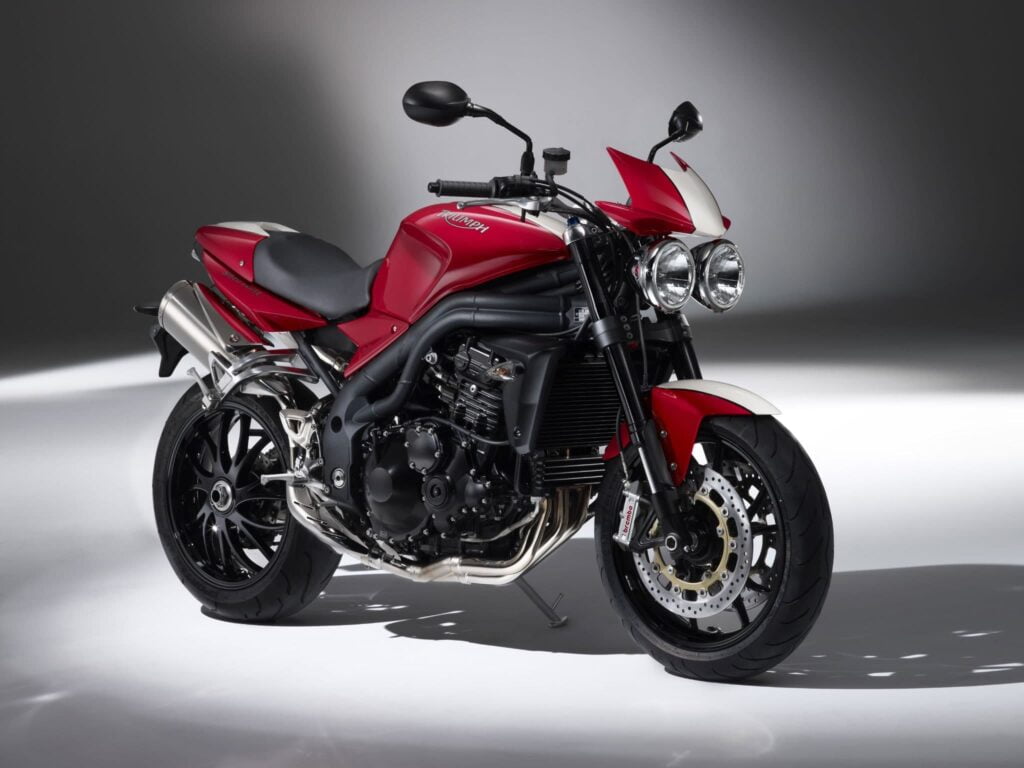
The 2010 Speed Triple SE was the culmination of all the changes in the 2005-2010 line, but with a sneak peak of suspension upgrades that would make it into the 2011 line, including revised internal valving of the fork and a 5% softer spring in the shock, both to make on-road manners more plush.
Plus, it got some sweet decals, came stock with the fly screen and seat cowl, and got and a nice stripe and paint job — “Tornado Red” with a “Crystal White” stripe.
Speed Triple 1050 (2011-2015): Fox eyes, the first R model, and ABS
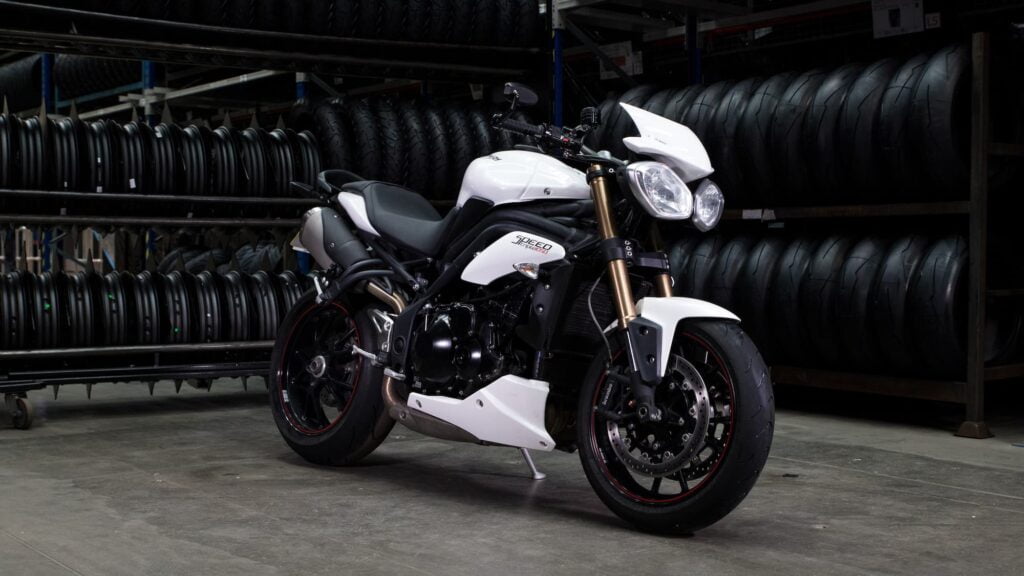
Goodbye, round headlights; hello, fox-eyes! It’s divisive, with some of you saying “good riddance” and some of you shedding a tear. Opinions aside, the new ones are definitely more aerodynamic.
Triumph kept the 1050 fuel-injected triple (hooray!) and squeezed an atom (five hp, three kw) more horsepower out of it. They did this through refinement rather than redesign, for example with better catalytic converter (also repositioned for mass centralisation), a larger airbox, and a wider crankcase ventilation hole to reduce pumping losses. Somehow, they got this minimal power increase through a huge eight per cent increase in peak torque. So the good news is that the engine behaves a lot like before — torque everywhere, pulling from just off idle all the way to the limiter, if you ever get there.
Engine aside, Triumph made a bunch of changes that refined rather than reimagined the 2008 revision to the Speed Triple. Triumph redesigned the tubular twin spar chassis to pur more weight on the front wheel. They also made it more comfortable, moving the rider 44mm (almost 2 inches) closer to the handlebars, and lightened the swingarm while lengthening it in the process. The bike feels slimmer and lower, with a bias on the front rather than slightly on the rear, as was the case with the former model (51/49 vs 49/51 previously, rounding).
Triumph also further refined the braking in the 2008 revision, adding a Brembo radial master cylinder to actuate the Brembo radial front brake calipers that were introduced, helping increase braking precision and feel.
Oh, also, Triumph brought back a 6-inch rim and 190-wide tyre, but managed to keep it lighter than previously, partly thanks to thinner brake discs, lighter wheels, and higher-grade tyres.
The net result is that the 2011 Speed Triple was better balanced AND 3kg / 6.6 lbs lighter… unless you opt for ABS, which balances it out. But nobody needs ABS, other than people who drive on roads that sometimes have unexpected oil slicks, gravel, or leaves (maybe not you, but it saved my ass and fairing more than once, converting me).
Speed Triple 1050 R (2012-2015)
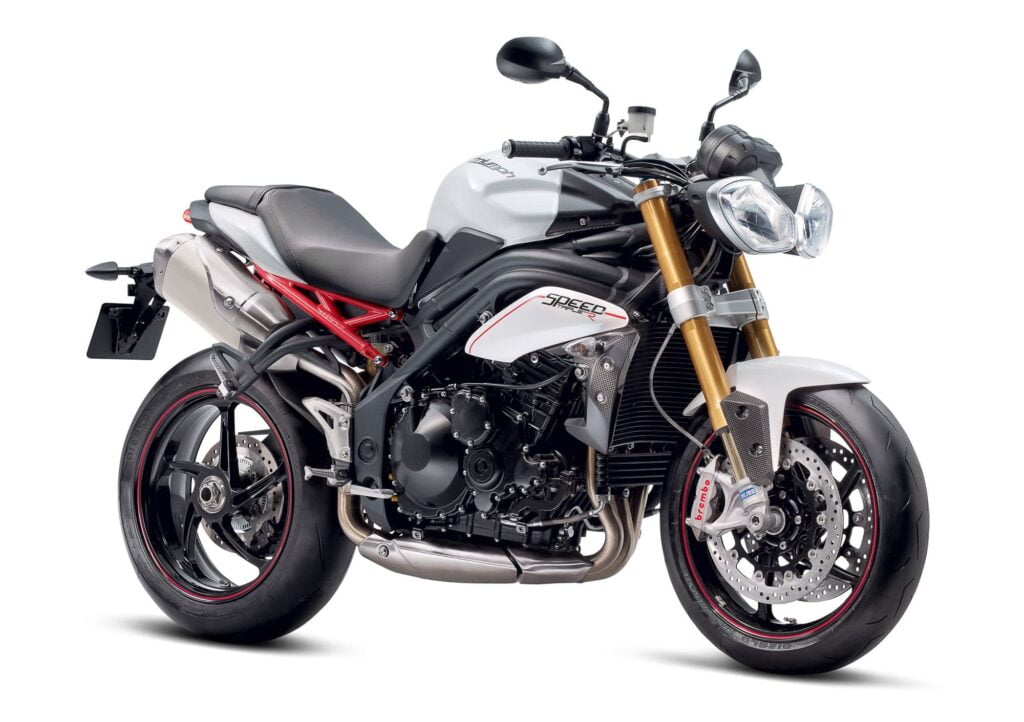
Here’s trouble — the first R model! The year 2012 was the first year that Triumph released a higher-spec “R” model, something they’ve kept doing (although R has become RS since 2018).
The original 2012 Speed Triple R had the same engine as the 2011 Speed Triple 1050, but got better suspension and brakes:
- Front suspension: Öhlins fully adjustable 43mm NIX30 USD forks
- Rear suspension: Öhlins TTX36 fully adjustable shock
- PVM Forced alumin[i]um wheels: a massive 1.7 kg / 3.7 lb lighter! Plus Pirelli Supercorsa SP tyres stock
- Brakes: Twin 320mm floating discs, Brembo M4.34 monobloc calipers
- New gearbox with improved shifting for smoother transitions
Öhlins! Finally! It might seem ridiculous because it seems every street bike comes with optional high-spec suspension these days, but it wasn’t always the case on the Speed Triple.
The first Speed Triple R was basically in response to people who wanted a Speed Triple but who wanted to do track days. That said, I’m sure most customers of the R just want the best there is, even if they just use it to ride to and from work or out on the street in other places. The lighter wheels and high-grip tyres went a long way to improving grip, too. (But Triumph abandoned these on the R models in subsequent years, possibly due to cost, so double check any you’re buying used has them.)
Those Öhlins suspension units stayed the same through to the 2018+ RS. Only the 1200 RS (2021+) received significantly upgraded suspension. So if you want a Speed Triple with suspension and brakes that are as good as on the 2018+ RS, just lacks things like cornering ABS and cruise control, then the 2012 Speed Triple 1050 R is the earliest you can go.
The Speed Triple R also got a snazzy red subframe, carbon fibre panels, and red pinstripes on the wheels for you to let everyone know you’re legit.
Triumph Speed 94 and 94 R (2015)
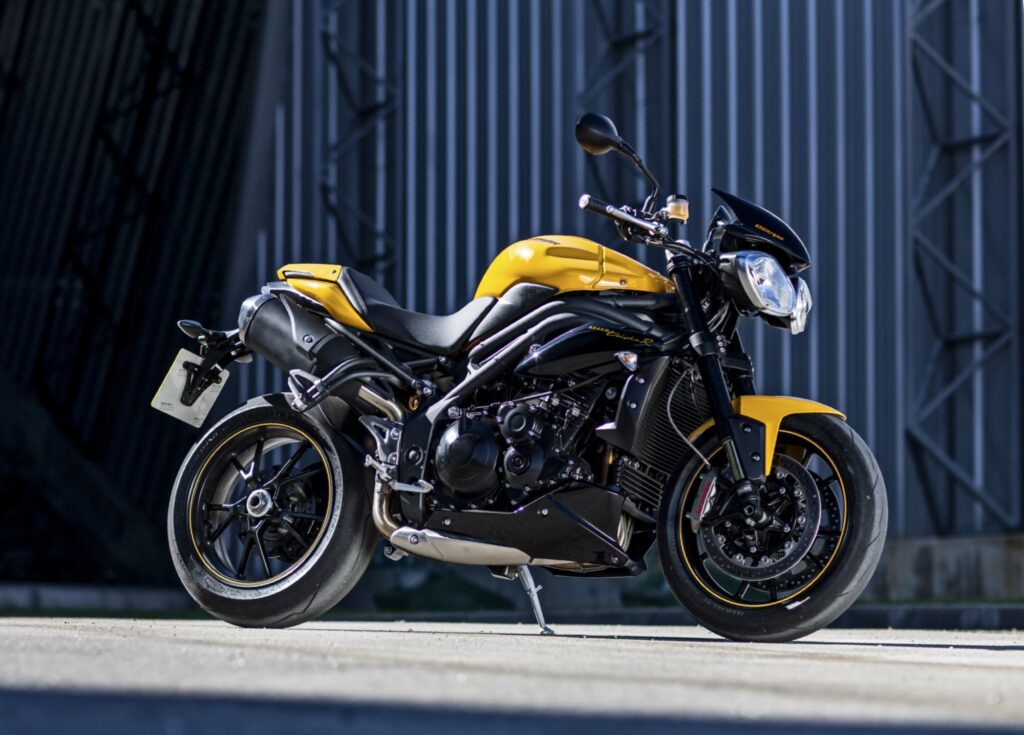
In 2015, Triumph released a special version of the 2011-2015 range of Speed Triples — the Speed 94 and Speed 94R, so named to call back to 1994 (which, as you know, is the year of the first Speed Triple).
It’s the same basic motorcycle, though in two unique colour schemes — Racing Yellow or Jet Black, to hearken back to the original iconic 1994 machines. It doesn’t look anything like the originals, though (and that’s a good thing).
Available in Racing Yellow or Jet Black, both colours are specially re-formulated mixes created to match the very first Speed Triple paint schemes, and instantly tie Speed 94 back to the iconic machines.
They have the following additional aesthetic features:
- Black exhaust silencer wraps
- Black filler cap
- Colour-matched fly screen, seat cowl and belly pan
- Yellow pin-striping (Racing Yellow colour option only)
- Speed Triple logos in the original 1994 typeface
- Commemorative Speed Triple 94 tank-mounted plaque
The Speed Triple 94R is, like the Speed Triple 1050 R, a higher-spec version of the same bike, with fully-adjustable Öhlins NIX30 43mm forks up front, an Öhlins TTX36 rear shock, Brembo M4.34 radial calipers, and Pirelli Supercorsa SP tyres.
Triumph Speed Triple R and S (2016-2017): More Ride Aids, More Power
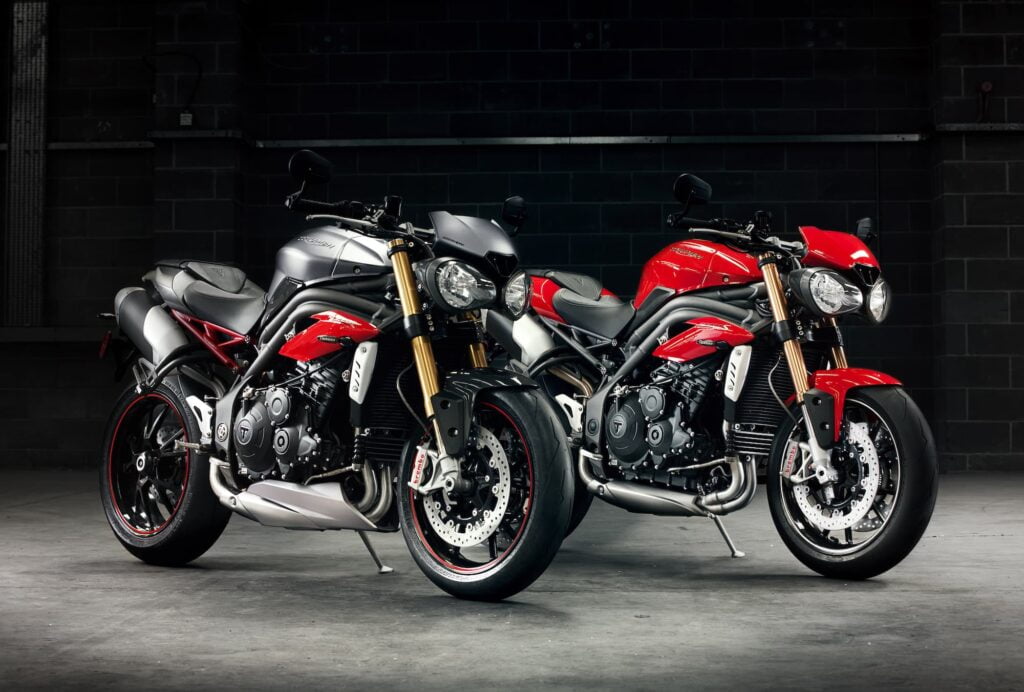
In 2016 Triumph gave the Speed Triple a full ride-by-wire system. This brought with it ride modes, traction control, and a switchable ABS system (that’s standard on all bikes).
That’s not to say they didn’t work over the engine! But we’ll get to that in a second. Wait, maybe I should start by saying they worked over the fox eyes to make them more teardrop-shaped, but that would be admitting Triumph riders obsess almost exclusively over the shape of headlights. I swear it isn’t true.
Anyway, RbW system meant that Triumph could give the 2016-2017 Speed Triple
- 5 Riding Modes: Rain, Road, Sport, Track, and a “Rider Configurable” mode.
- Traction Control: For the first time, TC was standard and integrated into the riding modes (though still switchable).
- ABS (now standard… sorry, haters)
Triumph also smoothed out the “jerky” low-speed fueling that occasionally plagued the 1050 with revised electronic ECU mapping. Also,
Aside from that, Triumph made many internal revisions to the 1050 engine to keep it emissions compliant while squeezing out more power. Triumph gave the 2016 engine a new crankshaft, new pistons, and a redsigned combustion chamber. All of this helped it rev more freely, giving it peak power of 103 kW / 138 hp @ 9500 rpm, up by about 4% from the previous gen.
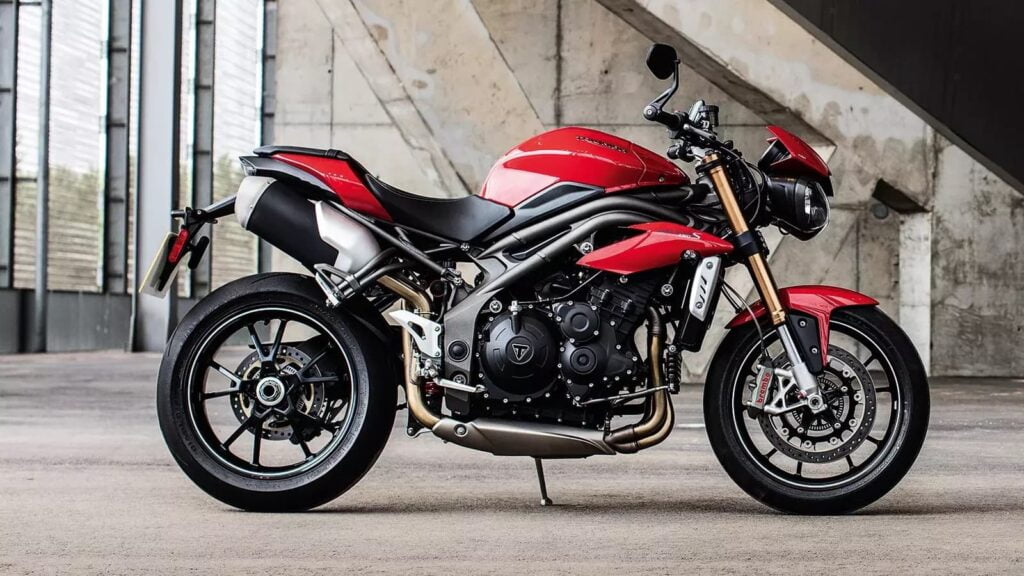
Triumph made two versions of the 2016-2017 Speed Triple: the S and the R. The main difference between them is suspension.
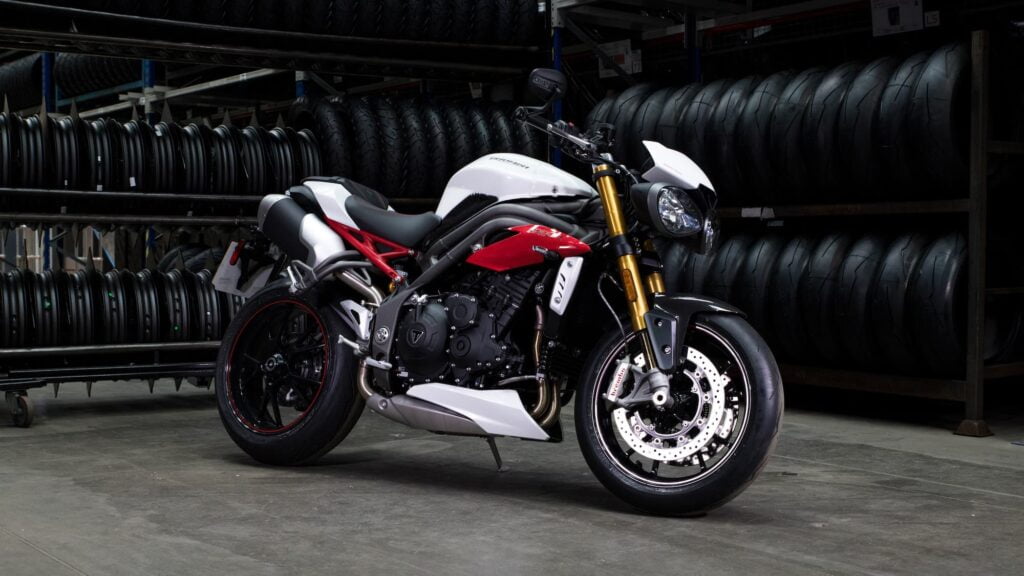
| Feature | 2016-2017 Speed Triple S | 2016-2017 Speed Triple R |
| Front Suspension (fully adjustable on both models) | Showa 43mm USD Forks | Öhlins NIX30 USD Forks |
| Rear Suspension (fully adjustable on both models) | Showa Monoshock | Öhlins TTX36 Shock |
| Brakes | Brembo M4.32 Monobloc | Brembo M4.32 monobloc (same) |
| Bodywork | Plastic | Carbon fiber mudguard & tank Infills |
| Detailing | Standard black/silver | Red Subframe, red wheel pinstripes, belly pan |
Speed Triple RS and S (2018-2020): Power Bump + RS model
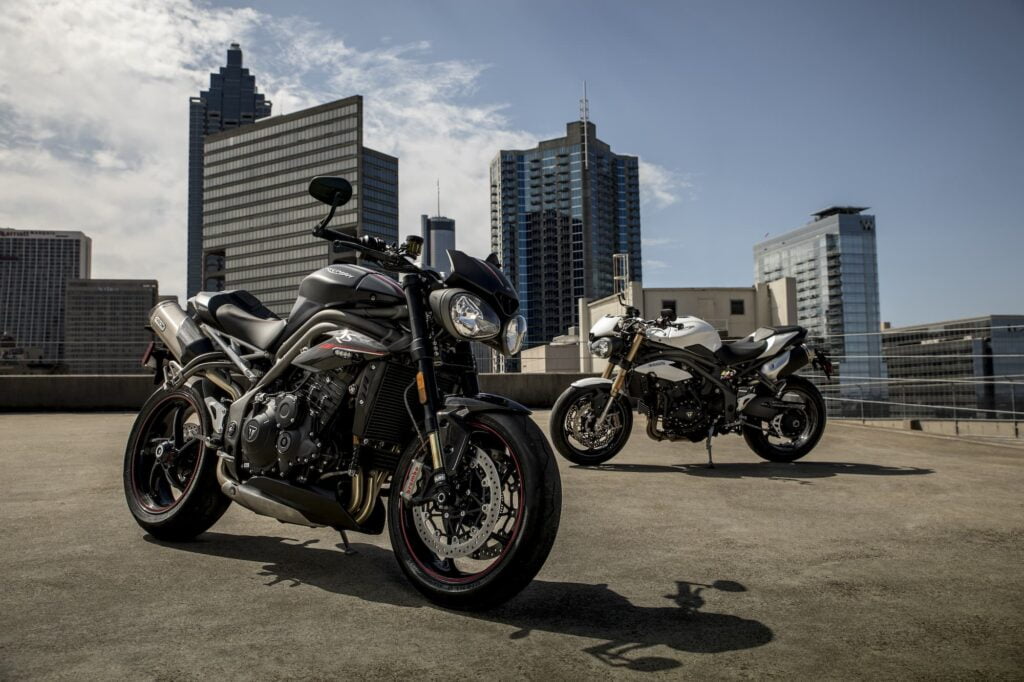
The 2018-2020 models of the Triumph Speed Triple were the grand finale for the 1050 engine. They got another bump in power, equipment spec, and technology, while keeping the general design aesthetics of the last-gen Speed Triple R and S.
The engine in the 2018-2020 models remained the 1050 cc inline triple — but this would be the last generation with this capacity! It would be the end of an era for an engine many say is one of the finest Triumph has produced.
For the 2018 iteration, Triumph bumped the compression ratio to 12.92:1, increasing peak power to 110 kW (148 hp / 150 PS), a ~6% bump from the last model, though revving higher to get there – the engine’s redline was raised 1,000 rpm. This came thanks to a lighter crankshaft, new pistons, and a new sump that lowered the oil level.
Like the 2016-2017 R and S, Triumph kept two designations, this time RS and S.
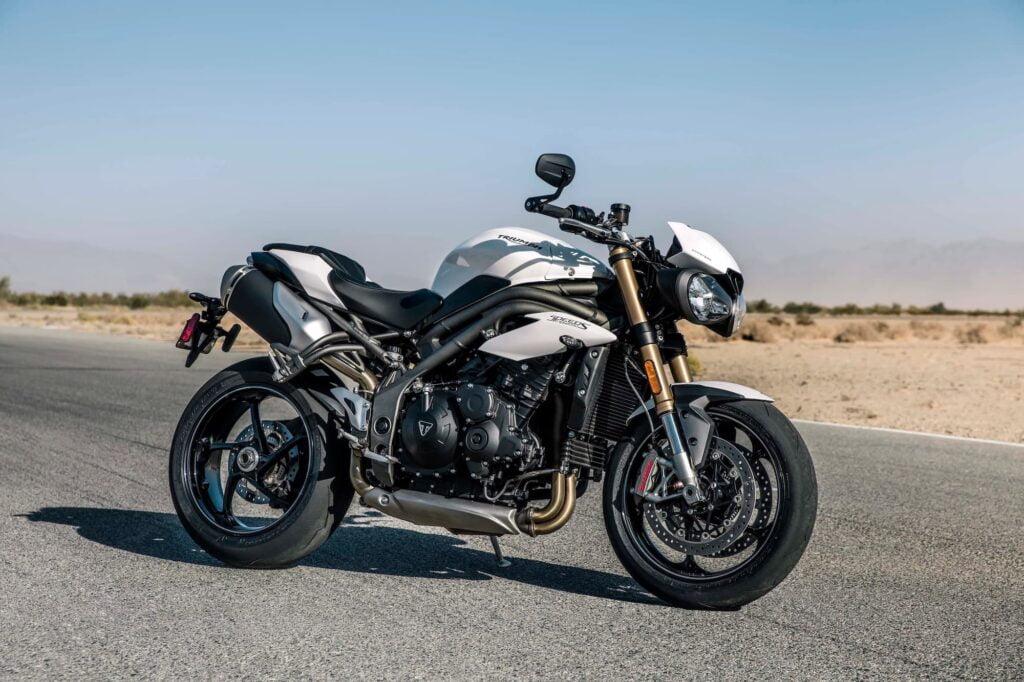
The S model is the revised 2016-2017 model, with a better engine and TFT display. Triumph also gave these bikes backlit switch gear, and both models got cruise control and DRLs.
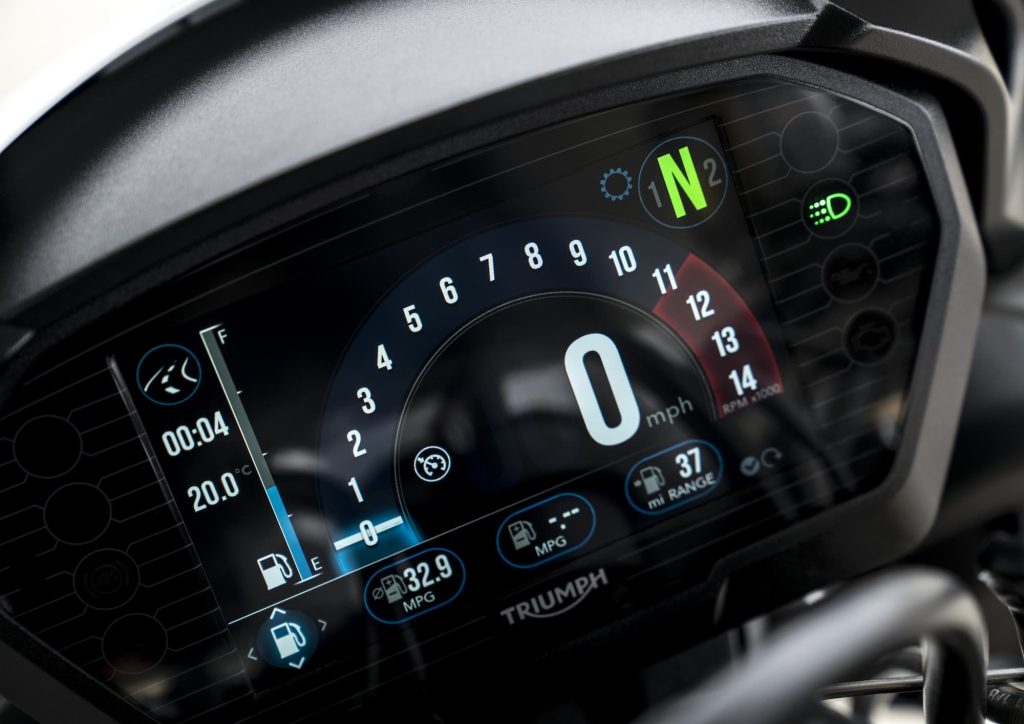
Both models got a TFT display, lightweight ten-spoke wheels (they look five-spoke, but have a little Y at the end), carbon fibre bodywork, and a revised exhaust, that gave both models a great sound — a deep, raspy howl that pops on overrun.
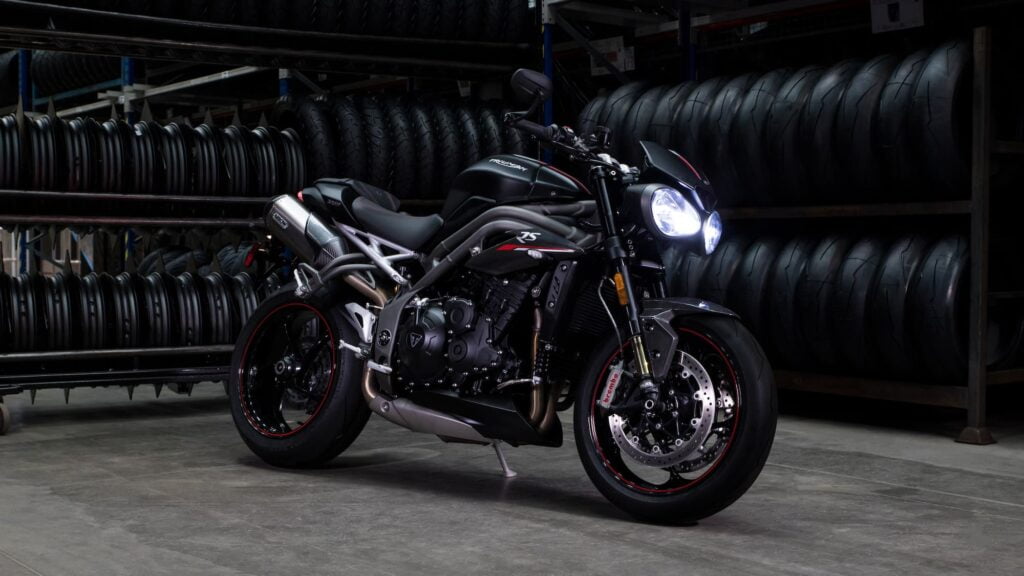
On top of the power bump and TFT display, the 2018 Speed Triple RS got a six-axis IMU as standard, giving it cornering ABS and cornering-aware traction control. All models of the Speed Triple after this point received this feature. It has slowly trickled down into even mid-range bikes from Triumph, like the Trident 660, but this was one of the first Triumph’s to get it.
It may appear strange that the IMU was an RS-only feature. It may have made sense at the time. But it’s such an integral part of the electronics that I expect it would have cost more to design two versions, one with and one without, than to just put it on all of them. These days, premium versions of bikes have higher-spec suspension and brakes, and lightweight components, but electronics is typically shared.
The RS also got standard keyless ignition and a matt aluminium subframe, a change from the red ones of earlier years.
The 2018+ Triumph Speed Triple RS retains the high-spec components of the 2016-2017 R that precedes it — Öhlins fully adjustable 43mm NIX30 USD forks, Öhlins TTX36 fully adjustable shock, and Brembo M4.34 calipers up front, plus other lightweight components.
The 2018 S and RS were, unsurprisingly, the favourites in the range for most riders, with the RS being described as the most “planted” to date (probably a combination of things, but the light wheels would help). Some preferred the S model for road riding, but it would be tough to pass on getting the kitchen sink of specs if you can afford it.
The 2018 Speed Triple S and RS remained king of the hill until 2020, when it was retired in favour of the new Speed Triple 1200 RS, which would have a new engine.
Triumph Speed Triple 1200 RS (2021+): New 1160 Engine
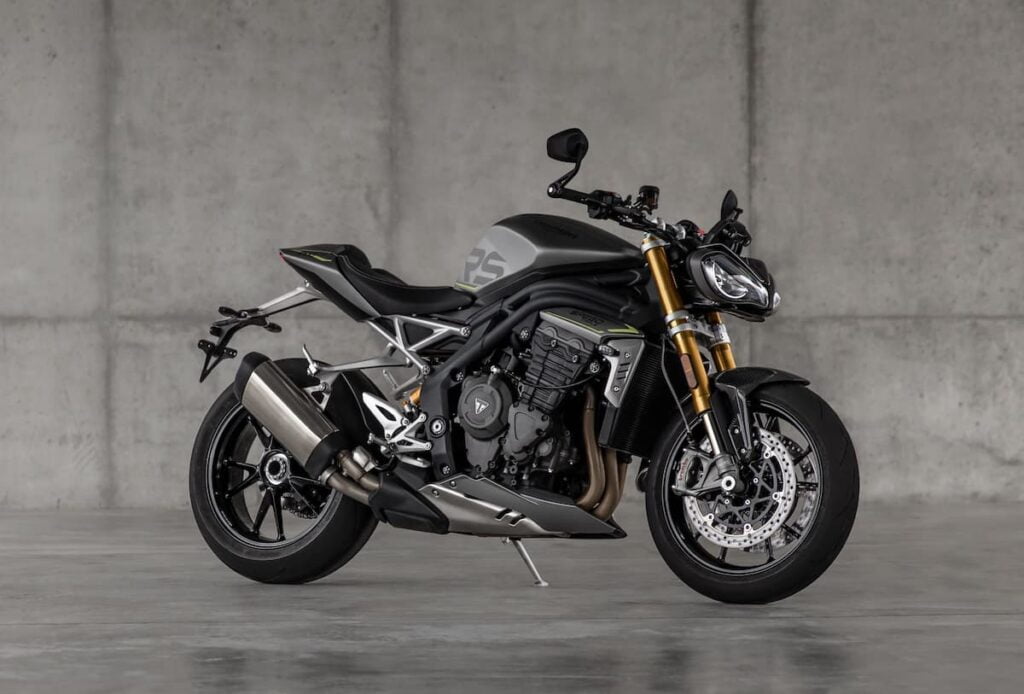
In 2021, Triumph released the new Triumph Speed Triple 1200 RS. This was the first time Triumph increased engine capacity in a Speed Triple in over a decade, since 2005.
Reviewers generally praised Triumph for not capitulating to pressure in the horsepower wars and trying to one-up others — e.g. the Ducati Streetfighter V4, which puts out over 200 hp at peak. But it’s still a mighty powerful bike, making 132 kW (180 PS / 177 hp) at 10,750 rpm, a huge bump of 22 kW or 30 PS.
Yes, 1160 cc is only a small increase in capacity over 1150 cc. But it comes via a totally redesigned engine with a significantly shorter stroke (thus higher bore:stroke ratio) and compression ratio, letting Triumph tune it for considerably more peak power with a higher peak rpm (650 rpm higher).
Consider how the torque has moved up in the rev range in the last 20 years (considering the fuel injected era… before this, and even at the T509 period, you’re probably not looking for outright power!)
| Spec | T509 (1997–1998) | 955i (1999–2001) | 955i Revision (2002–2004) | 1050 (2005–2010) | 1050 (2011–2015) | 1050 (2016–2017) | 1050 RS (2018–2020) | 1200 RS (2021–2024) | 1200 RS (2025 Update) |
| Capacity (cc) | 885 | 955 | 955 | 1050 | 1050 | 1050 | 1050 | 1160 | 1160 |
| Peak Power | 80 kW / 109 PS / 108 bhp @ 9,300 | 81 kW / 110 PS / 108 bhp @ 9,200 | 88 kW / 120 PS / 118 bhp @ 9,100 | 96 kW / 131 PS / 128 bhp @ 9,100 | 99 kW / 135 PS / 133 bhp @ 9,400 | 103 kW / 140 PS / 138 bhp @ 9,500 | 110 kW / 150 PS / 148 bhp @ 10,500 | 132 kW / 180 PS / 177 bhp @ 10,750 | 135 kW / 183 PS / 180 bhp @ 10,750 |
| Peak Torque | 85 Nm / 63 lb-ft @ 7,600 | 97 Nm / 72 lb-ft @ 5,800 | 100 Nm / 74 lb-ft @ 5,100 | 105 Nm / 77 lb-ft @ 5,100 | 111 Nm / 82 lb-ft @ 7,750 | 112 Nm / 83 lb-ft @ 7,850 | 117 Nm / 86 lb-ft @ 7,150 | 125 Nm / 92 lb-ft @ 9,000 | 128 Nm / 94 lb-ft @ 8,750 |
| Bore x Stroke | 76 x 65 mm | 79 x 64 mm | 79 x 65 mm | 79 x 71.4 mm | 79 x 71.4 mm | 79 x 71.4 mm | 79 x 71.4 mm | 90 x 60.8 mm | 90 x 60.8 mm |
| Comp. Ratio | 11.0:1 | 11.2:1 | 12.0:1 | 12.0:1 | 12.0:1 | 12.25:1 | 12.9:1 | 13.2:1 | 13.2:1 |
It’s interesting to see how torque used to peak as low as 5,100 rpm. What is this, a Harley? Nope! Yes, peak power has gone up, but at what cost?
Of course, peaks are only peaks, and it’s the curve that matters. There’s still plenty of torque just over 2,000 rpm and it doesn’t taper off until you hit the redline.
Initially, Triumph still sold the 2017 models alongside the 2021 RS, only replacing the 2018-2020 RS. So you could opt for the old engine at a lower price. But eventually, the old models were retired, and interestingly, Triumph only continued to sell the RS model.
- Öhlins fully adjustable 43mm NIX30 USD forks, Öhlins TTX36 fully adjustable shock
- Twin 320mm floating discs, Brembo Stylema monobloc calipers
- Low muffler (no more under-seat)
- A full keyless system (first time on any Triumph), including a keyless fuel filler.
Triumph still sold the 2017 models — the R and the S. The RS was the only one with the bigger engine. And the 1160-powered RS still had an IMU, cruise control, and the Öhlins full suspension.
The Speed Triple 1200 RS was the first speedie to lose the under-seat exhausts (after gaining them), though it kept the single-sided swingarm. So if you want those under-seat exhausts and are happy with less power, opt for a used Speed Triple R.
Impressively, the 2021 Speed Triple 1200 RS was just 198 kg wet, ready to ride… this is crazy light for a bike this powerful, but that might be just my metric number bias thinking 200 is some kind of magic number (it is).
2025 Speed Triple 1200 RS Update: Semi-Active Öhlins
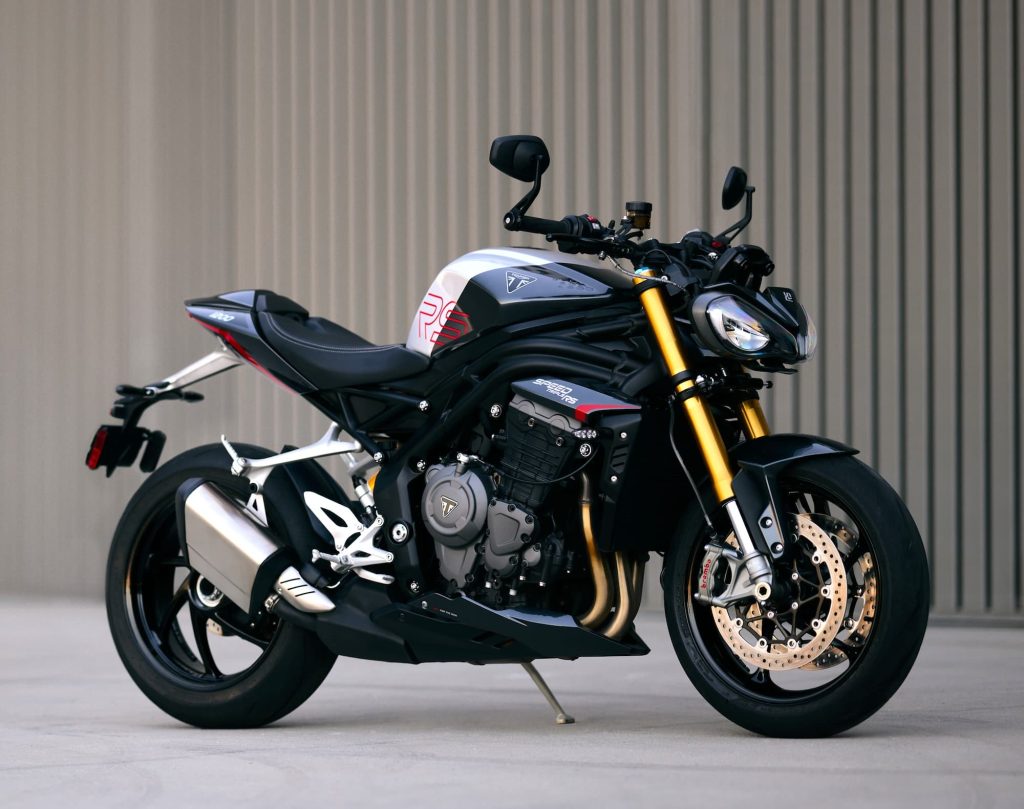
Triumph made some revisions to the 1200 RS for 2025, borrowing from the 1200 RR (which I’m about to go into) but extending them, too.
Yes, the engine got a small power bump, and made slightly more torque and slightly lower in the rev range (never sure how Triumph achieves this!), but that’s not the headline.
The feature worth mentioning is Öhlins Smart EC3 semi-active suspension. The SmartEC3 system is the first semi-active suspension setup on a Speed Triple RS (the RR did get it earlier).
This is part of a tech suite in the 2025 model that includes Öhlins Objective-Based Tuning Interface, which lets you adjust suspension firmness, braking and acceleration support, cornering support, and cruising support. Even the cruise control is adjustable.
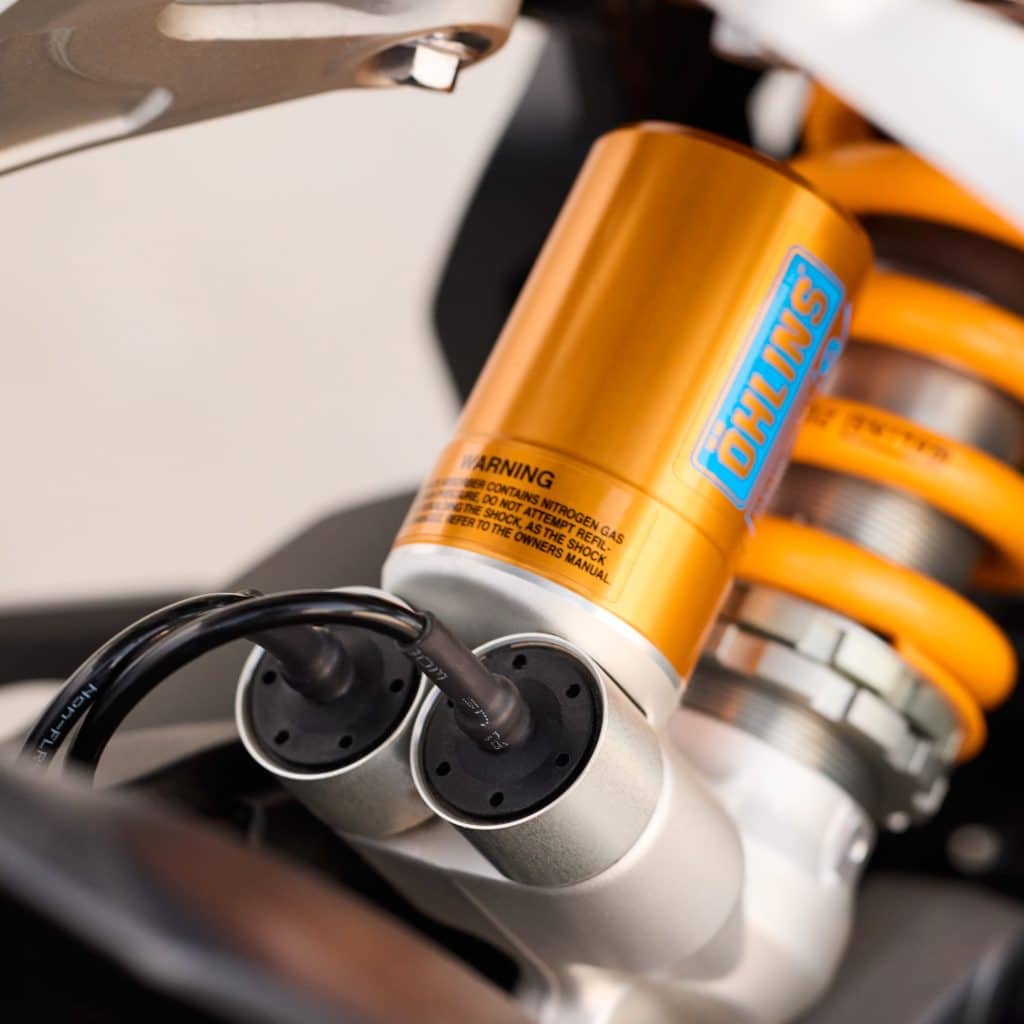
Triumph also replaced the wheels with new, lighter cast aluminium ones.
Triumph Speed Triple 1200 RR (2022+)
Now we’ve come partly around the circle! The sneak preview, if you’re reading this in order, is that the Speed Triple RR has semi-active suspension.
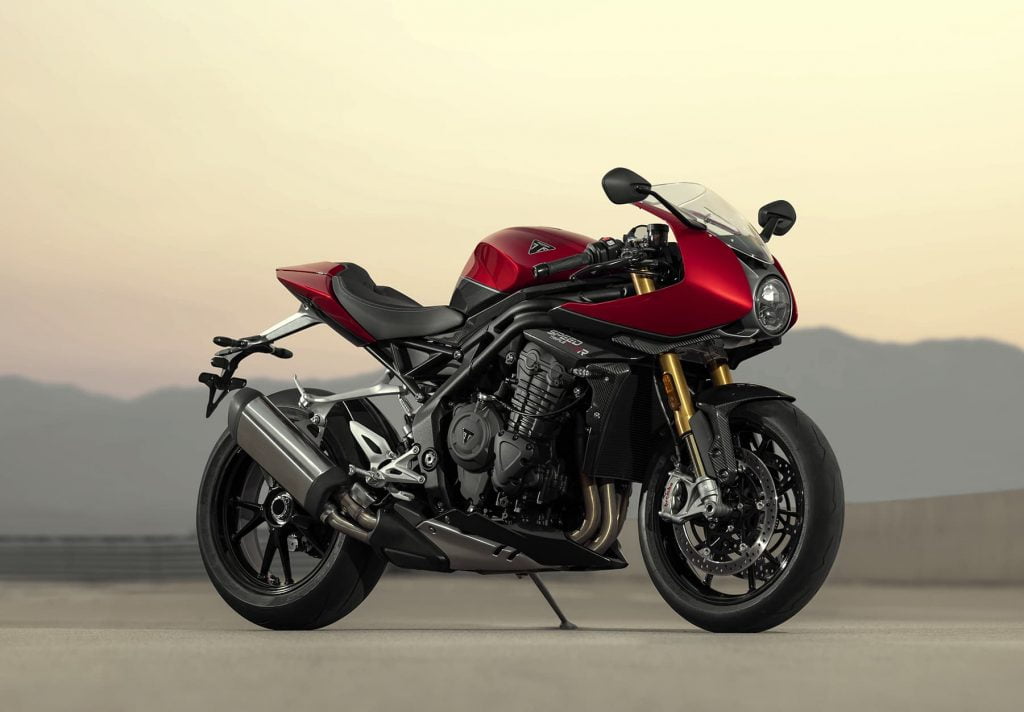
But really, what’s special to most is what the Speed Triple RR looks like. The Speed Triple RR adds a little fairing to the Speed Triple RS. It’s not a Daytona again by a long shot, but it’s acknowledging that sometimes, a little protection is good — if only to keep the bugs off the instruments and the lower half of my jacket.
The Speed Triple RR keeps the 1160 cc high-revving triple of the original 1200 RS, but adds:
- The new cockpit fairing with a single round headlight
- Clip-on handlebars, a racier foot peg and seating position
- Öhlins Smart EC 2.0 electronically-adjustable semi-active suspension
- Pirelli Diablo Supercorsa SA V3 tyres
In 2024, Triumph also released a special limited edition (limited to 270) of the 1200 RR which came with a custom paint scheme (“gold”), a leather seat, an Akrapovič exhaust, and more carbon fibre. Also, it came with a watch.
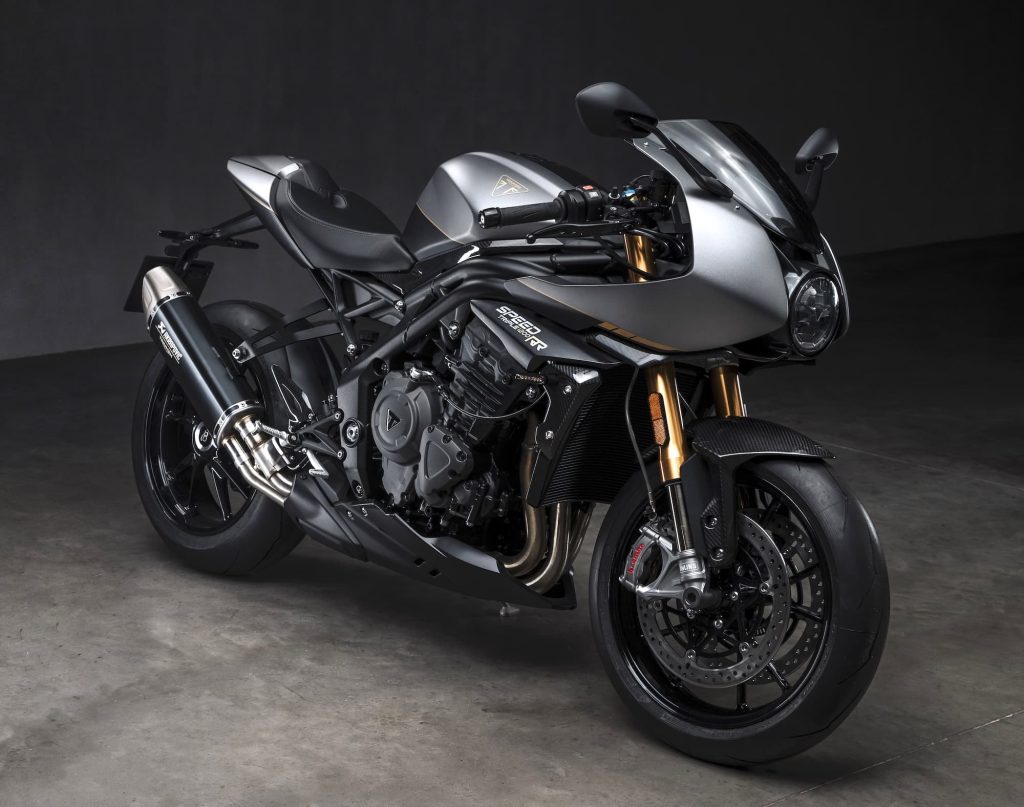
Looks nice, but my Casio G-Shock is still going strong, so I decided I didn’t need one of these.
Triumph Speed Triple RX (2025)
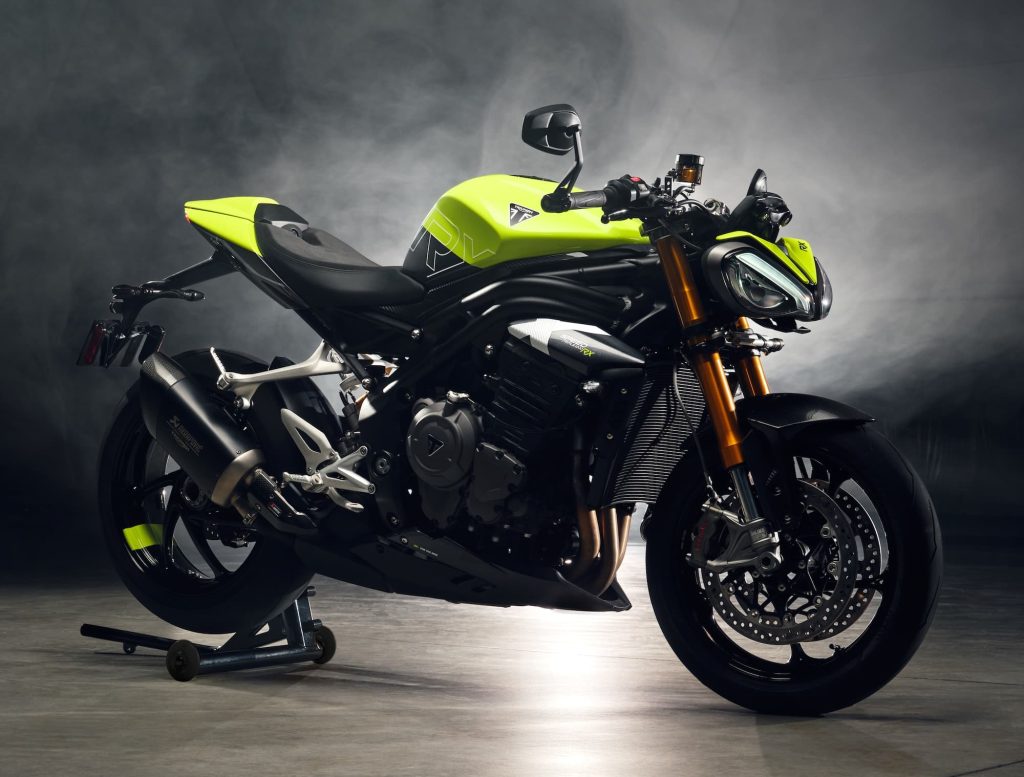
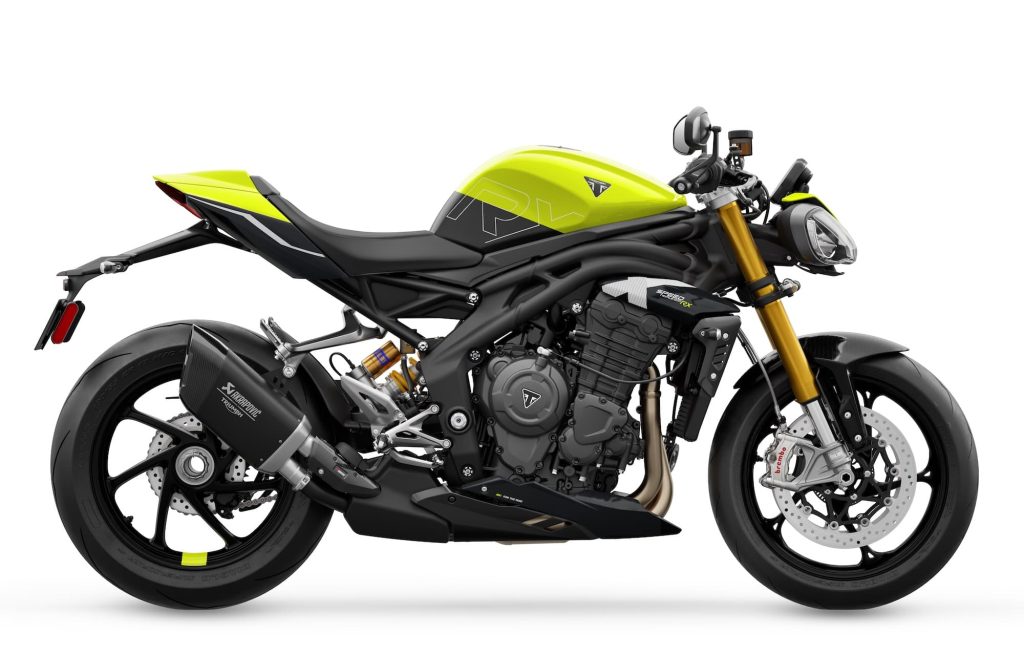
This was a limited production run of 1200 models for 2025 only. (“Limited” to 1200?)
You could think of it as a café racer version of the Speed Triple RR. It has clip ons that are 69 mm lower and 52 mm further forward than those on the Speed Triple 1200 RS. The footpegs are also higher and further back.
Triumph also updated the electronics. The 2025 Speed Triple RS already got semi-active Öhlins suspension. The RX model adds an Öhlins SD EC steering damper, and gets the Akrapovič exhaust as standard.
Triumph calls this colour “Performance Yellow”. Is it just me or is it kind of green?
What’s Next for the Speed Triple?
The Speed Triple has had a long history and is still an awesome bike. I personally liked the 1050 engines most, but I wouldn’t say no to rider aids for riding on the road. There are just so many cars doing crazy things, potholes, oil slicks… I can’t control everything.
One thing I’ve noticed is that with the creep of petrol prices, emissions restrictions, and congestion, the market for high-power sport motorcycles must be dwindling. So many models are being retired from street-legal form, and small-capacity bikes are becoming popular again.
It’s not emissions, in the case of the Speed Triple and Triumph in general. Triumph has done a very good job of keeping a flattish torque curve and not succumbing to power wars. When there have been emissions-driven updates, it hasn’t come at a cost to the consumer. And petrol prices are up and down. What is driving this trend, in my one-man opinion (dissenting views welcome), is that roads are getting crazy in many parts of the world. More people, worse conditions, and more anger leads to a heady cocktail that makes 100 mph+ less appealing for older riders than it used to be.
One sign this trend is impacting the Speed Triple is the fact that Triumph has retired “basic” versions of the bike, selling only premium ones (and premium-plus). While there are a few years left in it, I can’t help but think the bell will toll for the Speed Triple by 2030 or so, but I’m not a soothsayer!
Regardless, there are still used models aplenty on which to have fun, and if you haven’t, you’re missing out.

Beautiful write up! Always look forward to your history overviews.
Interesting to note a few things from 2016 to the newer 1200 models. Triumph first introduced a quickshifter in 2016 and then an autoblipper for the 2018 models. This were manufactured by Translogic. In the 1200, they switch the manufacturer to another brand (BING), but had a higher failure rate as well.
Hey buddy you didn’t mentioned for street triple 765 rx one of the historical ancestor street triple 675 rx thank you.
Hey, I think I did, in the article about Street Triples (this one is the Speed Triple).
I didn’t find that article about Street Triple because all of the words you’ve already written is: speed triple, no mentioned about Street even once!