
So you want a little motorcycle — but you’re a bit fancy, and want something from BMW.
Or maybe your eye has been caught by the high-end BMWs like the S 1000 RR or R 1300 GS, but you know they’re too much motorcycle. (For most people, you wouldn’t be wrong!)
Well, the little F class of parallel-twin powered bikes BMW released in 2026 might be for you.
BMW’s smallest twin-cylinder family now has three quite different motorcycles: the F 450 GS adventure bike, the F 450 R roadster, and the fully faired F 450 RR sport bike. All have the same 420 cc engine, and all make the same power. (Yes, 420 cc, not 450. The badge rounds up.)
This guide covers the production F 450 GS and the R and RR announced for 2027, using BMW’s launch specifications. I’ve separated the mechanical differences from the equipment packages, because an M Sport paint scheme doesn’t tell you everything about the motorcycle underneath it, it just makes it go faster.
Are you obsessed with motorcycles?
Well, I am. That’s why I created this site — as an outlet. I love learning and sharing what others might find useful. If you like what you read here, and you’re a fraction as obsessed as I am, you might like to know when I’ve published more. (Check the latest for an idea of what you’ll see.)
Where the BMW 450 family came from
For roughly a decade, BMW’s small-bike story centred on the G 310 R and G 310 GS. They’re not bad bikes in themselves — they look great and get the job done. Their 313 cc single-cylinder engine gave riders a cheaper, lighter route into BMW ownership than the larger F-series twins or boxer-engined motorcycles.
The F 450 family moves that idea up a class. BMW developed a new liquid-cooled parallel twin rather than stretching the G’s single. With 35 kW (48 PS / 47 hp), it targets Europe’s A2 licence ceiling at its full output. Learner approval still depends on the rules and approved-model list where you live.
It’s not the first time BMW has had F bikes, of course. BMW’s way of naming bikes has sometimes not been entirely consistent, but these days, F bikes are parallel twin powered.
BMW introduced the little 420-cc twin in the production F 450 GS. It followed with the F 450 R, then announced the F 450 RR on 15 October 2026. The RR completes the familiar adventure, naked and faired-sport line-up around a shared engine.
There was also a BMW G 450 X enduro years ago. Its 449 cc single-cylinder engine belongs to a different family. BMW’s original G 450 X press kit describes that separate competition enduro.
The BMW F 450 models in one table
Here are the chassis differences that change which bike suits you. BMW’s road-ready weights use its DIN specification; accessories and trim equipment can change the bike you collect from a dealer.
| Specification | F 450 GS | F 450 R | F 450 RR |
|---|---|---|---|
| Main role | Adventure / mixed-surface riding | Upright naked roadster | Faired road sport bike |
| Engine and output | 420 cc parallel twin; 35 kW (48 PS / 47 hp), 43 Nm (32 lb-ft) | Same | Same |
| Standard seat height | 845 mm (33.3 in) | 790 mm (31.1 in) | 790 mm (31.1 in) |
| Road-ready weight | 178 kg (392 lb) | 175 kg (386 lb); 176 kg (388 lb) with ERC | 177 kg (390 lb); 178 kg (392 lb) with ERC |
| Front / rear wheels | 19 / 17 inches | 17 / 17 inches | 17 / 17 inches |
| Front / rear suspension travel | 180 / 180 mm (7.1 / 7.1 in) | 140 / 140 mm (5.5 / 5.5 in) | 140 / 140 mm (5.5 / 5.5 in) |
| Fuel tank | 14 L (3.7 US gal) | 14 L (3.7 US gal) | 14 L (3.7 US gal) |
| Final-drive ratio | 3.43 | 3.13 | 3.13 |
| Riding position | Tall, upright; wide handlebar | Upright roadster; one-piece handlebar | Forward lean; clip-on handlebars |
| Bodywork | Adventure screen and bodywork | Minimal wind protection | Full fairing and screen |
The GS’s seat sits 55 mm (2.2 in) higher than the road models’, and its suspension has 40 mm (1.6 in) more travel at each end. Those are big enough differences to notice before you start the engine. Sit on the bike in your riding boots rather than judging reach from your height alone.
The RR adds only 2 kg (4 lb) to the R’s listed weight. Its fairing changes exposure to the wind, while the bars change how you sit. It doesn’t add a higher-output engine.
What all three BMW 450s share
Let’s start with what they have in common: the engine and the electronics.
The 420 cc twin: Same output, different gearing
The 420 cc engine in all 450 models has double overhead camshafts, four valves per cylinder and a six-speed gearbox. BMW quotes 35 kW (48 PS / 47 hp) at 8,750 rpm and 43 Nm (32 lb-ft) at 6,750 rpm for all three motorcycles.
The engine produces 80% of its maximum torque at 3,000 rpm: about 34 Nm (25 lb-ft). That gives you more of the engine’s output at moderate revs than the peak-power figure alone suggests. You still need the gearbox for the strongest acceleration, particularly with a passenger or on an uphill overtake.
The engine uses a 135-degree crankpin offset and a balance shaft. This gives it an uneven firing rhythm, somewhat like parallel twins that use a 270-degree crank, but BMW chose a different arrangement.
What’s interesting is that BMW used gearing to separate the GS from its road siblings. Its 3.43 final-drive ratio is shorter than the R and RR’s 3.13. For a given engine speed and selected gear, shorter gearing trades road speed for more torque multiplication at the wheel; tyres also affect the final result. So the GS will feel different to shift, despite the same engine at its core.
For the comparison with BMW’s older small single, see the F 450 R vs G 310 R guide. The twin’s stronger torque at lower revs is a bigger change than the extra 107 cc suggests.
Cornering ABS and the rest of the electronics
BMW gives all three ABS Pro, its cornering ABS, as standard, which means these are super high spec bikes for being entry level. The system takes lean angle into account when controlling brake pressure. It’s a substantial part of the buying argument in a class where many rivals still have conventional ABS.
They also have Dynamic Traction Control, engine drag-torque control and Dynamic Brake Control. Traction control manages rear-wheel slip under power; drag-torque control deals with slip during deceleration; brake control helps reduce unintended throttle input under braking. Our cornering ABS motorcycle guide puts that equipment in context.
The shared 6.5-inch colour TFT gives this small platform the sort of display BMW uses on much larger bikes. Heated grips, LED lighting, the Multi-Controller handlebar control and a USB-C socket also come standard in the global launch lists. Heated grips have a clearer everyday purpose on a cold commute than a screen full of riding statistics.
BMW F 450 GS: The taller, mixed-surface choice
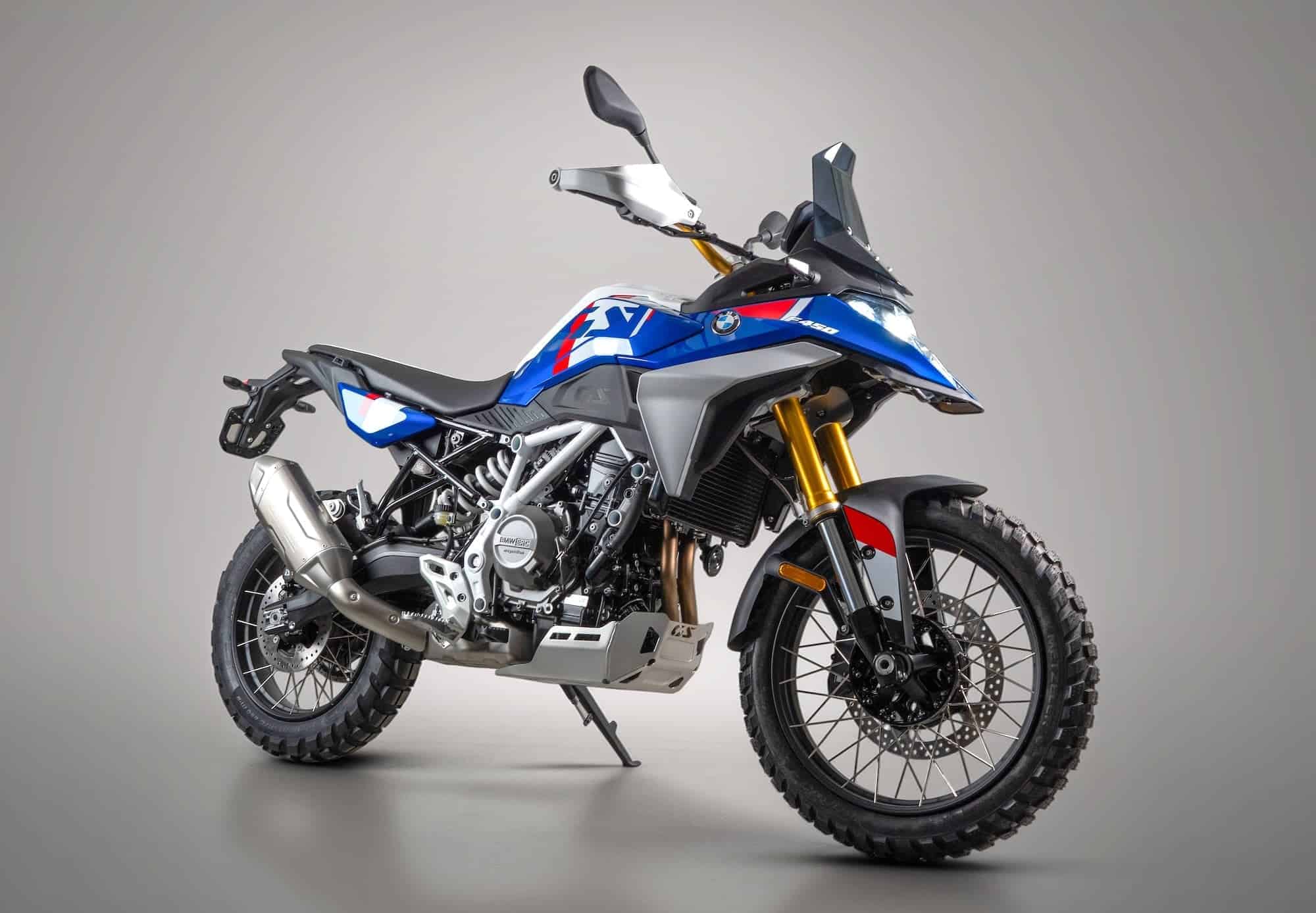
The GS gives the family its broadest choice of roads. Its 19-inch front wheel and 180 mm (7.1 in) suspension travel make more room for broken surfaces than the R and RR’s road chassis. It also has a screen and the upright riding position you’d expect from a small GS.
Standard cast wheels suit road riding and maintained gravel. BMW also offers cross-spoked wheels. Buy those for the riding you plan, rather than assuming wire spokes turn the GS into an enduro.
The GS has a 43 mm (1.69 in) KYB upside-down fork. BMW specifies WAD travel-dependent damping for the GS’s rear shock, with spring-preload and rebound adjustment. The road models’ rear-shock specifications list preload and rebound adjustment. The GS Sport suspension also adds fork damping adjustment.
Rain, Road and Enduro modes come standard. Higher trims add Enduro Pro, giving the GS a different mode selection from the road bikes. If you’re learning to ride on loose surfaces, take time to understand what each setting changes before relying on the name.
Choose the GS if your normal riding includes poor roads or gravel, or if you prefer its taller, upright riding position… or heck, if you just want to feel like an adventurer!
If you mainly ride smooth tarmac and find the seat awkward at stops, the R gives you the same engine and standard cornering ABS much closer to the ground.
Compare the GS with its rivals in our compact adventure motorcycle guide.
BMW F 450 R: The everyday roadster
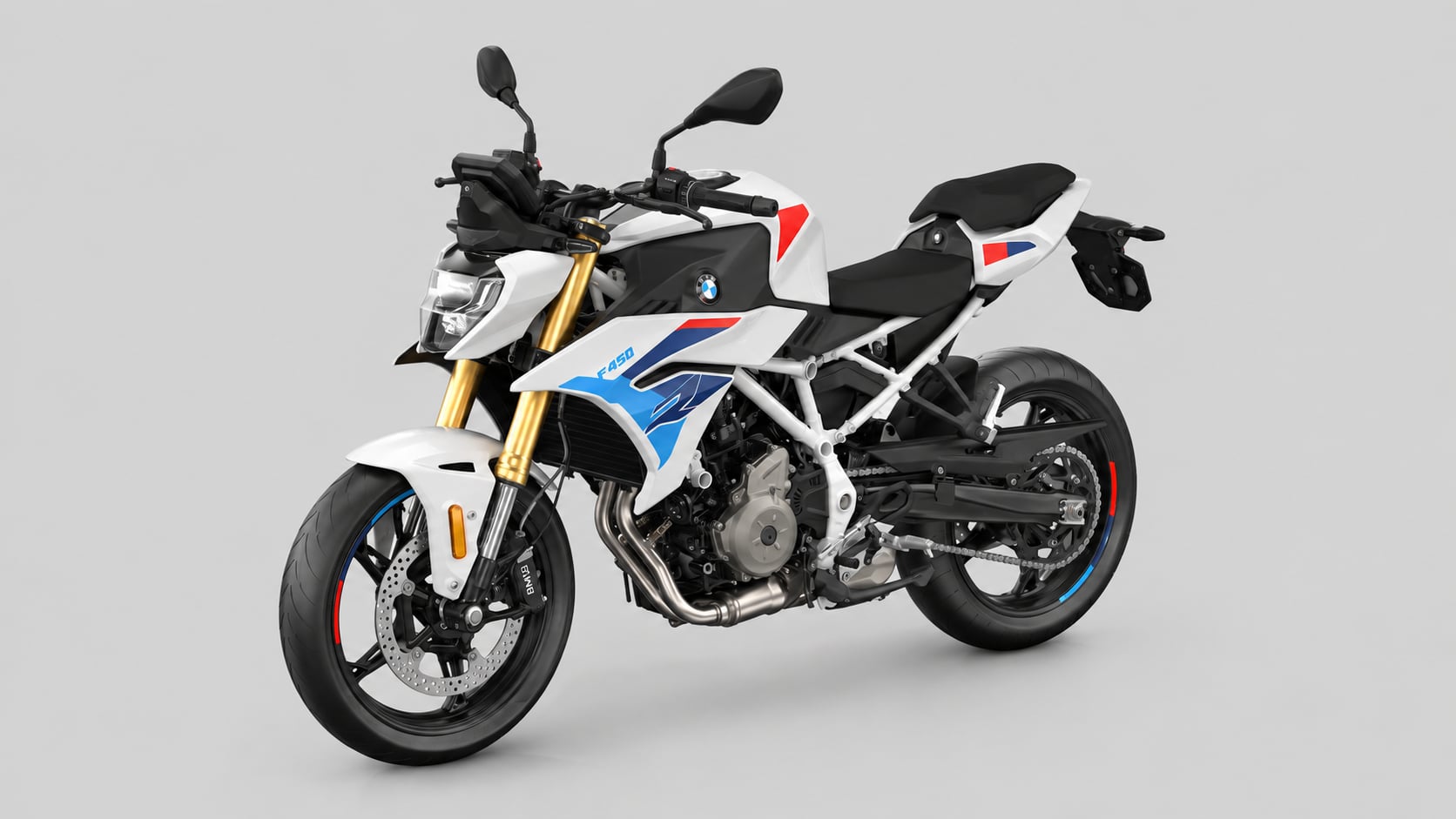
The R puts the twin into the simplest road-going shape: 17-inch wheels, an upright handlebar and little bodywork. Its 790 mm (31.1 in) standard seat is much lower than the GS’s, and its 175 kg (386 lb) listed weight is the lowest in the family, so this would be the easiest bike to manage if you’re shorter of stature or just like being close to the ground.
BMW keeps a proper chassis underneath it. There’s a 43 mm (1.69 in) KYB upside-down fork, a rear shock with preload and rebound adjustment, and a single 310 mm (12.2 in) front disc with a Brembo four-piston monobloc caliper. Higher trims add fork damping adjustment.
The R’s Rain, Road and Dynamic modes suit its tarmac role, with Dynamic Pro on higher trims. You get the full 35 kW engine without needing the M Sport version.
I’d start here for a commuter or a first road motorcycle that you plan to keep. You avoid the GS’s tall seat and the RR’s forward riding position. The compromise is wind exposure: a larger fuel tank doesn’t stop the air pushing on your chest for an hour on the motorway.
BMW F 450 RR: The small sport bike
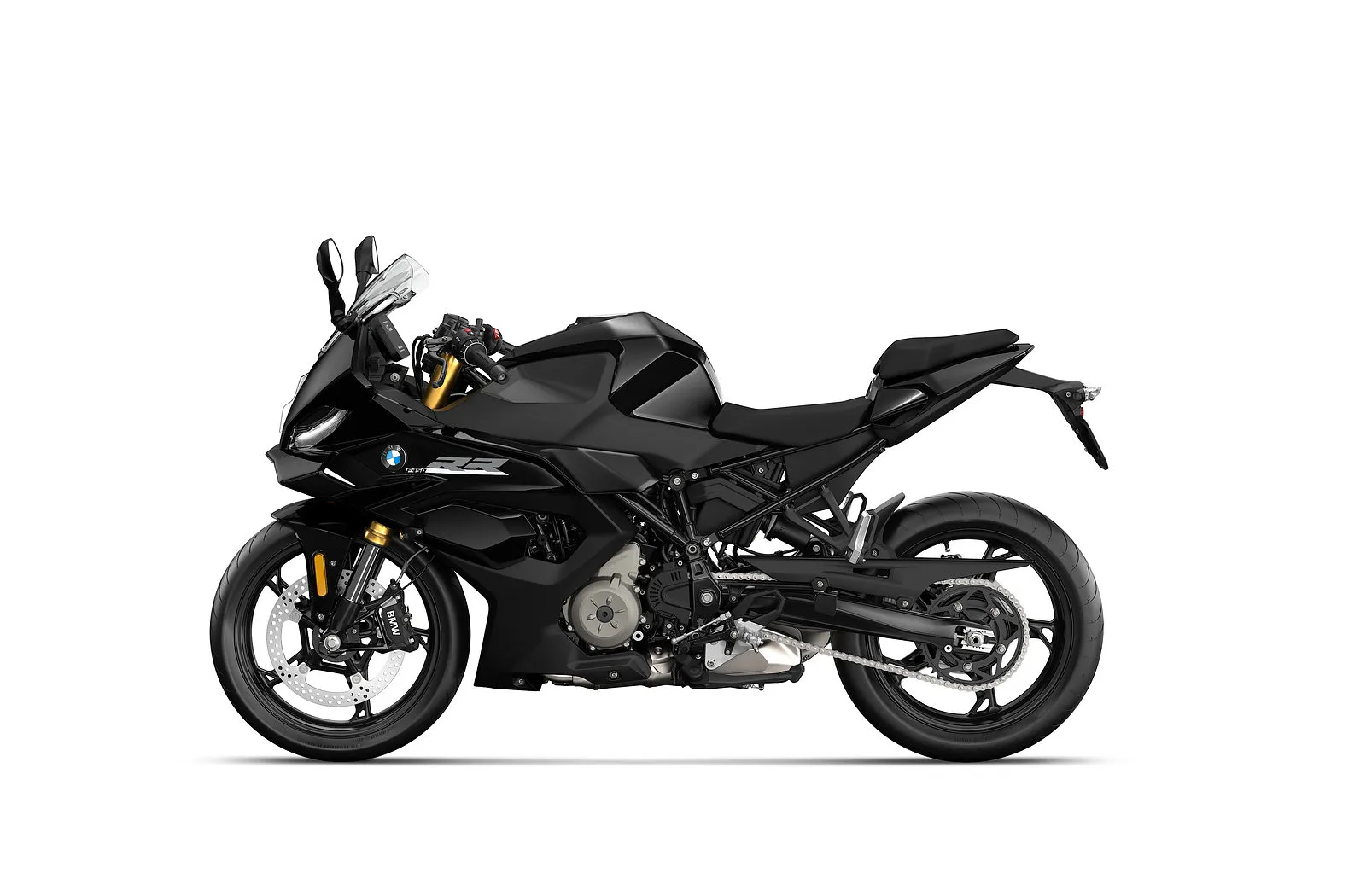
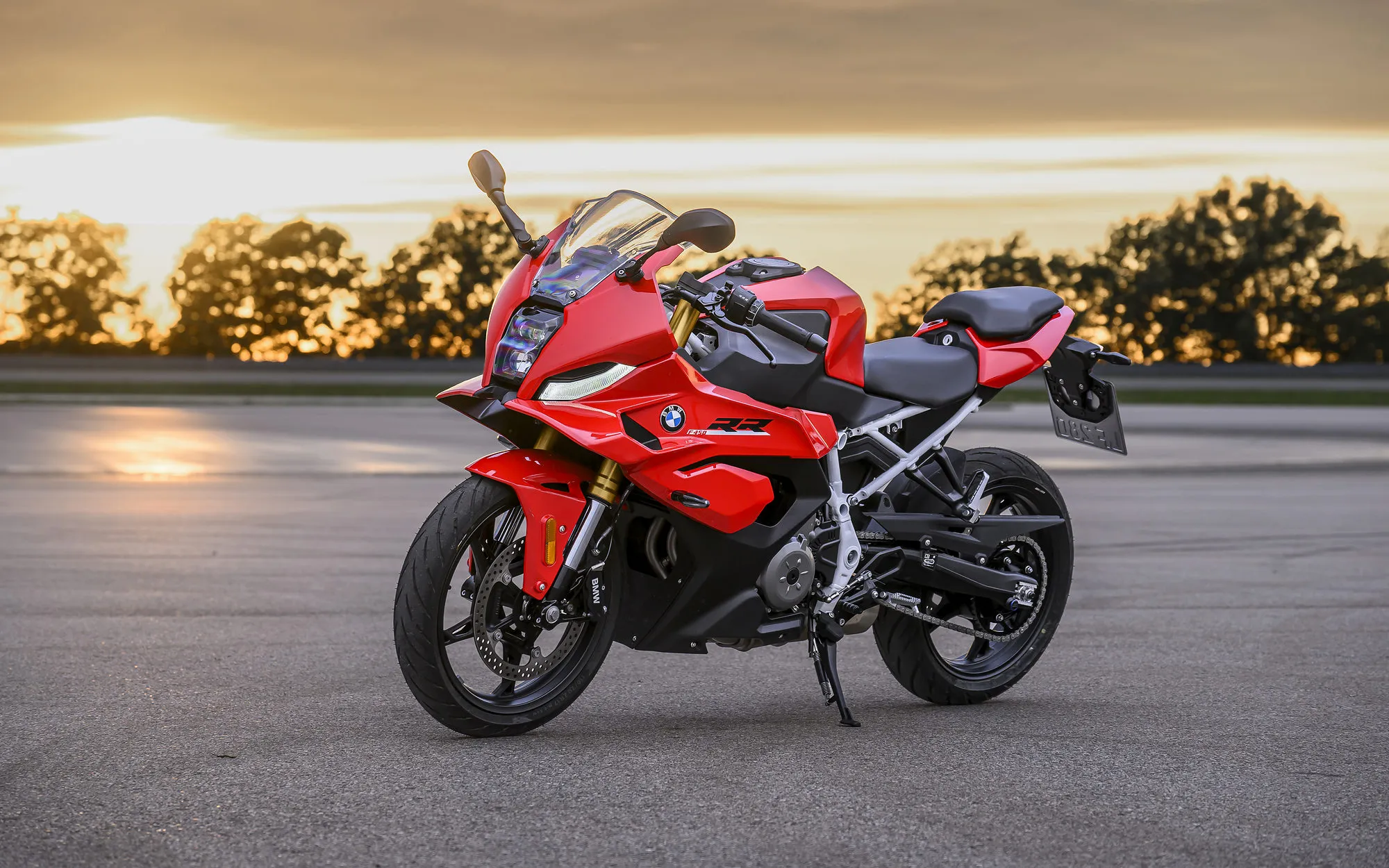
This is a class of bike I love — the everyday sport bike! It looks like the kind of thing that gets our blood flowing at the track, but it’s a bike that has power and comfort that can be used every day.
The RR is a lot like an R, but adds a full fairing, a screen and clip-on handlebars to BMW’s. Its engine keeps the same output as the R and GS. The RR badge buys the sport-bike layout rather than a more powerful tune.
It keeps the roadster’s 790 mm (31.1 in) seat height, 17-inch wheels, 140 mm (5.5 in) suspension travel and 14 L (3.7 US gal) tank. BMW lists 177 kg (390 lb) road-ready, or 178 kg (392 lb) with ERC. Rain, Road and Race modes come standard; M Sport adds the configurable Race Pro mode.
Look at the handlebar height and you’ll notice they aren’t TOO low. They’re somewhere around the middle of the tank in height. That, plus the fact that the seat height is low and it’s not too long a bike, keeps this easy to pilot about every day.
The RR has a single 310 mm (12.2 in) front disc and a Brembo four-piston monobloc caliper, matching the platform’s brake layout. BMW also gives it a reversible shift pattern, so you can set up the foot control for conventional road shifting or a reversed pattern for circuit riding.
The R and RR are so similar that you’d probably end up choosing one on aesthetics rather than the other, unless you really want that M sport road.
Which trim should you choose?
These are BMW’s global launch trim ladders. They show why you need to compare equipment across models rather than treating Sport, Exclusive and M Sport as interchangeable names.
| Model | Base | Next trim | Higher trim | Top package |
|---|---|---|---|---|
| F 450 GS | Standard electronics; Rain, Road, Enduro | Exclusive: adds Riding Modes Pro and Shift Assistant Pro | Sport: adds adjustable Sport fork | GS Trophy: includes ERC |
| F 450 R | Standard electronics; Rain, Road, Dynamic | Exclusive: adds Shift Assistant Pro and Sport suspension | M Sport: adds Riding Modes Pro / Dynamic Pro | M Sport with Innovation Package: adds ERC |
| F 450 RR | Cosmic Black; standard electronics and modes | Sport: Racing Red, Shift Assistant Pro and Sport suspension | M Sport: Snaefell white / M Motorsport; adds Riding Modes Pro / Race Pro | M Sport with Innovation Package: adds ERC |
The important purchase decisions are a quickshifter, adjustable fork damping and ERC. Paint is a separate reason to buy a trim, and a perfectly reasonable reason!
I’d pay attention to suspension adjustment if I planned regular track days or wanted to tune damping for my weight and roads. I’d choose the quickshifter if I enjoyed changing gears without the clutch lever. For dense commuting traffic, ERC has a clearer daily purpose than a configurable track mode.
Easy Ride Clutch: What does ERC actually do?
BMW’s optional Easy Ride Clutch uses a centrifugal mechanism that engages the clutch according to engine speed. You can pull away and come to a stop without operating the clutch lever. The lever stays on the handlebar for manual intervention. ERC comes standard on the GS Trophy and with the R and RR’s M Sport Innovation Package; BMW also lists retrofit availability for the other versions.
You still select the gears with your foot. Shift Assistant Pro handles clutch-free gear changes; ERC handles clutch engagement for starting and stopping. BMW says ERC preserves engine braking until shortly before you stop.
That makes ERC especially relevant if stop-start traffic tires your left hand, or if you want less clutch work on a rough climb. It also adds a mechanism whose behaviour you need to learn. Try a demonstration bike and practise slow turns and hill starts before deciding whether you prefer it to the conventional clutch.
Ownership, servicing and used buying
BMW specifies a 10,000 km (6,200 mile) service interval for this engine family. The launch material doesn’t replace the owner’s maintenance schedule: get the complete task list, time limits and valve-clearance interval for your model and market before budgeting for ownership.
All three have chain final drive. You still need to check chain adjustment, lubricate it and inspect the sprockets. Gravel use on a GS makes cleaning and checking the air filter more relevant; the RR’s fairing adds panels to inspect after a drop and remove for some workshop jobs.
The R and RR are new models, so there isn’t a long ownership record to establish their recurring faults or ERC repair costs. I wouldn’t assign them a reliability verdict from BMW’s name or assume the G 310’s maintenance schedule applies to the new twin.
For an early used example, ask for the first-service invoice and check the exact equipment against the VIN. Inspect fork seals, wheel rims and steering stops, then test the quickshifter and ERC if fitted. On an RR, look at panel fixings and engine covers for signs of a fall; on a GS, include the underside and luggage mounts.
The closest alternatives
The nearest comparison changes with the body style. These are the bikes I’d put alongside each BMW before deciding whether its equipment and riding position justify the local price.
| BMW | Alternatives | What to compare |
|---|---|---|
| F 450 GS | KTM 390 Adventure, Honda NX500, CFMOTO 450MT / Ibex 450 | Wheel sizes, seat reach, suspension travel, protection and luggage |
| F 450 R | Kawasaki Z500, Triumph Speed 400, KTM 390 Duke | Upright riding position, engine character, local price and rider assistance |
| F 450 RR | Aprilia RS 457, Kawasaki Ninja 500 / used Ninja 400, Honda CBR500R, KTM RC 390 | Riding position, fairing protection, ready-to-ride weight and cornering ABS |
The Aprilia RS 457 is a close twin-cylinder sport-bike comparison. The Ninja 400 and 500 family adds a large used-bike market, while the CBR500R offers another take on an everyday faired twin. Compare the exact model year: assistance systems and equipment change, sometimes without a new model name.
If you prefer a single-cylinder roadster, the Triumph 400 family gives you several riding positions and styles around its engine. A test ride is a better way to choose between single and twin than assuming the extra cylinder automatically suits you.
Which BMW 450 would I buy?
Most people should start with the F 450 R for everyday road riding. It has the shared engine and standard cornering ABS, the lowest listed weight and an upright riding position. Choose the trim after deciding whether you want suspension adjusters or help with clutch operation.
(I’d still choose the F 450 RR for everyday riding because I like sport bikes. But I’m not most people!)
I’d choose the F 450 GS for regular mixed-surface rides. Its larger front wheel and extra suspension travel address those roads directly. Make sure you’re happy moving it around at walking pace before buying the taller bike for trips you only imagine taking.
I don’t often plan to ride off road, but I do end up there unintentionally at times.
I’d choose the F 450 RR for a small faired sport bike. You get the low road-bike seat and shared twin with wind protection and clip-ons. If you enjoy that riding position, it makes sense for weekend road rides and occasional circuit days; if your wrists object in the showroom, start the comparison with the R.