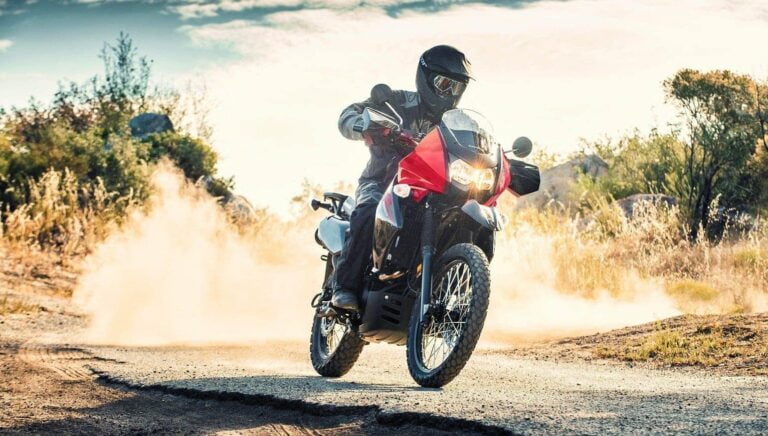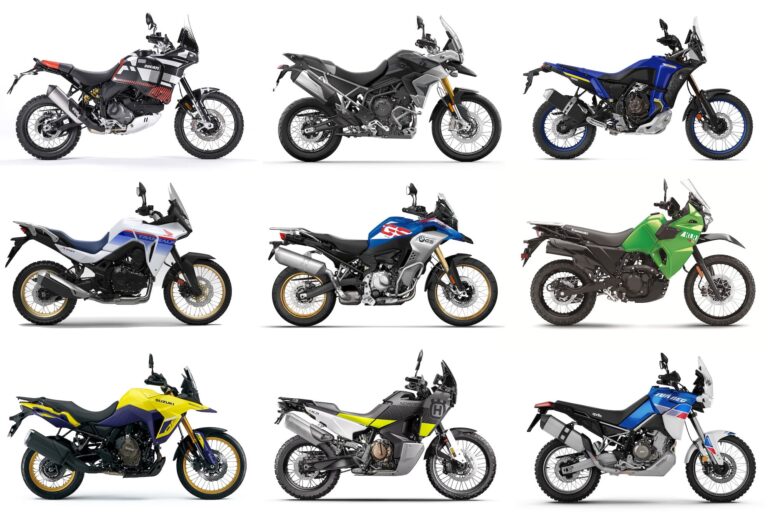

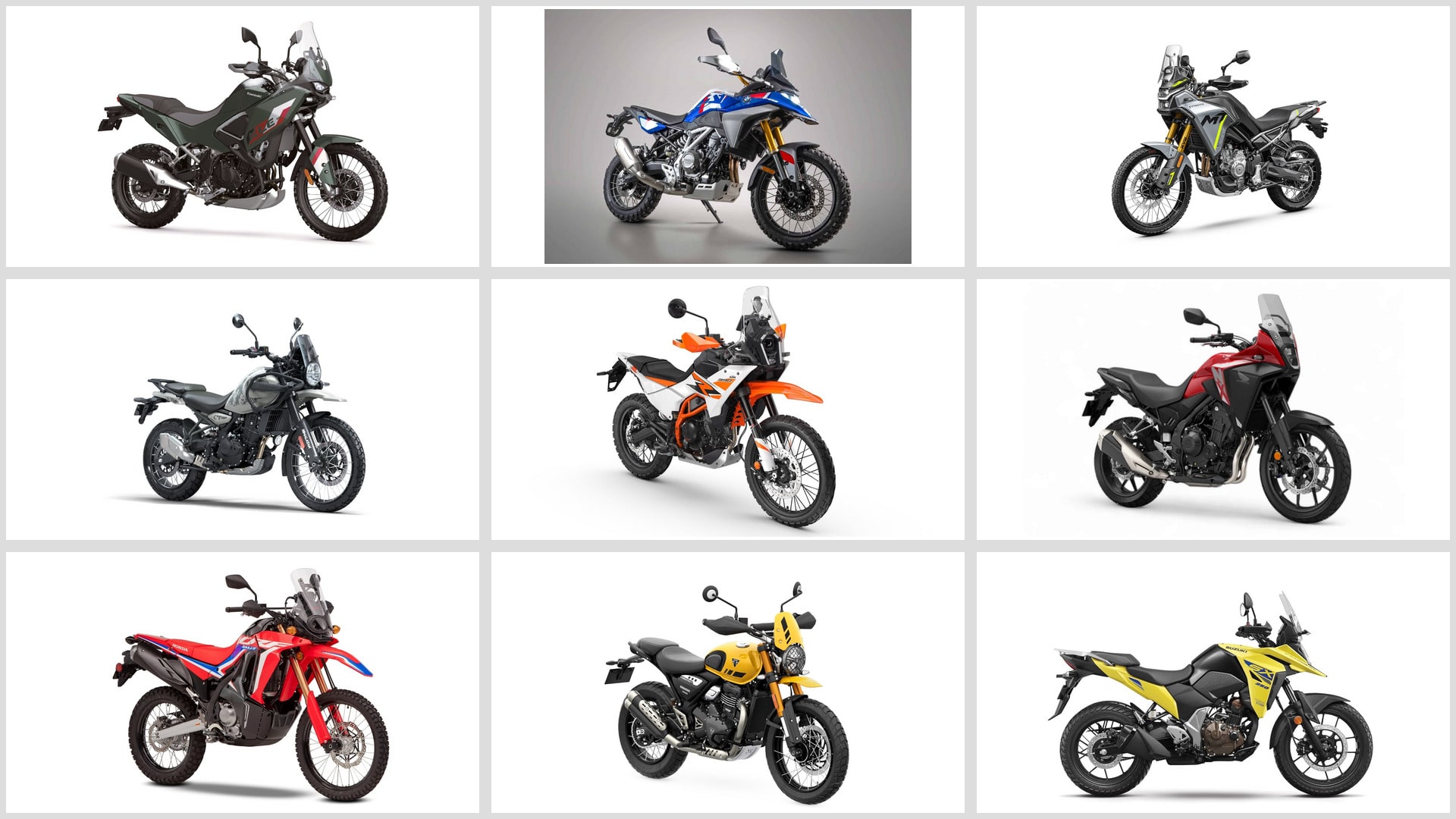
Compact adventure motorcycles have become a serious category of their own. These are not merely cheaper, slower versions of middleweight adventure bikes. The best of them are lighter in awkward terrain, easier to live with in town, less demanding on tyres and fuel, and still capable of carrying camping gear across a country.
This guide covers the main current adventure and adventure-adjacent motorcycles from roughly 250 to 500 cc. That range includes road-biased tourers, genuine small rally-style machines, and a few bikes that sit between a scrambler and an adventure motorcycle.
Updates
- 19 October 2026: Added the F 450 RR comparison in the BMW F 450 GS section and linked the complete BMW 450 buyers guide.
August 2026: Includes the production BMW F 450 GS and Kawasaki KLE500, plus the latest KTM 390 Adventure R/X, CFMOTO 450MT, Royal Enfield Himalayan 450, Honda NX500 and CRF300L Rally, Triumph Scrambler 400 XC, Suzuki V-Strom 250SX, and Benelli TRK 502 X.
Are you obsessed with motorcycles?
Well, I am. That’s why I created this site — as an outlet. I love learning and sharing what others might find useful. If you like what you read here, and you’re a fraction as obsessed as I am, you might like to know when I’ve published more. (Check the latest for an idea of what you’ll see.)
What counts as a compact adventure motorcycle?
For this list, the motorcycle must be road legal, currently sold in at least one meaningful market, and designed to handle touring plus unsealed roads. Most have a 250–500 cc engine, an upright riding position, some wind protection, provision for luggage, and at least a 19-inch front wheel.
The boundaries are intentionally practical. The Honda CRF300L Rally is closely related to a dual-sport, but its larger tank and rally fairing make it a credible lightweight travel bike. The Triumph Scrambler 400 XC lacks the wind protection of a conventional adventure motorcycle, but its tubeless spoked wheels, useful suspension, and off-road electronics earn it a place. The Benelli TRK 502 X qualifies by engine size, though its mass makes it an outlier.
Compact adventure motorcycles compared
Start with engine output, published weight and seat height. The weight labels matter: a dry figure excludes fluids that a ready-to-ride figure includes.
| Motorcycle | Engine | Power | Torque | Published mass* | Fuel | Seat |
|---|---|---|---|---|---|---|
| Benelli TRK 502 X | 500 cc twin | 35 kW / 47.6 hp | 46 Nm / 34 lb-ft | 213 kg / 470 lb dry | 20 L / 5.3 US gal | 860–895 mm / 33.9–35.2 in |
| BMW F 450 GS | 420 cc twin | 35 kW / 48 hp | 43 Nm / 31.7 lb-ft | 178 kg / 392 lb ready | 14 L / 3.7 US gal | 845 mm / 33.3 in |
| CFMOTO 450MT / Ibex 450 | 449.5 cc twin | 32.5 kW / 44 hp | 44 Nm / 32.5 lb-ft | 185 kg / 408 lb ready | 17.5 L / 4.6 US gal | 820 mm / 32.3 in |
| Honda CRF300L Rally | 286 cc single | 20.1 kW / 27.3 hp | 26.6 Nm / 19.6 lb-ft | 153 kg / 337 lb ready | 12.8 L / 3.4 US gal | 885 mm / 34.8 in |
| Honda NX500 | 471 cc twin | 35 kW / 47 hp | 43 Nm / 31.7 lb-ft | 196 kg / 432 lb ready | 17.5 L / 4.6 US gal | 830 mm / 32.7 in |
| Kawasaki KLE500 | 451 cc twin | 38 kW / 51 hp | 43 Nm / 31.7 lb-ft | 193–195 kg / 426–430 lb curb | 15.9 L / 4.2 US gal | 871 mm / 34.3 in |
| KTM 390 Adventure R / X | 398.7 cc single | 33 kW / 45 PS | 39 Nm / 28.8 lb-ft | 176 kg / 388 lb fuelled | 14 L / 3.7 US gal | 870 / 825 mm |
| Royal Enfield Himalayan 450 | 452 cc single | 29.4 kW / 40 hp | 40 Nm / 29.5 lb-ft | 196 kg / 432 lb curb | 17 L / 4.5 US gal | 825–845 mm / 32.5–33.3 in |
| Suzuki V-Strom 250SX | 249 cc single | 19.5 kW / 26.5 PS | 22.2 Nm / 16.4 lb-ft | 167 kg / 368 lb curb | 12 L / 3.2 US gal | 835 mm / 32.9 in |
| Triumph Scrambler 400 XC | 398 cc single | 29.4 kW / 40 PS | 37.5 Nm / 27.7 lb-ft | 186 kg / 410 lb wet | 13 L / 3.4 US gal | 835 mm / 32.9 in |
The next table compares the wheels, suspension and rider aids that affect how each bike handles road and gravel use.
| Motorcycle | Wheels | Travel front/rear | Ground clearance | Rider aids |
|---|---|---|---|---|
| Benelli TRK 502 X | 19/17-inch spoked | 140/173 mm | 210–220 mm by market | ABS |
| BMW F 450 GS | 19/17 cast; cross-spoke option | 180/180 mm | Not consistently published | Cornering ABS, TC, modes; ERC option |
| CFMOTO 450MT / Ibex 450 | 21/18 tubeless spoked | 200/200 mm | 220 mm | Switchable rear ABS and TC |
| Honda CRF300L Rally | 21/18 tube-type spoked | 260/260 mm | 275 mm | Rear-switchable ABS |
| Honda NX500 | 19/17 cast tubeless | 150/135 mm | 180 mm | ABS and traction control |
| Kawasaki KLE500 | 21/17 spoked | 211/196 mm | 172 mm | Switchable ABS |
| KTM 390 Adventure R | 21/18 tube-type spoked | 230/230 mm | 272 mm | Cornering ABS, TC, modes |
| KTM 390 Adventure X | 19/17 cast tubeless | 200/200 mm | 232 mm | ABS, ride-by-wire; market spec varies |
| Royal Enfield Himalayan 450 | 21/17 spoked; tubeless option/variant | 200/200 mm | 230 mm | Modes and rear-switchable ABS |
| Suzuki V-Strom 250SX | 19/17 cast tubeless | Not published | 205 mm | ABS |
| Triumph Scrambler 400 XC | 19/17 tubeless spoked | 150/150 mm | Not published | Off-road ABS and switchable TC |
How to read the numbers
- Wheel size: A 21-inch front wheel rolls through holes and loose ground more calmly. A 19-inch front usually gives quicker steering and a broader choice of road tyres.
- Mass: The number matters most when turning around on a slope, lifting the bike, or correcting a slide at low speed. Where the mass sits can matter as much as the total.
- Suspension travel: More travel gives the chassis room to absorb larger hits, but spring and damping quality still determine whether that travel is controlled.
- Engine layout: The twins are smoother and generally more relaxed at sustained highway speed. The singles are narrower, simpler, and often feel more direct on loose surfaces.
- Electronics: Switchable rear ABS is more useful in dirt than a long list of road modes. Cornering ABS and traction control matter more to riders who spend most of their time on wet or paved roads.
Benelli TRK 502 X
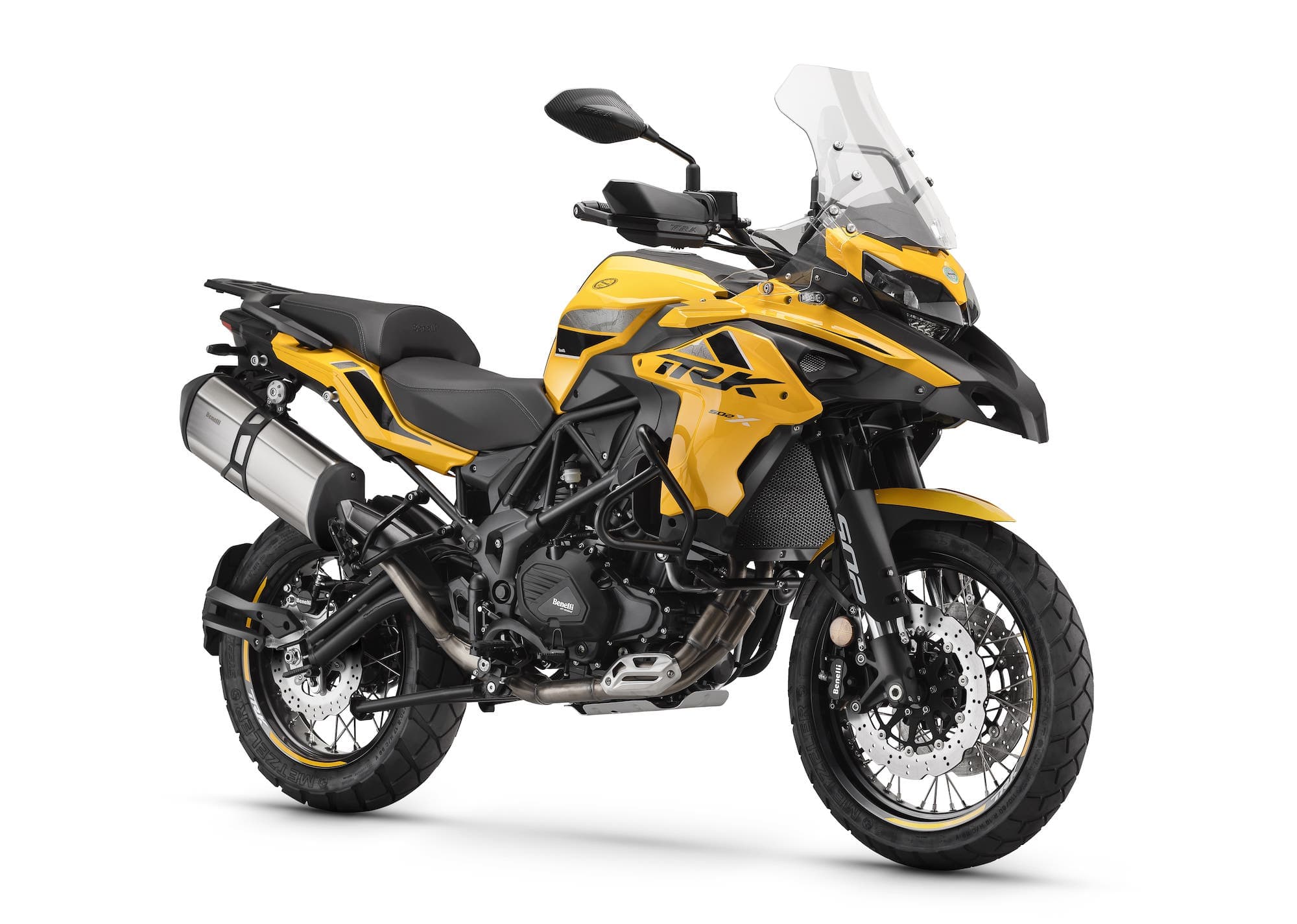
The TRK 502 X is the odd one out. Its 500 cc parallel twin makes a class-appropriate 35 kW (47.6 hp), yet the tall bodywork, 20-litre tank, generous passenger accommodation, and substantial mass make it feel much larger than the other bikes here.
That is not automatically a criticism. Riders who want weather protection, a broad seat, factory luggage options, and an unhurried two-up road bike may prefer the Benelli to a sparse single-cylinder machine. The 19/17-inch spoked wheels and longer-travel suspension also give it more tolerance for poor roads than the road-biased styling might suggest.
The caveat is mass. Benelli’s published figures differ by market and measurement standard, including a 213 kg dry figure and considerably higher ready-to-ride numbers. If the point of buying compact is easy recovery and low-speed confidence off road, start elsewhere.
BMW F 450 GS
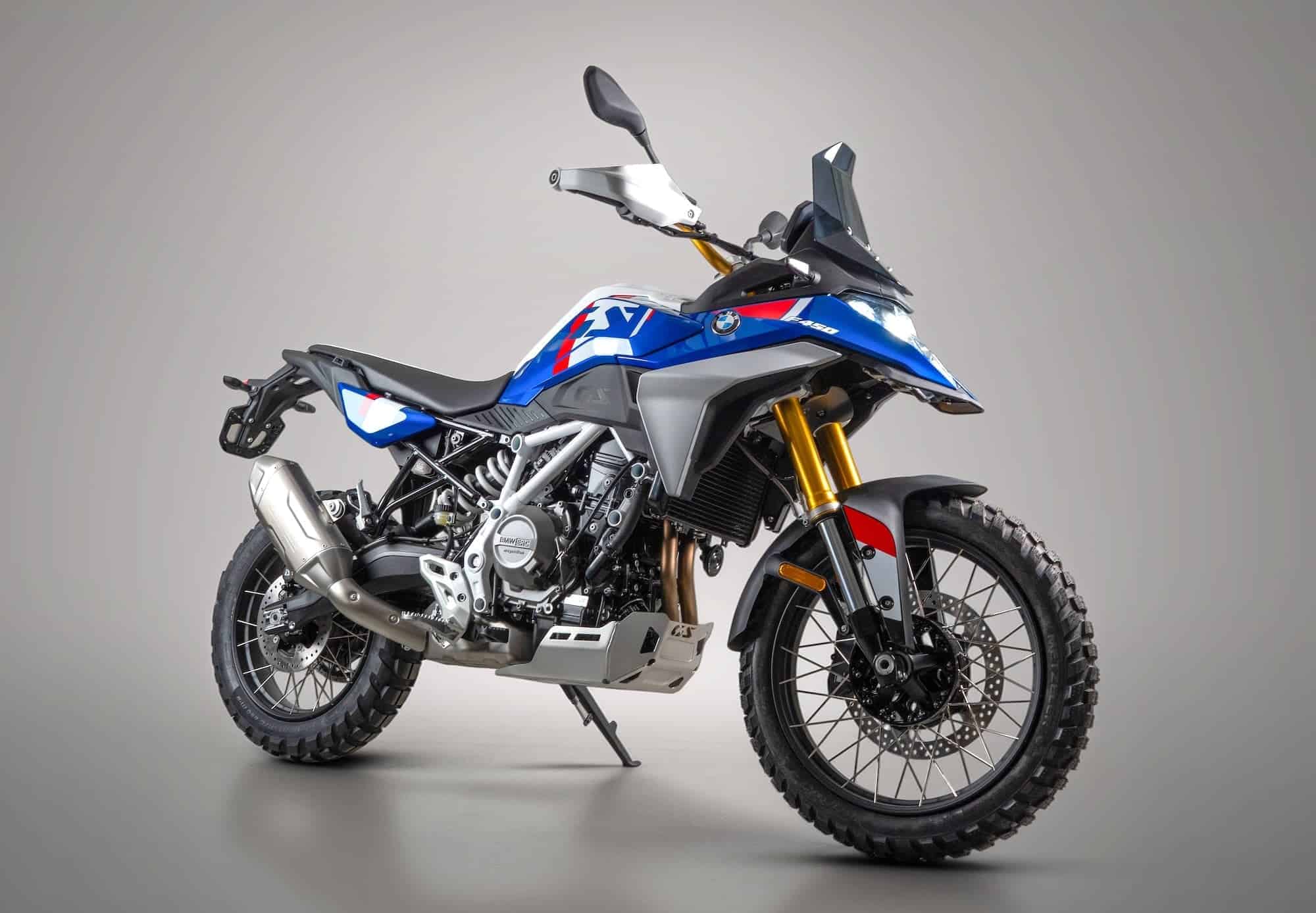
The production F 450 GS puts BMW directly into a category it previously left open between the G 310 GS and F 800/900 GS family. Its new 420 cc parallel twin makes 35 kW (48 hp) and 43 Nm, while BMW quotes a road-ready mass of 178 kg. That combination gives it one of the strongest power-to-weight ratios in this list.
The standard 19-inch cast front wheel, 180 mm suspension travel, cornering ABS, and traction control point to an all-road motorcycle rather than a small enduro. Cross-spoked wheels are available, and BMW’s Easy Ride Clutch can automate clutch operation while leaving the rider in control of the six-speed gearbox.
Choose it if low mass, road refinement, and electronic support matter more than a 21-inch front wheel. The unanswered ownership question is not the specification; it is how option pricing changes the value once the bike is configured as desired.
If you like the GS’s engine but ride only on tarmac, BMW now has two road alternatives. The F 450 R is an upright naked bike, and the F 450 RR adds a full fairing and clip-on handlebars for 2027. All three make 35 kW (48 PS) and 43 Nm (32 lb-ft), and all have standard ABS Pro and DTC.
The RR weighs 177 kg (390 lb) road-ready, but the more relevant changes are its 790 mm (31.1 in) seat, 17-inch front wheel and 140 mm (5.5 in) suspension travel. The GS has an 845 mm (33.3 in) seat, 19-inch front wheel and 180 mm (7.1 in) travel. Choose the GS for mixed surfaces; compare the R and RR if you want the same engine with a lower road chassis. The BMW 450 motorcycles buyers guide covers the packages and gearing differences.
CFMOTO 450MT / Ibex 450
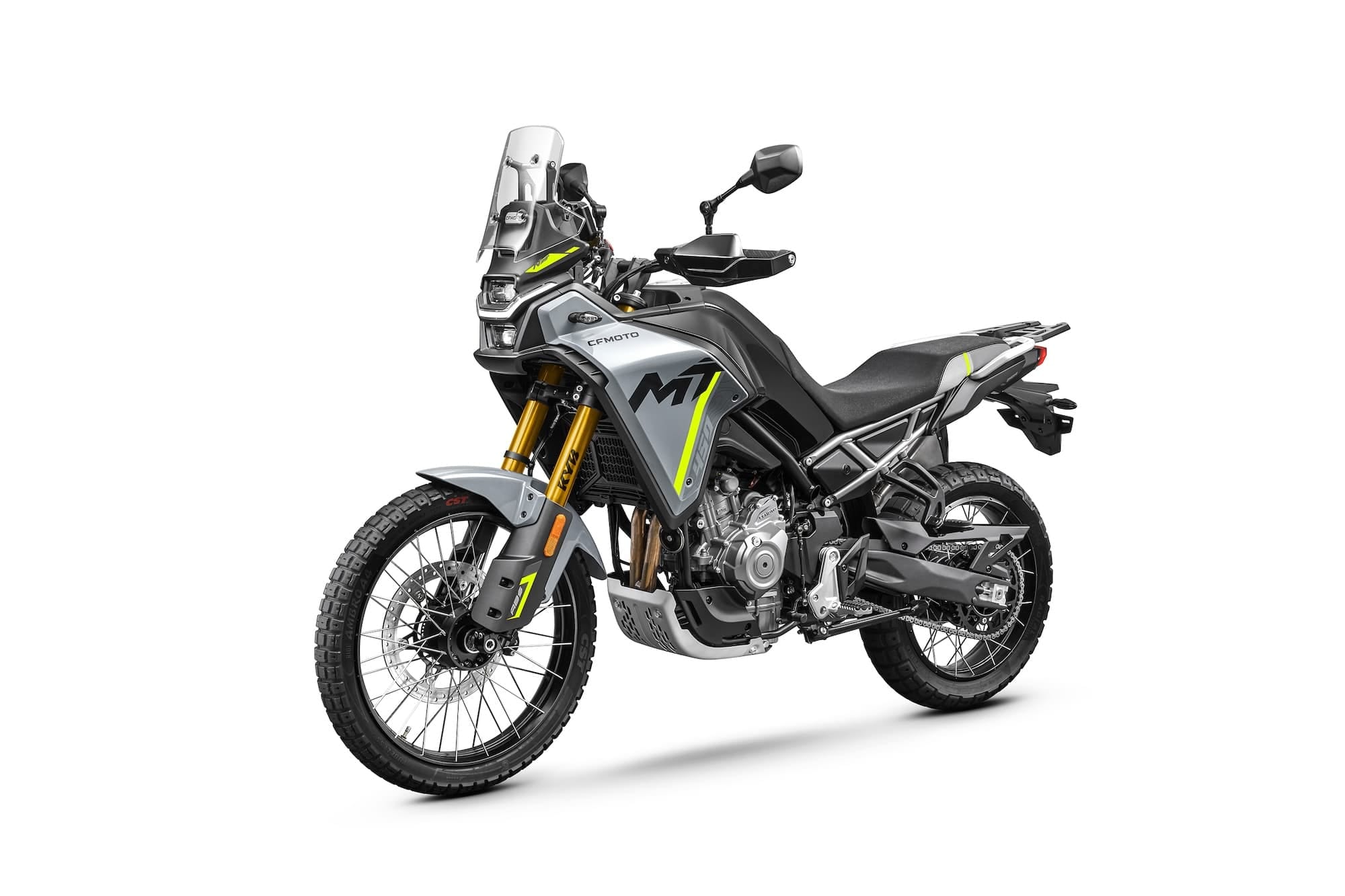
The 450MT pairs a 449.5 cc, 270-degree parallel twin with hardware that once belonged to much larger adventure bikes: 21/18-inch tubeless spoked wheels, 200 mm of travel at each end, a 17.5-litre tank, and a rear ABS channel that can be switched off.
Its 44 hp output is sufficient rather than dramatic, but the twin is smoother on fast roads than the single-cylinder alternatives. The standard 820 mm seat is also unusually accessible for a motorcycle with this much wheel and suspension travel.
The 185 kg ready-to-ride figure is not exceptionally light, and the suspension is set up for broad usefulness rather than race pace. Even so, the combination of comfort, range, tubeless wheels, and dirt-ready dimensions makes it one of the most complete packages here. See the CFMOTO 450MT model guide for a closer look.
Honda NX500 and CRF300L Rally
Honda gets two entries because forcing these bikes into one recommendation would hide the point of both. The NX500 is a compact road tourer that tolerates dirt roads. The CRF300L Rally is a lightweight trail bike adapted for travel.
Honda NX500
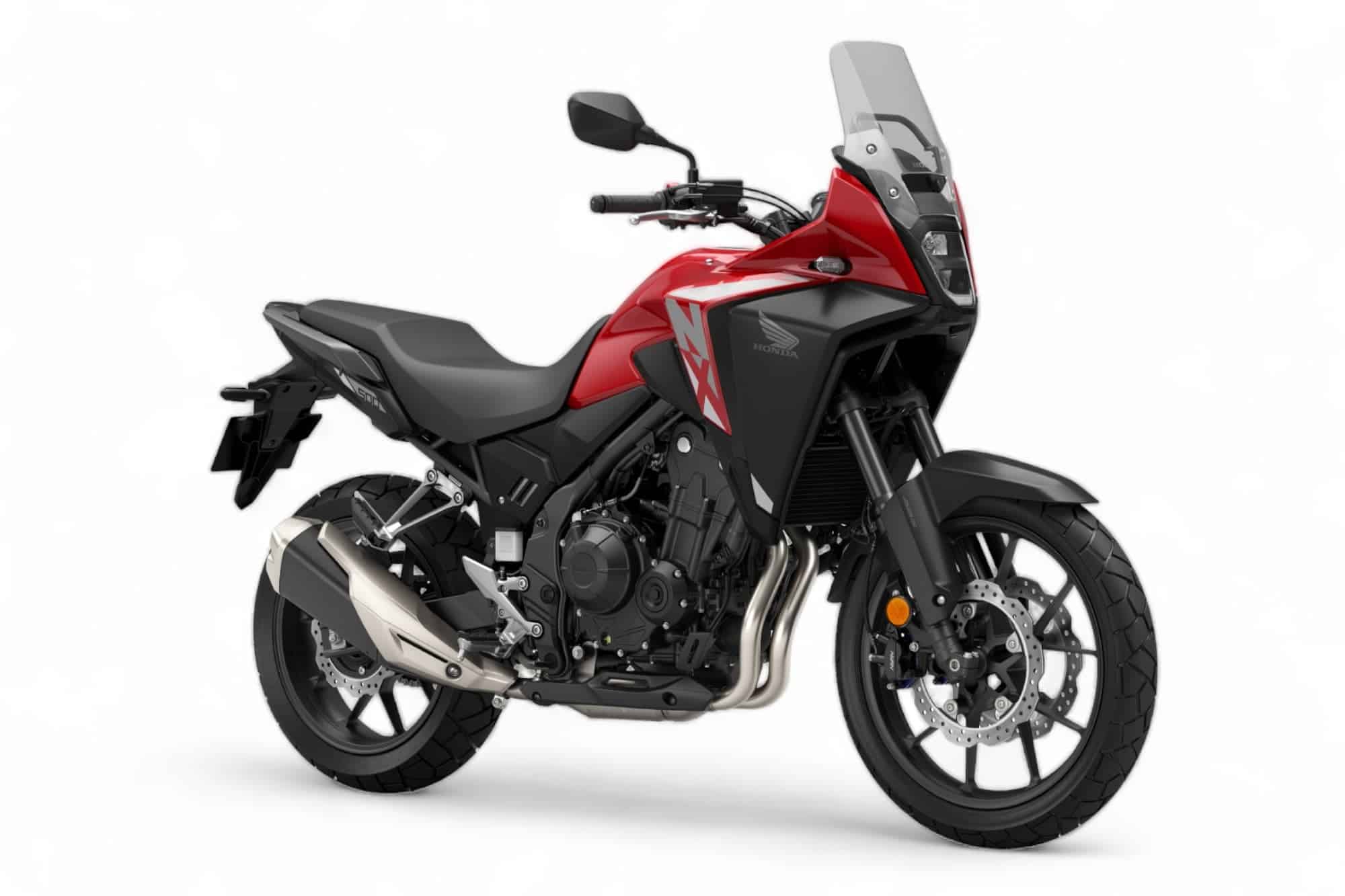
The NX500 uses Honda’s long-running 471 cc parallel twin, making 35 kW (47 hp) and about 43 Nm. Its strengths are smooth fuelling, excellent economy, a broad dealer network, and an engine with enough performance for normal motorway work without making the motorcycle intimidating.
A 19-inch cast front wheel, 180 mm ground clearance, and 196 kg road-ready mass reveal the intended use. It is well suited to commuting, paved touring, and maintained gravel roads. It is less happy in deep sand, rocks, or mud, where the cast wheels, road-biased geometry, and weight become harder to ignore.
Honda CRF300L Rally
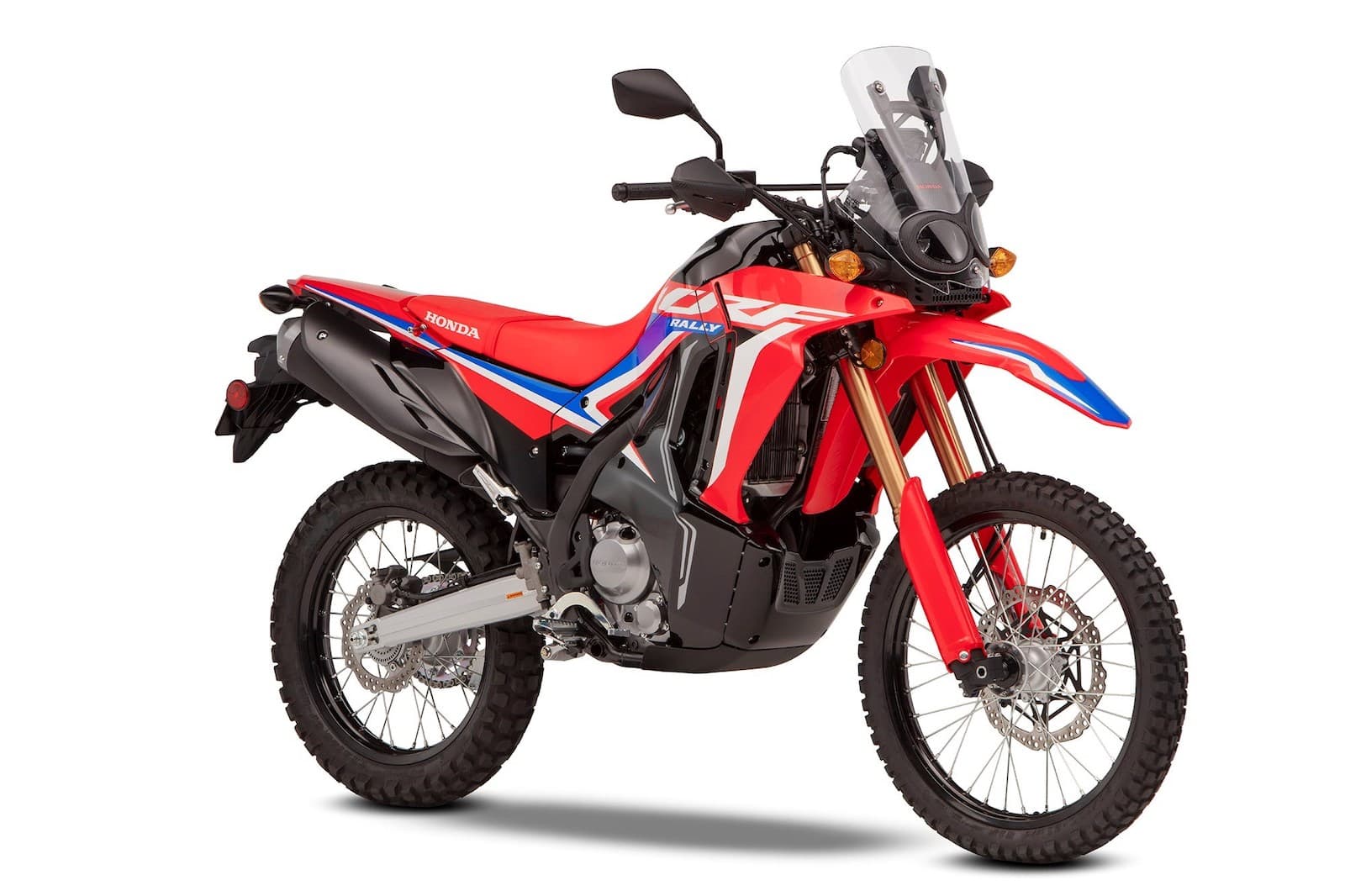
The CRF300L Rally makes only 20.1 kW (27.3 hp), but at 153 kg ready to ride it is 25–43 kg lighter than most of this group. Its 21/18-inch wheels, 260 mm suspension travel, 275 mm ground clearance, and narrow shape make a greater difference off road than a few extra horsepower.
The 12.8-litre tank and rally fairing make it much more travel-friendly than a basic dual-sport. On the other hand, passing performance, headwinds, luggage, and long motorway climbs expose the engine’s limits. The suspension is soft for heavier riders or fast loaded travel, despite the generous travel figure.
| Choose the NX500 if… | Choose the CRF300L Rally if… |
|---|---|
| Most kilometres are paved; you carry a passenger; highway comfort matters; you prefer tubeless tyres. | Bad roads and trails are central to the trip; lifting the bike matters; you travel solo and accept modest highway performance. |
Kawasaki KLE500
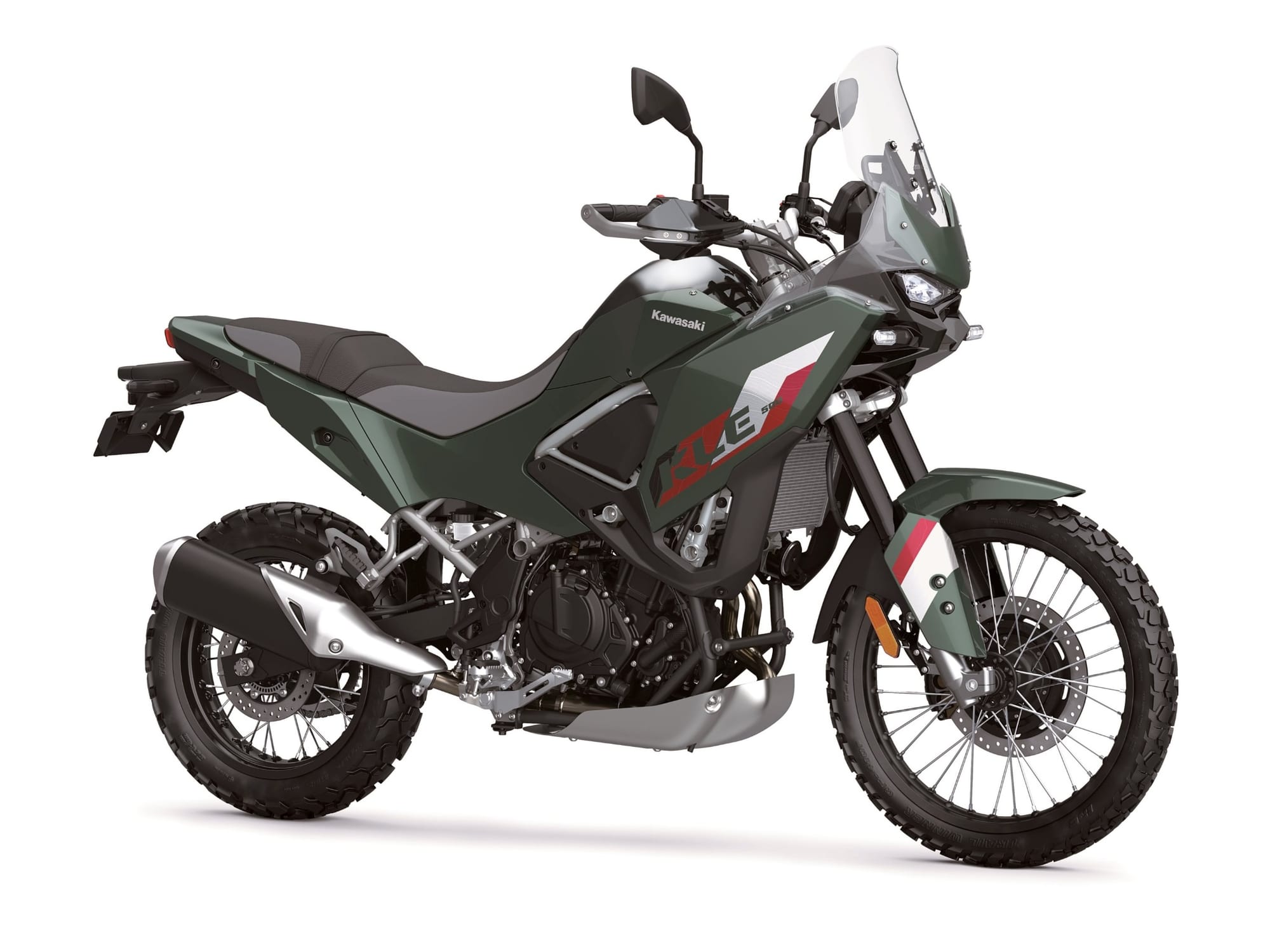
The revived KLE500 uses Kawasaki’s 451 cc parallel twin, tuned here for 51 hp and 43 Nm. The engine is familiar in principle from Kawasaki’s 500-class road models, but the KLE wraps it in a chassis with a 21-inch front wheel, 211 mm of fork travel, and 196 mm at the rear.
At roughly 193–195 kg curb, it is not as light as the BMW or CRF, and its 172 mm ground clearance is much less impressive than the long suspension numbers suggest. Still, its useful engine, comfortable standing geometry, simple electronics, and conventional serviceability give it broad appeal.
The SE adds a TFT display, taller screen, hand guards, and more substantial protection. It does not receive a stronger engine or upgraded suspension, so the base model may be the better starting point for riders who prefer to choose their own accessories. Read the full Kawasaki KLE500 guide.
KTM 390 Adventure R and X
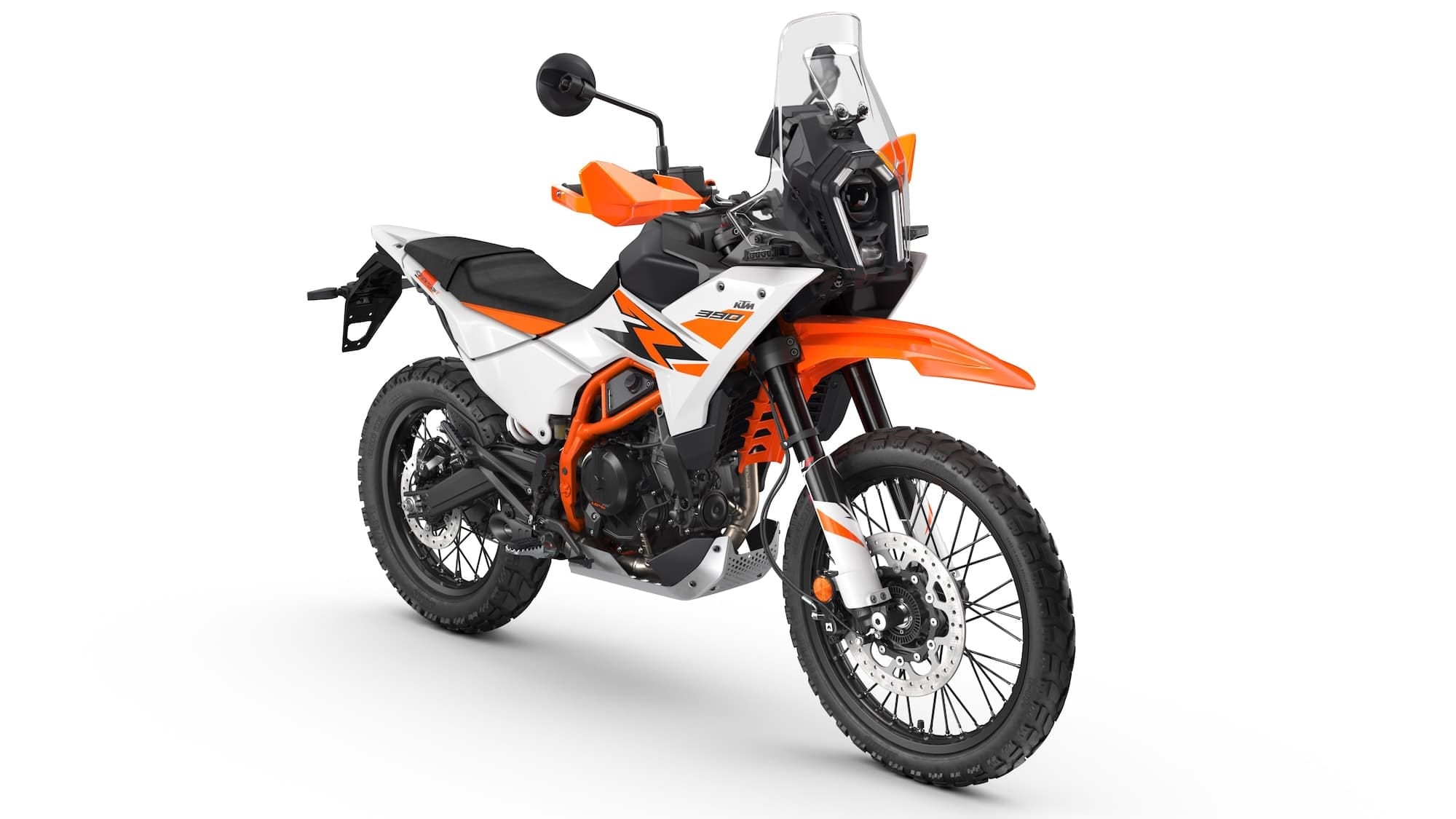
Both versions use KTM’s 398.7 cc LC4c single, producing 45 PS and 39 Nm. They also share a 14-litre tank and a quoted fully fuelled mass of 176 kg. From there, the chassis choices split.
The R has 21/18-inch spoked wheels, 230 mm of suspension travel at both ends, 272 mm ground clearance, and an 870 mm seat. Its electronics include ride modes, traction control, and cornering ABS with an off-road setting. It is the clear choice for riders who genuinely plan to use the chassis in rough terrain.
The X has 19/17-inch cast wheels, 200 mm suspension travel, 232 mm clearance, and a much friendlier 825 mm seat. It is the better fit for urban use, sealed-road touring, and easier gravel. Equipment differs between markets, so check the local specification rather than assuming every electronic aid from the R carries across.
Royal Enfield Himalayan 450
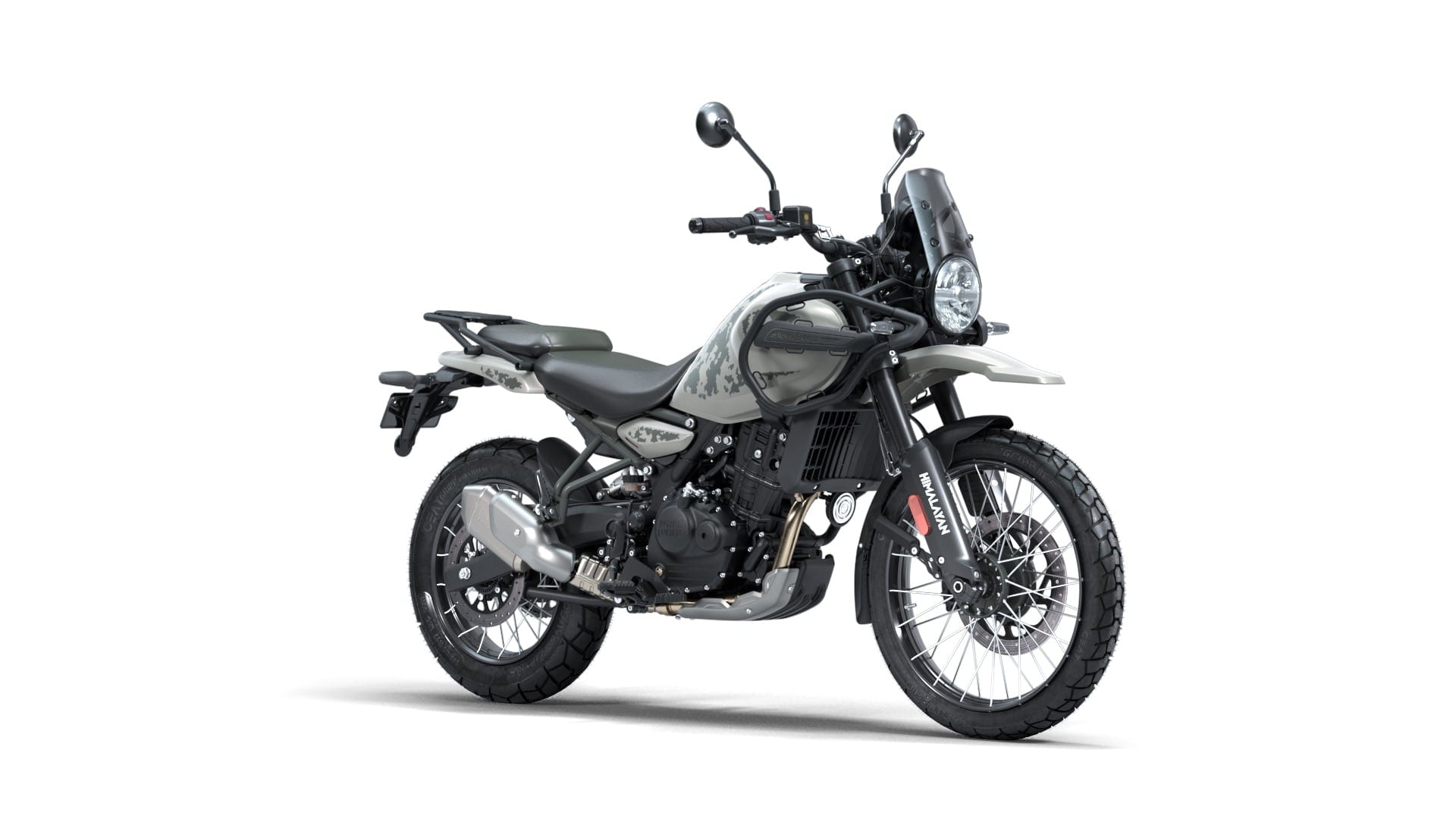
The Himalayan 450 replaced the old long-stroke 411 with Royal Enfield’s liquid-cooled 452 cc Sherpa single. Its 40 hp and 40 Nm do not make it the fastest bike here, but they give it enough reserve for overtaking and loaded travel that the earlier Himalayan lacked.
It has a 21-inch front wheel, 200 mm suspension travel at each end, 230 mm ground clearance, a 17-litre tank, and a standard seat adjustable between 825 and 845 mm. Tubeless cross-spoke wheels are available in some versions and markets; other versions use conventional tube-type spoked rims.
At 196 kg curb it is heavy for a single, but the neutral riding position, stable chassis, useful range, and tractable delivery make it an appealing unhurried travel bike. It suits riders who value comfort and simplicity over minimum mass. Our Himalayan 411 versus 450 comparison explains how extensive the redesign was.
Suzuki V-Strom 250SX
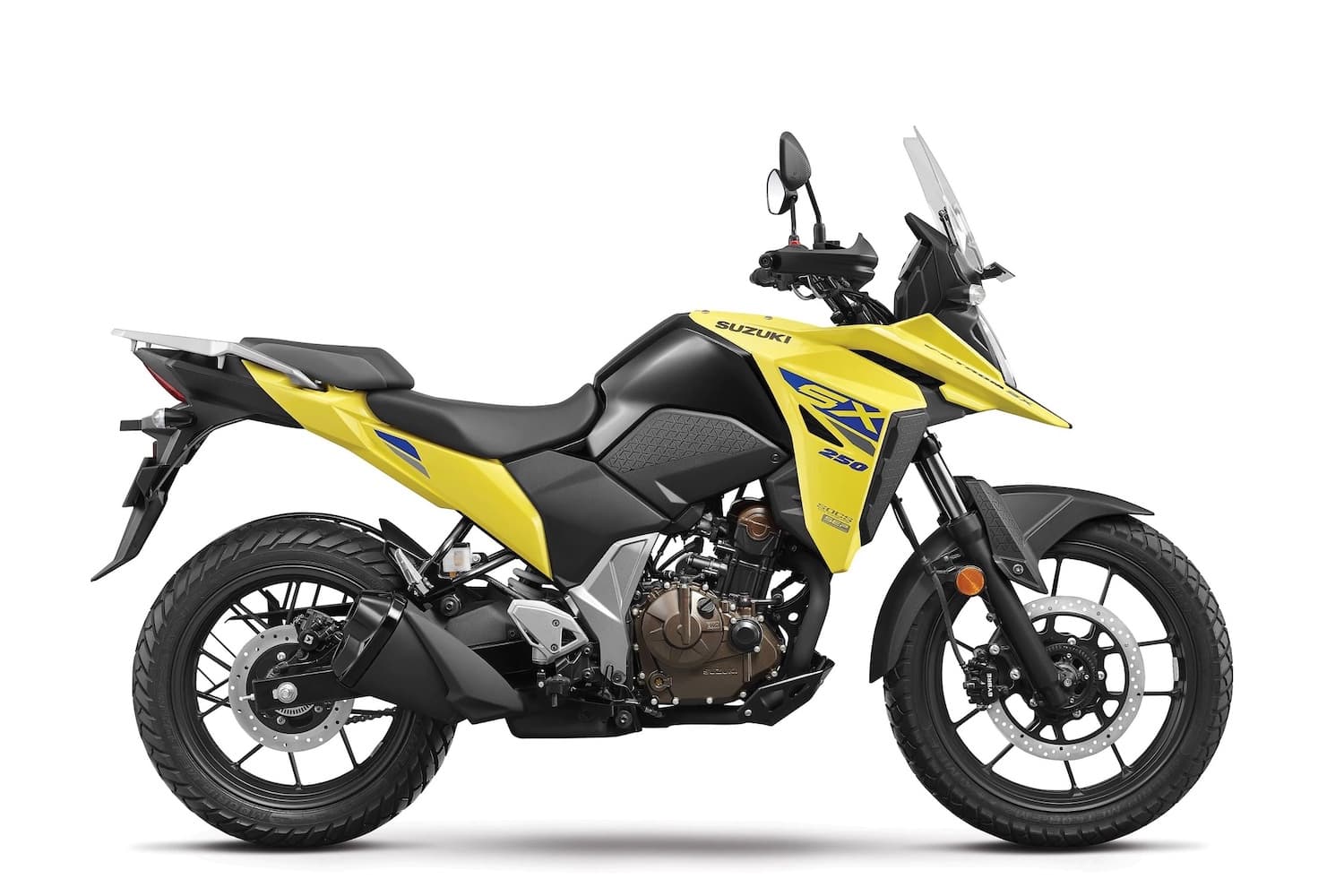
The V-Strom 250SX is the smallest and least powerful motorcycle here. Its oil-cooled 249 cc single makes 26.5 PS and 22.2 Nm, and Suzuki quotes 167 kg curb. A 19-inch cast front wheel, 205 mm ground clearance, tubeless tyres, a screen, hand guards, USB outlet, and rear rack give it the basic equipment needed for economical travel.
It is primarily a paved-road and maintained-gravel motorcycle. Suzuki does not publish generous suspension-travel claims, and the cast wheels and basic suspension are not aimed at hard trail use. Its virtues are fuel economy, low mechanical complexity, and calm everyday manners.
Availability is the main qualification: the 250SX is current in India, Japan, and selected international markets, but it is not a global model in the same sense as the NX500 or Himalayan.
Triumph Scrambler 400 XC
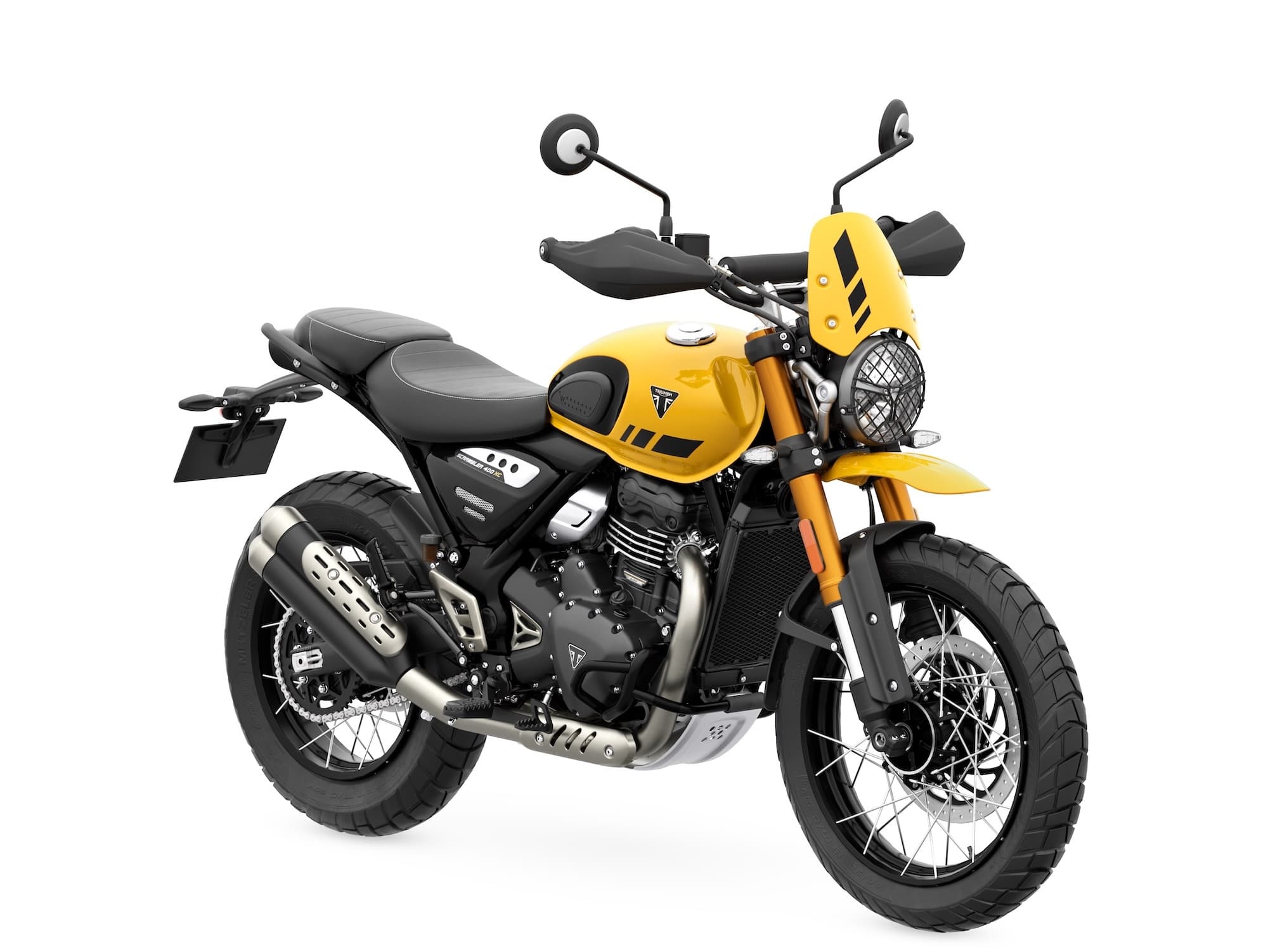
The Scrambler 400 XC adds tubeless side-laced spoked wheels, protection, and off-road-minded details to Triumph’s 400 platform. Its 398 cc single makes 40 PS and 37.5 Nm, while the chassis provides 150 mm suspension travel and a 19-inch front wheel.
It is compact, attractive, and easy to use on back roads. Off-road ABS and switchable traction control help when the surface loosens. Compared with a conventional adventure motorcycle, though, the small flyscreen gives little weather protection, the 13-litre tank is modest, and the 186 kg wet mass is not especially low.
Choose it for mixed everyday riding with occasional luggage and gravel, not because it is a miniature rally bike. See our Triumph 400 model guide for the differences across the family.
Which compact adventure motorcycle should you buy?
Use your regular riding to narrow the shortlist. These starting points put the chassis and riding position ahead of engine capacity alone.
| Your priority | Start with | Also consider |
|---|---|---|
| Mixed road and trail touring | Kawasaki KLE500 | CFMOTO 450MT, Himalayan 450 |
| Lowest mass for rough travel | Honda CRF300L Rally | KTM 390 Adventure R |
| Highway use plus gravel roads | Honda NX500 | BMW F 450 GS, KTM 390 Adventure X |
| Strong specification for the money | CFMOTO 450MT | Himalayan 450 |
| Technical off-road chassis | KTM 390 Adventure R | Honda CRF300L Rally |
| Low-seat flexibility | KTM 390 Adventure X | CFMOTO 450MT, Himalayan 450 |
| Two-up comfort and luggage room | Benelli TRK 502 X | Honda NX500 |
| Style, back roads, and occasional gravel | Triumph Scrambler 400 XC | BMW F 450 GS |
| Simple, economical regional-market tourer | Suzuki V-Strom 250SX | Honda CRF300L Rally |
Models not included
Yamaha currently has no direct compact adventure model between its small dual-sports and the Ténéré 700. Aprilia has shown interest in smaller-capacity adventure machinery, but a Tuareg 457 is not a production motorcycle as of August 2026. Ducati and Husqvarna likewise have no current direct entry that meets this guide’s scope.
There are other credible motorcycles from Moto Morini, Voge, QJMotor, Kove, and additional manufacturers. Some have limited international distribution, some are closer to specialist rally bikes, and specifications or support networks vary sharply by market. That boundary is not permanent: models will be added as their availability and ownership support become broad enough to make the comparison useful.
The Suzuki DR-Z4S is also omitted from the main table. It is a modern dual-sport and an interesting lightweight travel platform, but it lacks the standard wind protection and touring equipment used as the entry rule here.
Final observations
There is no single best compact adventure motorcycle because the category contains several different compromises. A 21-inch wheel and long suspension are valuable only if the trip reaches terrain that uses them. A smooth twin and tubeless road tyres may be far more useful when most days include long paved distances.
Start by deciding where the motorcycle must be easy: on the motorway, in city traffic, on a rocky climb, or when you have to lift it alone. That answer narrows this list more effectively than engine capacity or peak power.
If these bikes are too small or lightly powered for your use, see the complete middleweight adventure motorcycle comparison.