
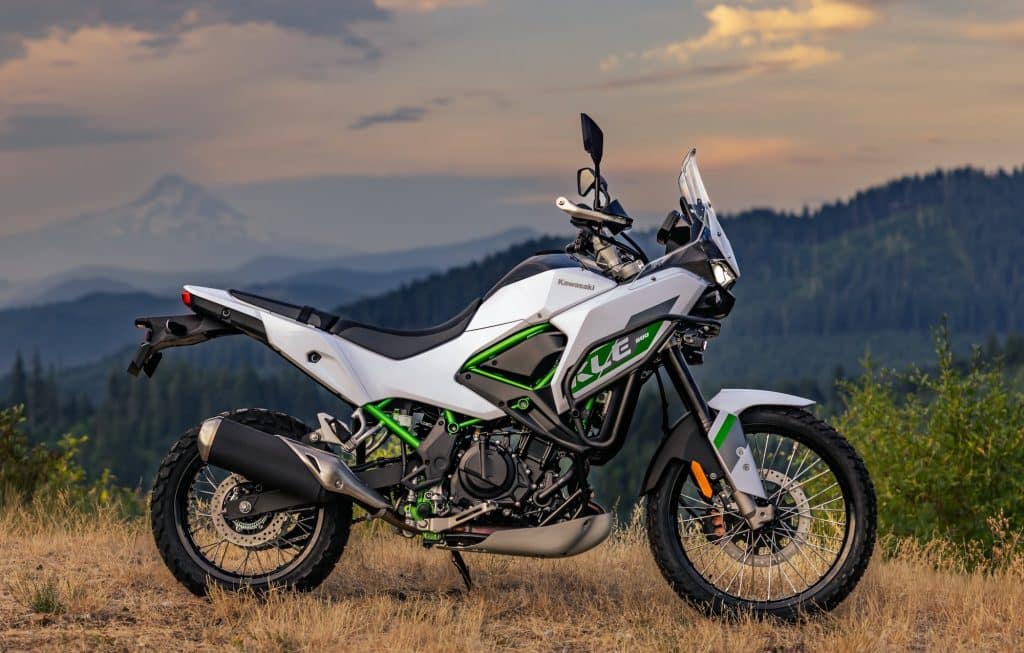
The Kawasaki KLE500 isn’t a bike most people reminisce about warmly — unless you’re one of the die-hard fans, or restored one for fun, or just have kept one alive forever. So there was no pressing need to revive the KLE500 name.
After all, Team Green already had the Versys range for road touring, the KLR650 for simple long-distance travel, and the KLX line for riders who put dirt first. Yet none of those bikes answers the question the original KLE500 answered in 1991: what if you put a road-bike parallel twin into a light, long-legged chassis with a 21-inch front wheel?
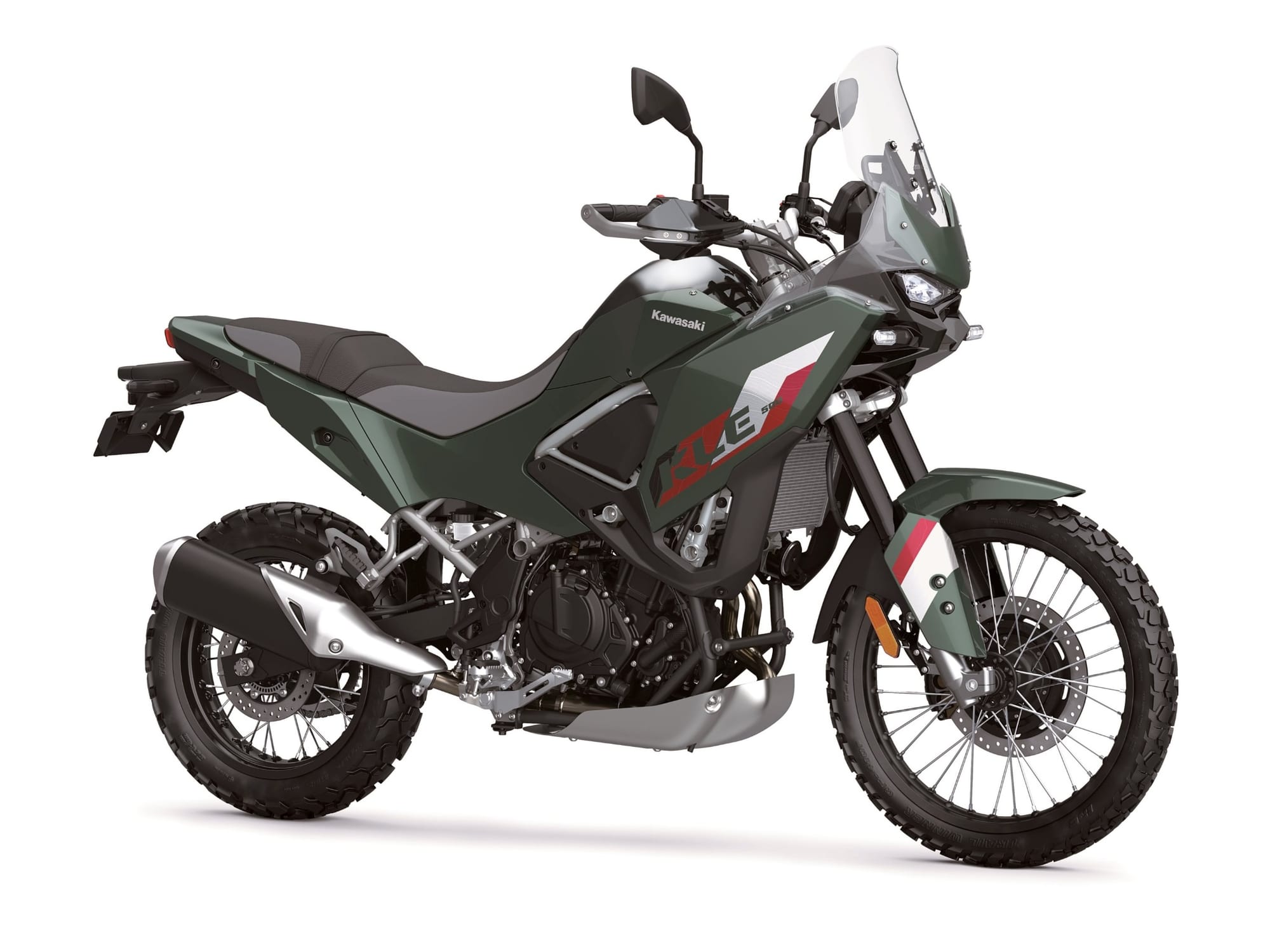
The 2026 Kawasaki KLE500 brings that idea back at a much better time. Small adventure bikes have stopped being treated as cheap substitutes for 1200 cc machines. A 451 cc twin can cross a city, sit at highway speed, carry luggage, sip fuel, and spend the afternoon on gravel without making every low-speed mistake feel like a deadlift.
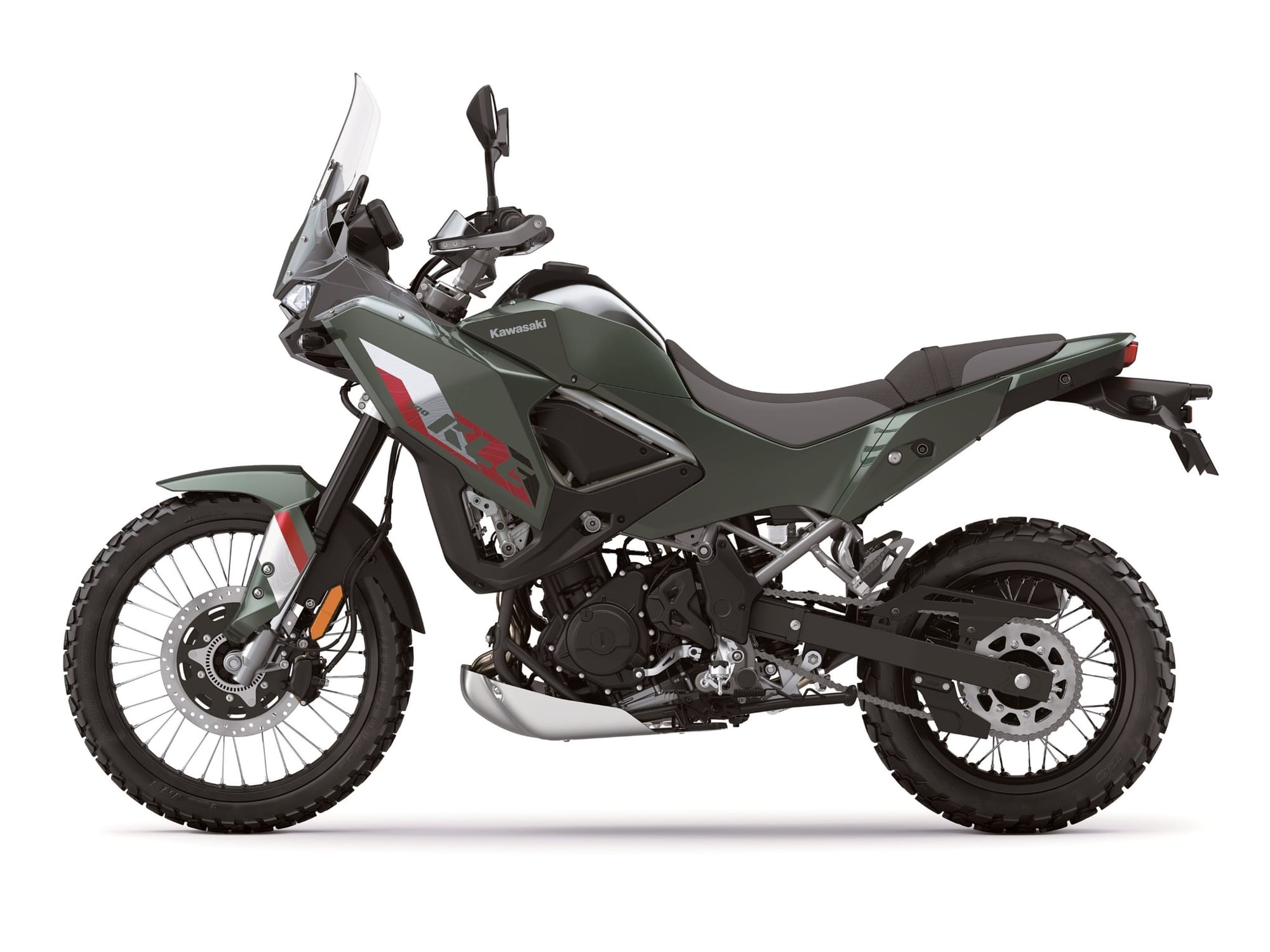
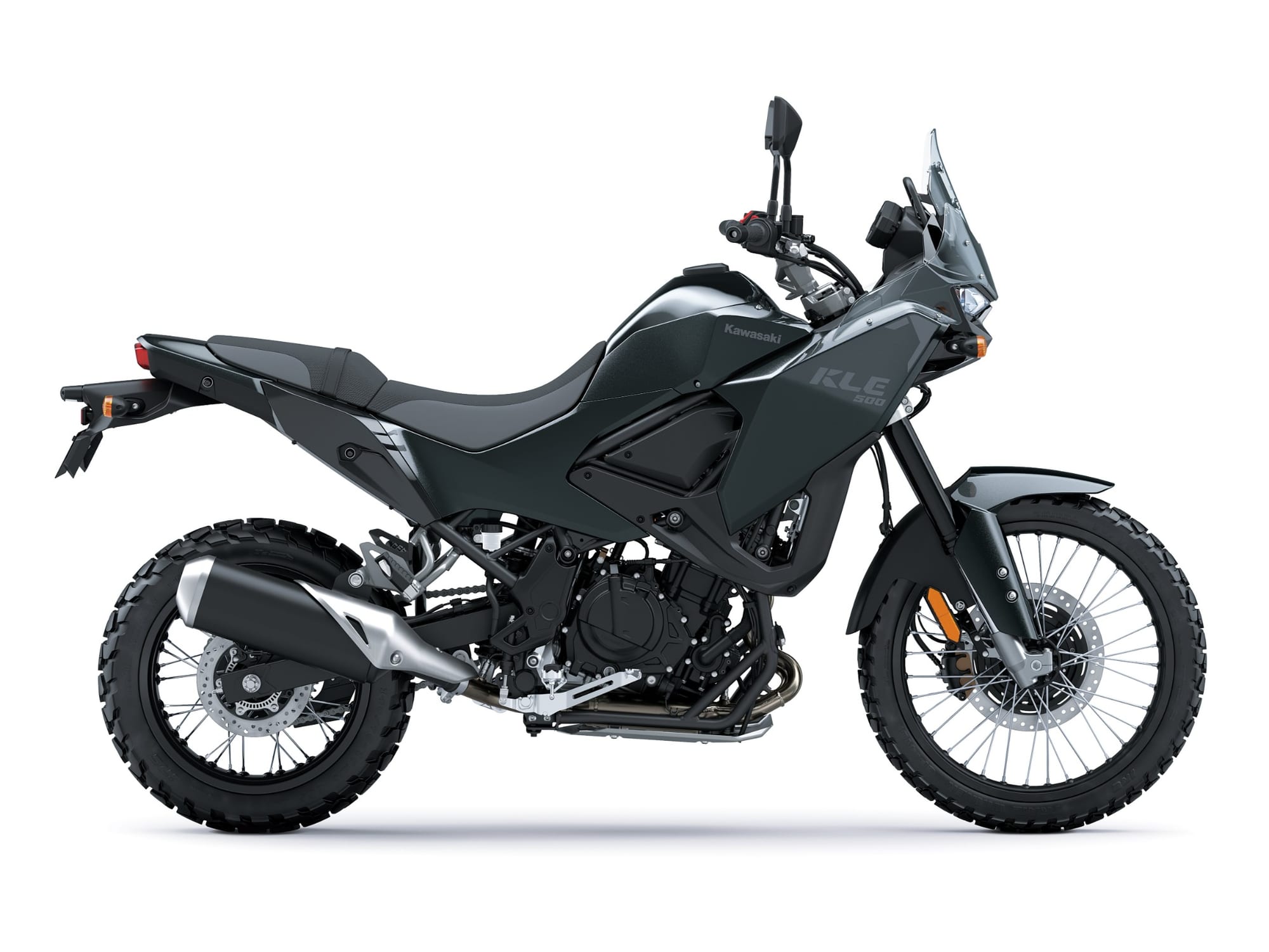
The new KLE500 is good because Kawasaki has kept the brief narrow. It has long suspension, spoke wheels, a useful screen, simple electronics, and the familiar engine from the Ninja 500 family. It is comfortable and easy to place on dirt roads. But the modest 185 mm (7.3 in) ground clearance tells you where the adventure ends: this is a travel bike for rough roads, not a 194 kg (428 lb) enduro.
Short answer: Choose the KLE500 if you want a friendly twin-cylinder adventure bike for commuting, touring, gravel and moderate trails. Choose the Honda NX500 if you rarely leave sealed roads, or the CFMOTO 450MT if wheel clearance, adjustable suspension and a lower seat matter more than Kawasaki familiarity.
Are you obsessed with motorcycles?
Well, I am. That’s why I created this site — as an outlet. I love learning and sharing what others might find useful. If you like what you read here, and you’re a fraction as obsessed as I am, you might like to know when I’ve published more. (Check the latest for an idea of what you’ll see.)
Kawasaki KLE500 model history: the road-bike twin goes exploring
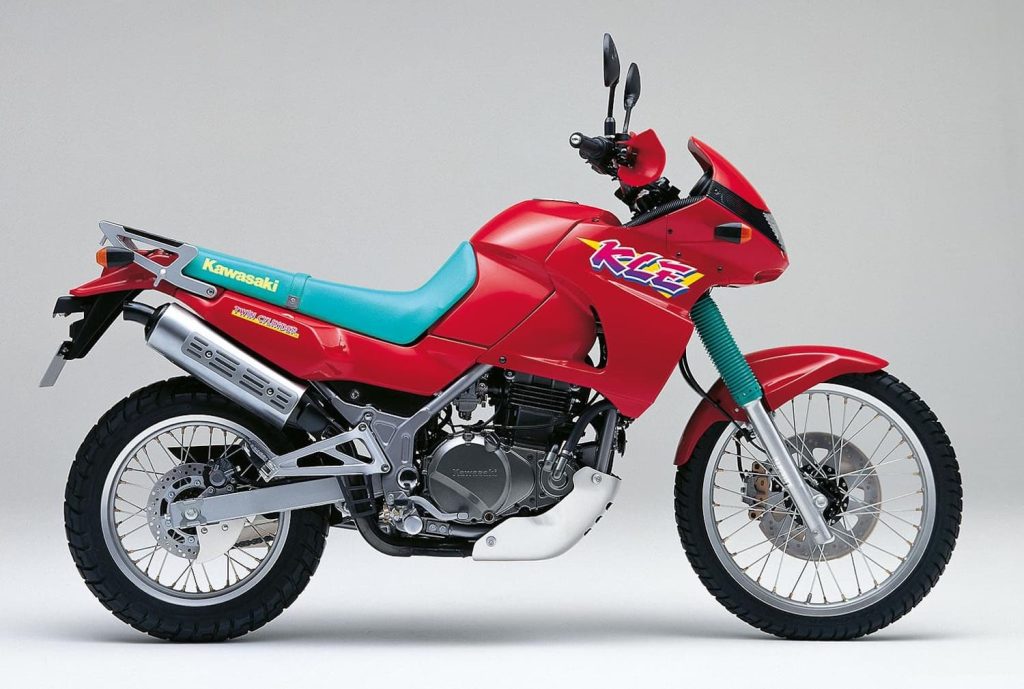
Kawasaki showed the first KLE500 at the 1990 IFMA show in Cologne and put it on sale for 1991. Like today, the timing was no coincidence, but rather a reaction to obvious market trends. Honda’s Transalp had shown that a middleweight motorcycle could mix touring comfort with dirt-road ability, while rally-shaped twins such as the Africa Twin made the idea look glamorous. Kawasaki’s answer was smaller, simpler and… a little stranger.
The original KLE500 combined a 498 cc liquid-cooled parallel twin with a steel double-cradle frame, a 41 mm conventional fork, a 21-inch front wheel, a 17-inch rear, and roughly 220/200 mm (8.7/7.9 in) of suspension travel. It had a small fairing, high exhaust, bash plate and enough room for a passenger. In modern language, it was a compact adventure tourer before manufacturers had agreed on what that meant.
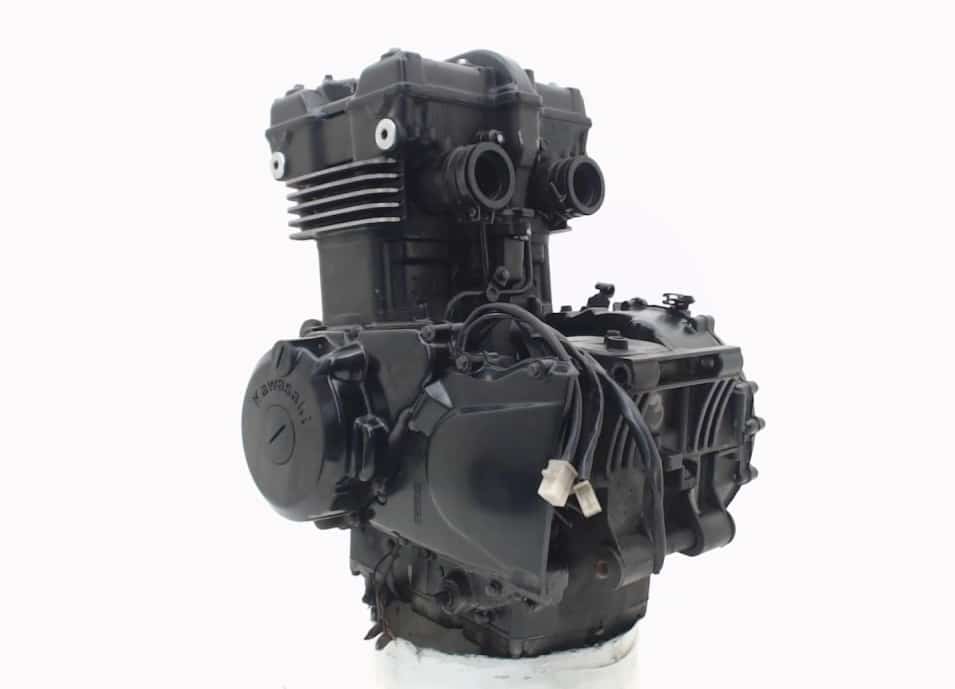
The first KLE500’s engine belonged to the same family as the GPZ500S, called the EX500 or Ninja 500 in other markets (again, not today’s Ninja 500… see that model guide here). Kawasaki kept the 74 x 58 mm bore and stroke but changed the tune, induction and other details for the taller, heavier dual-purpose bike.
That family spread widely. The ER-5 commuter used another version, and Kawasaki adapted it for the EN500/Vulcan 500 cruiser. The shared architecture was a liquid-cooled DOHC eight-valve twin with a 180-degree crankshaft. Each motorcycle had its own tune and transmission details, but the basic motor earned a reputation for surviving daily use with little drama.
The KLE version still preferred revs. Early full-power bikes made about 37 kW (50 PS), while later emissions and noise changes reduced the headline number. Riders coming from a single-cylinder trail bike found the engine smooth and lively at speed; riders expecting a tractor-like bottom end had to use the gearbox. That tension has returned with the 2026 bike.
Kawasaki revised the gearbox in 1993 after reports of bikes jumping out of gear. A 1994 update brought reshaped upper bodywork, a more padded stepped seat and a better cam-chain tensioner. Intake, carburettor and silencer changes followed in 1996, with taller gearing and a small loss of peak output. Secondary-air injection arrived in 1997.
The production record gets messy because model years and availability varied by country. Some summaries say the KLE vanished after 1997 or 1998, but European model-code records list A-series bikes through the early 2000s. The safest way to divide the family is the original-shape A-series and the substantially restyled B-series that arrived for 2005.
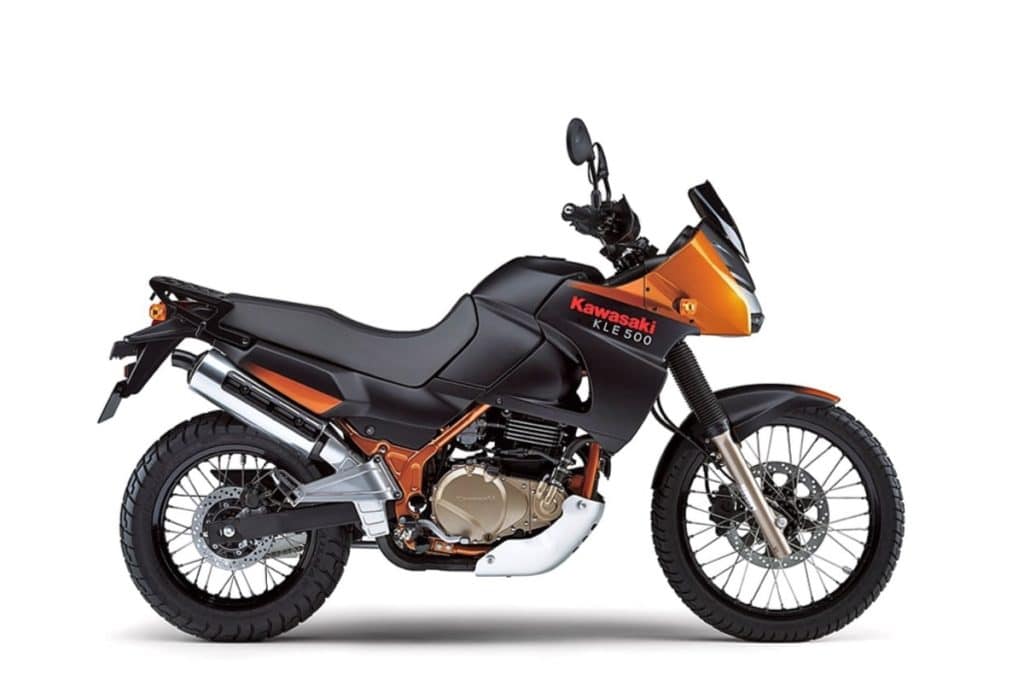
The 2005 facelift replaced the square 1990s nose with stacked lights and sharper bodywork influenced by Kawasaki’s Z750 and Z1000. Kawasaki revised the instruments, screen, seat, fork and exhaust, added a catalyst for Euro 2, and left the front brake disc exposed. The engine now made a claimed 33 kW (45 PS) at 8,300 rpm and 41 Nm (30.2 lb-ft) at 7,500 rpm. Underneath, it was still the same basic carburetted KLE.
Production ended in 2007. Kawasaki’s Versys 650 became the nominal successor, and even carried the KLE650 code, but its 17-inch cast wheels and road-biased chassis moved the idea towards sealed-road touring. The old KLE disappeared without a direct replacement. If you want the broader family context, the Honda Transalp history shows how Kawasaki’s long-running rival followed a similar path, though Honda returned to the name sooner.
It was partly a sign of the times. Adventure sport tourers were (and still are) a hugely popular segment — more so than actual adventure bikes. Most riders ride on roads! But history is, somewhat, repeating itself, and there’s a growing segment of small road engines used as versatile adventure bike motors. So Kawasaki is bringing the KLE500 back in new form.
Original KLE500 vs the 2026 KLE500
The new motorcycle repeats the old recipe. Both use a road-derived parallel twin, 21/17-inch spoke wheels, a single front disc and a tall riding position. Mechanically, they share almost nothing.
| Item | 1991-2007 KLE500 | 2026 KLE500 |
|---|---|---|
| Engine | 498 cc carburetted DOHC parallel twin; GPZ/EX500 family; 180-degree crank | 451 cc fuel-injected DOHC parallel twin; Ninja 500/Z500/Eliminator family; 180-degree crank |
| Claimed output | About 50 PS early; 45 PS and 41 Nm by 2005 | AU/EU: 33.4 kW (45 PS) and 42.6 Nm (31.4 lb-ft); US figure differs |
| Frame | Steel double cradle | Steel trellis with engine as a stressed member |
| Suspension | 41 mm conventional fork; about 220/200 mm travel | 43 mm inverted fork; 210/196 mm (8.3/7.7 in) travel |
| Wheels | 21/17-inch spokes; 90/90 and 130/80 tyres | 21/17-inch spokes; 90/90 and wider 140/70 tube-type tyres |
| Brakes | Single 300 mm front and 230 mm rear discs; no ABS | Single 300 mm front and 230 mm rear discs; switchable ABS |
| Weight | About 181 kg (399 lb) dry; 200 kg (441 lb) curb | 175 kg (386 lb) dry; 194 kg (428 lb) curb in Australia |
| Seat / clearance / tank | 850 mm (33.5 in) / 180 mm (7.1 in) / 15 L | 870 mm (34.3 in) / 185 mm (7.3 in) / 16 L |
| Equipment | Analogue instruments, halogen lighting, no rider aids | LCD or TFT, connectivity, LED lighting, assist/slipper clutch and switchable ABS |
The surprise is how closely the two bikes match in intent and size. The 2026 model has nearly the same peak output as the late Euro 2 bike, a slightly taller seat, and only 5 mm (0.2 in) more clearance. Modern packaging removes about 6 kg (13 lb) from comparable curb figures while adding ABS, injection and a stronger luggage-ready rear structure.
2026 Kawasaki KLE500 specifications — and what they mean
In Soviet Russia, spec sheet rides you! Yakov Smirnoff said it (no he didn’t).
| Item | 2026 Kawasaki KLE500 specification | What it means |
|---|---|---|
| Engine | 451 cc liquid-cooled DOHC eight-valve parallel twin; 70 x 58.6 mm; 11.3:1; fuel injection | The street-derived twin is smooth at sustained speed and stronger up top than a small single, but it still wants revs when the bike is loaded. |
| Power and torque | AU/EU: 33.4 kW (45 PS / 44.8 hp) at 9,000 rpm; 42.6 Nm (31.4 lb-ft) at 6,000 or 7,500 rpm by market source | Enough for highway travel and overtakes with planning. The broad midrange matters more than the modest (ok, low) peak figure. |
| Clutch and transmission | Six-speed; assist-and-slipper clutch; 46/15 final drive | The clutch action is light in traffic. The slipper mechanism reduces rear-wheel hop after a hurried downshift on road or dirt. |
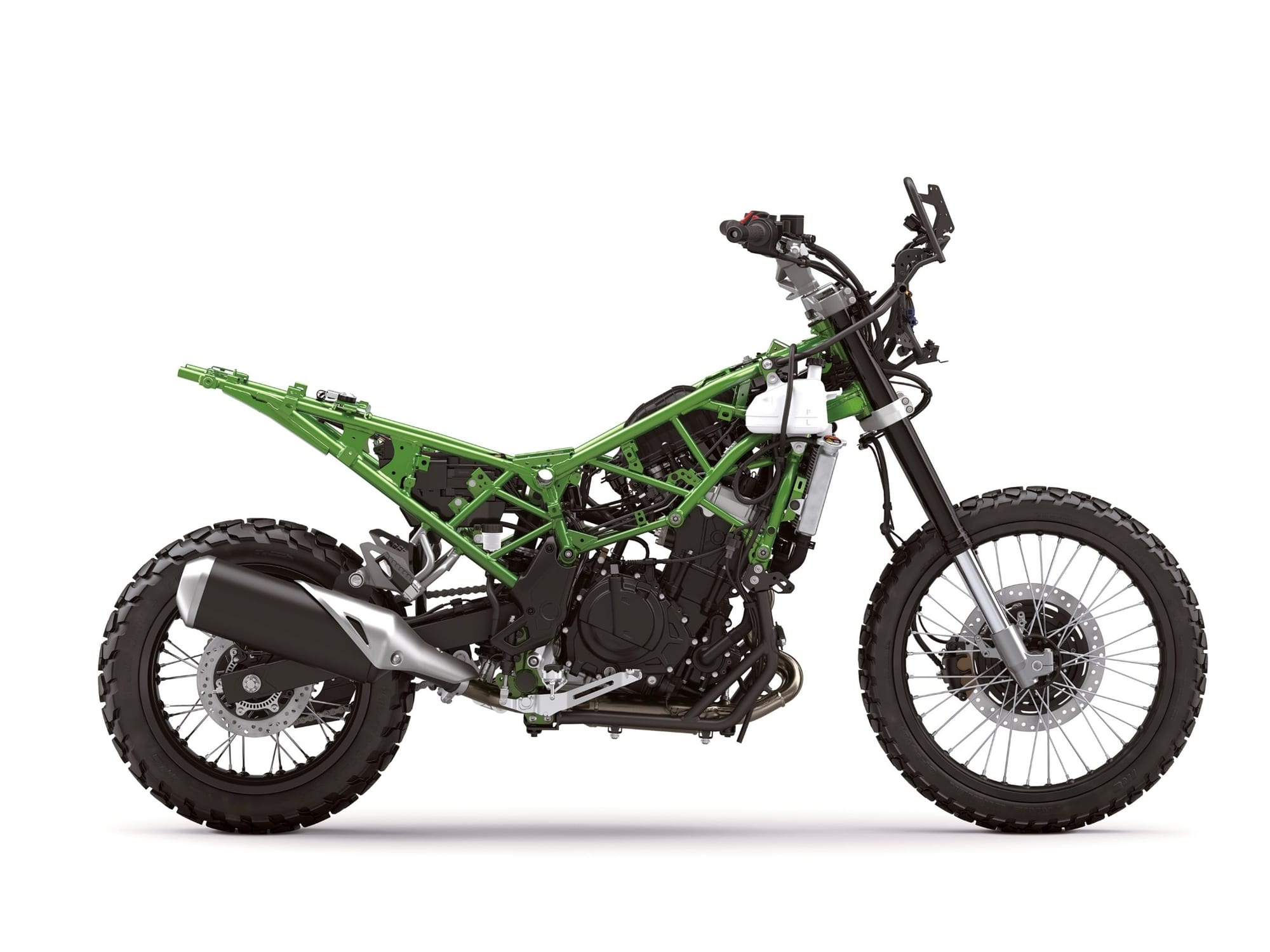
| Frame | High-tensile-steel trellis; engine is a stressed member; luggage-ready rear section | The bike is narrow and can take two panniers plus a top case without an improvised rack hanging from a weak tail. |
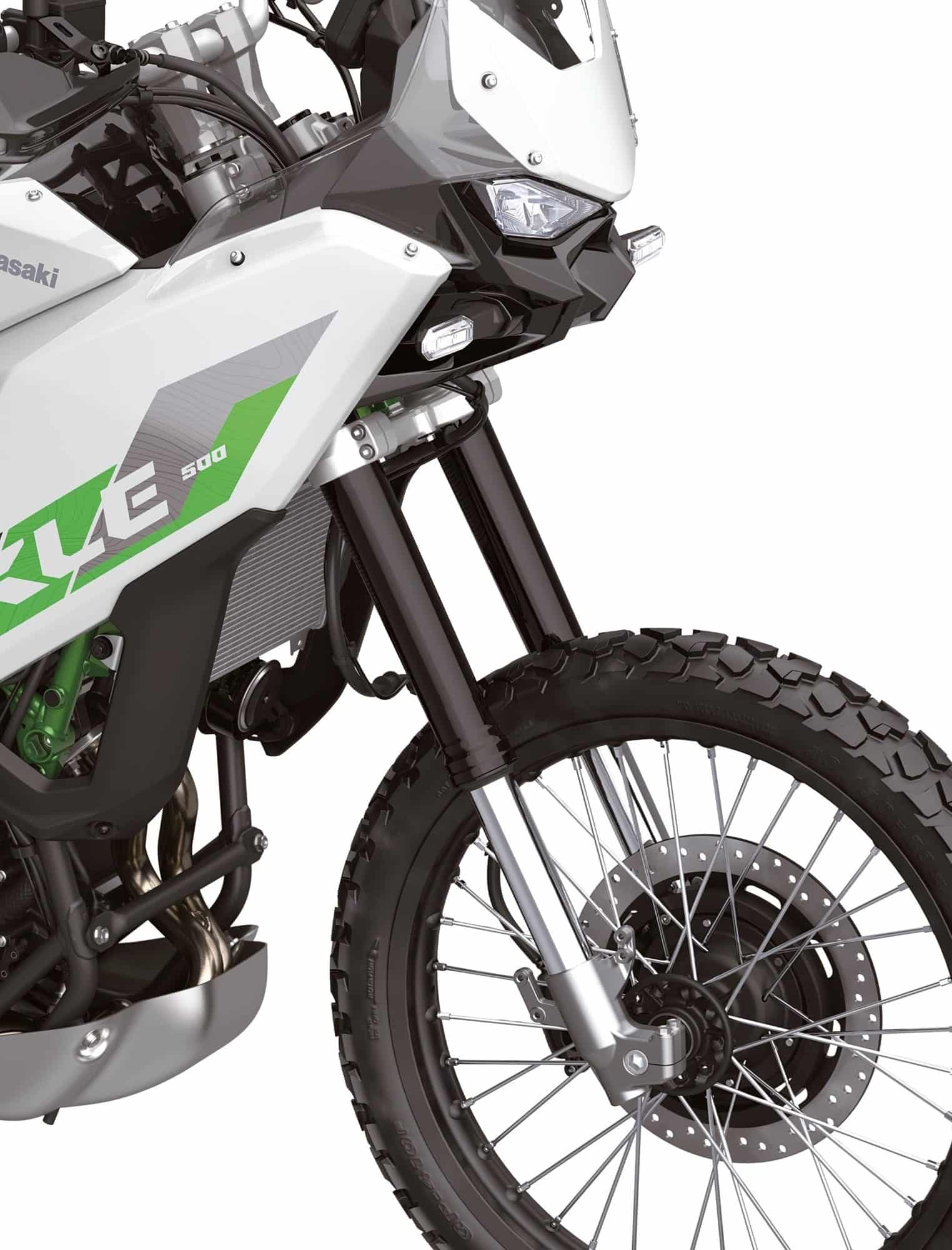
| Front suspension | 43 mm KYB cartridge-type inverted fork; 210 mm (8.3 in) travel; no adjustment | Long travel absorbs potholes, corrugations and moderate trail hits. Lack of damping adjustment limits how well you can tune it for speed or extra load. |
| Rear suspension | New Uni-Trak shock; 196 mm (7.7 in) travel; preload adjustment | You can correct sag for luggage or a passenger, but not change compression or rebound damping. |
| Wheels and tyres | 90/90-21 front and 140/70-17 rear; spoked, tube-type; IRC GP-410 tyres | The 21-inch front rolls over holes and rocks well. The 17-inch rear keeps road tyre choice broad, while tubes make puncture repairs slower. |
| Brakes and ABS | 300 mm front disc with two-piston caliper; 230 mm rear disc; both-channel ABS can be switched off | Simple, adequate brakes suit the pace. ABS cannot be disabled at the rear alone, and it resets after an ignition-key cycle. |
| Seat and clearance | 870 mm (34.3 in) seat; 185 mm (7.3 in) ground clearance; optional 30 mm lower rider seat | The seat is tall but the bike is narrow. Clearance, rather than suspension travel, restricts rocky-route ambition. |
| Weight | 194 kg (428 lb) curb, Australian base model; 195 kg (430 lb) European SE | Manageable for a twin-cylinder travel bike, but heavy enough that a muddy off-camber pickup still requires care. |
| Fuel and range | 16 L (4.2 US gal); 4.0 L/100 km (59 mpg, US) EU claim | The mathematical range is about 400 km (249 mi). Wind, luggage, dirt and reserve planning make the usable figure lower. |
| Electronics | ABS and Rideology phone connection; no traction control, ride modes or quickshifter | There is little to configure or pay for. Riders wanting cornering aids or adjustable throttle maps need another bike. |
The 451 cc engine and power delivery
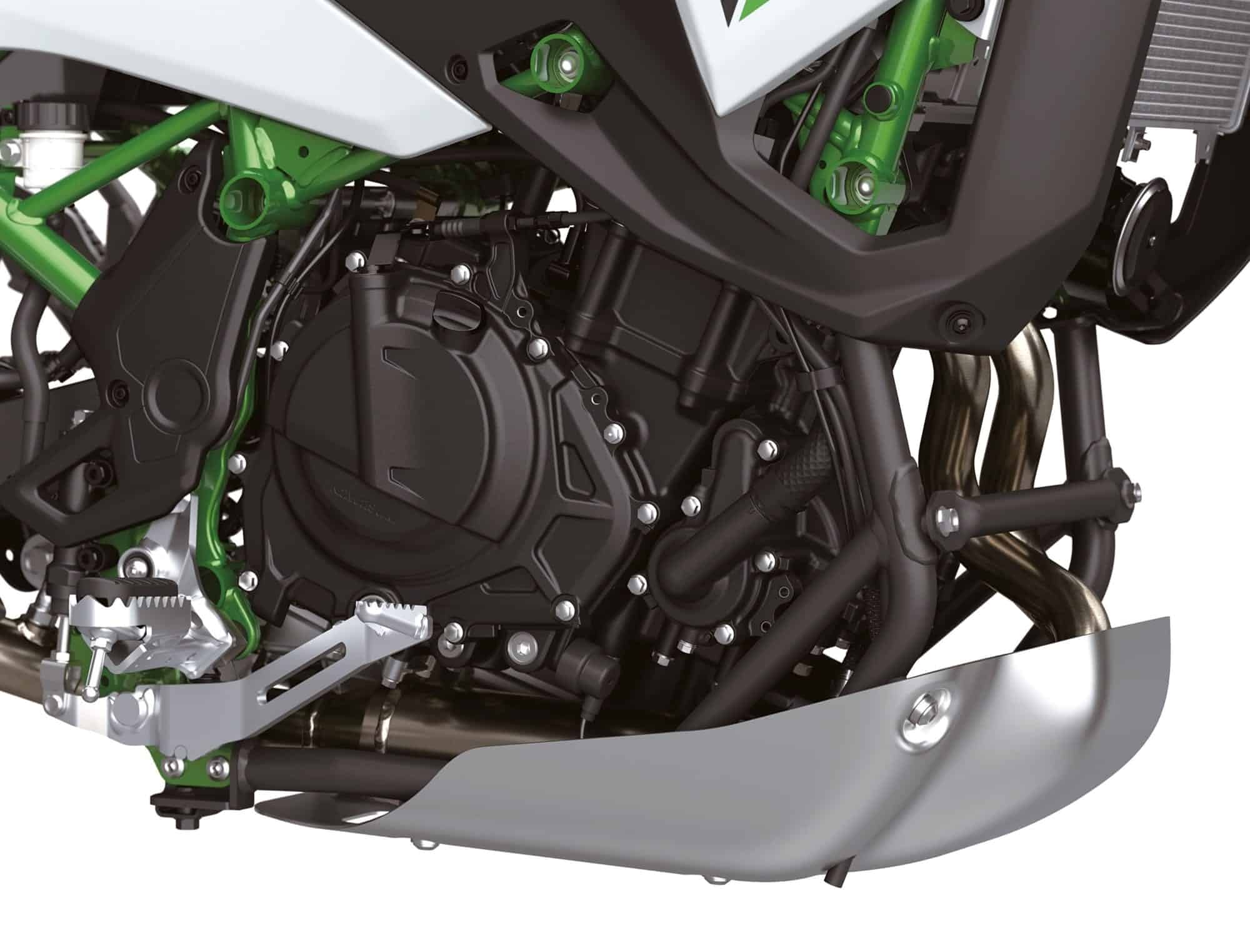
The 451 cc engine is familiar from the Ninja 500 and Z500, plus the Eliminator cruiser. Kawasaki changed the airbox, downdraft intake and final gearing for the KLE500, but did not turn it into a slow-revving trail motor. This is still a 180-degree road twin that makes its best power high in the tachometer.
At low rpm, response is clean and predictable rather than forceful. That helps on loose climbs because a small throttle correction does not kick the rear tyre sideways. Let the revs rise and the engine becomes much more willing. Fast overtakes, steep highway grades and a passenger ask for a downshift, which is hardly a punishment with the light clutch and positive six-speed gearbox.
The main trade is vibration above roughly 6,000 rpm. The engine will sit at freeway speed, and the fairing removes much of the wind load, but it does not have the lazy roll-on acceleration of a 650-800 cc adventure twin. The KLE rewards a rider who is willing to use revs and accepts that a smaller motorcycle saves weight and fuel by asking more of its gearbox.
What the 2026 Kawasaki KLE500 is like to ride
In town and at low speed
The KLE500 feels tall when you first swing a leg over it, but the narrow seat and bodywork make the 870 mm (34.3 in) figure less severe than it looks. The engine is smooth, the clutch is light, and the wide handlebar gives useful leverage. A 40-degree steering angle in each direction makes tight turns easier than the long wheelbase suggests.
The mass sits low enough that walking-speed balance is friendly, though 194 kg (428 lb) does not disappear when the road slopes away under one foot. Shorter riders should try the standard bike before ordering the 30 mm lower seat; the slim middle may be enough, and the lower cushion changes legroom.
On highways and fast country roads
Comfort is the KLE500’s strongest road argument. The footpegs sit under the rider rather than far forward, the handlebar falls naturally to hand, and the seat gives some room to move. The adjustable screen takes pressure off the chest without turning the cockpit into a still-air pocket. The taller SE screen gives more coverage and may also create more helmet turbulence for some heights, so screen position matters more than trim level.
The chassis stays calm at speed. Long travel does not produce excessive pitching under ordinary braking and acceleration, and the 21-inch front is slower to change direction than a 19-inch road wheel without feeling vague. On bumpy sealed roads the KLE is easy to trust: it holds a line, absorbs damaged surfaces and gives the rider time to make a correction.
At 110 km/h (68 mph), the twin has enough reserve for normal overtakes, but sixth gear is not a bottomless source of acceleration. Drop to fifth, use the upper half of the rev range, and it gets the job done. Add hard luggage and a passenger and the limitation becomes clearer. The bike will carry both; it simply asks you to plan passes rather than flick your wrist.
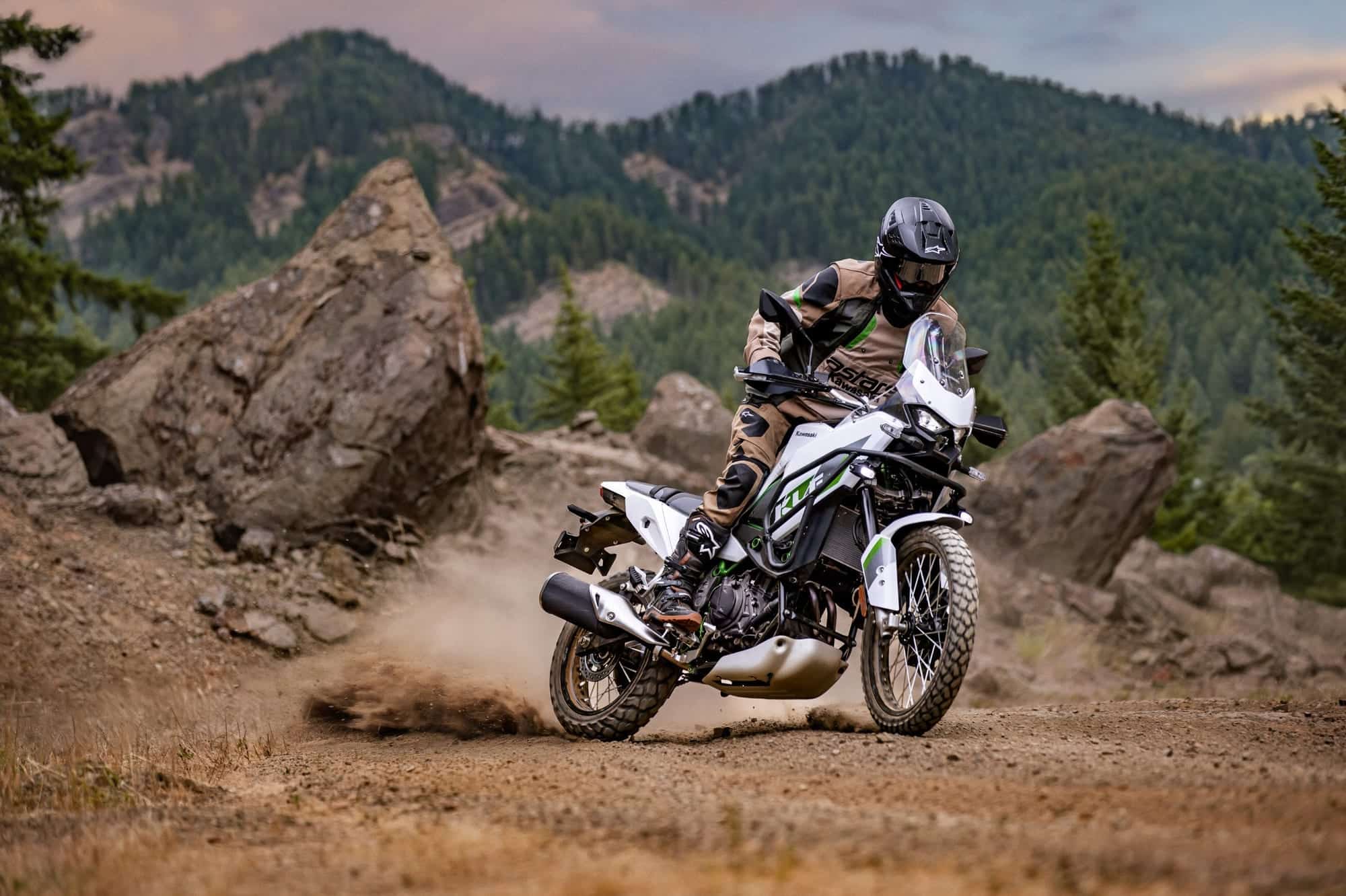
On gravel, corrugations and rough tracks
The standing position is one of the bike’s best details. The tank and side panels stay out of the way, the bar is far enough forward, and the peg position lets you steer through your feet without hanging from your arms. The engine’s smooth response gives good control when grip changes, while the 21-inch front wheel settles into loose surfaces rather than deflecting at every stone.
The suspension handles corrugations, potholes and sensible trail speed well. It becomes less composed through repeated whoops or hard-edged hits, especially because the fork has no adjustment and the shock only offers preload. Push a fast enduro pace and the rear can bottom. Slow down to an exploration pace and the bike works with you again.
Ground clearance is the number to remember. The KLE has 210 mm (8.3 in) of front travel but only 185 mm (7.3 in) beneath the bike. A rock that uses most of the suspension can also meet the skid plate. The base guard is modest; the SE plate wraps around more of the engine. Neither changes the need to pick a clean line through rocks and ruts.
Holding the ABS button switches the system off at both wheels. That is useful on loose descents and when you want to steer with rear-wheel slip, but the system will not let you keep front ABS while disabling only the rear. Turn the ignition off with the key and ABS returns; use the engine stop switch and the selected state stays. It is simple once learned, though not as flexible as the separate off-road settings on some rivals.
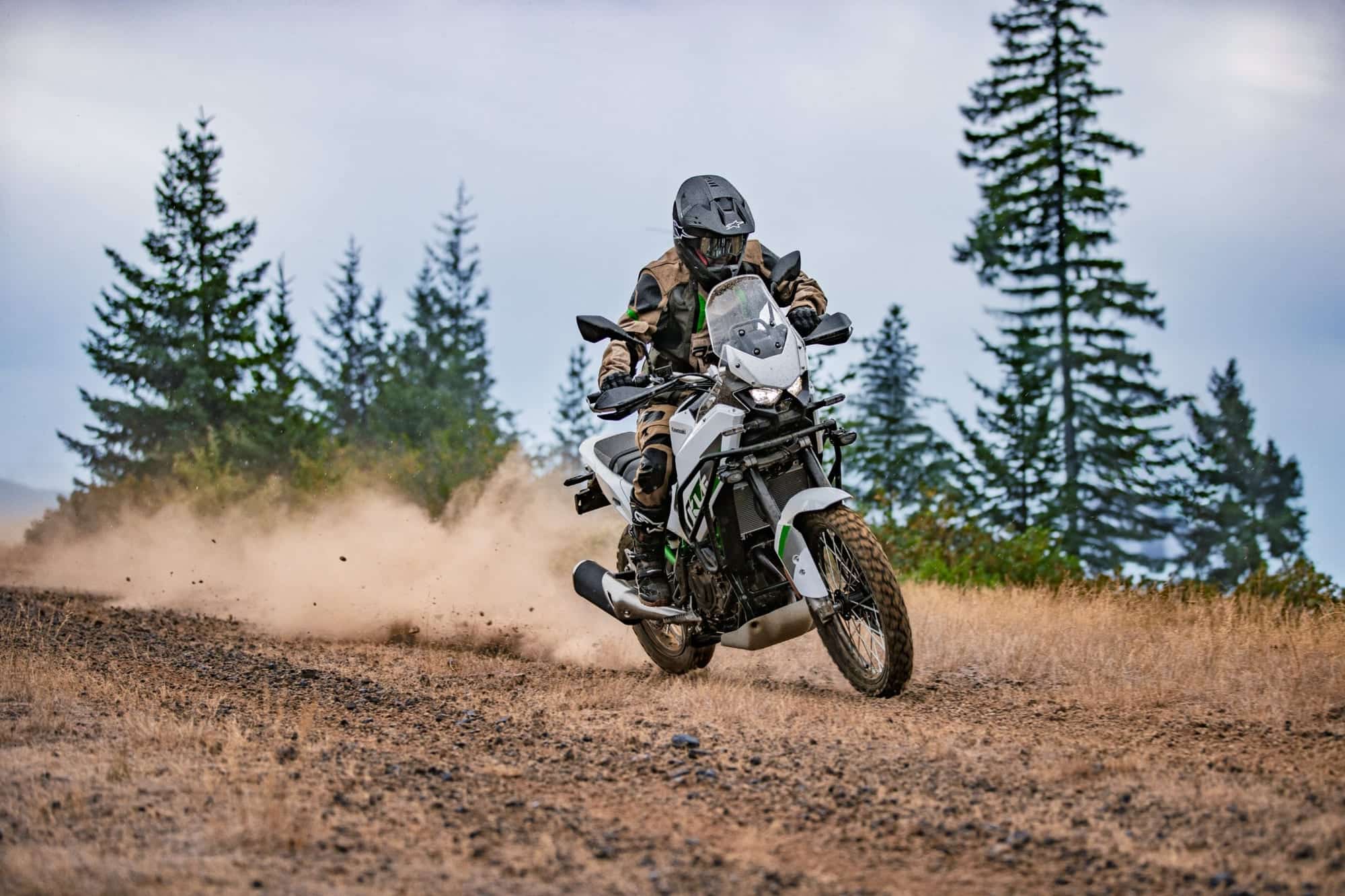
Suspension, brakes and tyres
The KLE500 has more suspension travel than most road-biased 500s, but Kawasaki has chosen compliance and cost control over adjustment. The 43 mm KYB cartridge fork has no external settings. The rear shock lets you change preload for luggage or a passenger, which matters because an overloaded rear changes steering and reduces already modest clearance.
The single 300 mm front disc and two-piston caliper look basic beside the four-piston brakes on some competitors. On the road the lever needs a firmer pull than a twin-disc street bike, but the response is progressive and easy to meter on loose ground. Riders who carry a passenger and three cases should leave more braking room; the hardware is adequate, not lavish.
IRC GP-410 tyres give a sensible road-and-gravel compromise. They stay predictable on sealed corners and find useful grip in ordinary dirt, though mud and deep sand will expose the open question that faces every original tyre: how far from the design brief are you going? The conventional spoke rims use tubes. A tube can still be repaired far from a tyre shop, but removing a wheel and patching it is slower than plugging a tubeless puncture.
KLE500 standard vs KLE500 SE
The SE is an equipment package, not a performance model. Both versions use the same engine, frame, suspension, brakes and wheel sizes. The SE money buys parts many touring riders would add anyway.
| Item | KLE500 standard | KLE500 SE | Does it matter? |
|---|---|---|---|
| Display | Full LCD with phone connection | 4.3-inch colour TFT with phone connection | The TFT looks better; the LCD still shows the riding information you need. |
| Windscreen | Shorter adjustable screen | About 107 mm (4.2 in) taller | Useful for highway use, though taller is not automatically quieter for every helmet and height. |
| Handguards | Not standard | Metal-reinforced wraparound guards | Worth having for weather, branches and low-speed drops. |
| Skid plate | Smaller lower guard | Larger aluminium wraparound plate | The SE part suits the bike’s low clearance, but an accessory plate may be cheaper than the whole trim upgrade. |
| Indicators | Conventional indicators by market | LED indicators | Little effect on the ride. |
| Mechanical changes | None | None | The SE is no faster and has no suspension upgrade. |
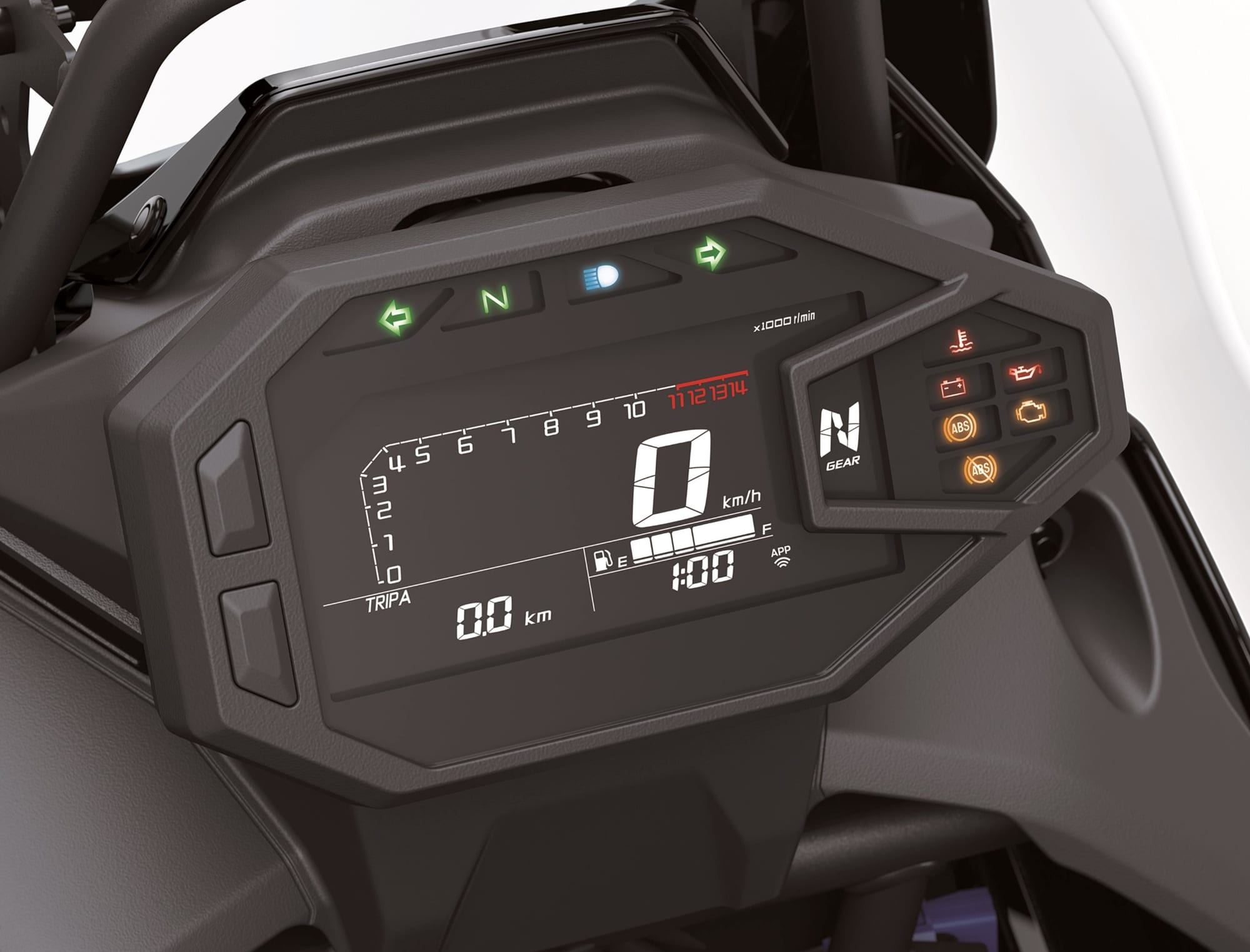
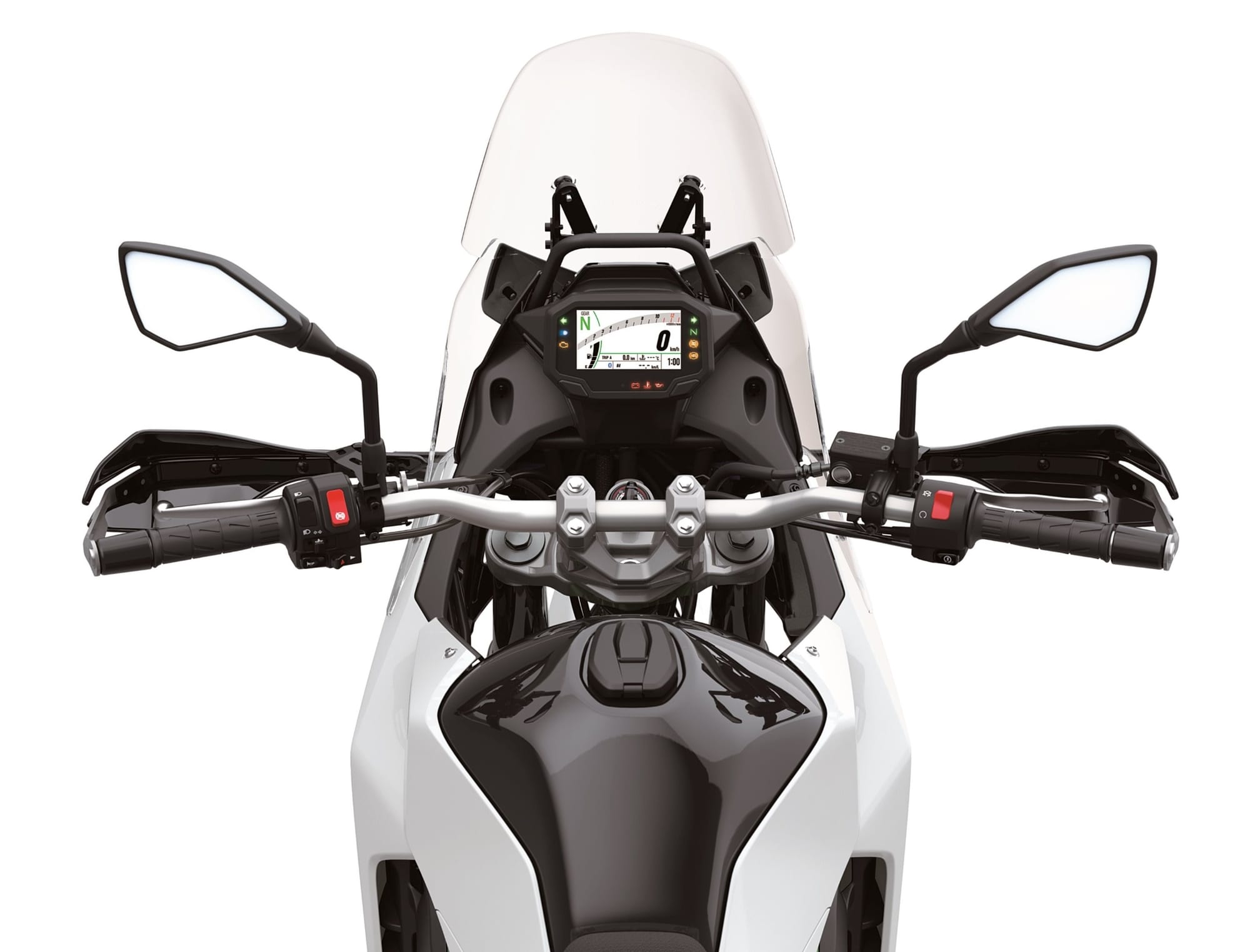
Buy the standard model if price matters and you prefer to choose your own protection parts. Buy the SE if you want the taller screen, reinforced handguards, larger skid plate and TFT together. The upgrade makes sense as a bundle; it does not make the motorcycle better underneath.
Everyday use, luggage and maintenance
The 16 L (4.2 US gal) tank and claimed 4.0 L/100 km (59 mpg, US) economy give the KLE genuine travel range. A published US first ride returned about 4.4 L/100 km (54 mpg, US) over roughly 560 km (350 mi), which points to around 320-350 km (200-217 mi) before a sensible fuel stop. Speed, wind, luggage and dirt can move that number sharply.
Kawasaki designed the rear frame for two panniers and a top case at the same time. That is useful for road touring, though three hard boxes add width, cost and weight high on the bike. Soft luggage is kinder during a trail fall. Heated grips, a USB-C socket, engine guards, a centre stand and lower seat are among the factory accessories.
The 451 cc engine family is established, but the KLE500 chassis is new, so nobody can make a serious long-term reliability claim yet. The maintenance burden should be conventional: oil and filter services, periodic valve-clearance inspections, coolant and brake fluid by time, and frequent chain attention after dust or rain.
Adventure-bike ownership adds its own routine. Watch spoke tension, wheel damage, chain slack, air-filter condition, fork seals, skid-plate impacts and loose fasteners. If the bike has luggage or crash protection, inspect the mounts after a fall. Those checks matter more than an app telling you that the odometer has changed since yesterday.
Kawasaki KLE500 vs Honda NX500, CFMOTO 450MT and other small adventure bikes
The KLE500 sits between the Honda NX500 and CFMOTO 450MT. It nearly matches the Honda’s power, torque and wet mass, but trades the Honda’s 19-inch cast front wheel and short travel for 21-inch spokes and about 200 mm of wheel movement. The CFMOTO goes farther towards dirt with an 18-inch rear, more clearance, adjustable suspension and lower weight.
| Motorcycle | Key figures | Why choose it | Why choose the KLE500 instead |
|---|---|---|---|
| Kawasaki KLE500 | 451 cc twin; 33.4 kW (45 PS); 42.6 Nm; 194 kg; 870 mm seat; 21/17 spokes; 185 mm clearance | Balanced road-and-gravel twin, stable chassis, useful range and reinforced luggage capacity | Because it’s better than the KLE500, though also not as good |
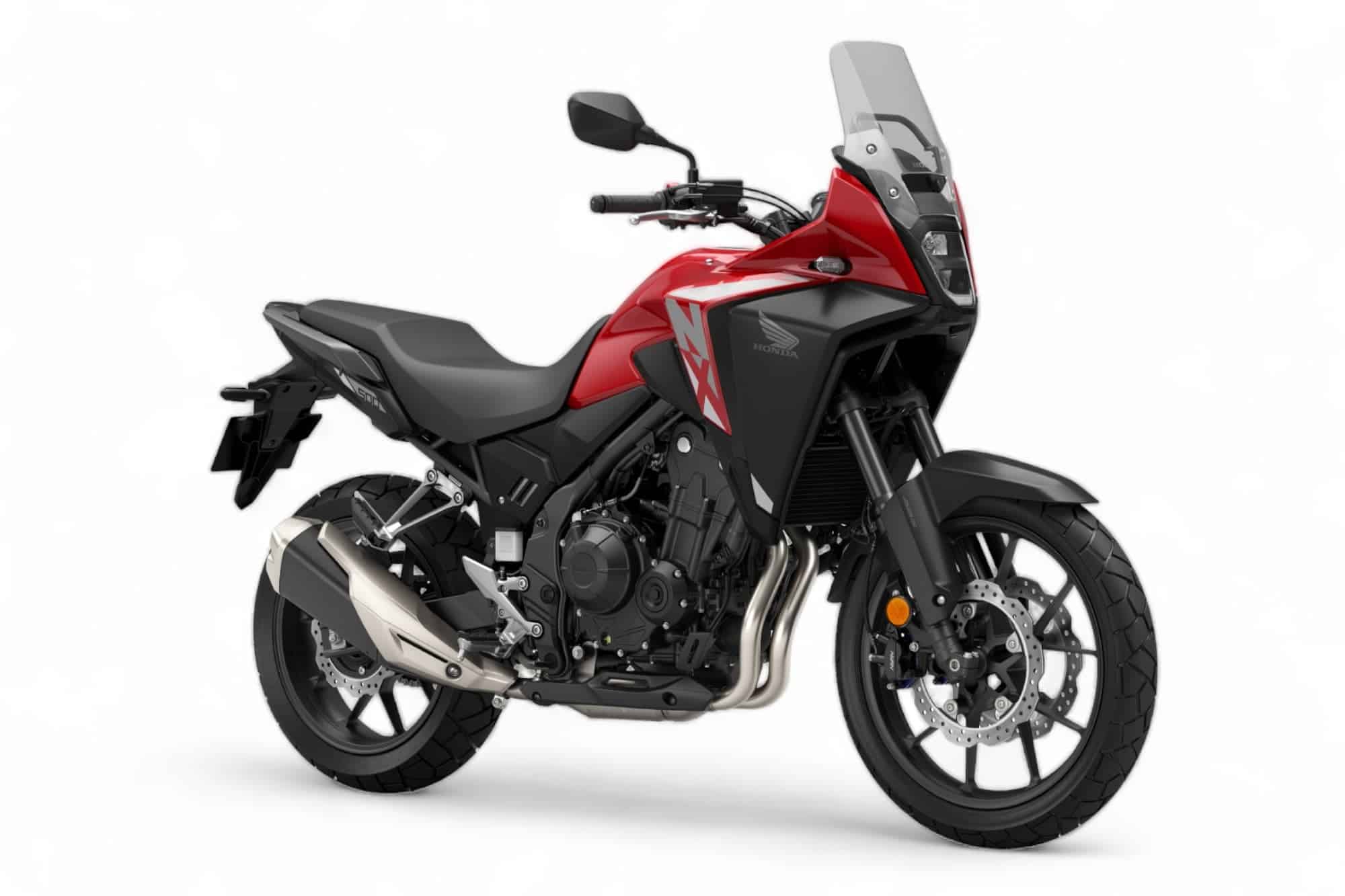
| Honda NX500 | 471 cc twin; 35 kW (47 hp); 43 Nm; about 196 kg; 834 mm seat; 19/17 cast wheels; 180 mm clearance | Lower seat, smoother road manners, cast-wheel convenience and stronger sealed-road focus | Much longer suspension, 21-inch spoke front and better standing ergonomics |
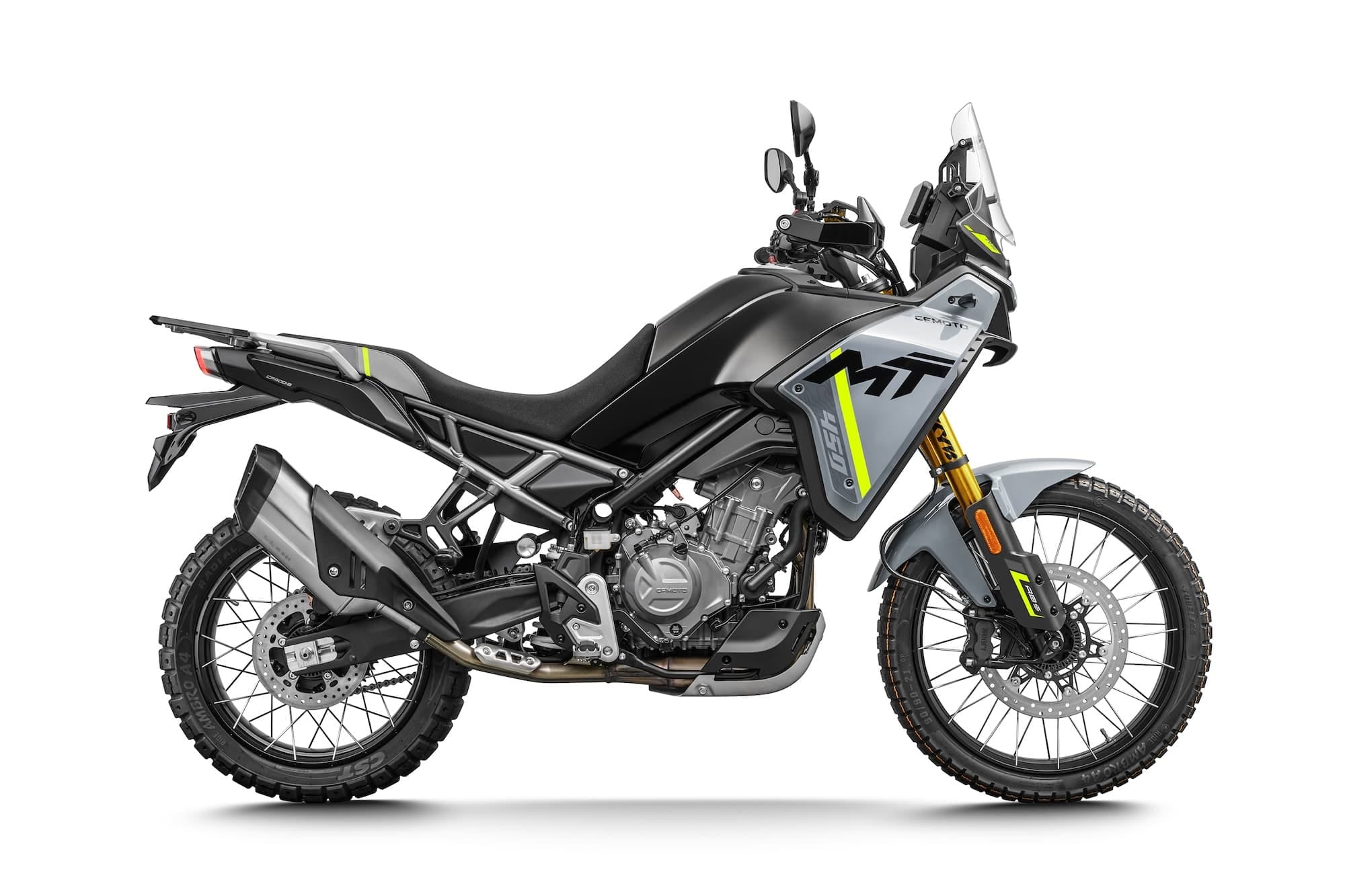
| CFMOTO 450MT | 449 cc 270-degree twin; 32.5 kW (44 hp); 44 Nm; 185 kg; 820/800 mm seat; 21/18 spokes; 220 mm clearance | Lower and lighter, more clearance, adjustable suspension, tubeless spokes, traction control | Kawasaki engine/dealer familiarity, road-friendly 17-inch rear and three-case-ready subframe |
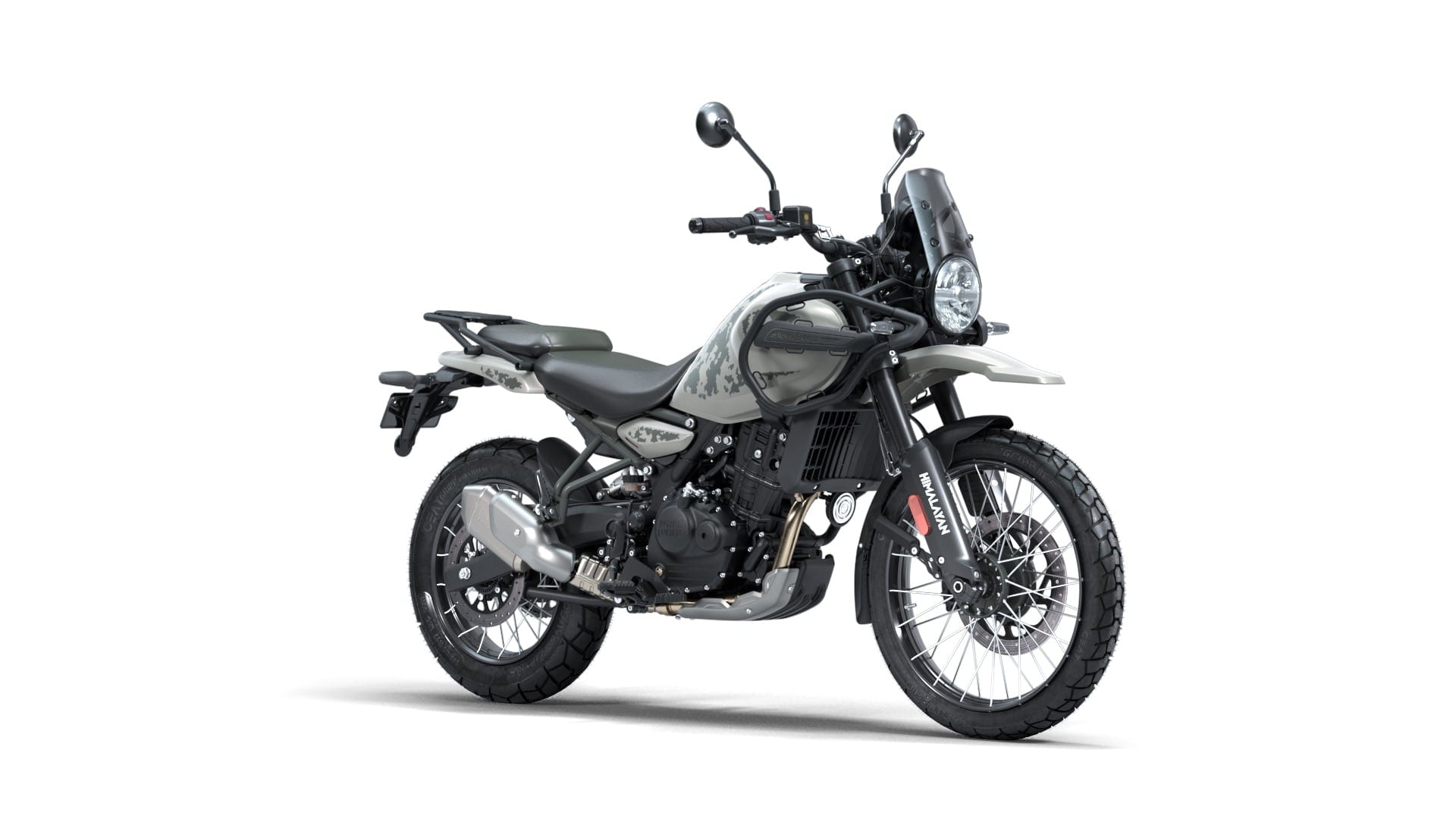
| Royal Enfield Himalayan 450 | 452 cc single; 29.4 kW (40 PS); 40 Nm; 196 kg; adjustable 825/845 mm seat; 230 mm clearance | Relaxed single-cylinder character, lower seat, more clearance and travel-oriented simplicity | Smoother high-speed twin, stronger peak performance and less vibration on long road links |
| KTM 390 Adventure R | 399 cc single; 33 kW (45 PS); 39 Nm; 176 kg fuelled; 870 mm seat; 21/18 spokes; 272 mm clearance | The clear trail choice: lighter, much more clearance and fully adjustable 230 mm suspension | Better highway comfort, larger tank, calmer manners and twin-cylinder smoothness |
| BMW F 450 GS | 420 cc twin; 35 kW (48 PS); 43 Nm; 178 kg; 845 mm seat; 19/17 cast wheels standard | Low mass, stronger electronics, premium brakes and a road/gravel focus | 21-inch front, longer travel, simpler controls and likely lower purchase/repair cost |
Choose the Honda NX500 for sealed roads
The NX500 is the easier daily road bike. Its 834 mm (32.8 in) seat is far lower, its 19-inch cast front wheel steers more like a crossover, and the suspension has much less travel. Power, torque and wet mass are close enough that engine performance will not decide the purchase. Choose Honda if your idea of off-road is a maintained gravel road and you value low-seat confidence, smoothness and simple tubeless tyre repair. Motofomo’s 2023 EICMA overview covers the NX500’s move on from the CB500X.
Choose the CFMOTO 450MT for more dirt
The CFMOTO 450MT is a compelling alternative for Kawasaki. It’s the cheaper, more capable Chinese motorcycle. It is about 9 kg (20 lb) lighter, has 35 mm (1.4 in) more ground clearance, uses a 21/18-inch tubeless spoke set, and gives you adjustable suspension, traction control and separate rear-ABS control. Its seat can sit 50-70 mm (2.0-2.8 in) lower. Kawasaki counters with a familiar dealer network, a proven 451 cc family and a stronger touring-luggage brief. If the route is rough, the CFMOTO wins on hardware. If the trip is mostly road and ownership confidence matters, the KLE has a cleaner case.
There are many thousands of happy CFMOTO owners, but it’s still not easy to test ride one in person everywhere — and this can be the clincher for many.
The Himalayan, KTM and BMW take clearer sides
The Himalayan 450 is the slower, more characterful travel bike. The KTM 390 Adventure R is the trail specialist, with far more clearance and adjustment but a tall seat and single-cylinder road manners. The BMW F 450 GS goes the other way: lighter and electronically richer, with 19/17-inch wheels that suit sealed roads and easy gravel.
The broader middleweight adventure comparison shows how much larger and faster the next class has become. A Yamaha Ténéré 700, Aprilia Tuareg 660 or KTM 790 Adventure gives you much stronger performance and, in some cases, far better off-road hardware. They also cost more, use more fuel and become harder to manage when stopped. The KLE500 exists for riders who consider those costs part of the problem.
Kawasaki KLE500 verdict
The 2026 KLE500 works because Kawasaki has recreated the original idea instead of copying the original motorcycle. A modest road-bike twin, long suspension, 21-inch front wheel and practical bodywork made sense in 1991. Fuel injection, modern packaging and switchable ABS make the same formula easier to live with now.
But it’s a specific balance that it promises that makes it compelling. The thing is, if you know you want to spend more time on either the road or dirt, you might be tempted by one of the alternatives.
However, if you demand that your adventure bike be capable everywhere but have a spoked 21-inch front wheel, decent clearance, and the branding of a well-known Japanese manufacturer, the KLE500 will work for you.