

“Middleweight” has become a slightly elastic term in adventure motorcycles. In this guide it means the current 600–1000 cc machines that sit below the large-capacity BMW GS, Ducati Multistrada V4, KTM 1390 and Honda Africa Twin class. The smallest bike here is the 652 cc Kawasaki KLR650; the largest is the 931 cc MV Agusta Enduro Veloce.
This is a current-market comparison, not a ranking. It covers the motorcycles with meaningful international availability, explains the main variants, and compares the specifications that change how a bike feels: ready-to-ride mass, engine output, suspension, wheel and tyre format, seat height, fuel capacity and rider aids.
Updated August 2026. Specifications below are based on the latest manufacturer information available at the time of writing. Equipment, output, suspension travel and even model names can differ by market. Weight figures deserve particular care: some manufacturers quote fully fuelled mass, while Ducati, KTM, Husqvarna and MV Agusta publish figures without fuel. Those exceptions are labelled rather than converted into false like-for-like numbers.
Are you obsessed with motorcycles?
Well, I am. That’s why I created this site — as an outlet. I love learning and sharing what others might find useful. If you like what you read here, and you’re a fraction as obsessed as I am, you might like to know when I’ve published more. (Check the latest for an idea of what you’ll see.)
Middleweight adventure motorcycles: the 2026 list
| Motorcycle | Engine | Claimed peak output | Published mass | Fuel |
|---|---|---|---|---|
| Aprilia Tuareg 660 Rally | 659 cc parallel twin | 59 kW / 80 hp; 70 Nm (52 lb-ft) | 199 kg (439 lb), wet | 18 L (4.8 US gal) |
| Benelli TRK 702 X | 698 cc parallel twin | 51.5 kW / 70 hp; 70 Nm (52 lb-ft) | 218 kg (481 lb), wet | 20 L (5.3 US gal) |
| BMW F 900 GS Adventure | 895 cc parallel twin | 77 kW / 105 PS; 93 Nm (69 lb-ft) | 246 kg (542 lb), fully fuelled | 23 L (6.1 US gal) |
| CFMOTO 800MT-X | 799 cc parallel twin | 70 kW / 95 hp; 87 Nm (64 lb-ft) | 214–220 kg (472–485 lb), market dependent | 22.5 L (5.9 US gal) |
| Ducati DesertX V2 | 890 cc 90° V-twin | 81.1 kW / 110.3 hp; 92 Nm (68 lb-ft) | 209 kg (461 lb), wet without fuel | 18 L (4.8 US gal) |
| Honda XL750 Transalp | 755 cc parallel twin | 67.5 kW / 92 PS; 75 Nm (55 lb-ft) | 210 kg (463 lb) manual; 216 kg (476 lb) E-Clutch | 16.9 L (4.5 US gal) |
| Husqvarna Norden 901 Expedition | 889 cc parallel twin | 77 kW / 105 PS; 100 Nm (74 lb-ft) | 214.5 kg (473 lb), without fuel | 19 L (5.0 US gal) |
| Kawasaki KLR650 ABS | 652 cc single | 29.8 kW / 40 hp; 53 Nm (39.1 lb-ft) | 209 kg (461 lb), fully fuelled | 23 L (6.1 US gal) |
| KTM 790 Adventure | 799 cc parallel twin | 70 kW / 95 PS; 87 Nm (64 lb-ft) | 203 kg (448 lb), without fuel | 20 L (5.3 US gal) |
| KTM 890 Adventure R | 889 cc parallel twin | 77 kW / 105 PS; 100 Nm (74 lb-ft) | 200 kg (441 lb), without fuel | 20 L (5.3 US gal) |
| Kove 800X Pro | 799 cc parallel twin | about 70 kW / 95 hp; 79 Nm (58 lb-ft) | about 190 kg (419 lb), wet; varies by market | 20 L (5.3 US gal) |
| Moto Guzzi V85 TT Travel | 853 cc transverse V-twin | 59 kW / 80 hp; 83 Nm (61 lb-ft) | 243 kg (536 lb), wet with Travel equipment | 23 L (6.1 US gal) |
| MV Agusta Enduro Veloce | 931 cc inline triple | 91 kW / 124 hp; 102 Nm (75 lb-ft) | 235 kg (518 lb), running order without fuel | 20 L (5.3 US gal) |
| Suzuki V-Strom 800DE | 776 cc parallel twin | 62 kW / 84 PS; 78 Nm (58 lb-ft) | 230 kg (507 lb), wet | 20 L (5.3 US gal) |
| Triumph Tiger 900 Rally Pro | 888 cc inline triple | 79.5 kW / 108 PS; 90 Nm (66 lb-ft) | 228 kg (503 lb), wet | 20 L (5.3 US gal) |
| Yamaha Ténéré 700 | 689 cc parallel twin | 54 kW / 73.4 PS; 68 Nm (50 lb-ft) | about 208 kg (459 lb), wet | 16 L (4.2 US gal) |
There is a ~95 hp cluster in the middle: the CFMOTO 800MT-X, KTM 790 Adventure and Kove 800X Pro all land around 70 kW. The Transalp and V-Strom sit a little lower; the Norden, KTM 890 and Tiger sit higher. The DesertX V2 and Enduro Veloce bring superbike-adjacent engine performance into this class. The KLR650 is the outlier: far less powerful, simple, long-legged and cheap in the markets where Kawasaki sells it.
Chassis, seat height and electronics comparison
| Motorcycle | Wheels / tyres | Travel front / rear | Seat height | Cruise / cornering ABS / quickshifter |
|---|---|---|---|---|
| Aprilia Tuareg Rally | 21/18, tubes | 240 / 240 mm | 860 mm (33.9 in) | Yes / No / Optional |
| Benelli TRK 702 X | 19/17, tubes | 140 / 173 mm | 835 mm (32.9 in) | No / No / No |
| BMW F 900 GS Adventure | 21/17, tubeless | 230 / 215 mm | 875 mm (34.4 in); options 805–890 mm | Optional / Yes / Optional |
| CFMOTO 800MT-X | 21/18, tubeless | 190–230 / 190–230 mm by market | 830–870 mm by market | Yes / Yes / Yes |
| Ducati DesertX V2 | 21/18, tubeless | 230 / 220 mm | 880 mm (34.6 in) | Yes / Yes / Yes |
| Honda XL750 Transalp | 21/18, tubes | 178 / 190 mm | 850 mm (33.5 in) | No / No / E-Clutch or optional QS |
| Husqvarna Norden 901 Expedition | 21/18, tubeless | 240 / 240 mm | 887–907 mm (34.9–35.7 in) | Yes / Yes / Yes |
| Kawasaki KLR650 | 21/17, tubes | 200 / 203 mm | 871 mm (34.3 in) | No / No / No |
| KTM 790 Adventure | 21/18, tubeless | 200 / 200 mm | 840–860 mm (33.1–33.9 in) | Optional / Yes / Optional |
| KTM 890 Adventure R | 21/18, tubeless | 240 / 240 mm | 880 mm (34.6 in) | Optional / Yes / Optional |
| Kove 800X Pro | 21/18, tubeless | 240 / 240 mm | about 875 mm (34.4 in) | 2026: Yes / market dependent / Yes |
| Moto Guzzi V85 TT Travel | 19/17, tubeless | 170 / 170 mm | 830 mm (32.7 in) | Yes / Yes / No |
| MV Agusta Enduro Veloce | 21/18, tubeless | 210 / 210 mm | 870 mm (34.3 in) | Yes / Yes / Yes |
| Suzuki V-Strom 800DE | 21/17, tubes | 220 / 220 mm | 855 mm (33.7 in) | No / No / Yes |
| Triumph Tiger 900 Rally Pro | 21/17, tubeless | 240 / 230 mm | 860–880 mm (33.9–34.6 in) | Yes / Yes / Yes |
| Yamaha Ténéré 700 | 21/18, tubes | 210 / 200 mm | 875 mm (34.4 in); low version 860 mm | No / No / Optional |
A few notes on how to read this table, and what benefits a specification may have:
- Wheel size: A 21-inch front wheel rolls over rocks and holes more calmly than a 19, but it gives slower steering and a narrower road-tyre choice. An 18-inch rear accepts the broadest choice of dirt tyres.
- Rim type: Tubeless cross-spoked rims let you plug many punctures without removing the wheel; tube-type rims are often easier to repair after a hard impact but make a simple nail more work.
- Suspension specs: Suspension travel is only a starting point. Spring rates, damping quality and correct setup matter more than an extra 10 mm. Likewise, a low seat does not always mean an easy reach: a narrow 850 mm seat can be friendlier than a broad 830 mm one.
- Tech: An IMU allows ABS and traction control to account for lean and pitch. It is useful on the road, especially in a surprise braking event, but it does not make a heavy bike light in sand. Cruise control has a much bigger day-to-day benefit for riders who cross long distances on motorways.
Aprilia Tuareg 660 and Tuareg Rally
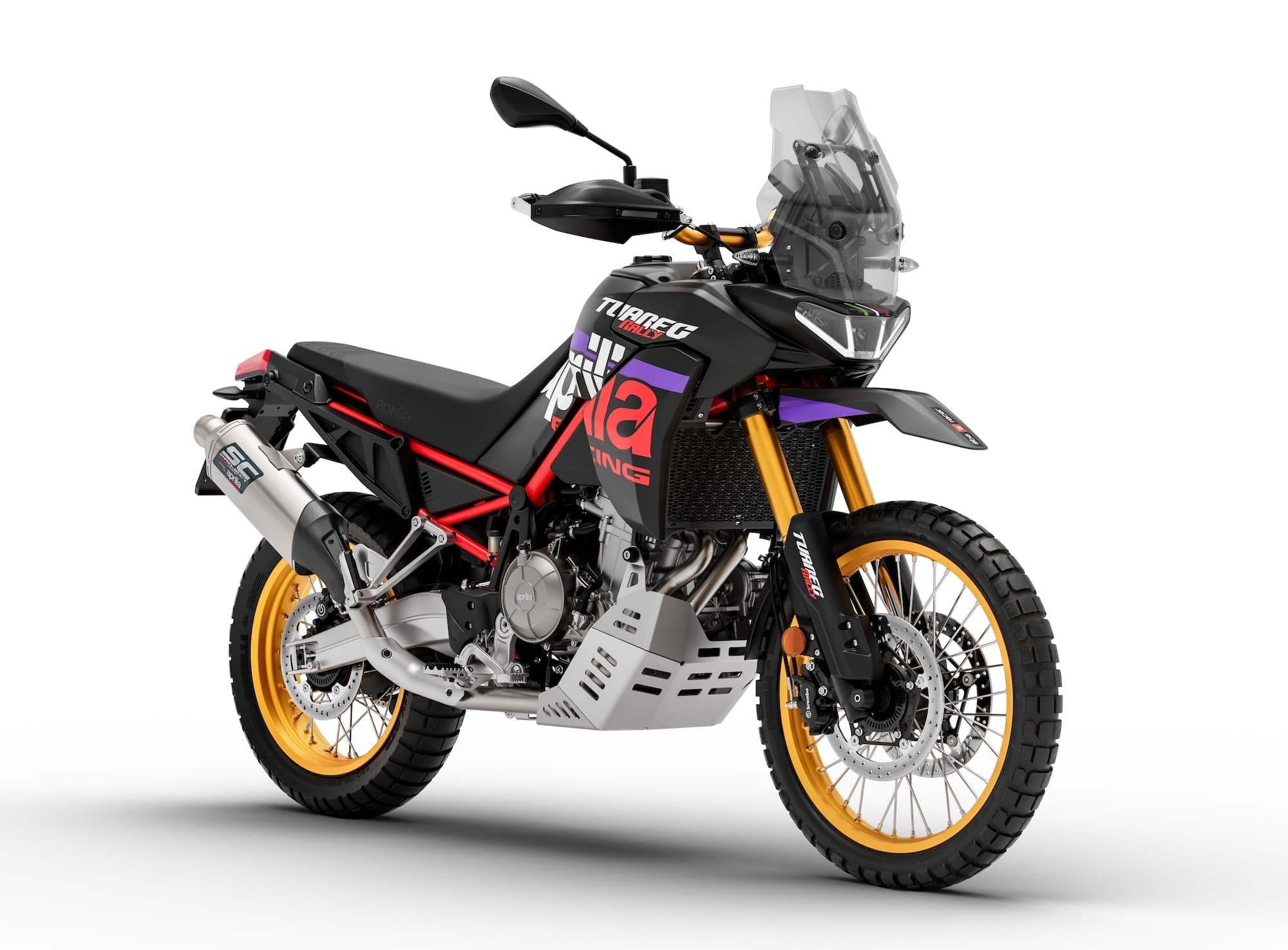
The 659 cc Tuareg is one of the few bikes here designed as an adventure motorcycle before it became a tourer. Its 18 L tank carries fuel low, the standard model weighs 204 kg (450 lb) wet, and the 80 hp engine is smooth without feeling flat. Cruise control and four ride modes are standard, while the ABS can be configured for dirt.
The 2025-on Rally is the current reference version. It weighs 199 kg (439 lb) wet and uses fully adjustable KYB suspension with 240 mm of travel at both ends. The tube-type, narrow-channel wheels accept more serious dirt tyres. Its trade-offs are the same ones that apply to any harder-edged trim: taller, firmer and less convenient to repair after a puncture.
Benelli TRK 702 X
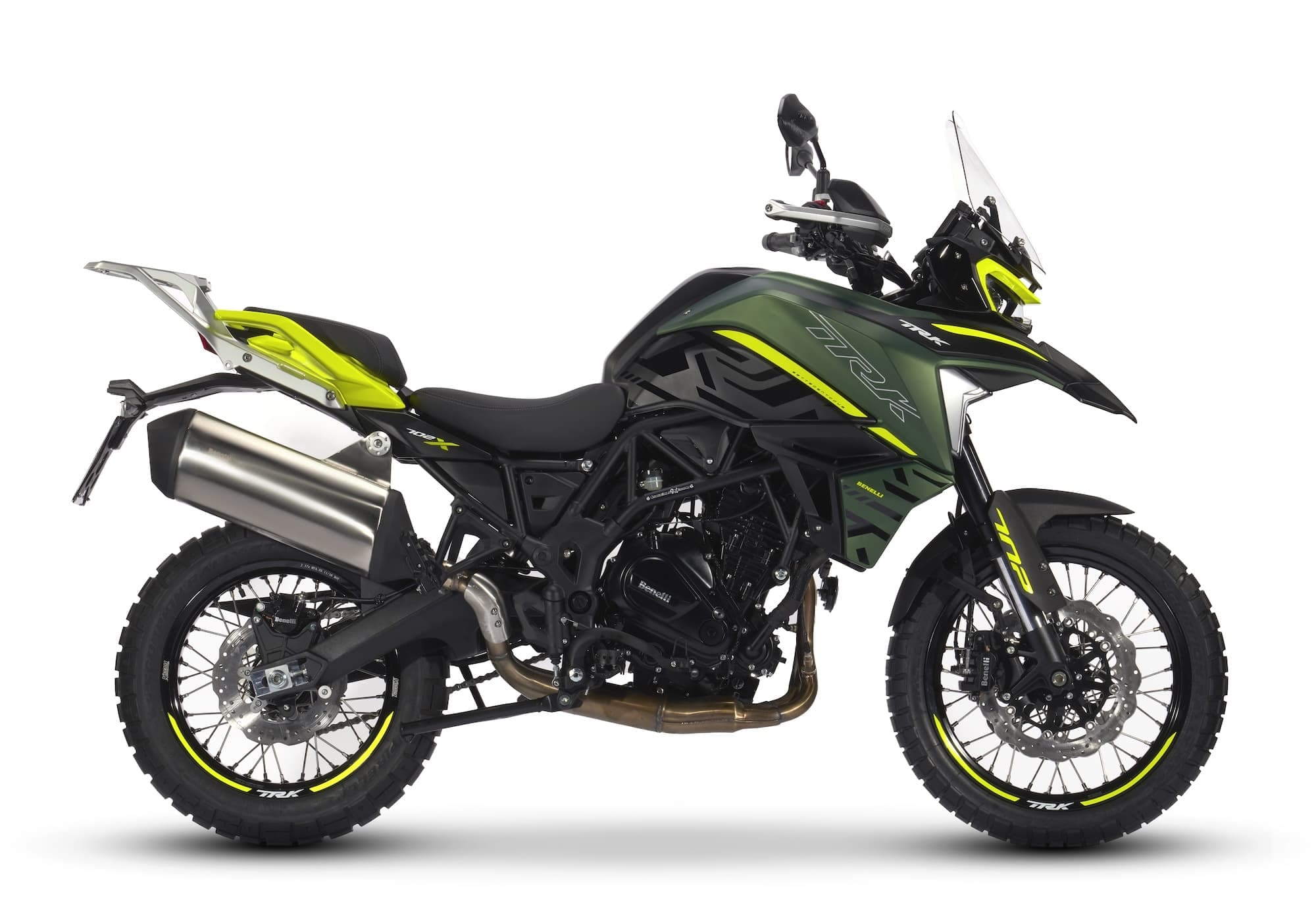
The TRK 702 X replaces the older 502 X’s modest performance with a 698 cc twin making 51.5 kW (70 hp) and 70 Nm (52 lb-ft). A 20 L tank, 835 mm seat and roomy bodywork make it easy to understand as a road-and-gravel travel bike. The current EU5+ specification is around 218 kg (481 lb) ready to ride.
It has a 19-inch front, 17-inch rear and tube-type spoked wheels. The 50 mm upside-down fork gives 140 mm travel; the rear wheel has about 173 mm. That is enough for broken roads and maintained gravel, but it is not aimed at the same terrain as the Tuareg Rally, Norden Expedition or KTM 890 Adventure R. The electronics are correspondingly simple: ABS, a TFT display and phone connectivity, but no cruise control, IMU or quickshifter.
BMW F 900 GS and F 900 GS Adventure
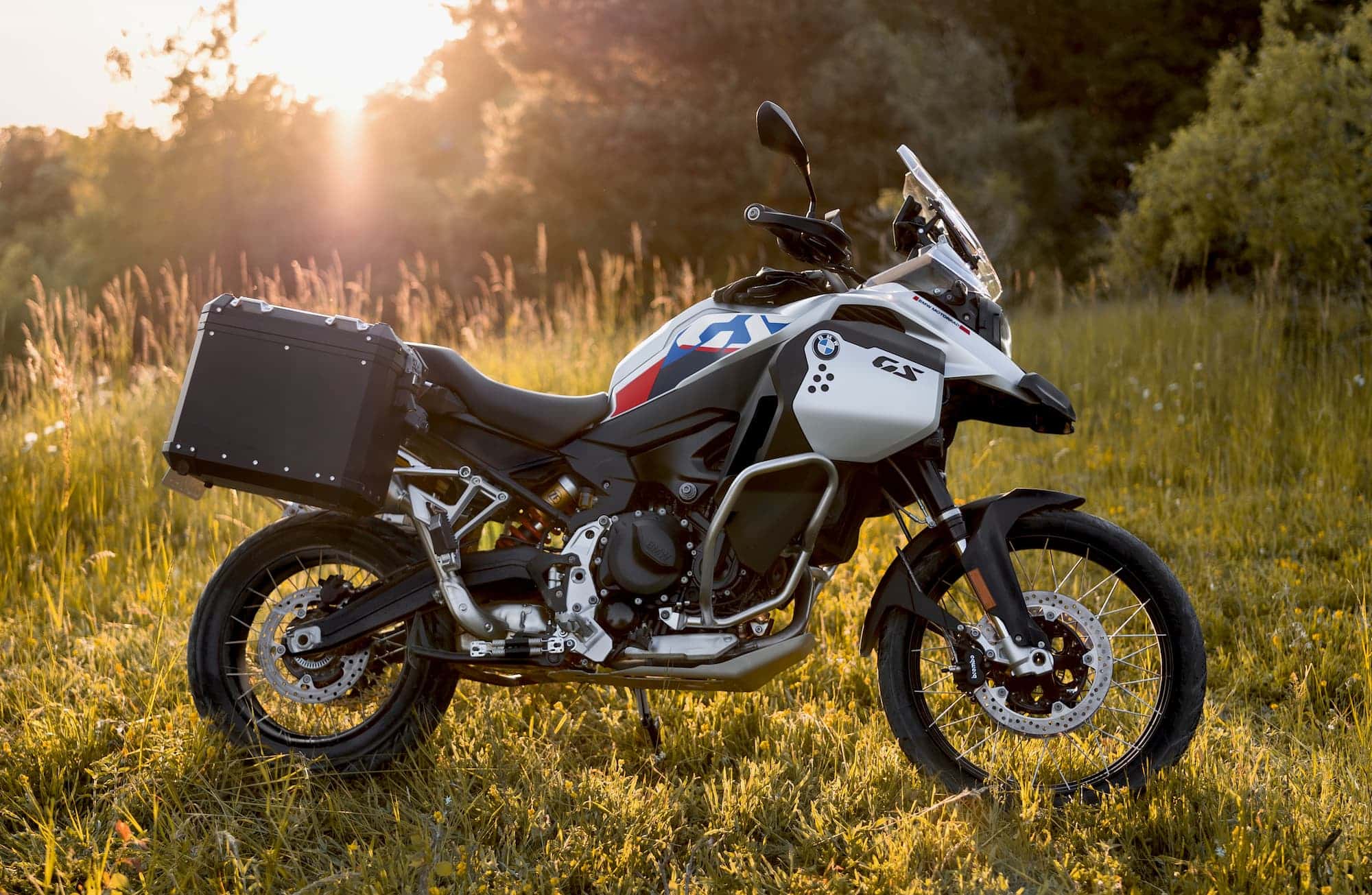
BMW split the family clearly. The F 900 GS is the lighter, more off-road-focused model at 219 kg (483 lb) fully fuelled with a 14.5 L tank. The Adventure is the long-distance version: 246 kg (542 lb), 23 L of fuel, a larger screen, standard protection and luggage preparation. Both use the 895 cc twin in 77 kW / 105 PS form with 93 Nm (69 lb-ft).
The Adventure has 230/215 mm suspension, 21/17-inch tubeless cross-spoked wheels and a standard 875 mm seat. BMW offers lowering and seat combinations from 805 to 890 mm, making it unusually configurable. ABS Pro and two road modes are standard; Dynamic ESA, cruise control, extra modes and Shift Assistant Pro depend on package and market. Check the build sheet rather than assuming every used bike has them.
CFMOTO 800MT-X
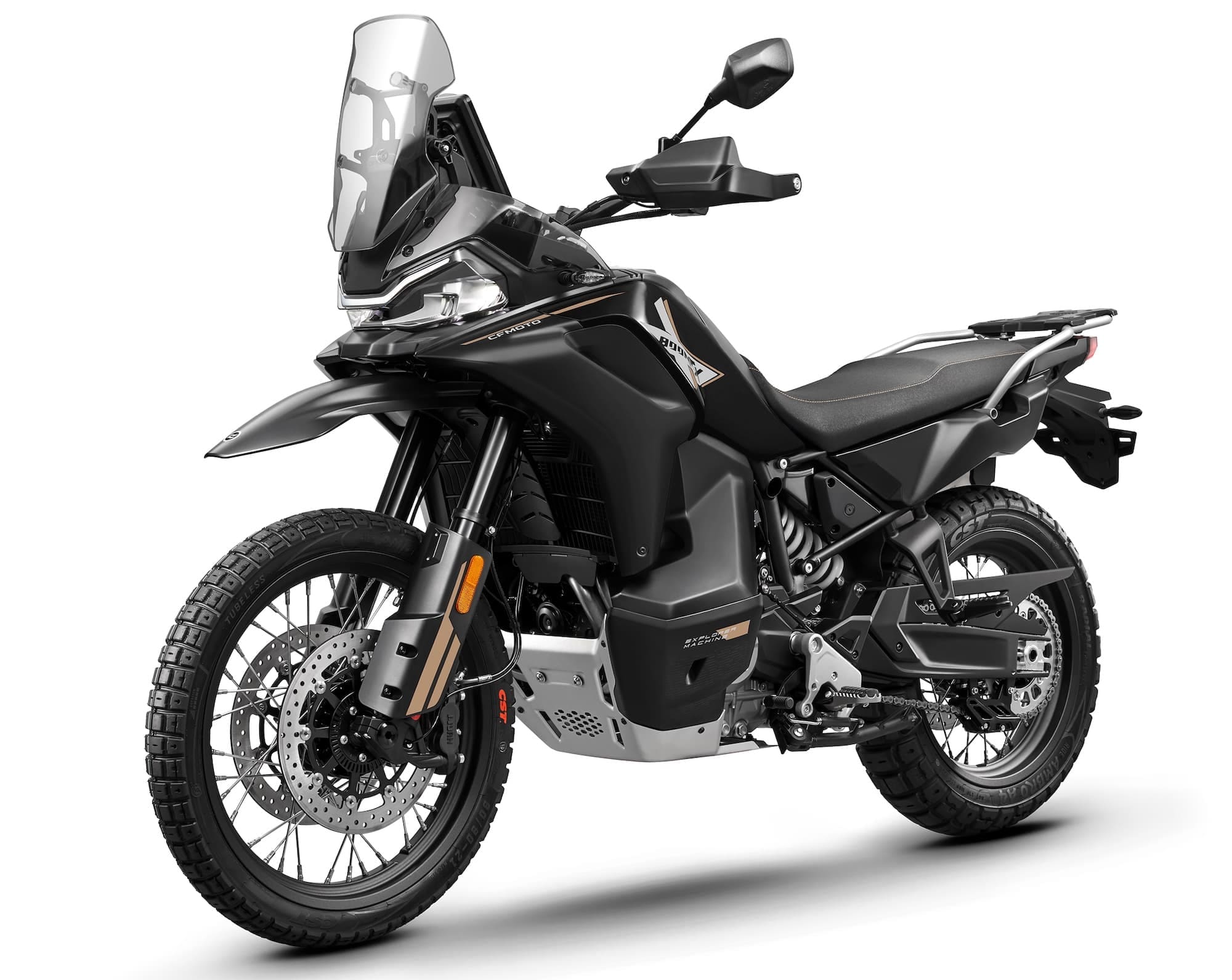
The 800MT-X is not an 800MT Touring with different wheels. Its fuel is carried low, its ergonomics are narrower, and international versions use 21/18-inch tubeless wheels with up to 230 mm suspension travel. The 799 cc twin makes 70 kW (95 hp) and 87 Nm (64 lb-ft), while the 22.5 L tank is one of the largest in the class.
Standard equipment is extensive: cruise control, bidirectional quickshifter, three ride modes, a steering damper, tyre-pressure monitoring and Bosch six-axis cornering ABS and traction control. Published mass, seat height and suspension travel differ materially by market; some versions quote 214 kg, an 830 mm seat and 190 mm travel, while the international long-travel specification is taller and can approach 220 kg. Confirm the exact local specification before comparing prices.
For the relationship between CFMOTO and KTM, see the Motofomo CFMOTO company overview.
Ducati DesertX V2
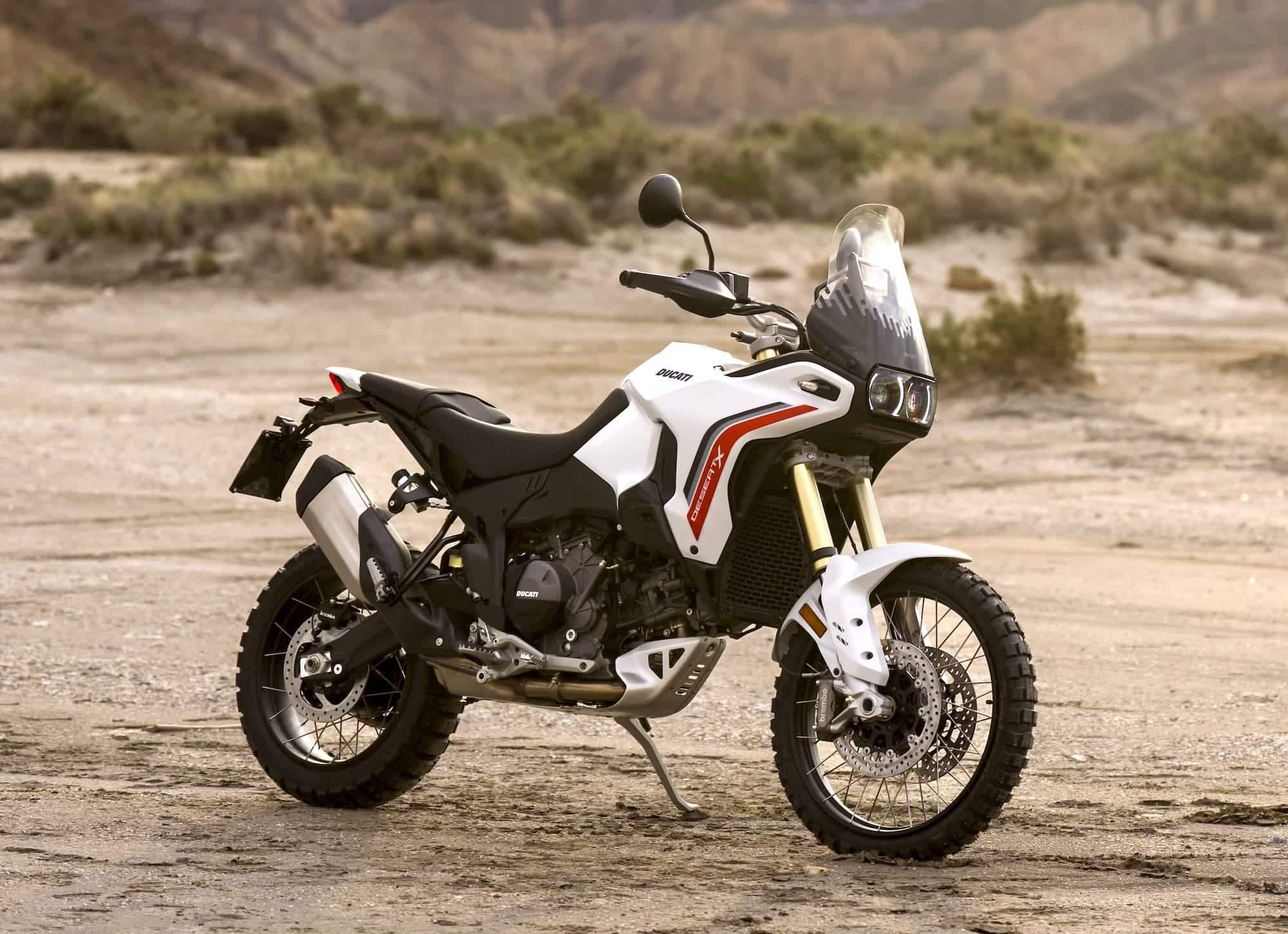
The 2026 DesertX V2 replaces the 937 Testastretta engine and steel trellis frame with Ducati’s 890 cc IVT V2 and an aluminium monocoque. It makes 81.1 kW (110.3 hp) and 92 Nm (68 lb-ft). More important for ownership, it drops desmodromic valves and stretches the valve-clearance interval to 45,000 km (28,000 mi).
KYB suspension gives 230 mm front and 220 mm rear travel, with 21/18-inch tubeless cross-spoked wheels and an 880 mm seat. Cruise, cornering ABS and an up/down quickshifter are standard. Ducati quotes 209 kg wet without fuel, so it is roughly 222 kg with its 18 L tank filled. There is no separate V2 Rally yet; the old 937 Rally remains the harder-edged first-generation choice.
See the complete Ducati DesertX buyer’s guide for the 937, Rally, Discovery and V2 differences.
Honda XL750 Transalp
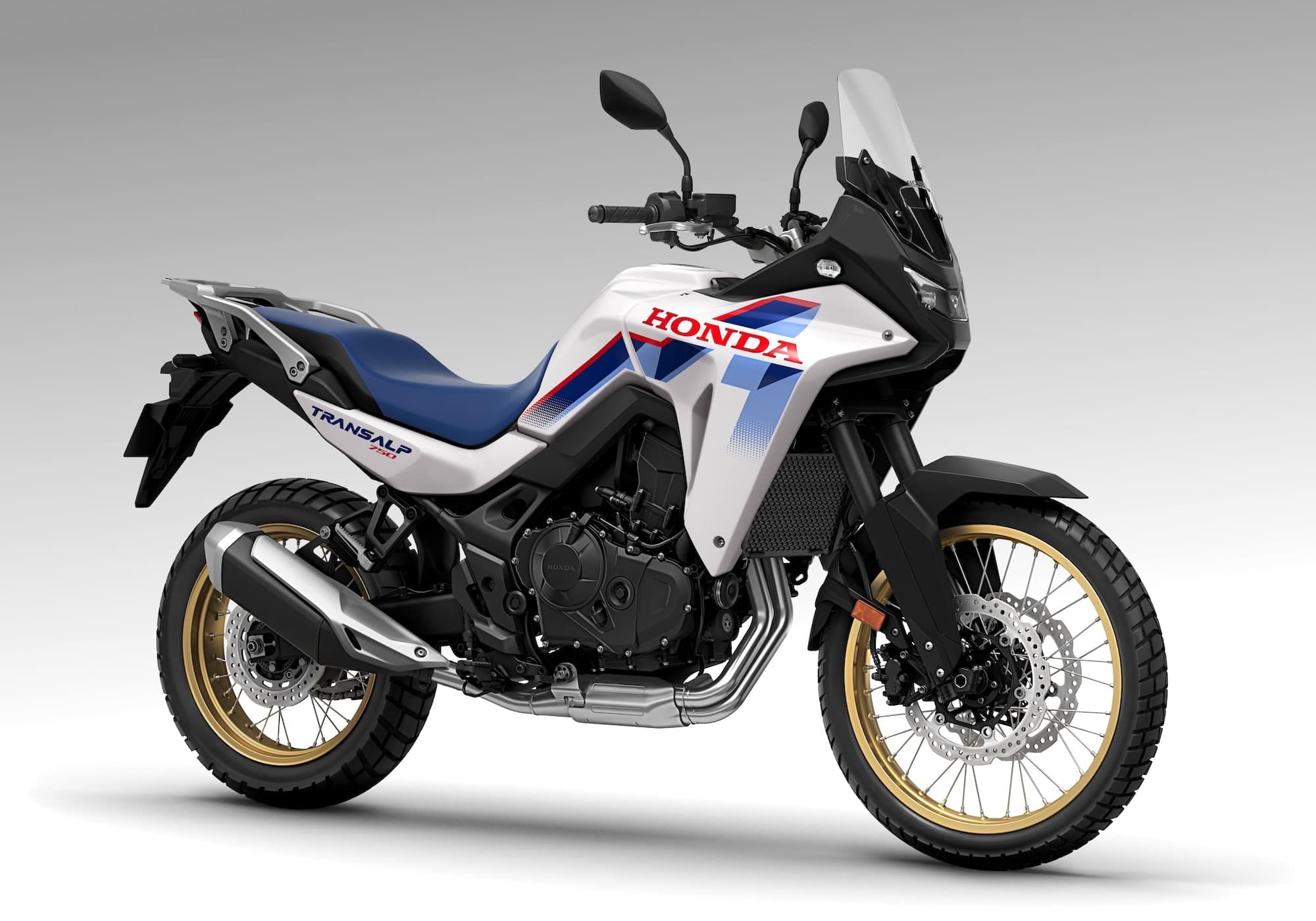
The Transalp remains the useful middle position between the simple Ténéré and the electronics-heavy European bikes. Its 755 cc Unicam twin makes 67.5 kW (92 PS) and 75 Nm (55 lb-ft), and the manual version weighs 210 kg (463 lb) ready to ride. The 850 mm seat and relatively narrow waist make it accessible for a 21-inch-front bike.
Honda revised the headlight, wind protection, suspension settings and display for 2025. For 2026 it added an E-Clutch option, which manages the clutch for starts, stops and shifts while retaining the foot lever. That version weighs 216 kg (476 lb). The bike still has tube-type 21/18-inch wheels, no cruise control and no IMU-based cornering ABS. Its Showa suspension has less adjustment and travel than the harder off-road models, but the Transalp is lighter than most of the touring-heavy choices.
For the older V-twins and how Honda arrived here, see the complete Honda Transalp history.
Husqvarna Norden 901 and Expedition
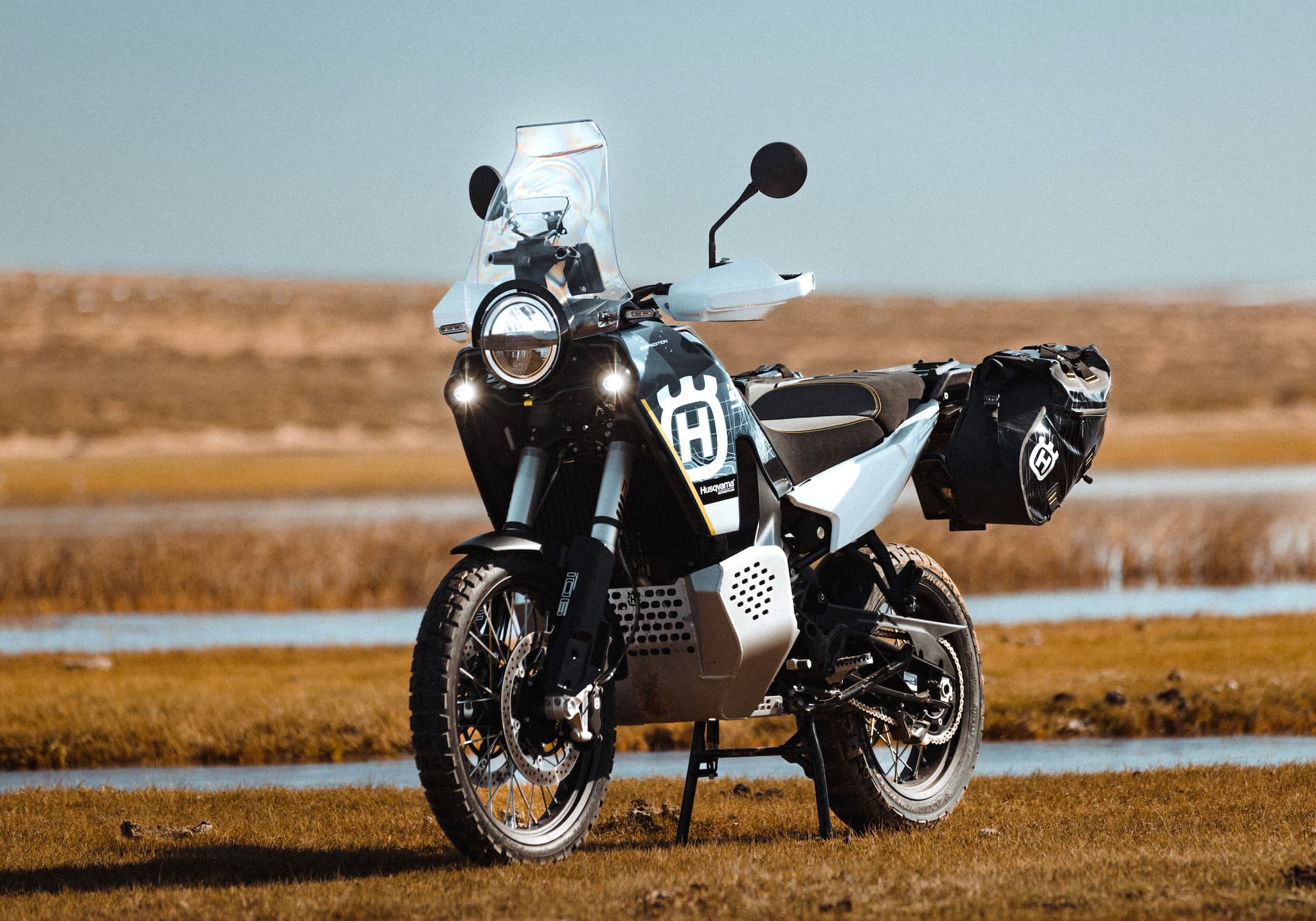
The Norden 901 shares its 889 cc, 77 kW / 105 PS engine and low-slung 19 L tank concept with KTM’s 890 platform, but wraps it in broader bodywork and a more relaxed touring brief. The standard Norden has 220 mm WP APEX suspension. The Expedition steps up to fully adjustable 240 mm WP XPLOR suspension, a taller screen, heated equipment, centre stand and luggage.
The Expedition’s published 214.5 kg (473 lb) excludes fuel, putting it around 229 kg fully fuelled before luggage. Its 887–907 mm adjustable seat is among the tallest here. Cruise control, cornering ABS, lean-sensitive traction control and an up/down quickshifter are standard on the Expedition.
Kawasaki KLR650
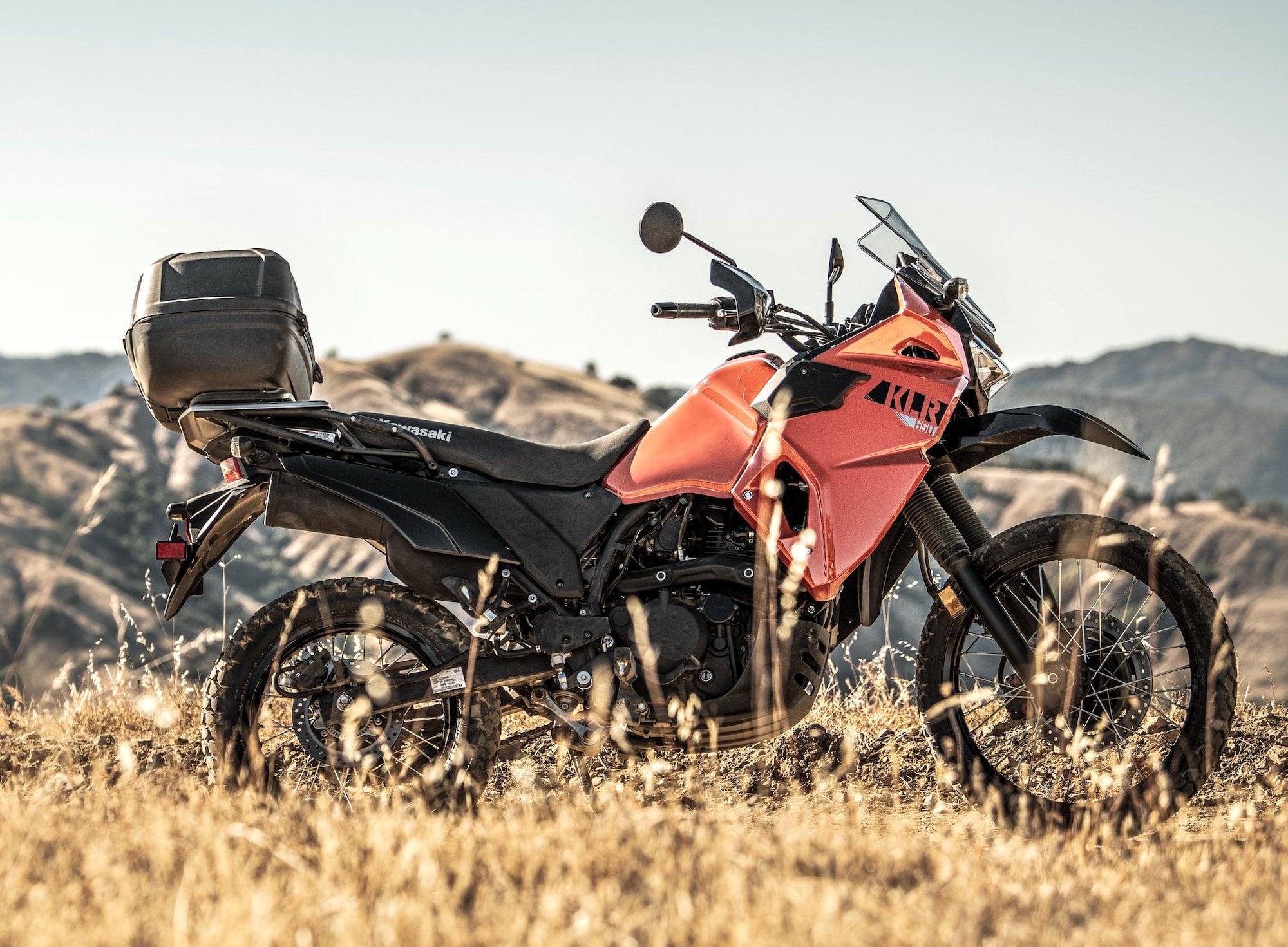
The KLR650 is still a current 2026 model in North America. Its fuel-injected 652 cc single makes 40 hp and 53 Nm (39.1 lb-ft), drives through five gears and carries 23 L of fuel. The ABS version weighs 209 kg (461 lb) fully fuelled, which is a lot for 40 hp but not unusual once a steel chassis, large tank and basic bodywork are counted.
It has 21/17-inch tube-type wheels, 200/203 mm suspension travel and an 871 mm seat. ABS is the only rider aid. The KLR makes sense for steady travel, simple servicing and low purchase cost. It is the wrong answer if you want quick two-up overtakes, modern suspension damping or a compact bike for technical trails.
KTM 790 Adventure and 890 Adventure R
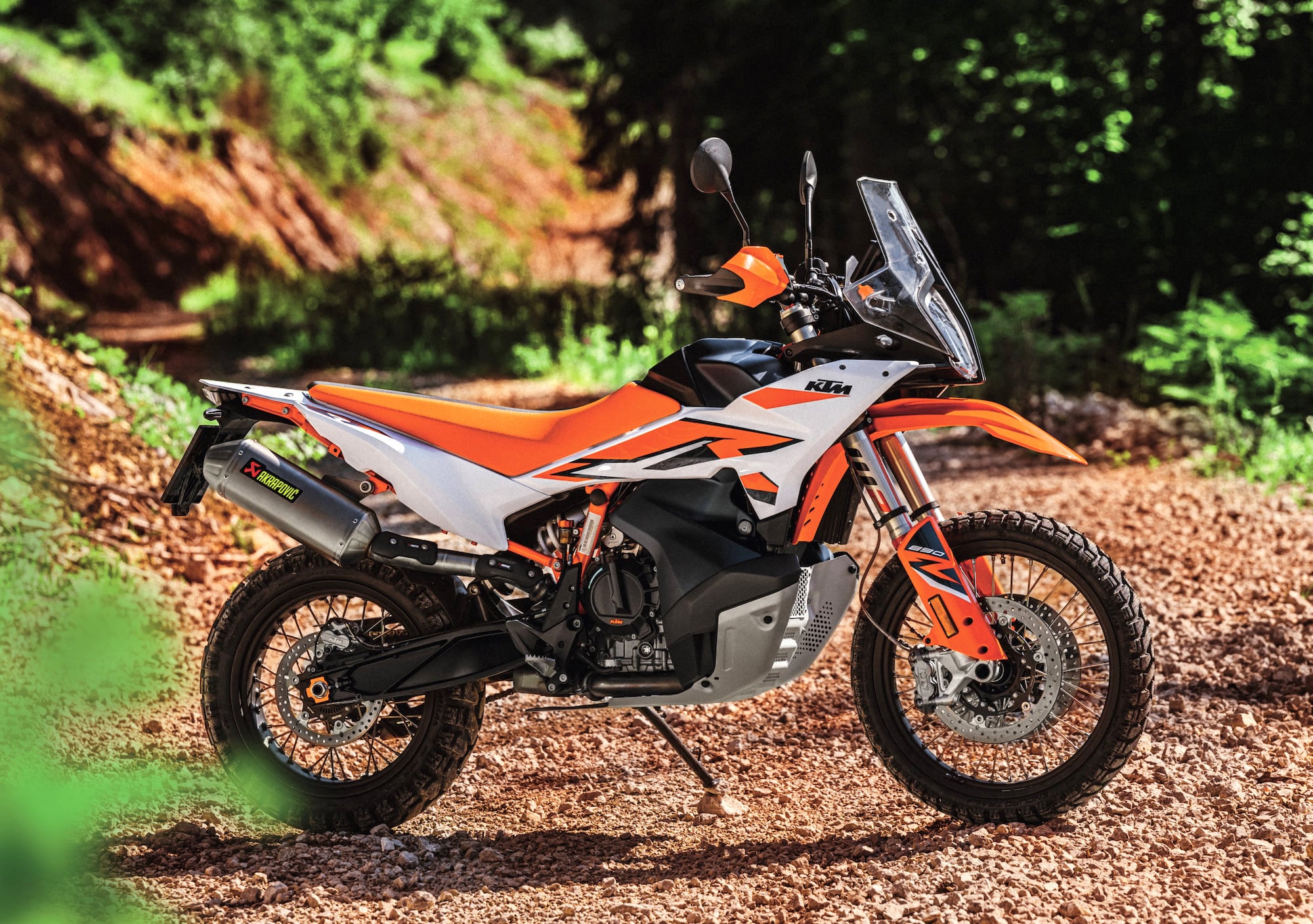
The 790 is the lower-cost all-rounder: 70 kW / 95 PS, 87 Nm (64 lb-ft), 200 mm WP APEX suspension and an adjustable 840–860 mm seat. KTM quotes 203 kg without fuel. The low 20 L tank keeps much of that mass beside the engine rather than above it.
The 890 Adventure R has 77 kW / 105 PS, 100 Nm (74 lb-ft), fully adjustable 240 mm WP XPLOR suspension and an 880 mm seat. It is lighter on paper at 200 kg without fuel. Both have an IMU and cornering ABS; cruise control and the quickshifter are often software or package options. Confirm what is activated on a used bike.
The main decision is not 790 versus 890 by power. Buy the R if you need its suspension and are comfortable with the height. The 790 is easier to justify for mixed road use, travel and moderate dirt.
Kove 800X Pro
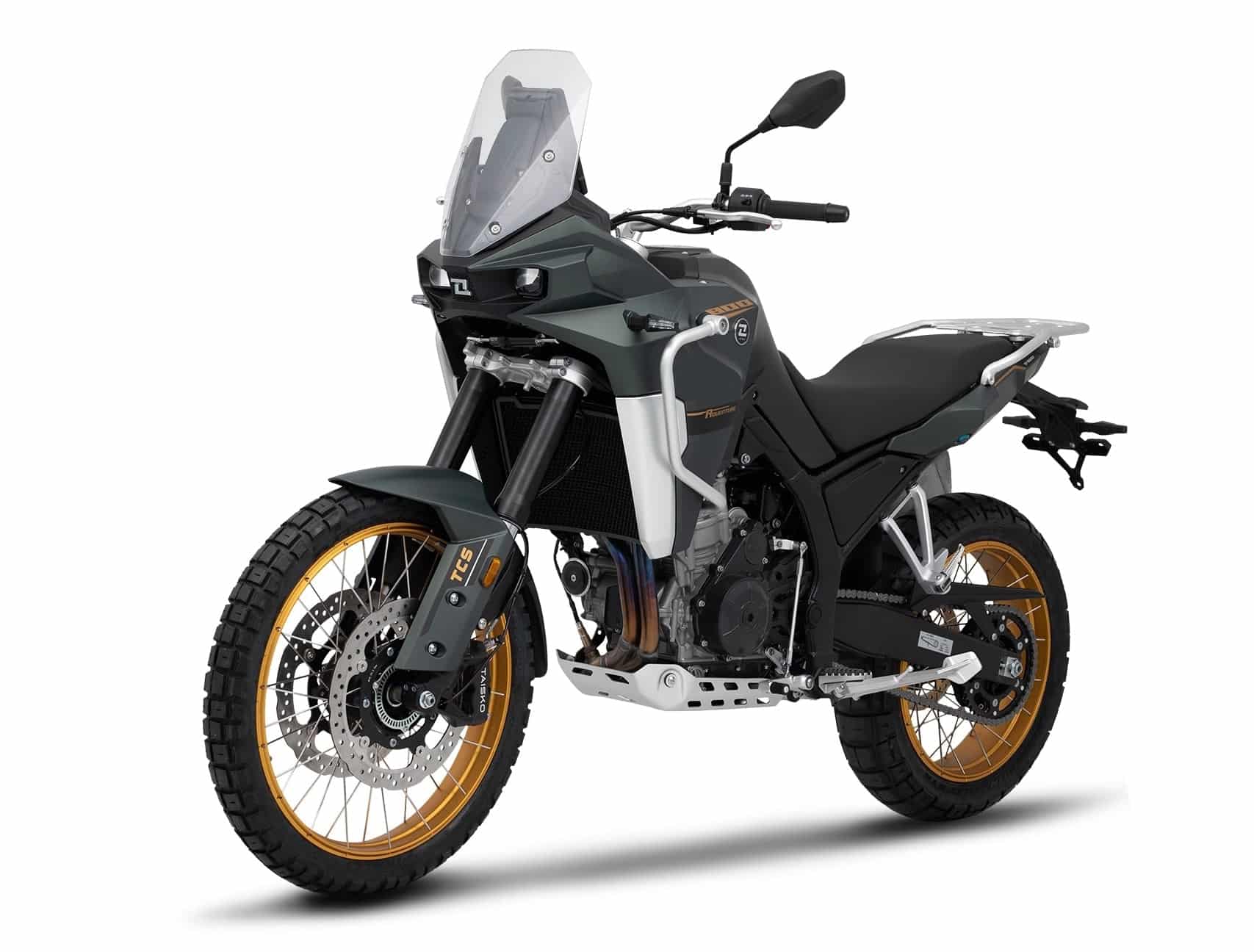
The 800X Pro’s headline is mass. Depending on market specification it is quoted around 190 kg (419 lb) wet, with a 20 L tank, 240 mm KYB suspension and 275 mm ground clearance. Its 799 cc parallel twin makes roughly 70 kW / 95 hp. That gives it an unusually strong power-to-weight position in this group.
Current 2026 versions add ride-by-wire, cruise control, a bidirectional quickshifter and revised ride modes. ABS and traction-control specifications differ by distributor, so confirm whether a local bike has an IMU rather than assuming from the display or mode names. Dealer coverage and parts logistics also deserve more weight in this purchase than they do with Honda or Yamaha.
For background on the manufacturer and its model range, see Who is Kove Moto?
Moto Guzzi V85 TT and V85 TT Travel
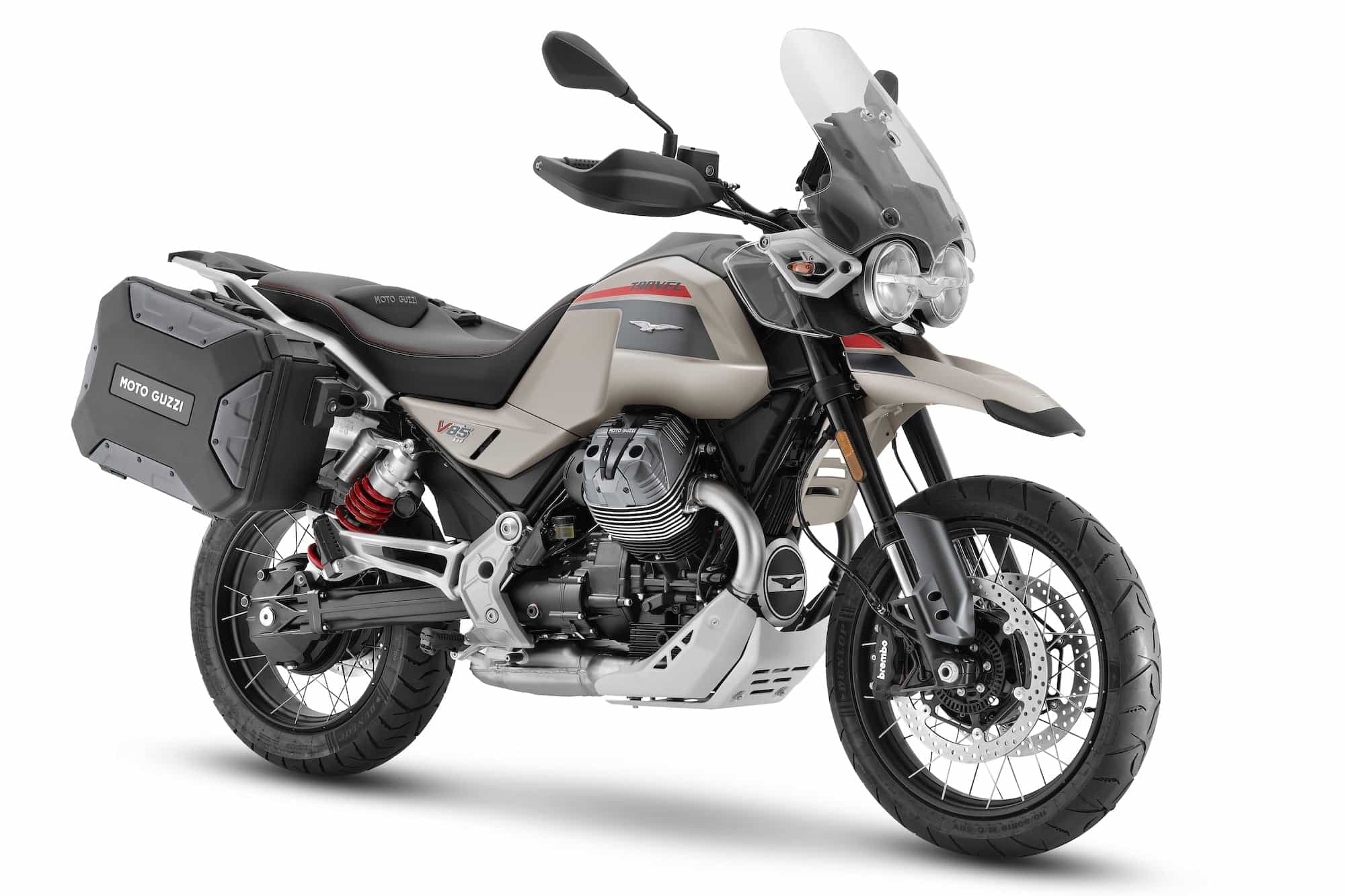
The current V85 TT is the road-biased alternative in this list. Its 853 cc air-cooled transverse V-twin now has variable intake timing and makes 59 kW / 80 hp with 83 Nm (61 lb-ft). It uses shaft drive, tubeless 19/17-inch wheels and 170 mm suspension at both ends. The 830 mm seat is one of the lowest here.
The Travel weighs 243 kg (536 lb) wet with its panniers and equipment, and carries 23 L of fuel. It has cruise control, a six-axis IMU, cornering ABS, five ride modes, heated grips and seat, phone connectivity and a larger screen. Pick it for road travel, easy valve access and freedom from chain adjustment. Pick something with a 21-inch front and longer suspension for rougher routes.
Read the Moto Guzzi V85 TT review and technical overview for more on the unusual engine and ownership experience.
MV Agusta Enduro Veloce
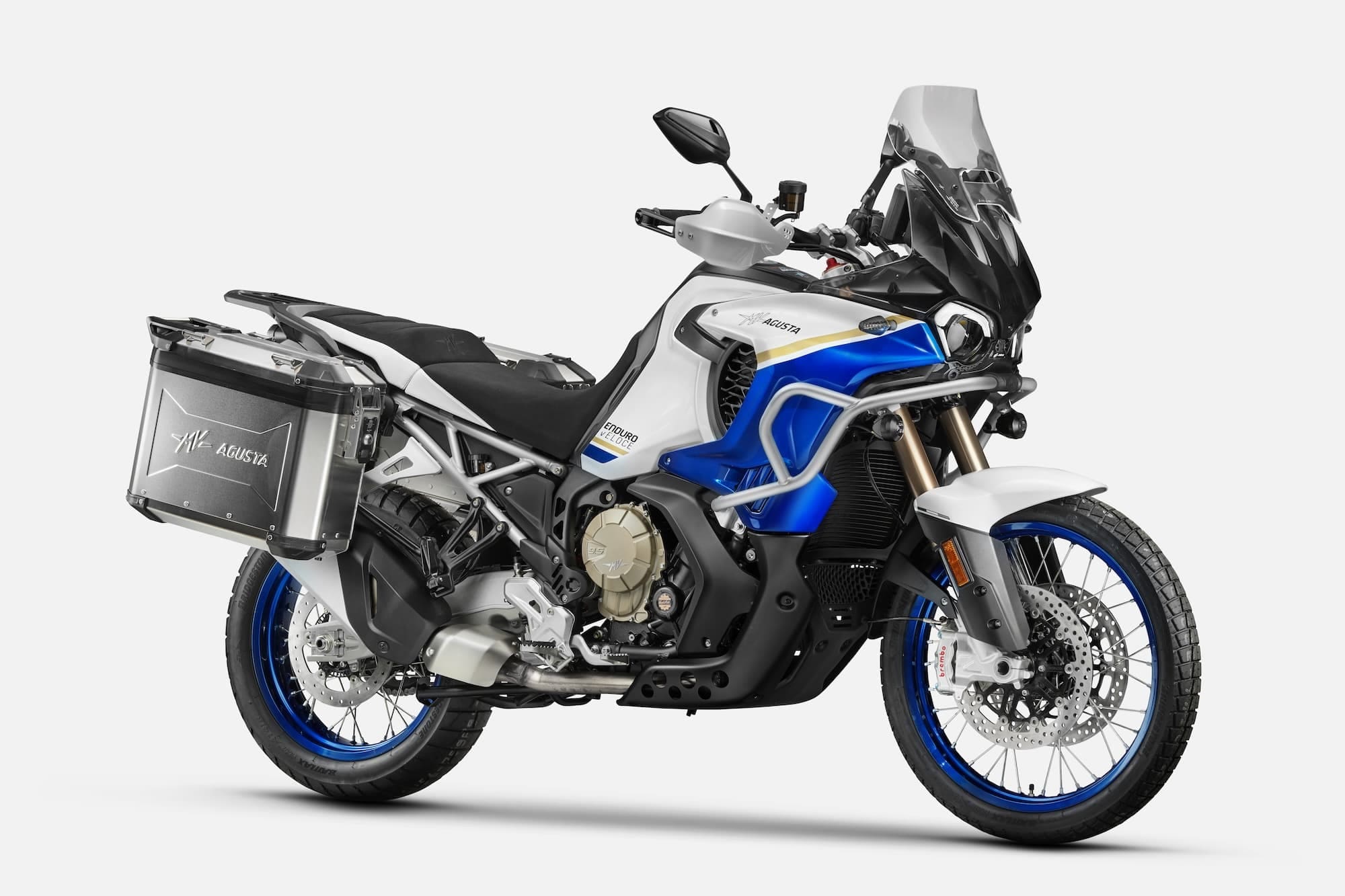
The Enduro Veloce is the production successor to the limited LXP Orioli. Its 931 cc triple has a counter-rotating crankshaft and makes 91 kW / 124 hp with 102 Nm (75 lb-ft), the highest figures in this comparison. MV quotes 235 kg (518 lb) in running order without fuel, so it is not the lightest despite its compact engine.
It has 21/18-inch tubeless wheels, 210 mm suspension, an 870 mm seat, cruise control, cornering ABS, a quickshifter, a seven-inch display and standard travel equipment including aluminium panniers, crash protection and auxiliary lights in many markets. It is the premium, fast road-and-dirt choice here. Price, dealer reach and ownership support matter as much as its specification.
Suzuki V-Strom 800DE
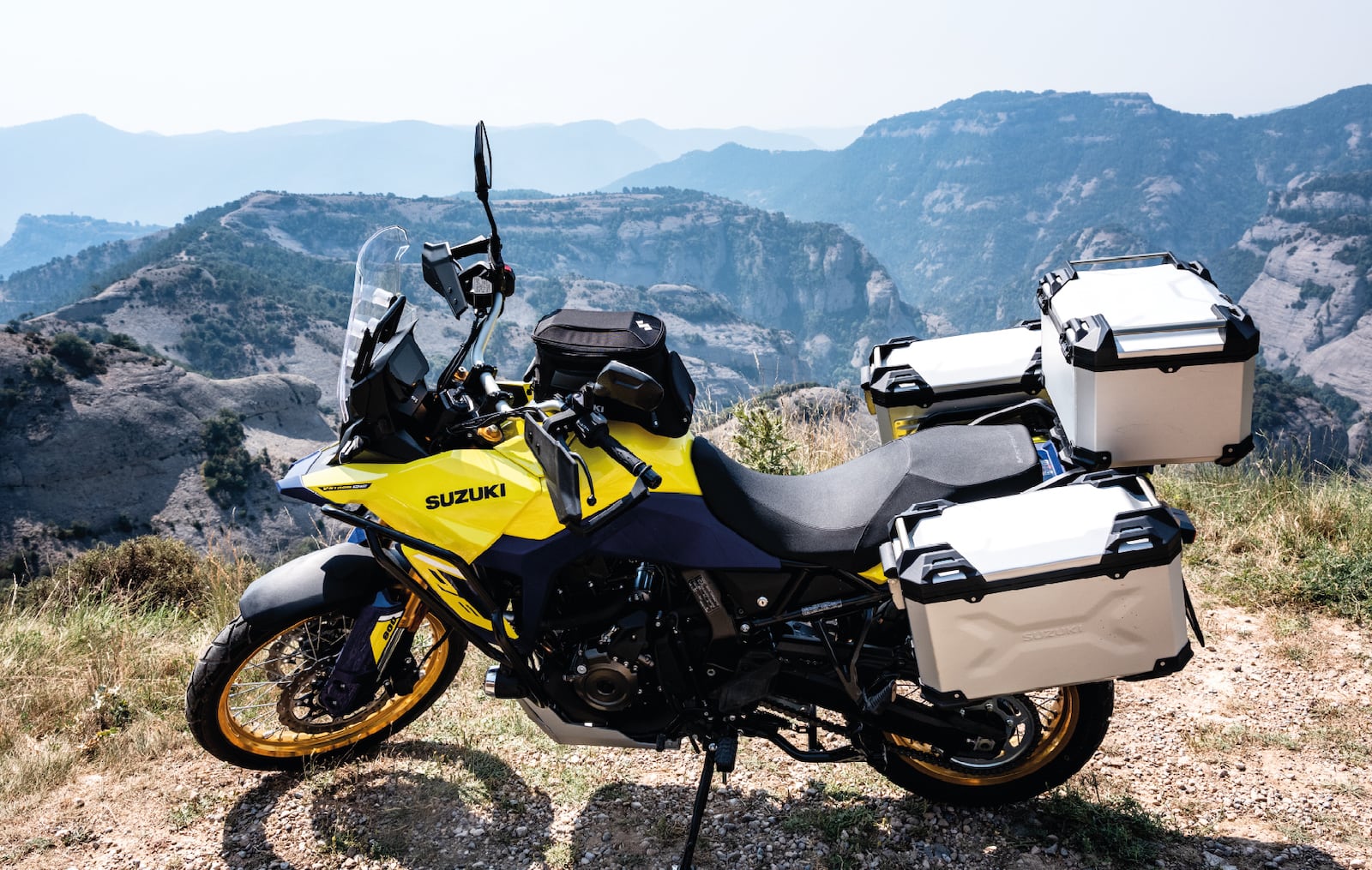
The 800DE uses Suzuki’s 776 cc 270-degree parallel twin, making 62 kW / 84 PS and 78 Nm (58 lb-ft). Its 220 mm Showa suspension is fully adjustable at the front, and the bike has a 21-inch front wheel, 20 L tank and an 855 mm seat. At 230 kg (507 lb) wet, it is heavier than the Transalp and Ténéré.
Suzuki gives it three throttle maps, adjustable and off-road traction control, rear-ABS deactivation and a bidirectional quickshifter, but no cruise control or IMU. The 17-inch rear and tube-type wheels are practical compromises rather than an enduro specification. The result suits riders who split time between road touring and maintained dirt and value predictable, well-supported mechanicals.
The road-focused 800, called 800RE in some markets, has 19/17-inch cast wheels, 150 mm suspension and a lower 825 mm seat. See the V-Strom 800 buyer’s guide for the full RE-versus-DE comparison.
Triumph Tiger 900 Rally Pro
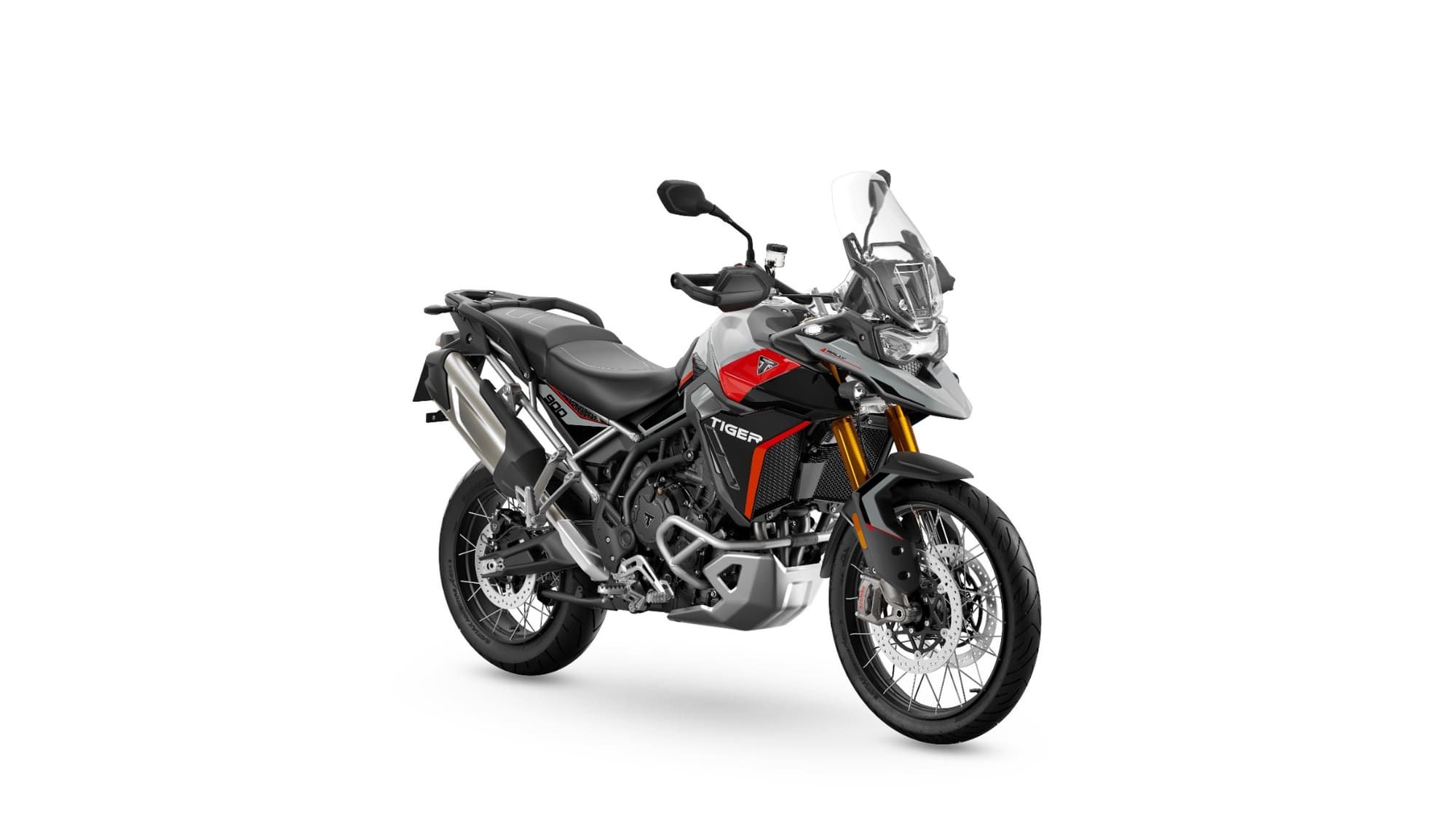
Triumph updated the Tiger 900 for 2024, raising output from the 888 cc T-plane triple to 79.5 kW / 108 PS and 90 Nm (66 lb-ft). The Rally Pro weighs 228 kg (503 lb) wet and uses 21/17-inch tubeless cross-spoked wheels, with 240 mm Showa fork travel and 230 mm at the rear.
Its equipment list is complete without many boxes to tick: cruise control, cornering ABS and traction control, up/down quickshifter, heated grips and seats, tyre-pressure monitoring and six ride modes. The 860–880 mm adjustable seat and broad cockpit make it more of a two-up travel bike than the Tuareg or Kove. If your dirt is fast gravel rather than narrow trail, that balance works.
Yamaha Ténéré 700 and Ténéré 700 Rally
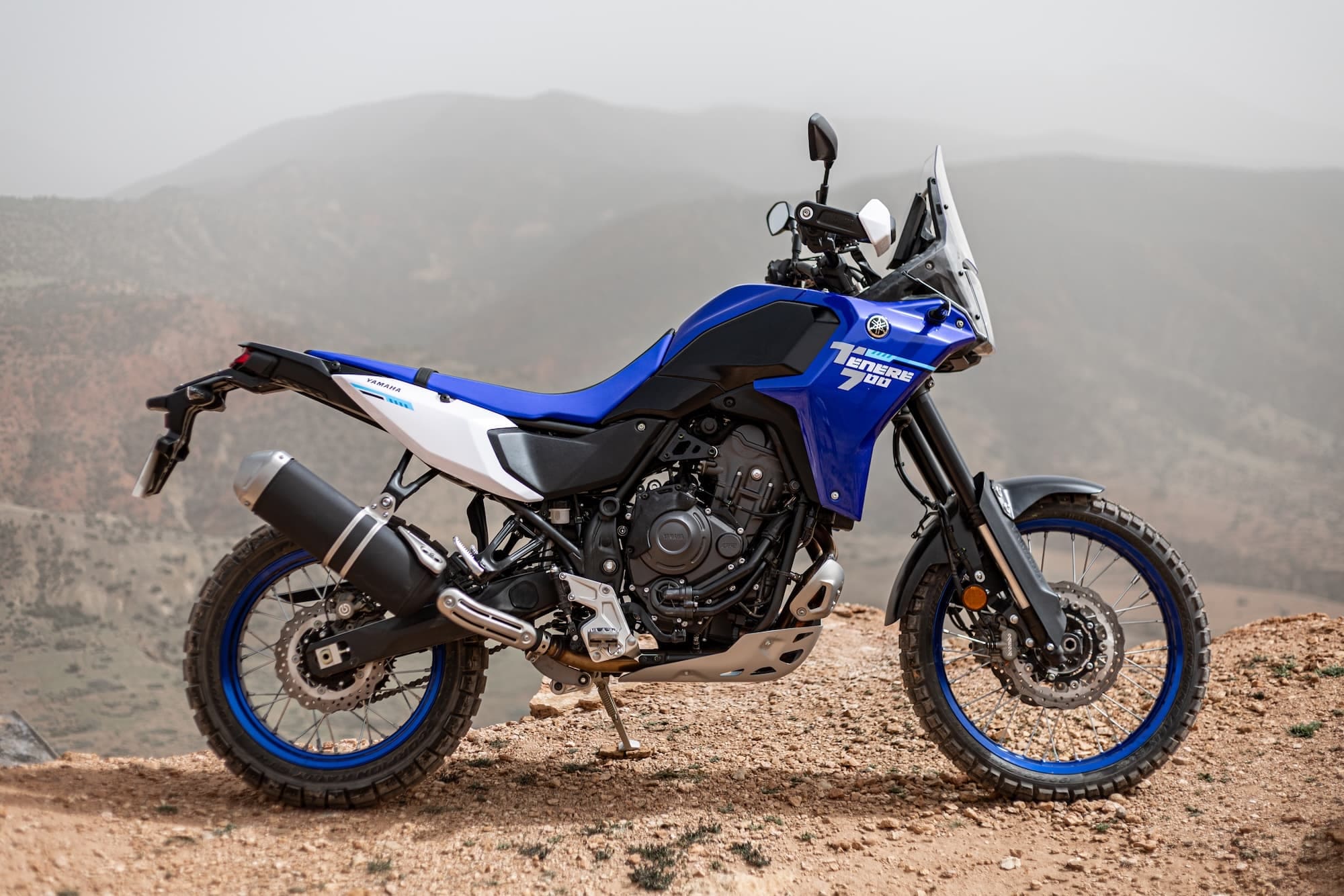
The Ténéré 700 still uses the 689 cc CP2 twin, making 54 kW / 73.4 PS and 68 Nm (50 lb-ft). Yamaha’s 2025 update added ride-by-wire, two power maps, switchable traction control, revised ABS control, a 6.3-inch TFT display and more suspension adjustment. It kept the things owners value: a narrow standing position, 21/18-inch wheels, a 16 L tank and restrained electronics.
The standard bike has 210/200 mm suspension and an 875 mm seat; a factory low version reduces the seat to 860 mm. The Rally raises travel to 230/220 mm and the seat to 910 mm, with stronger protection and rally-style equipment. Neither has cruise control or an IMU. An accessory quickshifter is available in some markets.
The Ténéré remains a good starting point if you want proven mechanicals, a huge accessory market and fewer layers between your right hand and the rear tyre. It is less attractive for long two-up motorway work. See the updated Ténéré 700 model and variant guide.
Maintenance and service intervals
Service intervals are useful, but they are not the whole ownership cost. Valve access, bodywork removal, parts supply, dealer labour rates and whether a bike has a chain or shaft all matter. The table gives the common headline intervals for current international models. Always use the manual for your exact market and model year.
| Motorcycle family | Engine-oil service | Valve-clearance inspection | Ownership note |
|---|---|---|---|
| Aprilia Tuareg 660 | 10,000 km (6,200 mi) | 20,000 km (12,400 mi) | Quickshifter is optional; Rally uses tubes |
| BMW F 900 GS | 10,000 km (6,200 mi) / annually | 20,000 km (12,400 mi) | Package equipment changes servicing and replacement cost |
| Ducati DesertX V2 | 15,000 km (9,000 mi) / 24 months | 45,000 km (28,000 mi) | No timing belts and no desmodromic valve service |
| Honda XL750 Transalp | 12,000 km (8,000 mi) | 24,000 km (16,000 mi) | E-Clutch adds components but not a second transmission |
| Husqvarna Norden 901 / KTM 790–890 | 15,000 km (9,300 mi) | 30,000 km (18,600 mi) | Check activated software options on used bikes |
| Kawasaki KLR650 | 12,000 km (7,600 mi) | 24,000 km (15,200 mi) | Simple single, but five-speed chain drive and tubes |
| Moto Guzzi V85 TT | 10,000 km (6,200 mi) | 10,000 km (6,200 mi) | Valve checks are frequent but access is easy; shaft drive |
| Suzuki V-Strom 800 | 6,000 km (3,750 mi) | 24,000 km (15,000 mi) | Short oil interval; standard quickshifter on the DE |
| Triumph Tiger 900 | 10,000 km (6,000 mi) / annually | 20,000 km (12,000 mi) | High standard equipment reduces accessory shopping |
| Yamaha Ténéré 700 | 10,000 km (6,000 mi) in many markets | 40,000 km (24,000 mi) | US schedules use shorter mileage steps |
For Benelli, CFMOTO, Kove and MV Agusta, current published schedules and warranty requirements differ enough by distributor that a single international number would mislead. Check the owner’s manual supplied with the exact bike and ask the local dealer to price the first major valve service before buying.
Which type of middleweight adventure motorcycle suits you?
| Priority | Start with | Reason |
|---|---|---|
| Harder off-road use with low mass | Aprilia Tuareg Rally, Kove 800X Pro | About 200 kg wet or less, 21/18 wheels and 240 mm suspension |
| Harder off-road use with mature electronics | KTM 890 Adventure R, Norden 901 Expedition | Strong engine, low tank, IMU and well-developed long-travel suspension |
| Simple, proven mixed travel | Yamaha Ténéré 700, Honda Transalp | Moderate mass, broad dealer support and restrained electronics |
| Value with a full electronics package | CFMOTO 800MT-X | Cruise, IMU and quickshifter are standard in a long-range package |
| Road travel with some gravel | Moto Guzzi V85 TT Travel, Benelli TRK 702 X | Lower seats, 19-inch fronts and touring-oriented bodywork |
| Two-up touring plus real dirt ability | Triumph Tiger 900 Rally Pro, BMW F 900 GS Adventure | Payload, wind protection, luggage support and long-travel chassis |
| Maximum road performance | MV Agusta Enduro Veloce, Ducati DesertX V2 | The strongest engines here, with complete electronic aids |
| Low-cost, steady remote travel | Kawasaki KLR650 | Large tank, simple single and low purchase price where available |
Final observations
There is no single centre of this class anymore. A KLR650 and an Enduro Veloce share an upright riding position and a 21-inch front wheel, but almost nothing else. The useful split is between lighter dirt-focused bikes, balanced all-rounders and equipment-heavy travel bikes.
Choose the category first. Decide how much motorway, passenger use, rough dirt and lifting after a fall are actually part of your riding. Then compare seat reach, local dealer support and the price of the equipment you will genuinely fit. A long specification sheet cannot make the wrong size and weight right.
What’s missing? A few brands unique to China + some European markets, like Moto Morini, QJMotor, and a few others. They’re great, but limited in distribution. That boundary is not permanent. I will review it as distribution broadens and the motorcycles become realistic choices in more countries.

Why leave off the moto guzzi v85tt?
Hi there Degs, I’m glad you said it — I was prevaricating about the V85 TT. It’s so different. And this is such a broad list to start with, I even thought I should leave off half the bikes here (or split it into two). But you’re right, I’ll add it in when I get a chance.
Did you mean MV Agusta as they make triples
Thanks Richard, you have no idea how often I mentally get them mixed up. I’m one of those people who says “Let’s have dinner for chicken.” I even remember thinking “Write the right one, Dana, don’t mix it up this time.” They’re both Italian and start with M and have a space in the name. Running out of storage space in my brain. Anyway, thanks!
Another question on why you left off the Guzzi V85? I don’t like the looks of these style bikes so don’t and won’t own one, but it is a near perfect expression of the segment.
Thanks — I appreciate how you’re advocating strongly despite not wanting to own one. I can’t argue with your impartiality! Anyway, I was in the middle of adding it when you sent in your comment. Thanks again.
Getting this article in my feed was another instance of questioning if Google is actually reading minds already. Thank you for the simplicity, thoroughness, and impartiality.
Oh, I know the feeling! But my mind is really easy to read so it’s not that great a feat. Motorcycles, coffee, MMA, repeat.
How could you forget the Ducati Scrambler Desert Sled?
Moderately priced. Simple electronics. Air Cooled 803 that just so happened to win the NHHA and Mint 400 offroad Hooligan classes.
Hey there Stratton, I did not forget the Ducati Scrambler Desert Sled, as I mentioned! I’ve always liked them the most out of the Scramblers (I like the size and look, even before the function). Great bike, and Ducati Scramblers are lots of fun, but the Ducati DesertX is more appropriately comparable to most bikes in this list of utilitarian adventurers, and I’m keeping it to one model per brand. (I know having bikes like the Moto Guzzi V85 TT confuses things, but that is the closest that brand has.)
Hi, it sounds be good to see a seat height comparison table as that can be a major stitching point with ADV bikes, especially if you’re going to ride 2 up.
This was a very good idea 8 months ago when you made this comment… and I finally made the update! Enjoy.
Hi Dana, very informative article. Any reason you opted for KLR 650, not Versys 650 in your comparison?
They have a lot of overlap, but in Kawasaki’s line-up the KLR is definitely more adventure focused. That said, I, too, would love to see a KLR with the parallel twin motor. Something more like the KLE500. I guess that wasn’t a popular bike, though, so Kawasaki wasn’t keen to replace it.
Seat height chart is useless without a max hight too. Or at least is uselessly biased.
I know everyone complains about too tall motorcycles, but I’m 6 foot 4 inches and need to tallest bike I can find.
“Uselessly biased” is a bit harsh. What do you mean about by “max height”? The height of the bars? You can change bars on bikes.