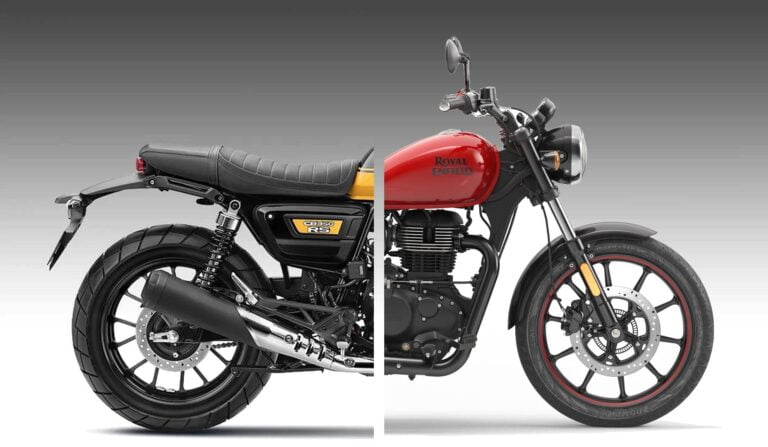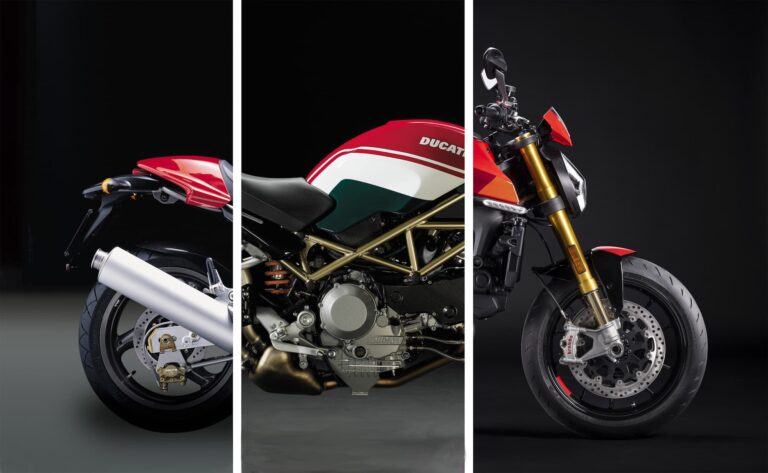

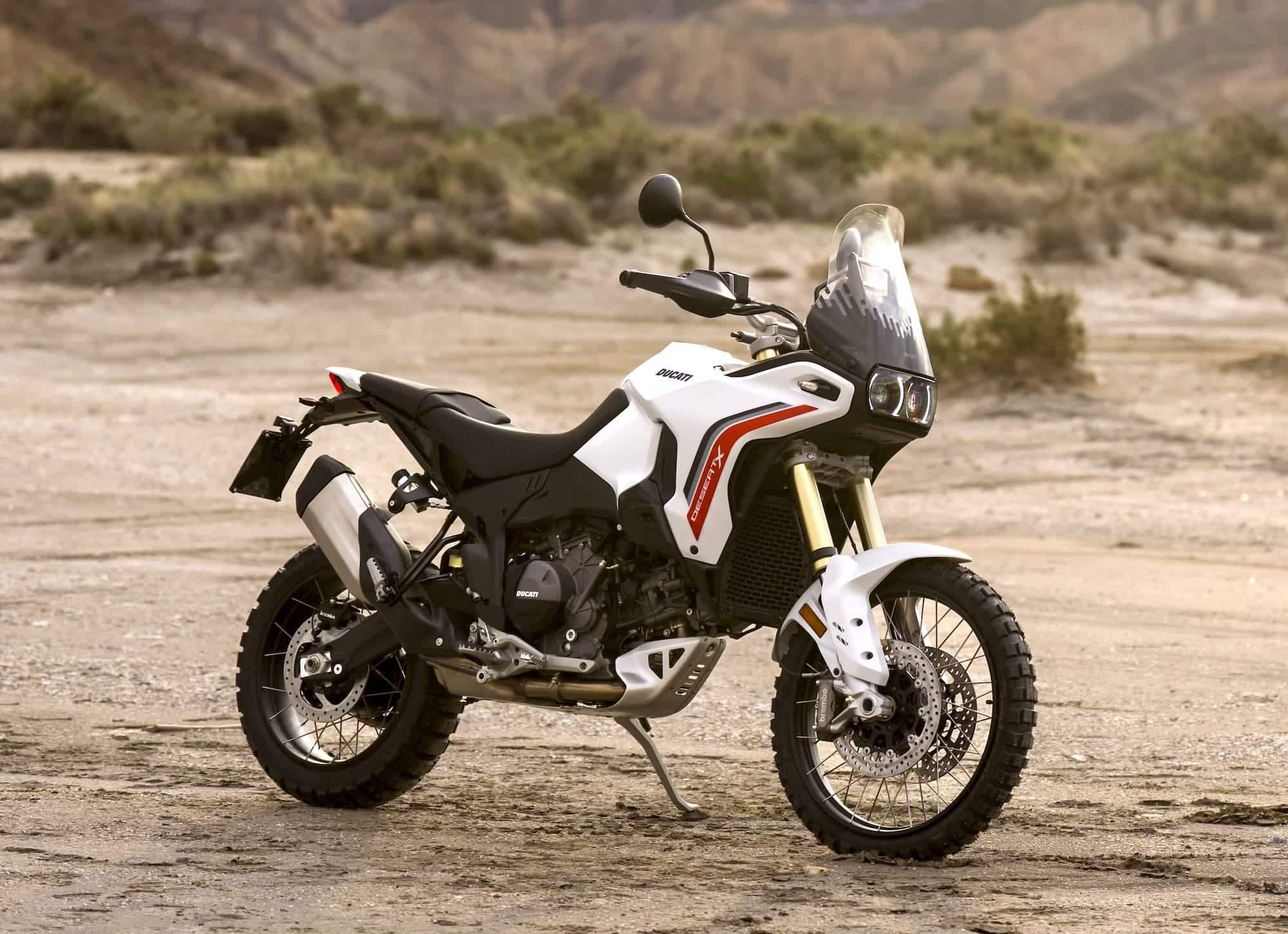
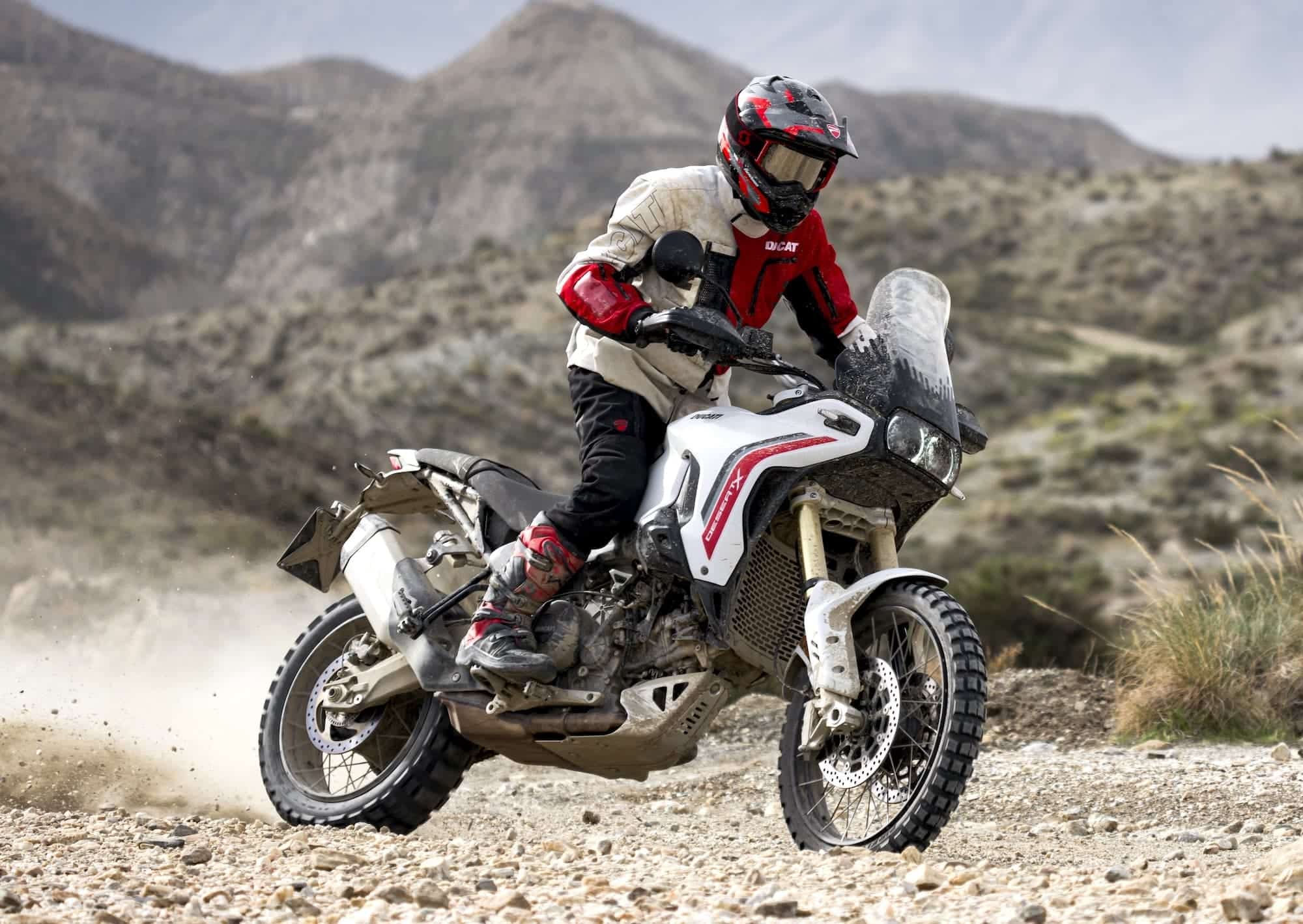
The Ducati DesertX arrived for 2022 as the Ducati adventure bike for people who wanted to keep going when the road stopped. A 21-inch front wheel, proper suspension travel, a standing-friendly riding position and a surprisingly off-road-specific gearbox separated it from the Multistrada family.
Then Ducati changed nearly everything underneath it. The 2026 DesertX V2 looks like a careful update, but its 890 cc engine, aluminium monocoque frame, progressive-link rear suspension, smaller tank and much longer valve-service interval make it a second generation in the meaningful sense.
This guide covers both generations, the Standard, Discovery and Rally versions of the original 937, the single-model V2 range, maintenance, the Multistrada comparison and the middleweight alternatives. It is a model guide rather than a road test: where a specification sounds impressive, I explain what it changes for an owner.
The short version
Buy the 2022–2025 DesertX 937 if value, a 21 L tank and the proven Testastretta platform matter more than avoiding timing-belt and desmodromic-valve maintenance. Buy the 937 Rally if you will genuinely use its tougher wheels and longer, higher-grade suspension. Buy the 2026-on DesertX V2 if you want the best standard chassis, lower-rpm response and the friendliest long-term maintenance schedule.
There is currently no separate DesertX V2 Rally or Discovery model. Ducati’s Touring and Rally labels describe accessory configurations of the one V2 model; neither changes its engine, frame or suspension.
Are you obsessed with motorcycles?
Well, I am. That’s why I created this site — as an outlet. I love learning and sharing what others might find useful. If you like what you read here, and you’re a fraction as obsessed as I am, you might like to know when I’ve published more. (Check the latest for an idea of what you’ll see.)
Ducati DesertX history in brief
Ducati had made adventure bikes before. Fans of motorcycle history or perhaps casual scrolling addicts who browse BringATrailer.com or Iconic (oh look! they changed to Iconic Auctioneers from Iconic Motorbike Auctions) for fun will be loosely aware of the Cagiva Elefant.
“Cagiva? But that’s not Ducati,” you mumble. Well, it was, and it wasn’t. They had a messy overlapping history which I won’t get into, but basically, they were a thing for a while. If you find that confusing, well, now they’re owned by Volkswagen!
Anyway, here’s the Cagiva Elefant.
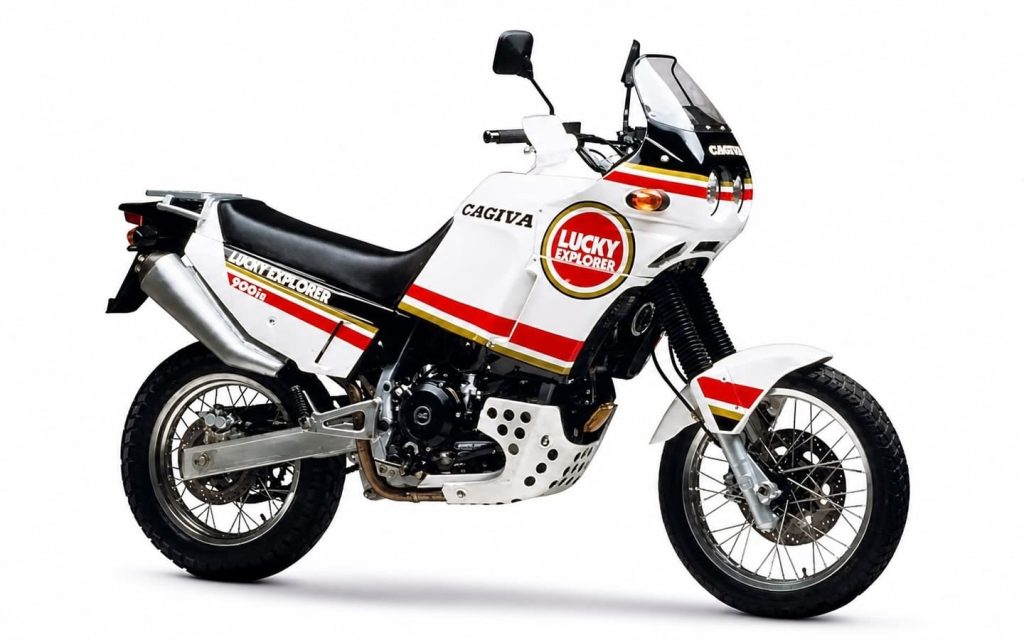
Ain’t she a looker?
The original Cagiva Elefant was based on the Desmodue engine, a 904cc 2 valve per cylinder with desmodromic valves and cam belts that also graced the Supersport of the time, the Monster, and a previous generation of superbikes. It started off carburettor-fed, but evolved into fuel injection, as other Desmodue engined-bikes did.
So it was no surprise that the original DesertX concept, shown at EICMA in 2019, was not just based on the Cagiva Elefant, but also graced with a Desmodue engine — this time from the Scrambler 1100.
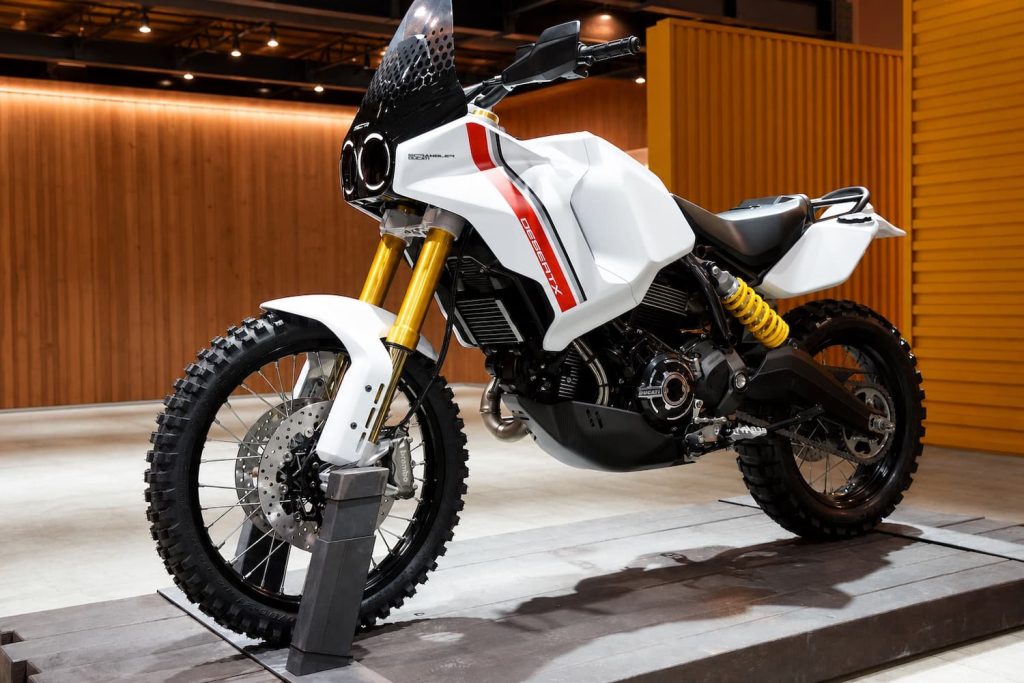
This basically felt like a Ducati Scrambler Desert Sled done right.
But just months later, Ducati unveiled the first-generation Ducati DesertX with production specs.
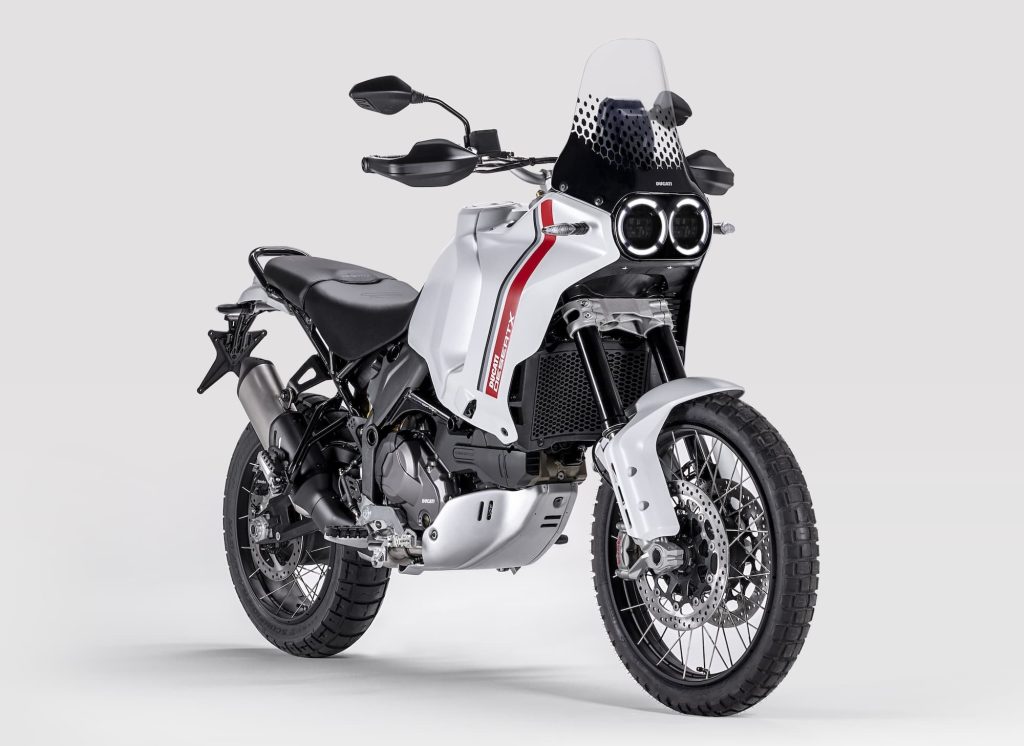
The first-generation Ducati DesertX used the familiar 937 cc Testastretta 11-degree engine in a new steel trellis chassis, with 230 mm front and 220 mm rear suspension travel, a 21/18-inch wheel set and low first-through-fifth ratios for dirt. It was Ducati’s first modern motorcycle designed around a 21-inch front wheel.
The 937 Testrastretta 11 engine has now been retired from all production bikes, but it was the previous-generation middleweight engine that was in all the bikes including the Monster, Multistrada, Hypermotard, and Supersport (there are so many, I always think I’m missing one!)
But it’s a great motor — liquid-cooled, higher power, lighter, and with much higher service intervals.
The family expanded before it was replaced. Rally added competition-style suspension and stronger wheels for 2024; Discovery packaged useful travel protection and comfort equipment for 2025. For 2026, the V2 reset the range around Ducati’s newer 890 cc non-desmodromic engine and a lighter aluminium monocoque chassis.
| Model year | Model | Main mechanical identity | What it means to a buyer |
|---|---|---|---|
| 2022–2025 | DesertX | 937 cc Testastretta, steel trellis frame, 230/220 mm travel | The least expensive entry to the family used; broad parts and servicing knowledge, but belts and desmodromic valves remain part of ownership |
| 2024–2025 | DesertX Rally | Same 937 cc engine; 250/240 mm higher-grade suspension and tube-type Excel rims | The most capable factory version in rough, fast terrain, and also the tallest |
| 2025 | DesertX Discovery | Standard 937 chassis with protection and touring accessories | A convenient travel package, not a Rally underneath |
| 2026 onward | DesertX V2 | 890 cc IVT V2, aluminium monocoque, progressive-link rear suspension | A genuine second generation with easier engine maintenance and revised ergonomics; only one mechanical model so far |
The important used-market dividing line is therefore not a colour or electronics update. It is 2025 versus 2026: 937 Testastretta and trellis frame on one side, 890 IVT V2 and aluminium monocoque on the other.
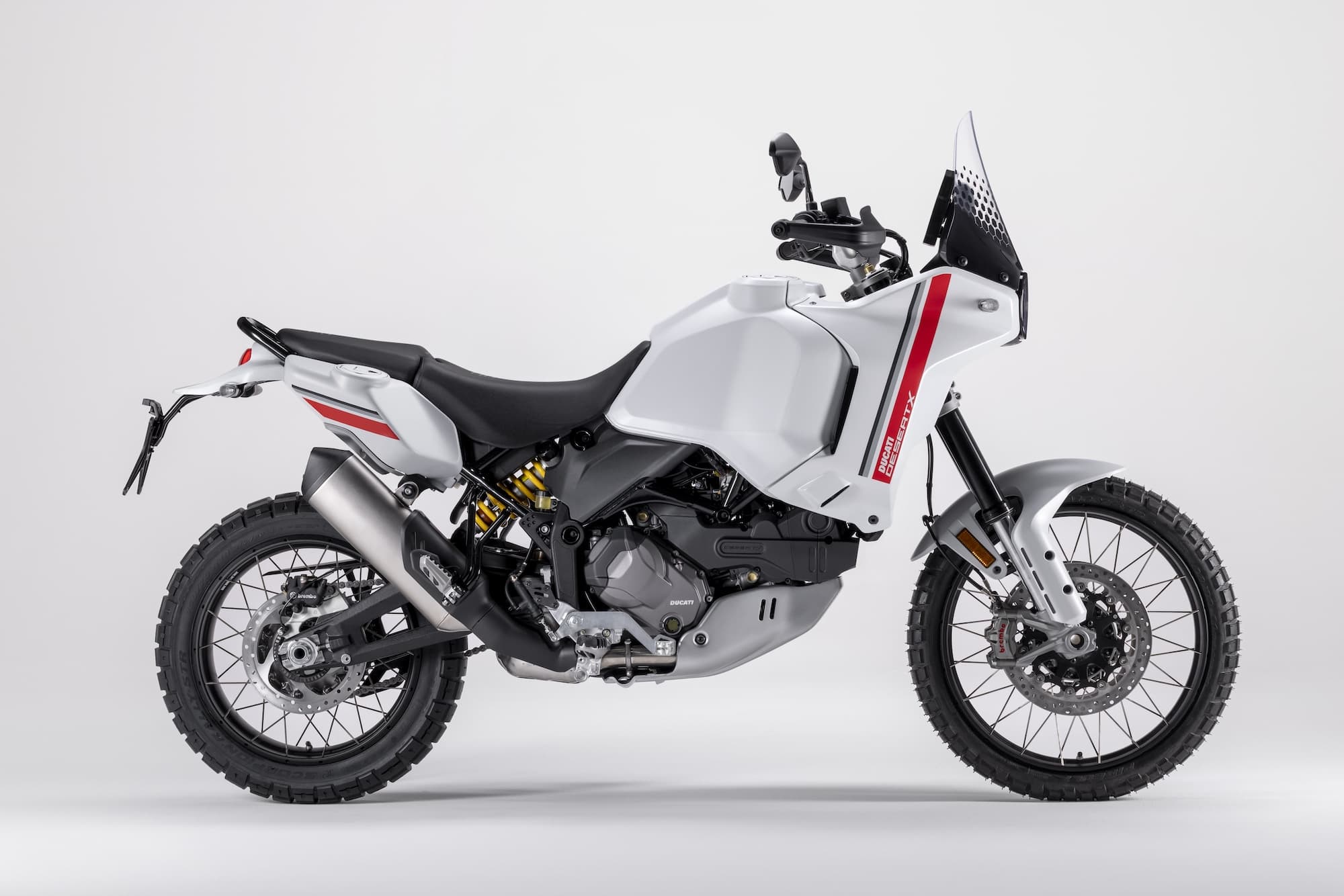
First generation: 2022–2025 DesertX 937
The original DesertX is built around Ducati’s 937 cc Testastretta 11-degree V-twin. It is the same basic engine family used in bikes including the contemporary Multistrada V2, Monster, Supersport and Hypermotard, but the DesertX got adventure-specific ratios and final gearing. The first five gears are shorter than the old Multistrada’s; sixth is long enough for touring.
| Item | 2022–2025 DesertX specification | Why it matters |
|---|---|---|
| Engine | 937 cc liquid-cooled Testastretta 11-degree V-twin; desmodromic four-valve heads | Strong, familiar Ducati middleweight performance, with periodic valve-clearance and timing-belt work |
| Claimed output | 81 kW (110 CV) at 9,250 rpm; 92 Nm (68 lb-ft) at 6,500 rpm | More road acceleration than most sub-800 cc adventure twins without the bulk of a 1,200 cc-class bike |
| Frame | Steel trellis main frame with aluminium swingarm | Conventional, inspectable construction; check lower rails and mounts carefully on a used bike that has hit rocks |
| Suspension | Fully adjustable 46 mm KYB fork, 230 mm travel; fully adjustable KYB shock, 220 mm travel | Enough adjustment and stroke for loaded travel and uneven terrain; setup matters more than the number of clicks |
| Wheels and tyres | Tubeless cross-spoked 21 x 2.15 front and 18 x 4.5 rear; 90/90-21 and 150/70 R18 | Proper off-road tyre sizes and roadside plug repair for ordinary punctures |
| Brakes | Twin 320 mm front discs with Brembo four-piston calipers; 265 mm rear disc | Strong road braking, with cornering ABS modes that can be reduced for dirt |
| Fuel capacity | 21 L (5.5 US gal) | Useful touring range; an optional 8 L rear tank extended it further but added mass high and rearward |
| Seat height | 875 mm (34.4 in); accessory combinations from 845 to 890 mm | Tall for shorter riders, although Ducati supplied more seat-height options than the silhouette suggests |
| Claimed mass | 210 kg (463 lb) wet without fuel | Manageable while moving, but roughly 225 kg with a full tank before luggage and protection |
| Electronics | Six riding modes, cornering ABS, traction and wheelie control, engine-brake control, cruise control and up/down quickshifter | A complete electronics package from the first model year; condition and calibration matter more than chasing a later year |
In real terms, the original bike sits in an unusual place. Its output is close to a road-biased middleweight tourer, yet its geometry, wheel sizes and suspension are closer to a large enduro. The 21 L tank and broad electronics package make it easy to use as a travel bike, while the low gearing, narrow standing area and 250 mm of ground clearance give it a reason to exist beside a Multistrada.
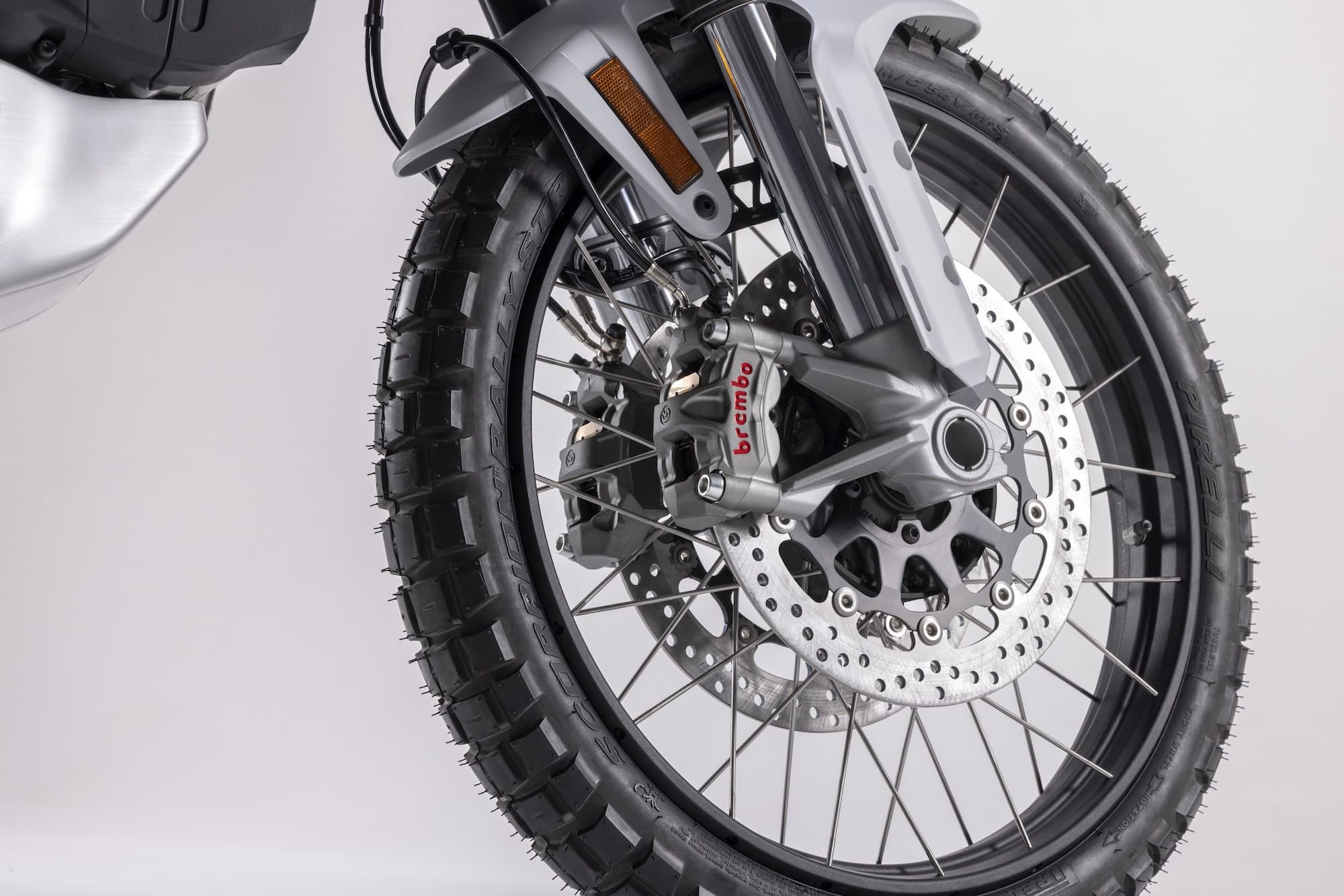
For more on why the original was mechanically different from Ducati’s existing range, see six ways the Ducati DesertX was actually different. The broader engine family is covered in the Motofomo guide to Ducati engines.
DesertX 937 variants: Standard, Discovery and Rally
All first-generation versions use the same 937 cc engine and core electronics. The expensive difference is chassis hardware. Rally is a materially different off-road model; Discovery is an accessorised standard model.
| Item | DesertX Standard | DesertX Discovery | DesertX Rally |
|---|---|---|---|
| Model years | 2022–2025 | 2025 | 2024–2025 |
| Engine/output | 937 cc; 81 kW (110 CV), 92 Nm | Same as Standard | Same as Standard |
| Frame | Steel trellis | Steel trellis | Steel trellis with Rally-specific chassis detail |
| Front suspension | 46 mm KYB, fully adjustable, 230 mm | Same as Standard | 48 mm KYB closed-cartridge, fully adjustable, 250 mm |
| Rear suspension | KYB, fully adjustable, 220 mm | Same as Standard | KYB with high/low-speed compression adjustment, 240 mm |
| Wheels | Tubeless cross-spoked | Tubeless cross-spoked | Tube-type Takasago Excel rims |
| Seat height | 875 mm (34.4 in) | 875 mm (34.4 in) | 910 mm (35.8 in); 880 mm low option |
| Ground clearance | 250 mm (9.8 in) | 250 mm (9.8 in) | 280 mm (11.0 in) |
| Claimed wet mass without fuel | 210 kg (463 lb) | Higher once its equipment is fitted | 211 kg (465 lb) |
| Factory equipment emphasis | Base platform | Touring screen, centre stand, heated grips, navigation licence and extra protection | Longer competition-derived suspension, stronger rims, steering damper and off-road bodywork |
| Best fit | Mixed use and best used value | Turn-key road touring with occasional dirt | Fast, rough off-road use |
The Rally’s extra 20 mm at each end is not mainly about making the specification sheet taller. Its closed-cartridge fork separates damping oil from the main spring chamber more effectively, while the shock gives finer compression control. That buys more consistency during repeated hard impacts. The Excel rims are chosen for impact resistance, although tubes make a simple nail puncture more involved than plugging a tubeless tyre.
The trade-off is physical. A 910 mm seat is exceptionally tall, and the raised centre of gravity does not disappear in traffic or on a cambered stop. Riders whose difficult terrain means graded gravel rather than whoops and ledges will usually get more from a correctly sprung Standard than from paying for Rally hardware they never load hard.
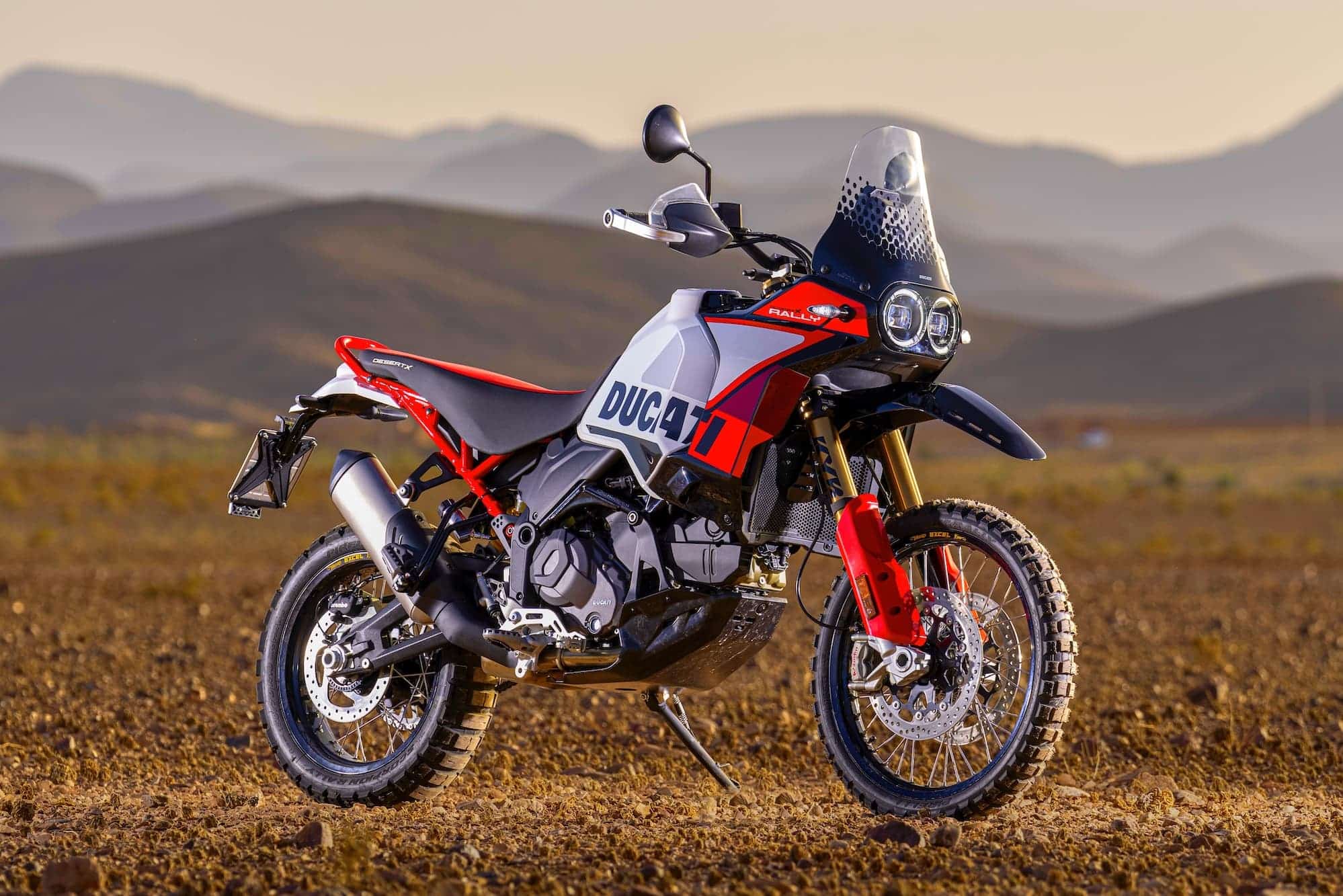
Discovery sits at the opposite end of that decision. Its centre stand, heated grips, taller screen, engine and radiator protection, reinforced handguards and navigation licence are useful, but its suspension, wheels and 875 mm seat remain Standard specification. Buy one if you value the fitted equipment at the used price. Do not pay Rally money on the assumption that the livery hides Rally running gear.
Second generation: 2026-on DesertX V2
Ducati announced the 2nd gen DesertX in early 2026 for a later 2026 release date.
The V2 generation keeps the two round lights, white bodywork and 21/18-inch stance, but the engine and frame architecture are new. Ducati’s 890 cc V2 uses variable intake timing and conventional spring-return valves rather than desmodromic valves. The aluminium monocoque incorporates the airbox and uses the engine as a stressed structure, replacing the 937’s steel trellis main frame.
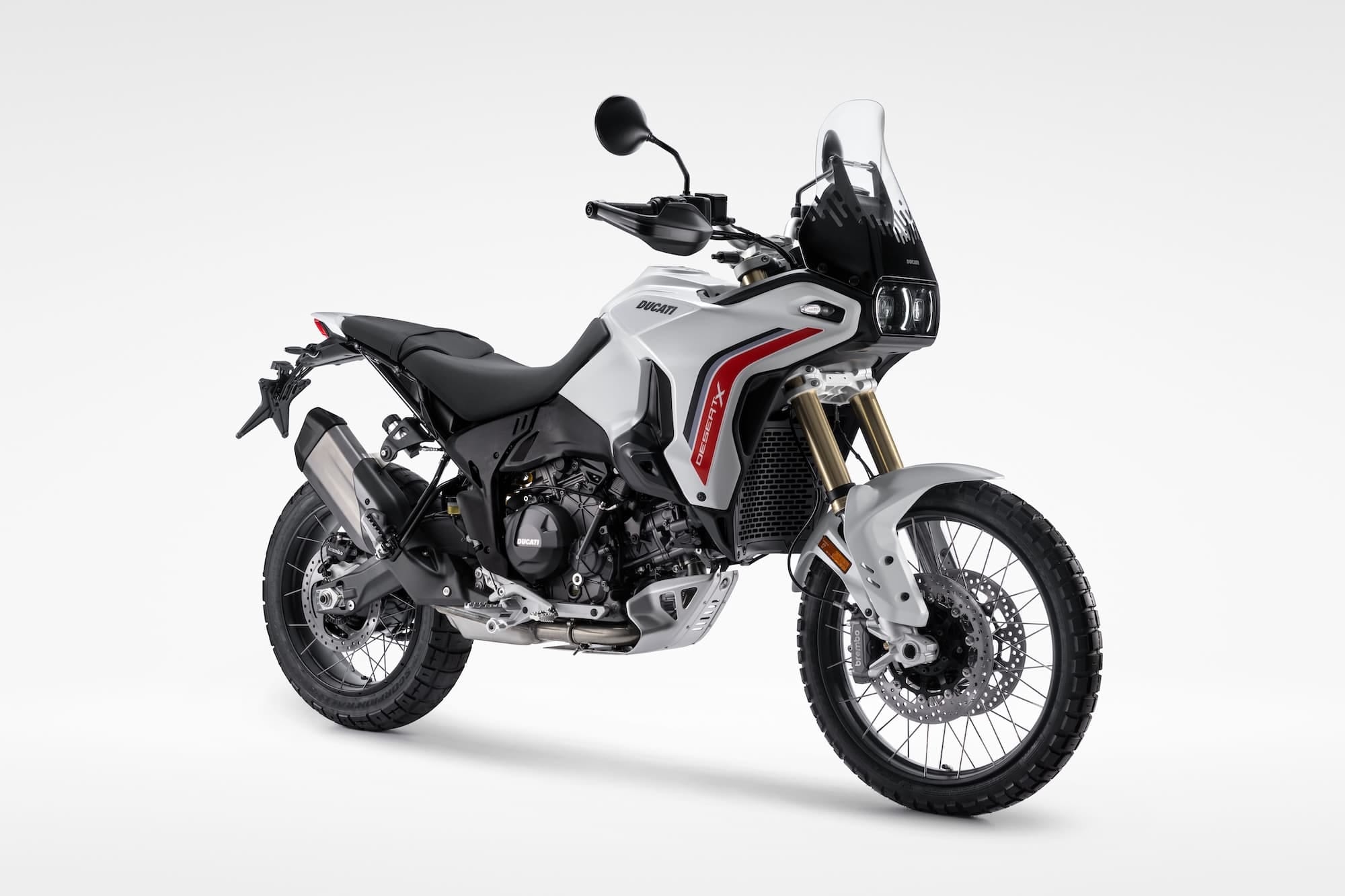
DesertX 937 versus DesertX V2
Below is a table of how things changed between the generations of Ducati DesertX.
| Item | 2022–2025 DesertX 937 | 2026-on DesertX V2 | Real-world significance |
|---|---|---|---|
| Engine | 937 cc Testastretta 11-degree; desmodromic valves; fixed valve timing | 890 cc V2; spring-return valves; intake variable timing | The V2 loses 47 cc but spreads torque more deliberately and removes timing belts and desmodromic clearance work |
| Claimed output | 81 kW (110 CV) at 9,250 rpm | 81.1 kW (110 CV) at 9,000 rpm | Peak performance is effectively unchanged; the reason to upgrade is delivery and ownership, not a bigger top-end number |
| Claimed torque | 92 Nm (68 lb-ft) at 6,500 rpm | 92 Nm (68 lb-ft) at 7,000 rpm; 70% available from 3,000 rpm | The higher torque peak is misleading on its own: variable intake timing helps make useful drive much earlier |
| Frame | Steel trellis | Aluminium monocoque/airbox; engine is structural | Fewer major frame pieces and revised mass placement; damage assessment after a hard impact deserves care because the engine and monocoque are part of the load path |
| Rear suspension | Directly mounted fully adjustable KYB shock, 220 mm | Fully adjustable KYB with remote preload and progressive Full Floater linkage, 220 mm | The linkage lets the initial movement stay compliant while resistance rises deeper in the stroke |
| Front suspension | 46 mm fully adjustable KYB, 230 mm | 46 mm fully adjustable KYB, 230 mm, revised internals | Travel is unchanged, so this is a tuning change rather than a claim of greater capability by length alone |
| Front brakes | Twin 320 mm discs | Twin 305 mm discs | Smaller discs reduce rotating and unsprung mass; outright road leverage is slightly reduced on paper, while Brembo four-piston calipers remain |
| Fuel capacity | 21 L (5.5 US gal) | 18 L (4.8 US gal) | The V2 is narrower between the knees but will normally need fuel sooner |
| Seat height | 875 mm standard; 845–890 mm with options | 880 mm standard; 840–900 mm with options | The standard V2 is 5 mm taller, but its full accessory range reaches lower |
| Claimed wet mass without fuel | 210 kg (463 lb) | 209 kg (461 lb) | Only 1 kg separates the claims. Not a dramatic diet |
| Wheelbase | 1,608 mm | 1,615 mm | A 7 mm increase is too small to define the bike alone; revised rider placement and geometry matter together |
| Geometry | 27.6-degree rake; 122 mm trail | 27-degree rake; 114 mm trail | Less trail points toward quicker steering response, while the long wheelbase preserves stability |
| Quickshifter | Lever microswitch system | DQS 2.0 using gear-drum position sensing | Fewer parts at the lever and more direct shift-state information for the ECU |
| Battery | Conventional specification | Lithium-ion | Saves mass high in the motorcycle, but demands a lithium-compatible charger |
The engine figures deserve emphasis. The V2 does not make meaningfully more peak power or torque than the 937. Its case is that the intake cam timing can change with engine speed, allowing a calmer, more tractable low end without choking the top end. Ducati says 70% of maximum torque is present by 3,000 rpm. That matters when balancing the motorcycle at low speed far more than another few kilowatts near the limiter would.
Ducati also kept the gearbox purpose-specific. First through fourth are short, sixth is taller, and the DesertX uses a 15/46 final ratio. That separates it from the new Multistrada V2 even though the engine architecture is shared.
Chassis, ergonomics and electronics
The V2 moves the footpegs rearward and the seat and handlebar forward. Its 18 L tank is narrower around the standing area. Together, those changes put the rider closer to the front wheel and leave more room to move fore and aft without hooking a knee on the tank. The new rear linkage also makes suspension response more progressive without reducing the 220 mm travel.
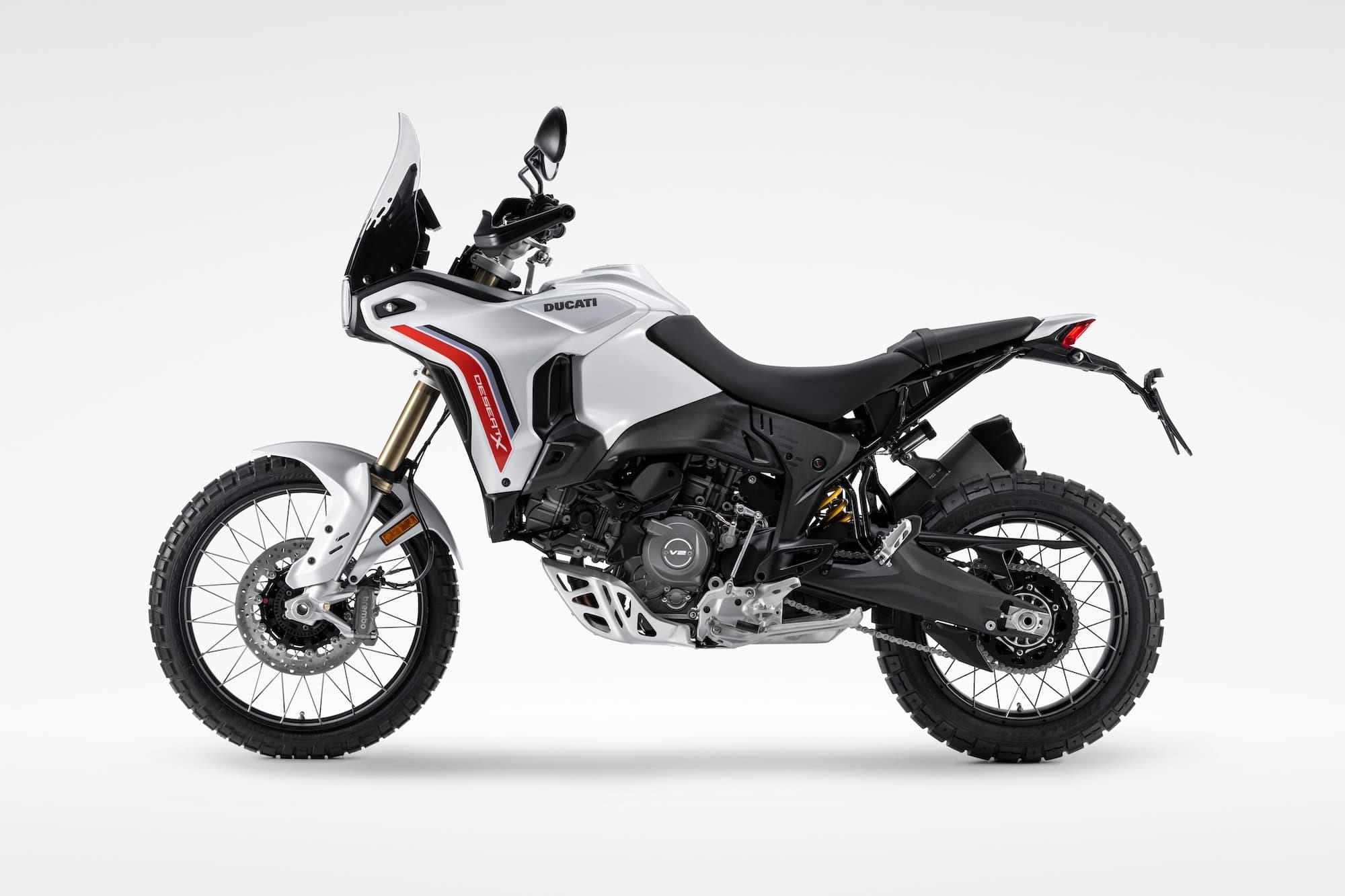
The tank’s outer covers can be replaced separately after cosmetic damage, and the air filter sits in the monocoque with easier service access. These are small but sensible changes on an adventure bike: dust-filter inspections and low-speed drops are normal use, not exotic failures.
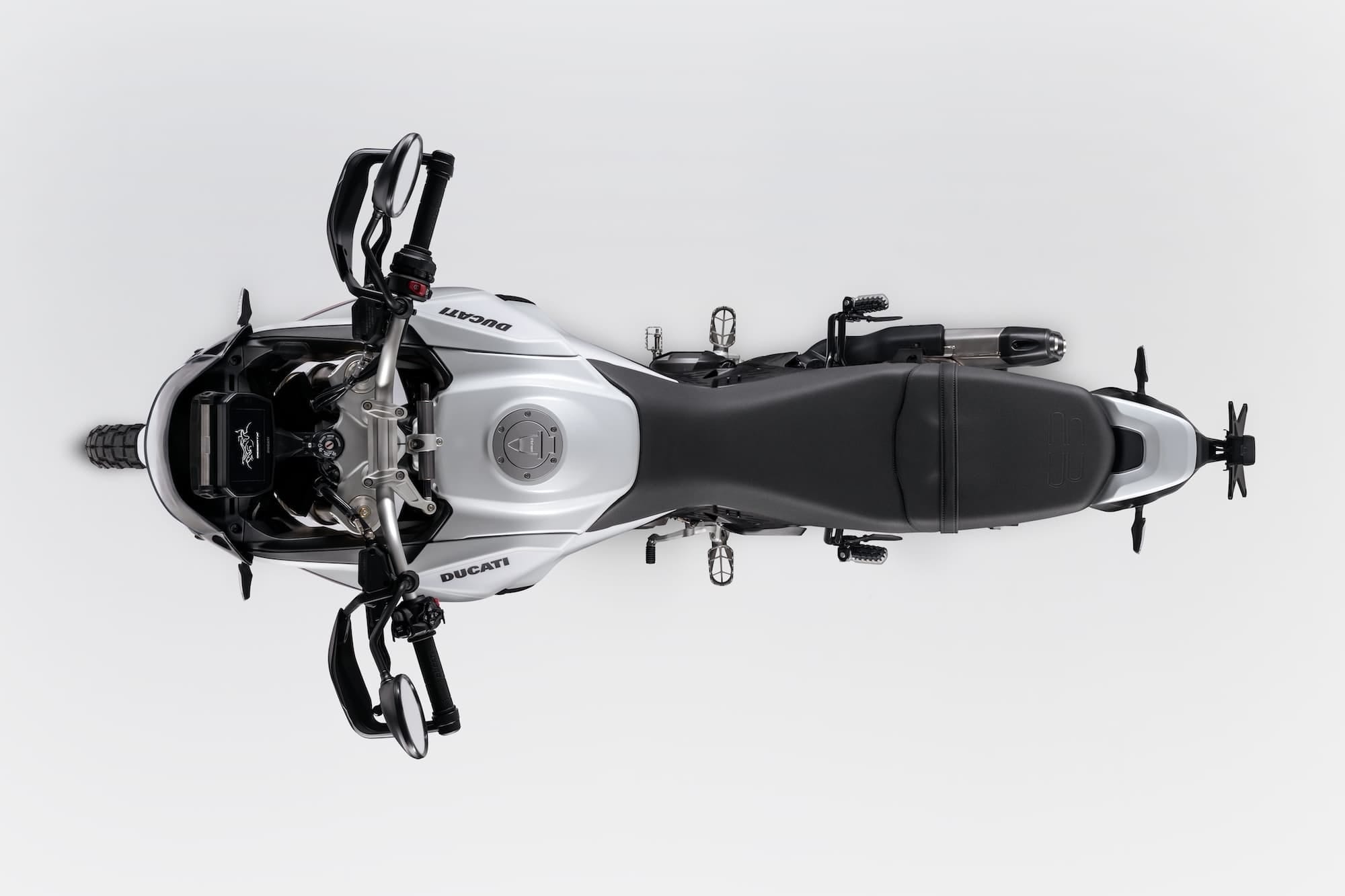
Electronics still centre on six riding modes: Sport, Touring, Urban, Wet, Enduro and Rally. A six-axis inertial unit supports cornering ABS, traction control and wheelie control, while cruise control, engine-brake control and the up/down quickshifter are standard. The V2 adds Ducati Brake Light EVO, revised switchgear with two quick-access buttons, a horizontal TFT display, two USB outlets and a utility bar above the dash.
One V2 model, two accessory configurations
As of August 2026, Ducati lists one DesertX V2 model. The configurator’s Touring and Rally packages can make search listings look like variants, but they do not create separate homologated models in the way the 937 Rally did.
| V2 offering | Status | What it adds | What does not change |
|---|---|---|---|
| DesertX V2 | The actual production model | Standard 890 cc engine, KYB suspension, 21/18 tubeless wheels and full electronics package | Not applicable |
| Touring configuration | Accessory bundle | Side cases, centre stand, heated grips, passenger handgrips, bullbar and larger screen | Engine, frame, wheel sizes, suspension travel and tuning remain the base V2 specification |
| Rally configuration | Accessory bundle, not a DesertX V2 Rally model | Rally seat, auxiliary tank, high front fender, engine guard and handguards | No 48 mm closed-cartridge fork, extra travel, Excel rims or Rally-specific shock |
This distinction affects used values. Accessories can be useful and expensive to add later, but a V2 with the Rally bundle should not command the same model premium as a first-generation DesertX Rally unless Ducati releases a separate V2 Rally in future. Check the VIN and original sales invoice rather than relying on a classified-ad label.
DesertX maintenance: 937 versus V2
This is where the V2 generation makes its strongest ownership argument. Both engines have a 15,000 km (9,000 mi) oil-service distance, but the 890 moves the valve-clearance inspection from 30,000 to 45,000 km and removes scheduled timing-belt replacement.
| Maintenance item | 2022–2025 DesertX 937 | 2026-on DesertX V2 | Ownership significance |
|---|---|---|---|
| Initial service | 1,000 km (600 mi) | 1,000 km (600 mi), or six months where specified | Confirm completion on any nearly new example; it establishes the service record after running-in |
| Annual service | Every 12 months if the distance interval is not reached | Every 12 months | Low annual mileage does not mean zero scheduled attention |
| Engine oil and filter | 15,000 km (9,000 mi), with annual time-based servicing | 15,000 km (9,000 mi) or 24 months | The distance is generous for both; riders using dust, heat or repeated short trips may sensibly service earlier |
| Valve-clearance inspection | 30,000 km (18,000 mi), desmodromic system | 45,000 km (28,000 mi), spring-return valves | The V2 stretches the expensive inspection by 50% and uses a more conventional valvetrain |
| Timing system | Rubber timing belts; replace every five years under Ducati’s schedule | Chain-driven camshafts; no scheduled belt replacement | Age matters on a low-mileage 937. The V2 removes a calendar-based engine expense |
| Brake and clutch fluid | Every 24 months | Every 24 months | Moisture absorption is time-based; check the date, not only colour or mileage |
| Engine coolant | Periodic replacement under the model schedule | Every 48 months | Useful evidence of thorough long-term care, particularly on older 937 bikes |
| Air filter | Inspect and service more often in dust | Inspect/clean during routine servicing; scheduled replacement at 30,000 km (18,000 mi), earlier in dust | A dusty adventure-bike airbox deserves inspection before purchase regardless of the odometer |
| Drive chain | Clean, lubricate and adjust frequently; more often after dirt or rain | Same | Adventure use shortens chain and sprocket life; condition is more informative than model year |
For the complete item-by-item schedules, consumables and torque values, see the separate DesertX 937 maintenance schedule and DesertX V2 maintenance schedule.
A low-mileage 2022 bike can therefore be due for belts before it is due for its first valve inspection. Ask for invoices, not a seller’s recollection that it was “serviced recently.” On the V2, the long valve interval lowers scheduled workshop exposure, but the model is too new for a mature high-mileage reliability record. A simpler schedule is not proof that nothing will fail.
Ducati DesertX versus Multistrada V2
The confusing part of the Ducati range is that each DesertX generation has a contemporary Multistrada V2 with a closely related engine. The easy answer is that the Multistrada is the better road motorcycle and the DesertX is the better dirt motorcycle. Of course, you can do either with both! For ages, we just had the Multistrada, and made do.
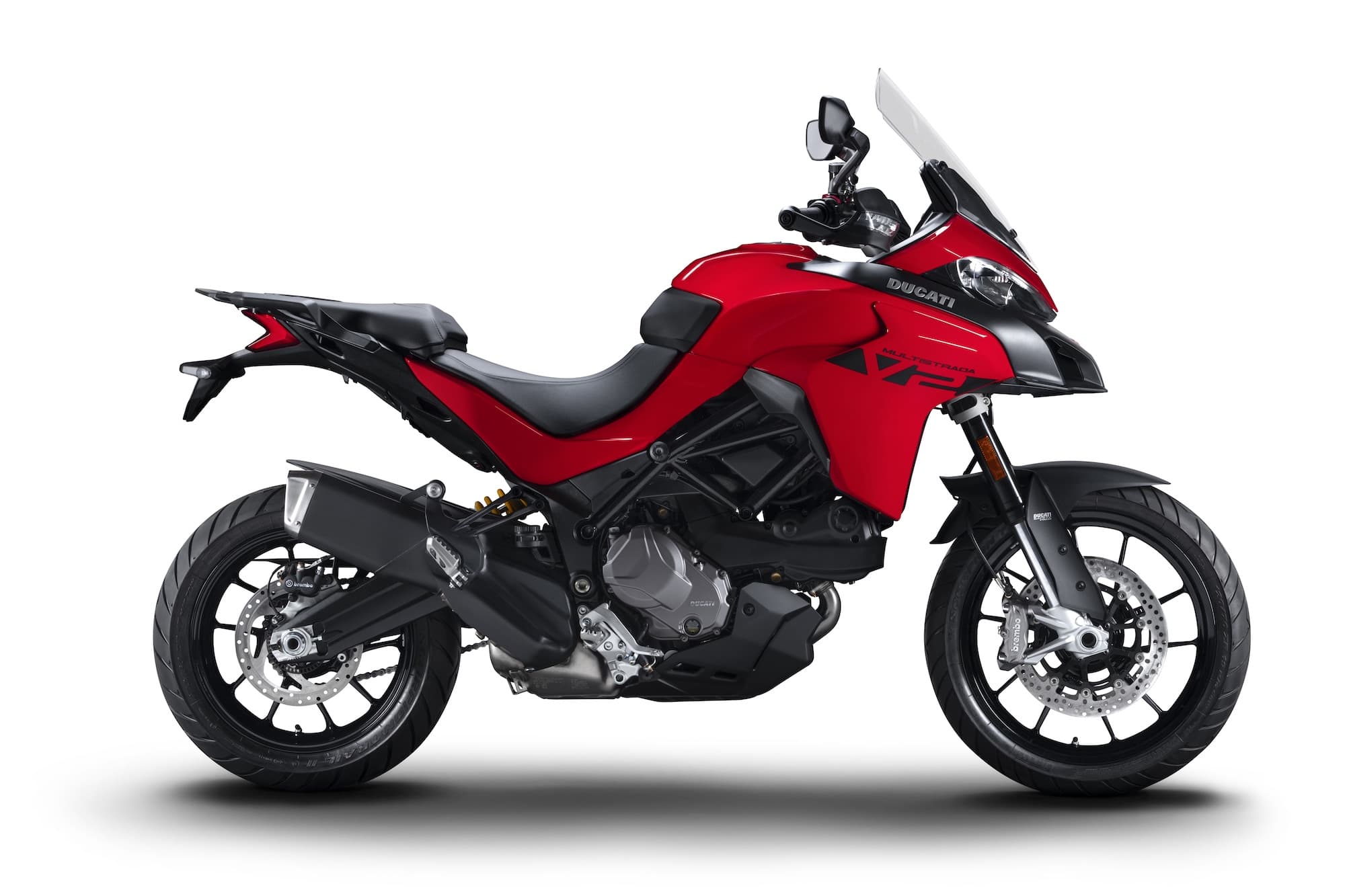
| Item | 2022–2024 Multistrada V2 937 | 2025-on Multistrada V2 890 | 2026-on DesertX V2 890 |
|---|---|---|---|
| Primary brief | Road touring with light gravel ability | Lighter, sportier road touring | Mixed-surface travel and serious off-road ability |
| Engine | 937 cc Testastretta 11-degree | 890 cc IVT V2 | 890 cc IVT V2 |
| Claimed output | 83 kW (113 CV) at 9,000 rpm; 96 Nm at 7,750 rpm | 85 kW (116 CV) at 10,750 rpm; 92 Nm at 8,250 rpm | 81.1 kW (110 CV) at 9,000 rpm; 92 Nm at 7,000 rpm |
| Final drive | Road-oriented gearing | 15/40 | 15/46, with shorter first-through-fourth gears and taller sixth |
| Wheels | 19/17-inch cast; wire-spoke option in some markets | 19/17-inch cast | 21/18-inch tubeless cross-spoked |
| Suspension travel | 170/170 mm | 170/170 mm | 230/220 mm |
| Suspension choice | Base mechanical; S semi-active Skyhook | Base mechanical; S semi-active Skyhook | Fully adjustable mechanical KYB |
| Standard seat height | 830 mm (32.7 in) | 830–850 mm (32.7–33.5 in), adjustable | 880 mm (34.6 in) |
| Fuel capacity | 20 L (5.3 US gal) | 19 L (5.0 US gal) | 18 L (4.8 US gal) |
| Claimed wet mass without fuel | 220 kg (485 lb) | 199 kg base/202 kg S | 209 kg |
| Engine maintenance | 15,000 km oil; 30,000 km desmodromic valves; timing belts | 15,000 km oil; 45,000 km valves; no timing belts | 15,000 km oil; 45,000 km valves; no timing belts |
The new Multistrada’s extra peak power arrives 1,750 rpm higher than the DesertX’s, and its taller 15/40 final drive suits fast road work. The DesertX turns the same engine family toward low-speed control with shorter lower gears and a larger rear sprocket. A 21-inch front wheel rolls over holes more calmly and accepts a broader choice of dirt tyres, but it changes direction less eagerly on pavement than a 19-inch wheel.
The Multistrada is also about 50 mm lower at the seat, carries more fuel and offers semi-active suspension in S form. For frequent two-up touring, daily road use and brisk paved riding, those are practical advantages. The DesertX gives 60 mm more front travel, 50 mm more rear travel, a narrower standing position, 18-inch rear tyre options and substantially more clearance. If your “off-road” is a maintained access road, buy the Multistrada. If deep ruts, loose climbs or embedded rocks are a planned part of the trip, buy the DesertX.
For the larger end of Ducati’s road-adventure range, the Multistrada V4 buyer’s guide covers the V4, V4 S, Pikes Peak and Rally models.
DesertX V2 versus middleweight adventure rivals
The DesertX V2 competes with motorcycles that define “middleweight” very differently. Aprilia and Yamaha prioritise low mass; Honda prioritises approachability and road manners; Suzuki supplies a lot of equipment and fuel capacity for the money. Ducati combines high output, a long service interval and premium off-road hardware, usually at a premium price.
| Model | Engine and claimed output | Claimed mass | Seat/fuel |
|---|---|---|---|
| Ducati DesertX V2 | 890 cc V-twin; 81.1 kW (110 CV), 92 Nm | 209 kg wet without fuel | 880 mm; 18 L |
| Aprilia Tuareg 660 | 659 cc parallel twin; 59 kW (80 CV), 70 Nm | 204 kg wet | 860 mm; 18 L |
| Yamaha Ténéré 700 | 689 cc parallel twin; 54 kW (73 PS), 68 Nm | 208 kg wet and fuelled | 875 mm; 16 L |
| Honda XL750 Transalp | 755 cc parallel twin; 67.5 kW (92 PS), 75 Nm | 210 kg kerb | 850 mm; 16.9 L |
| Suzuki V-Strom 800DE | 776 cc parallel twin; 62 kW (84 PS), 78 Nm | 230 kg kerb | 855 mm; 20 L |
Add roughly 13 kg for 18 L of petrol to the Ducati claim and it is around 222 kg before accessories. That does not make the Ducati heavy beside the Suzuki, but it stops the bare 209 kg number making the V2 look as light as the Tuareg or Ténéré on equal fuel terms. Mass standards are part of the specification, not a footnote.
| Model | Wheels and suspension travel | Choose it when | What the DesertX V2 does better |
|---|---|---|---|
| Ducati DesertX V2 | 21/18 tubeless; 230/220 mm | You want high output, strong electronics, long engine-service intervals and genuine dirt geometry together | Reference model |
| Aprilia Tuareg 660 | 21/18 tubeless; 240/240 mm | Low mass, suspension stroke and a manageable 860 mm seat matter more than peak power or dealer reach | More torque and power, longer valve interval, a larger accessory ecosystem and stronger high-speed road performance |
| Yamaha Ténéré 700 | 21/18; 210/200 mm | You value mechanical simplicity, predictable CP2 power and broad parts support | Far more power, cruise control, more sophisticated rider aids, tubeless wheels as standard and fully adjustable suspension |
| Honda XL750 Transalp | 21/18 tube-type; 200/190 mm | A lower seat, smooth road manners, value and daily usability outweigh hard-terrain priorities | More suspension travel and adjustability, tubeless wheels, stronger protection potential and more off-road-specific ergonomics |
| Suzuki V-Strom 800DE | 21/17 tube-type; 220/220 mm | Price, a 20 L tank, comfort and a tractable engine matter more than saving mass | Lower comparable mass, an 18-inch rear, tubeless rims, more power and a much longer valve-inspection interval |
The Tuareg is the closest conceptual alternative: it is narrow, well suspended, electronically complete and easier to manage. The Ténéré is the choice for riders who would trade cruise control and power for simplicity. The Transalp is less committed to difficult terrain but easier to live with every day. The V-Strom 800DE is heavy, comfortable and good value. See the Ténéré 700 model guide, V-Strom 800 buyer’s guide, Aprilia 660 family guide and Honda Transalp model history for the longer versions of those decisions.
If you are still deciding what belongs in this class, the middleweight adventure motorcycle comparison explains the wider field.
What to check when buying a used DesertX
A DesertX may have spent its life commuting, crossing continents or being dropped in a rock garden. Odometer mileage alone does not tell you which. Inspect evidence of use and evidence of competent maintenance together.
| Area | What to check | Why it matters |
|---|---|---|
| Identity and records | VIN, model year, original invoice, service invoices and recall completion | Confirms whether a bike is Standard, Discovery, Rally or an accessorised Standard; establishes time-based belt work on the 937 |
| Engine service | Initial and annual services, 30,000 km valve record on a 937, 45,000 km record on a V2, and five-year belt record on a 937 | A stamp without an itemised invoice may not show that the expensive work was done |
| Air intake | Air-filter cleanliness, sealing surfaces and dust downstream of the filter | Off-road dust can damage an engine long before a scheduled street-use interval suggests inspection |
| Wheels | Rim dents, loose or uneven spokes, corrosion, tyre age, wheel bearings and tubeless sealing | Large spoked wheels absorb impacts but do not make them disappear; the Rally’s tube-type rims change puncture repair |
| Suspension | Fork seal film, chrome damage, shock leakage, linkage play on the V2 and smooth adjuster operation | Long-travel suspension is expensive to rebuild correctly and frequently exposed to grit |
| Frame and protection | Skid plate, engine mounts, steering stops, radiator, lower frame area or V2 monocoque, subframe alignment and tank covers | Scrapes are normal; cracks, crushed mounts, fresh paint or misalignment suggest a harder impact |
| Drive chain | Tight spots, adjustment remaining, sprocket-hooking and chain-guide wear | Dirt, water and strong torque can consume a neglected final drive quickly |
| Brakes and controls | Disc condition, pad life, lever feel, handguard clearance and straight pedals/levers | A low-speed fall can bend controls or leave a handguard pressing on a lever |
| Electronics | Cold start, warning lights, all riding modes, ABS settings, cruise, quickshifter, heated accessories and both keys | Intermittent switchgear or poorly wired accessories are easier to find before purchase than after |
| Luggage and accessories | Mounting cracks, exhaust clearance, fastener quality and wiring protection | Heavy luggage amplifies subframe loads. A 2023 accessory recall concerned incorrect assembly that could let the right soft bag contact the exhaust |
The soft-bag action was an accessory recall, not a recall of every DesertX motorcycle. Still, use the VIN and accessory part numbers to check the current status with Ducati or the relevant national recall database. Recall campaigns and market coverage can change.
On a test ride, do not interpret every clunk from a long-travel bike on dual-purpose tyres as a fault. Look for repeatable symptoms: steering that will not track straight, pulsing brakes, a false neutral in the same shift, a quickshifter that fails under consistent load, or suspension that sticks rather than moving freely. Compare cold and fully warm behaviour.
Which Ducati DesertX should you buy?
| Your use | Best fit | Why | Main compromise |
|---|---|---|---|
| Mixed road and dirt on the lowest sensible used budget | 2022–2025 DesertX Standard | Same engine, electronics, wheel sizes and suspension travel as Discovery at a lower entry price | Budget for time-based belts and the 30,000 km desmodromic service |
| Long-distance travel with useful equipment already fitted | DesertX Discovery, or a well-accessorised Standard | Heated grips, centre stand, screen and protection are costly to recreate individually | No Rally suspension upgrade; equipment adds mass |
| Repeated fast and rough off-road riding | 2024–2025 DesertX Rally | Closed-cartridge fork, more travel, stronger rims and steering damper are substantive changes | 910 mm seat, tubes and higher purchase cost |
| Longest engine-service intervals and the latest chassis | 2026-on DesertX V2 | 45,000 km valve inspection, no timing belts, progressive rear linkage and revised standing ergonomics | 18 L tank, new-model price and limited long-term field history |
| Mostly road, two-up touring and occasional maintained gravel | Multistrada V2 or V2 S | Lower seat, 19-inch front wheel, road gearing and optional semi-active suspension suit the job better | Much less suspension travel and clearance for difficult terrain |
| Lower mass and lower price matter more than Ducati power | Aprilia Tuareg 660, Yamaha Ténéré 700 or Honda Transalp | Each makes a different useful trade: Tuareg chassis, Ténéré simplicity, Transalp approachability | Less peak performance and, depending on model, fewer standard electronics or less suspension adjustment |
My value pick is a well-documented first-generation Standard with the protection and luggage you actually need. It gives away none of the basic wheel size or suspension travel to Discovery, and many used examples already have the expensive accessories. The service record is more important than a low odometer.
The Rally makes sense for a narrower group than its desirability suggests. Buy it because you know what overheated or under-damped suspension feels like in rough terrain, not because it is the top trim. For everyone else, its height is a constant cost for capability used occasionally.
The V2 is the strongest long-term ownership proposition. It keeps the 110 hp performance level, improves low-rpm usefulness, lengthens the valve interval and removes belts. Its smaller tank is the one clear touring regression, and the 1 kg claimed mass reduction is too small to drive a buying decision.
Frankly, you could also wait and see what’s in store next. I think a V2 Rally or V2 Discovery is probably around the corner.