

How do you “review” a cult bike? A bike which has forum faithful frothing at the mouth about the virtues of the V4? A bike with decades of history that Honda has tried to re-invent and re-introduce a couple of times? That’s my problem with writing this VFR800 8th gen review — it’s almost impossible to satisfy everyone. Because ultimately, I sold it, and not every aspect of my VFR800 review is glowing.
So this is as balanced a review of my VFR800 as possible. I’m not you, you’re not me, but maybe we share some things in common — let’s see if my view helps.
Early in 2021, I was looking for a commuter bike.
I knew I’d have a 40–50 km (25–31 mile) commute most days of the week for the term of a six-month project — mostly freeways, a bit of traffic, some sweepers, and a few nice entry and exit ramps.
… But what’s a “commuter” bike? You can commute on anything. I’ve seen people “commute” in supercars and on superbikes. I suppose it’s different for anyone, but to sum it up neatly… a commuter motorcycle is a bike you don’t mind putting miles on, and on which you can still have fun (it’s a motorcycle, after all). So on one extreme, don’t commute on your showroom Ducati 916 with zero miles on it, but on the other hand, you don’t have to be on a Honda CB500 (not that there’s anything wrong with that, though).
After considering a few options that could work for me, I ended up with a Honda VFR800 8th gen. (See my guide to the Honda VFR generations for why this is commonly called an 8th gen.)
This review covers the 2014–2017 VFR800F sold in Australia. Honda kept the same eighth-generation design on sale later in some other markets, with sales continuing into 2022 in Japan.
My choices were slim. This was Australia, during a year of supply shortage. Used bikes were more expensive than usual. New bikes were scarce, especially in the ideal colours.
And if I wanted a commuter bike with a bit of bark in it, my choices were slimmer. The two things don’t go hand in hand. Commuters are reliable, predictable, and versatile. A fun sport bike is loud, hot, and impractical. How do you combine those two?
Well, you can’t exactly… but there are a few sweet nexus points. The Honda VFR800 is one of them.
The VFR800 range has reached cult status — by which I mean the fans are adulatory, more so than the spec sheets would imply. So there was a lot I wanted to know about the VFR800, including
- Is the VFR800 truly a “do it all” bike?
- Is the VFR800 still exciting, or sporty?
- Just how comfortable is the VFR800?
- Would the VFR800’s V4 engine give me that “berserk” feeling I’m used to from exciting motorcycles?
Here’s what I found out.
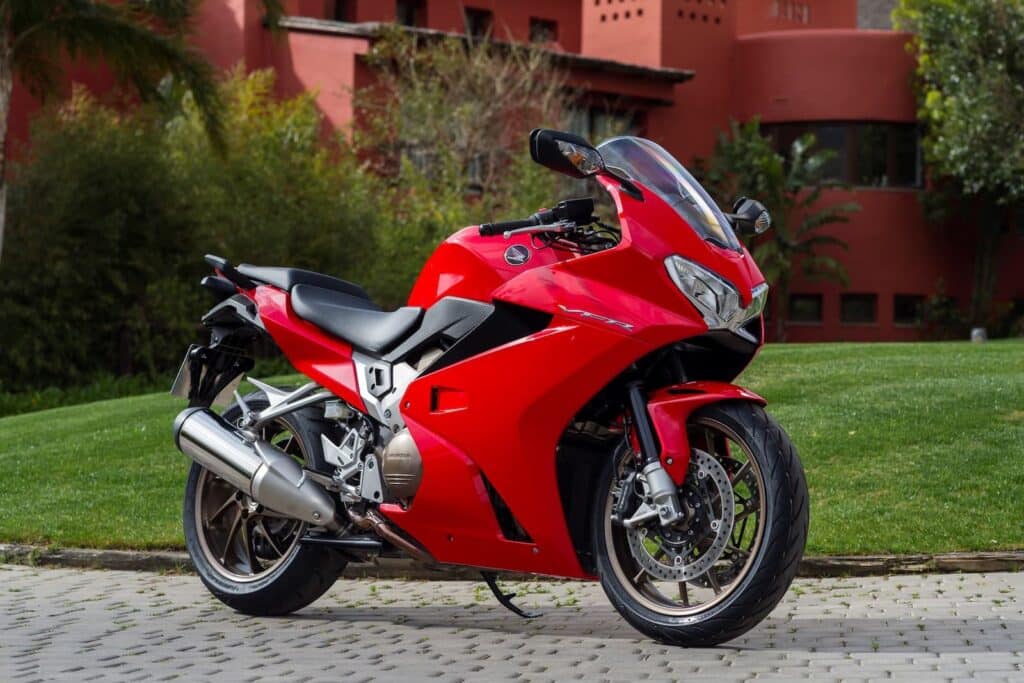
Editor’s note: I ended up selling my VFR800 after three months. I enjoyed it, but it didn’t light my fire.
A lot of people will tell me that if I want to go fast, ride hard, or get laughing-in-my-helmet thrills, then maybe the 8th gen VFR800 Deluxe isn’t the bike for me. Or that I’m missing the point, or that maybe I should “upgrade the rider”. All of that is valid.
The thing is, when you strip back any motorcycle purchase… a lot of what makes you love a bike is an ephemeral, entirely subjective feeling. Sometimes the heart knows, and sometimes it doesn’t and you give it a try. With so many bombastic reviews spewing forth adulating epithets about the virtues of the VFR, I feel I owe it to the internet to say — cool machine, but it’s not for everyone. In the end, it wasn’t for me.
But I’ll try to share why it might be for you.
Updates
* September 2026: Checked specifications and ownership advice, corrected the service interval, and refreshed the current alternatives.
Are you obsessed with motorcycles?
Well, I am. That’s why I created this site — as an outlet. I love learning and sharing what others might find useful. If you like what you read here, and you’re a fraction as obsessed as I am, you might like to know when I’ve published more. (Check the latest for an idea of what you’ll see.)
Quick specs of the Honda VFR800 8th Gen
You can’t ride a spec sheet, but a few figures explain why the VFR800 feels the way it does.
| Part | VFR800 8th gen spec |
|---|---|
| Engine | 782 cc liquid-cooled, 16-valve, DOHC 90-degree V4 with VTEC |
| Power (claimed) | 78 kW (105 hp) at 10,250 rpm |
| Torque (claimed) | 75 Nm (55 lb-ft) at 8,500 rpm |
| VTEC transition | About 6,400 rpm |
| Redline | 12,000 rpm; I naturally shifted at about 10,000 rpm |
| Wet weight | About 240 kg (529 lb), with small differences by market and equipment |
| Front suspension | 43 mm Showa conventional fork; the Deluxe adds rebound-damping adjustment |
| Rear suspension | Single shock with remote preload and rebound-damping adjustment |
| Front brakes | Dual radial-mounted four-piston calipers with 310 mm floating discs |
| Rear brake | Single 256 mm disc |
| Drivetrain | Six-speed transmission, chain drive, single-sided swingarm |
| Buying now | Used only. Prices vary widely; service history, Deluxe equipment and factory luggage matter more than old MSRP figures. |
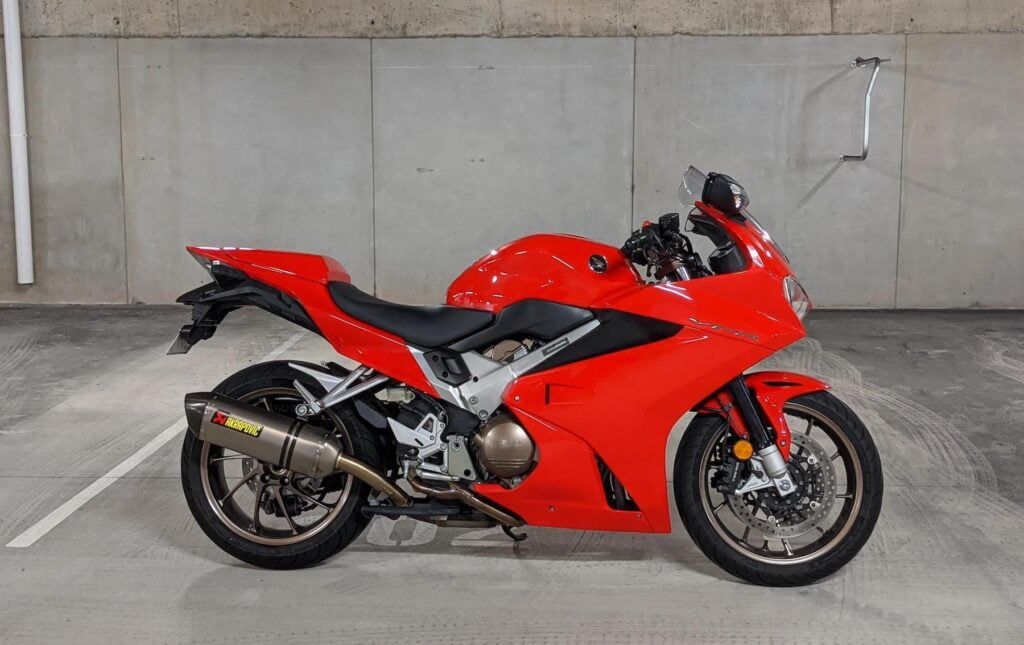
The Appeal of the VFR — Why buy a VFR800?
So, why even try a VFR? Because it does so much right.
Firstly, that engine. It’s a charmer. The V4 has plenty of character for a reliable donk with a steady purr. It has much more burble than the Hornet 919, another fast but manageable Honda that I really liked.
I wanted to ride a motorcycle with a V4 engine without having nearly 150 kW (200 hp) on tap, and the VFR800 looked ideal. I often think about 75 kW (100 hp) is a sweet spot for using the engine properly on the road.
The V4 in the VFR800 doesn’t produce an angry, edgy rasp like a Ducati V-twin or a Yamaha R1’s crossplane inline four. It’s gentle, but it has enough texture to keep things interesting.
Secondly, the VFR800 8th gen comes well equipped, especially in Deluxe form. You get heated grips, self-cancelling turn signals, a clear dash, a centre stand, ABS and traction control. Factory panniers use matched keys and integrate cleanly with the bodywork.
Today’s new V4 market is broader, but the closest practical choices are much more powerful and expensive. Smaller new V4s also exist, though they’re cruisers rather than sport tourers. The VFR800 still occupies an unusual middle ground on the used market.
Thirdly, the VFR is easy to ride. It carries considerable weight, but I found it easy to place and lane-split on, like a much smaller bike.
Finally, the VFR looks really nice. The paint on mine was deep and red and screamed “buy me!”. It has bronze wheels and a single-sided swingarm. I even like the view from the front: both headlights illuminate, so well-meaning strangers don’t tell you that one is out.
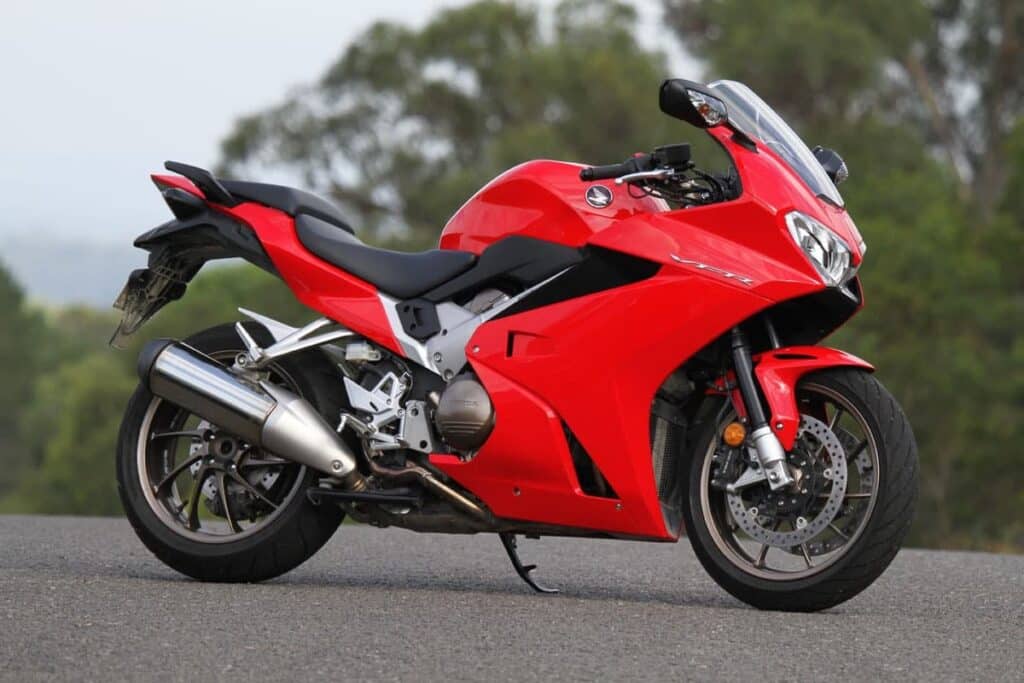
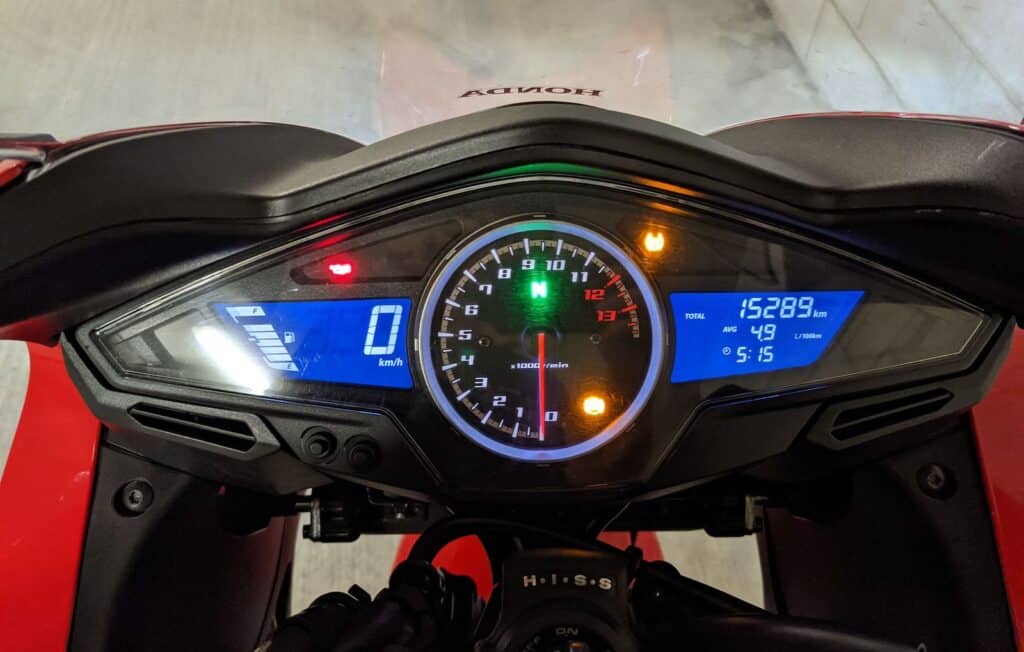
Even the dash is comforting to me — it shows the information I want without taking over the cockpit. I can also stop staring at the engine temperature when it reaches about 100°C (212°F) in traffic, which is normal but distracting.
Variants of the Honda VFR800 8th gen (Standard vs Deluxe)
Honda sold standard and Deluxe versions in the US. Most other markets received one version with equipment broadly equivalent to the US Deluxe.
 Centre stand
- Rebound-adjustable front suspension
- Traction control and heated grips
- Front-wheel ABS ring
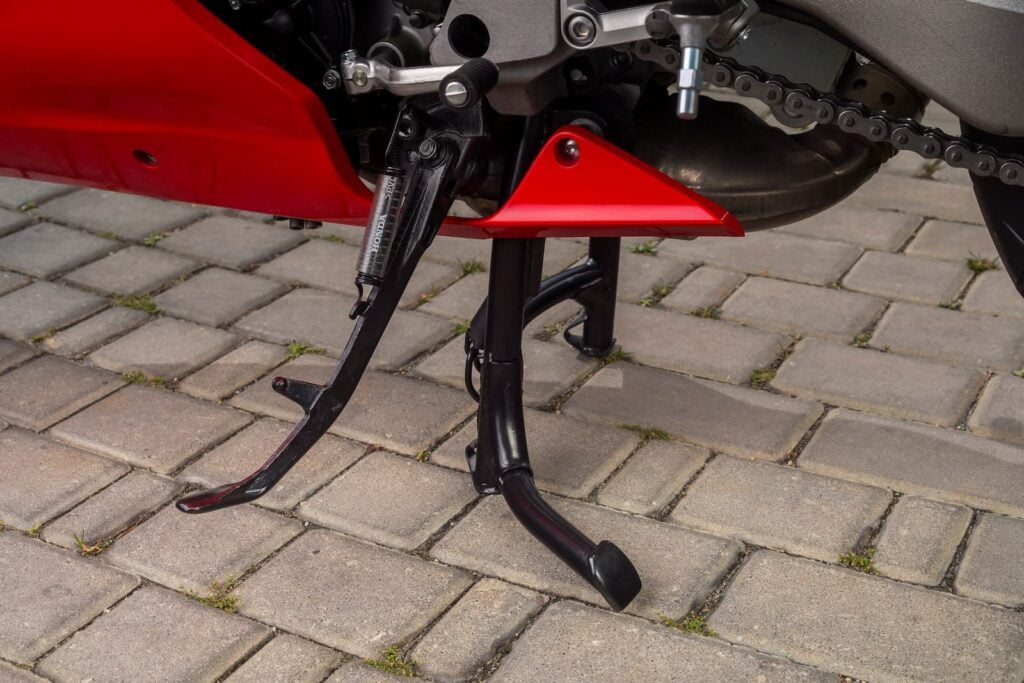
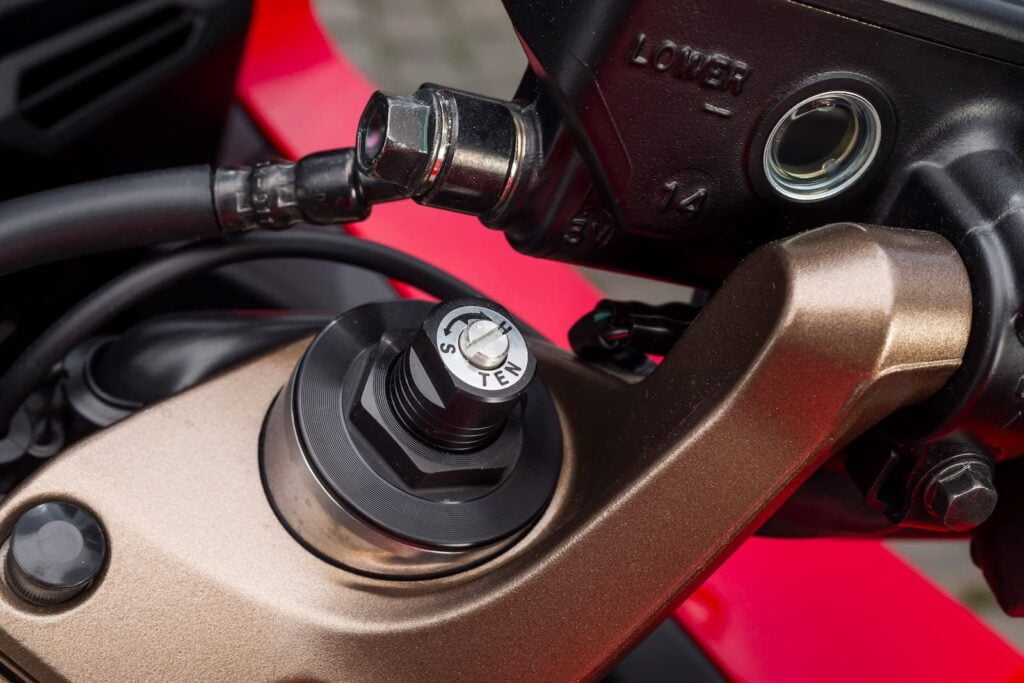
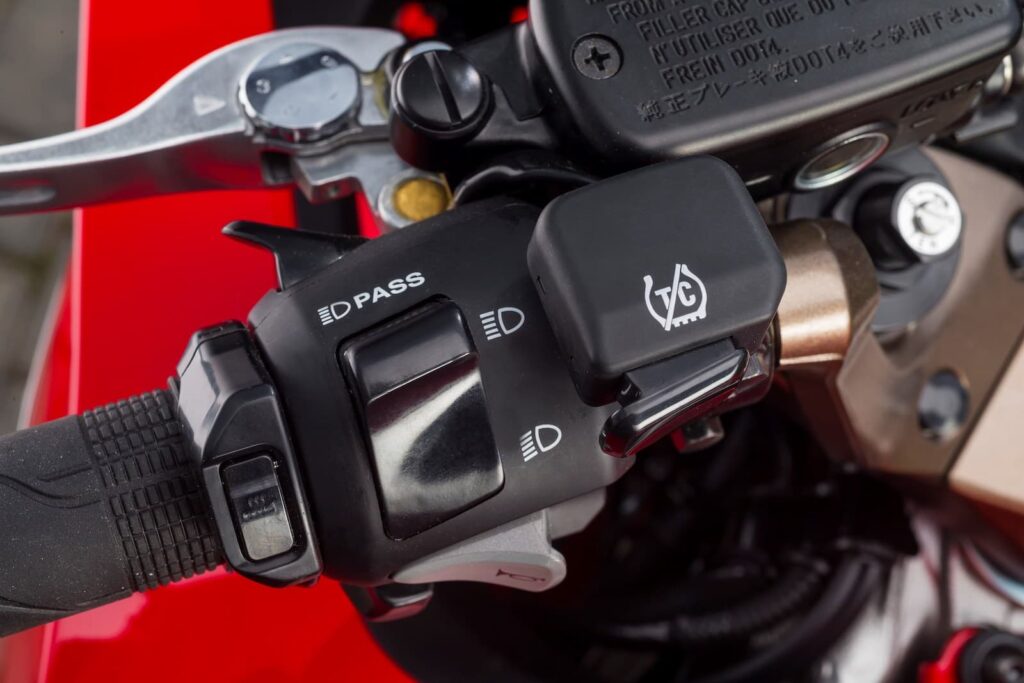
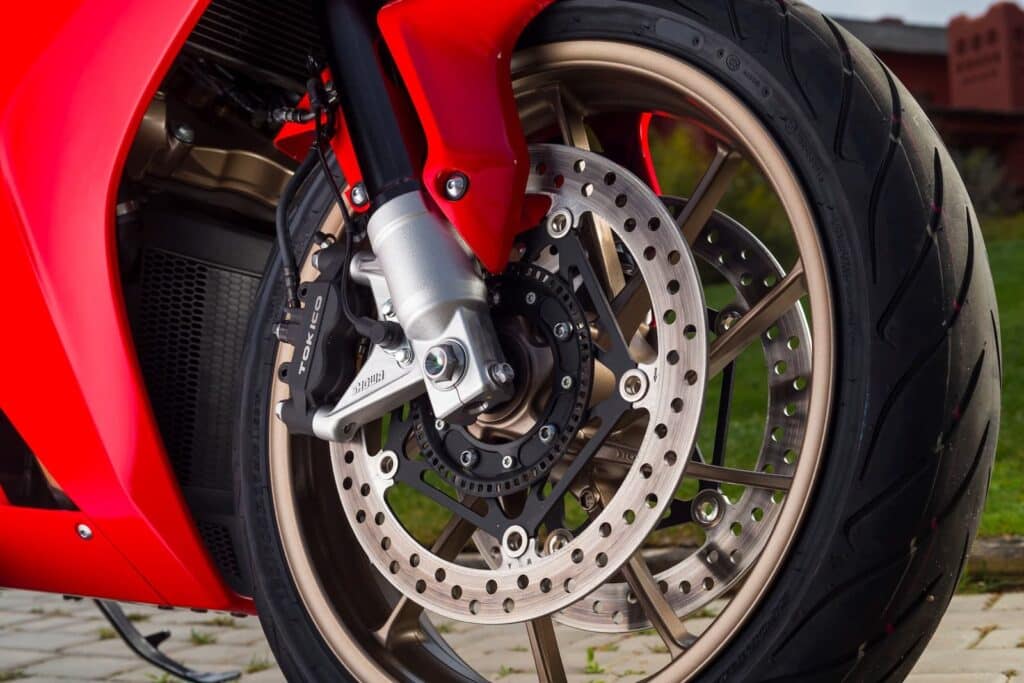
I’d buy the Deluxe if choosing between similar used examples. It adds:
- Front-suspension adjustment for preload and rebound damping
- Self-cancelling turn signals
- ABS and traction control
- Heated grips
- A centre stand
I’ve ridden both and liked both. The standard VFR still has the same engine, chassis and basic character, so condition and service history can outweigh the equipment difference.
The adjustable suspension is the biggest everyday benefit. Fixed damping may suit a rider near the setup Honda chose, but adjustment helps if you’re much lighter or heavier, ride with luggage, or carry a passenger. The common 75–85 kg range is about 165–187 lb.
ABS is the other major reason to choose the Deluxe. I strongly prefer it on a commuter. Heated grips and a centre stand also make cold-weather riding and chain maintenance easier.
The self-cancelling indicators work well, though I tried not to depend on them because most motorcycles don’t have them. The traction control is basic and can feel intrusive on broken or loose surfaces, but you can switch it off.
I wouldn’t trade a good standard bike solely to get a Deluxe. If you’re buying now, compare the whole motorcycle: condition, documented servicing, suspension work, factory luggage and asking price.
Riding the Honda VFR800
It’s quite hard to describe what it’s like to ride any motorcycle. Piecing through reviews, everyone wants to say every motorcycle is amazing at something — because everyone likes reading a positive review. Positive reviews attract fans, who then share them, giving each other confirmation bias.
But what is the VFR800 really like to ride, from someone with no agenda and who has ridden a lot of bikes? That’s what I’ll try to share, as well as to dispel any myths.
In summary, riding the VFR is like riding a fast enough, reasonably comfortable sportbike. It’s definitely faster than you need for a commuter, but without being so powerful that it’s champing at the bit and egging you to go on, way past speed limits. It corners easily, and holds itself with grace through everyday curves — it’s hard to scrape it in normal everyday riding (well, at least on my route), and that’s getting past angles of 35 degrees on turnoffs and roundabouts.
Firstly, the VFR800 is not a sport bike. It’s fast enough. For someone who has ridden bikes spanning 10-200 hp and enjoyed them all in different ways, I equate riding the VFR with any number of middleweight commuters — the Kawasaki Ninja 650 (full power), Yamaha Tracer 900 GT, or Honda Hornet CB900 919, just to name a few.
“Blasphemy!” cry the VFR800 faithful. Many people take VFRs to the track, after all, and will be quick to point out that it has its roots in racing, and they know a person (or are that person) who can make mincemeat of more powerful sport bikes because it’s more about the rider than the bike.
That’s all true. But everything’s relative. I guess there are a few definitions of fast — lap times, acceleration times, and just “feeling” fast. By all three of these metrics, a VFR800 will lose to a 600cc sportbike, particularly the last definition. But the degree of importance of each of those is entirely up to you.
Launching the VFR800 is fun. Being a commuter or sport tourer, it doesn’t rev to infinity and isn’t geared for top speed. So you can give it full throttle and shift into second at around 80 km/h (50 mph) quite naturally, or push it forward to 100 km/h (62 mph) where you really need to shift.
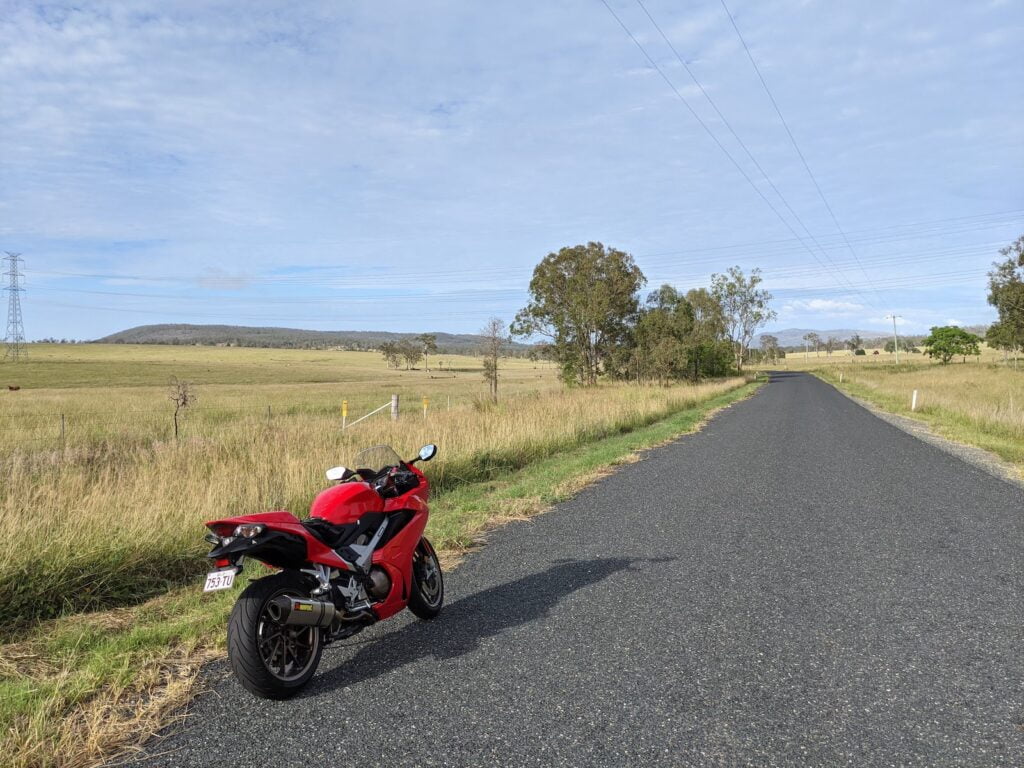
By the time you’re at 65 km/h / 40 mph, you’re also at the part of the rev range where VTEC actuates. This is where things get really rowdy. VTEC means your bike is now a four-valve V4 sportbike, not a two-valve commuter. You’re rewarded with a raspier exhaust note and a sudden surge of power.
Is VTEC sudden? On some earlier models of the VFR800 (mostly 2002-2005), riders and reviewers complained that the VTEC valve actuation was too sudden. I don’t find this a problem with the 2014+ 8th gen. Sure, if you’re going around a corner and accidentally let the throttle hesitate around the VTEC actuation point, it feels weird. But it’s not unsettling. Dare I say it — it’s “character”.
Because the VFR800 is kind of a sport bike, many think of it as one. It is definitely sportier than a Ninja 650 or Versys 650 (both definitely in the “commuter” category of motorcycles).
But the Honda VFR800 is not as sporty as more intentionally sport-focused motorcycles. My over ten-years-older CBR600F4i has a lot more fire in the belly and corners far more easily. It even had superior suspension — in fact, the F4i’s forks are a sometimes upgrade for some generations of the VFR (not often for the 8th gen). And the F4i, like other sportbikes in the 600cc class, revs higher, and is more engaging in the top end of the powerband.
The VFR800 does corner well. I found it quite easy to tuck and lean into curves. The angle of the handlebars is not so wide that you’d be fooled into thinking it was a naked bike, but not so shallow as to make you think you’re on a supersport.
Pushing on one handlebar on the VFR meant I’d dive into an on- or off-ramp and hold my corner as I wound on the throttle. Here’s one of its virtues as a mid-powered commuter — I never really felt scared of breaking traction. (Not something I can say about the motorcycle that replaced it.)
The times when I most appreciated the VFR800 were the times when I didn’t actually want the ultimate motorcycle. Like when it was dark and cold and I was riding home in the rain. At times like that, having a basket-load of torque at the back wheel (and no traction control) can make a commute nerve-wracking. Firing up the VFR and having the beautiful dash light up, and the road well illuminated in front of me, was positively comforting.
Riding Position of the VFR800 — Is it Comfortable?
The VFR800 is definitely not an upright commuter (like the VFR800X), but nor is it a sport bike on which your wrist is roughly the same height as the seat of your pants. In fact, my favourite thing about the VFR800 is the position — it’s not so upright that I think “this is a motorcycle for when I have back problems”, nor is it so far forward that I think I’m mooning the car behind me.
Sport touring is one of my favourite categories of motorcycle. It’s under-appreciated. Everyone these days seems to choose between adventure tourers, sportbikes, or cruisers… but the sport tourer — bikes like the VFR800, the Ninja 1000, the Suzuki Hayabusa (kinda), and the Ducati Supersport — are such a nice balance of comfort and excitement that I just wonder why they’re overlooked.
In standard riding position, with the seat at its lowest position (it has two positions), the VFR800 is acceptably comfortable if you like the sport-touring position. If you keep your arms straight, you’ll end up putting pressure on your wrists, so you really should grip the tank. Unfortunately — the tank is quite slippery and doesn’t lend itself to gripping without some kind of hugger material added.
Committing to a sport tourer, I installed the factory bar risers. These colour-matched plates sit under the handlebars and add about 25 mm (1 inch) of height. The change worked well for me. I felt I could ride for days without getting tired or bored.
I’ve ridden a number of sport bikes as well as adventure sport tourers (like the Tracer 900). Which bike is most comfortable for you depends on so much, like how strong your core is, how long your legs, torso, and arms are, and how long you want to ride for. For my particular balance, the VFR800 was perfect.
Alternatives to the VFR800
The VFR800 sits between a traditional sport tourer and an everyday commuter. The best alternative depends on whether you want its riding position, its practical equipment, or specifically its V4 engine.
| Motorcycle | Why consider it | How it differs from the VFR800 |
|---|---|---|
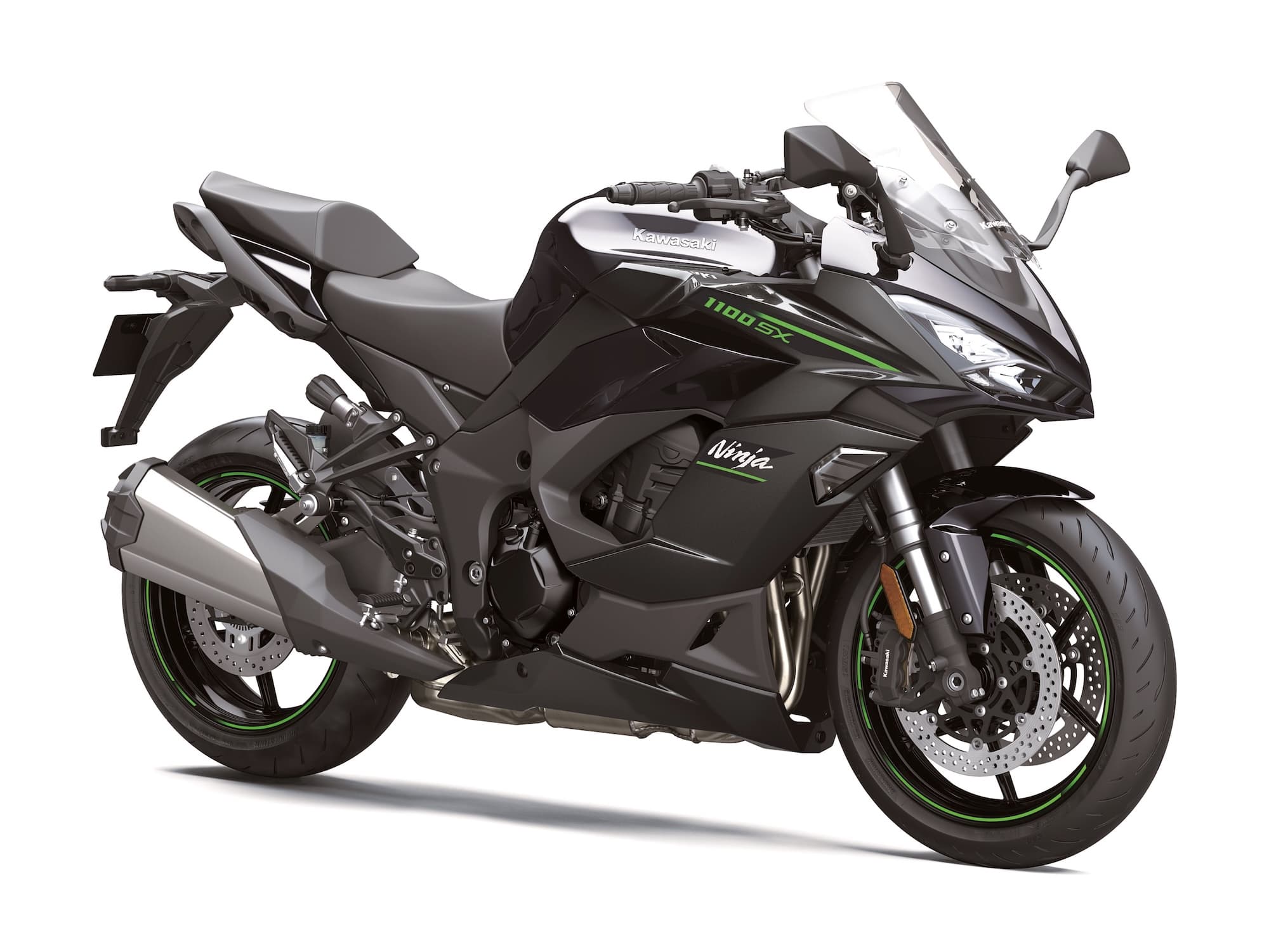
| Kawasaki Ninja 1000SX / 1100SX | The closest conventional new sport-tourer: fairing, factory luggage, cruise control and a comfortable forward lean. | The inline four has much more torque and power. The bike is newer and better equipped, but it doesn’t have the VFR’s V4 pulse. |
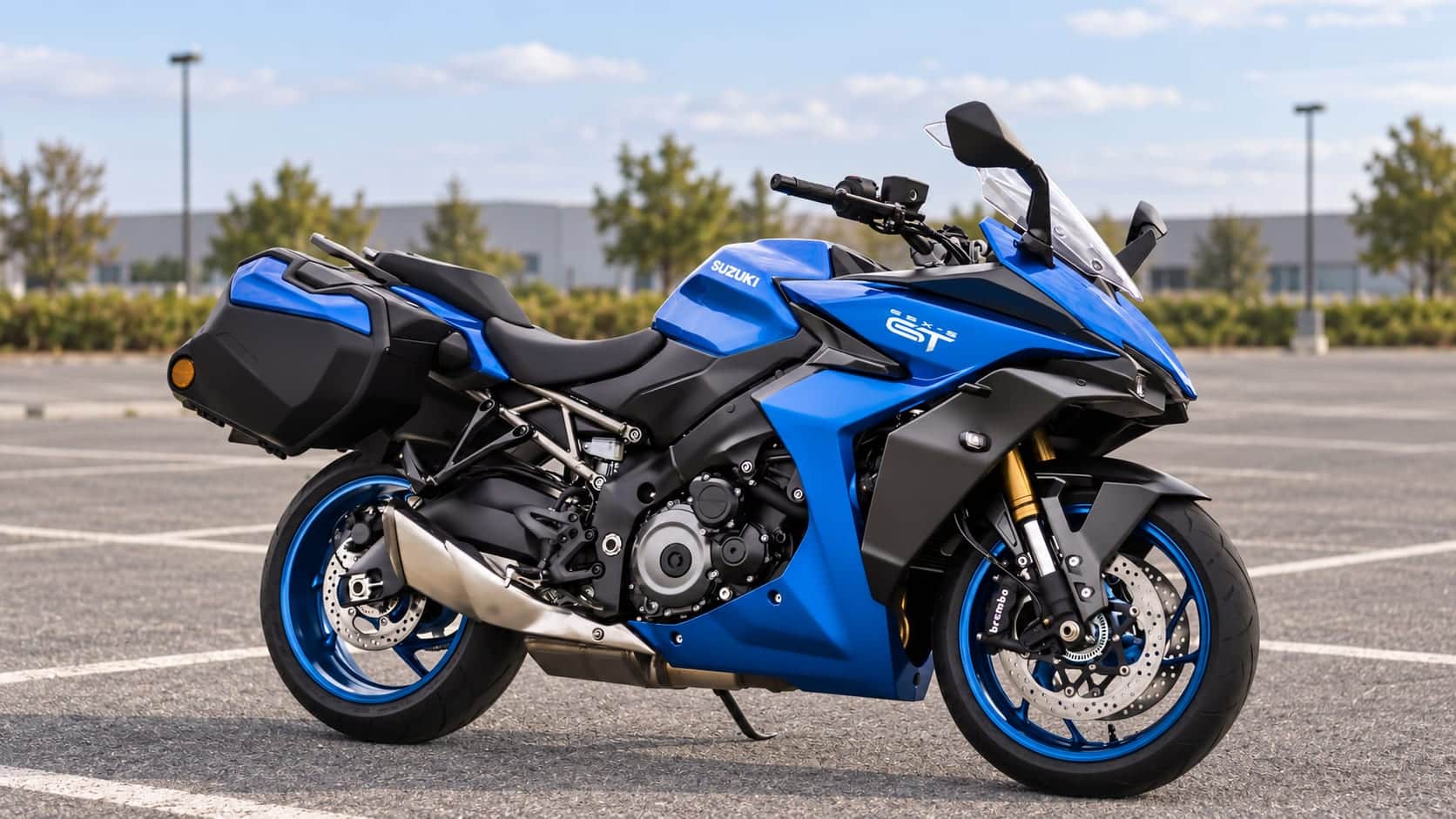
| Suzuki GSX-S1000GT / GT+ | A faired road bike with cruise control, a quickshifter and factory panniers. | It is lighter and far more powerful. Its 999 cc inline four feels harder-edged, and the standard GT doesn’t have lean-sensitive ABS. |
| Yamaha Tracer 9 / GT / GT+ | A lighter, upright all-rounder with a lively three-cylinder engine and strong touring equipment. | It has a much more upright adventure-sport riding position. The GT and GT+ add equipment the VFR never had, including semi-active suspension and, on the GT+, adaptive cruise control. |
| Ducati SuperSport 950 / SuperSport V2 | A road-focused Ducati with a fairing and a less committed riding position than a Panigale. | It is lighter and sportier, with less luggage capacity and higher ownership costs. The engine is a V-twin, not a V4. |
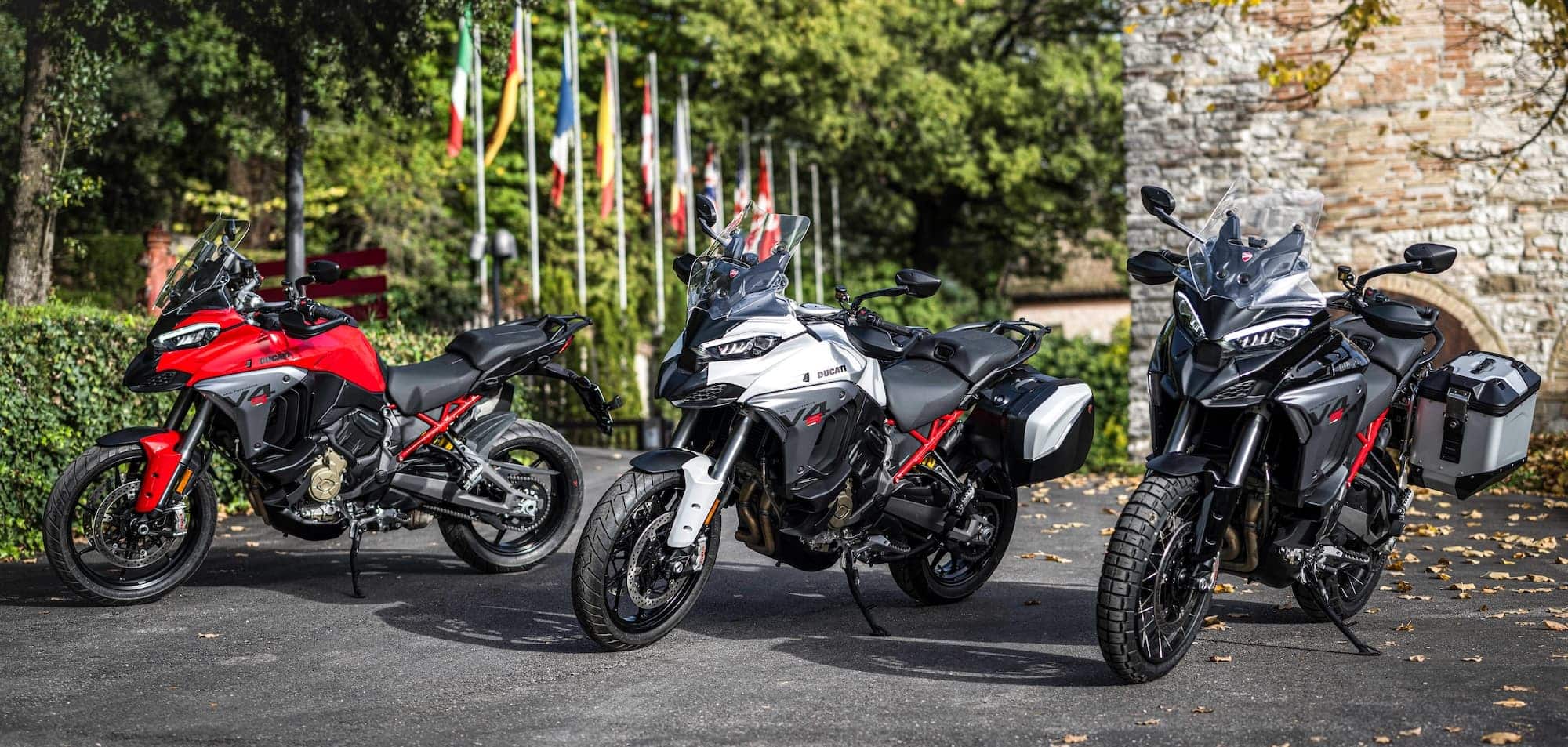
| Ducati Multistrada V4 / V4 S | The closest current V4 if you want comfort, luggage and long-distance ability. The 1158 cc V4 makes 125 kW (170 CV) and 124 Nm (91 lb-ft), with a 60,000 km (37,000 mile) valve-clearance interval. | It is taller, much faster and far more expensive. Its upright adventure-sport position feels different from the VFR’s sport-touring crouch. |
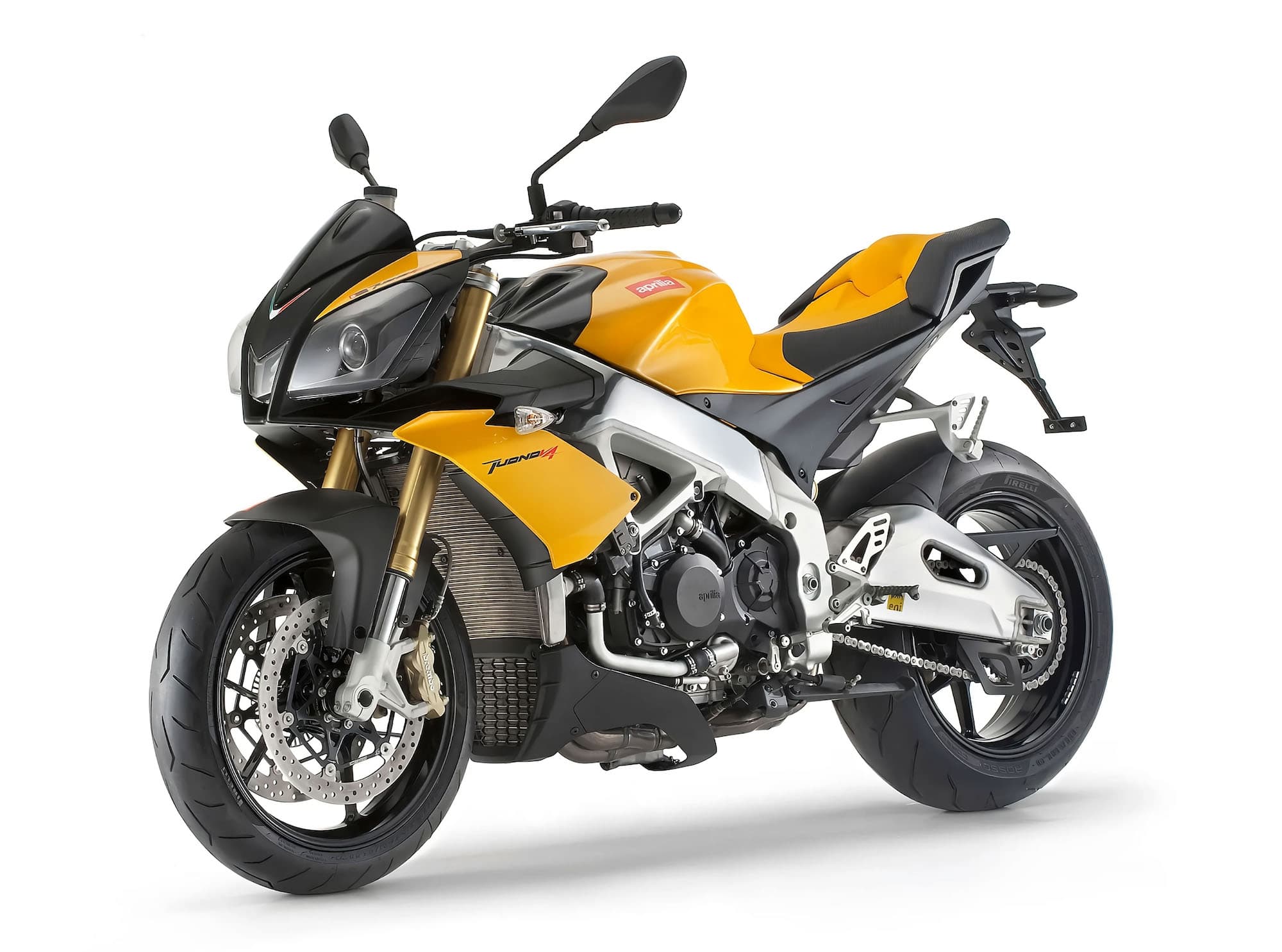
| Aprilia Tuono V4 | The closest current V4 if engine sound and fast road riding matter most. The current 1099 cc engine makes 132 kW (180 CV) and 121 Nm (89 lb-ft). | It is much more intense, less protective and less convenient for luggage. Running costs are also higher. |
| Honda VFR800X Crossrunner | A used alternative with the same basic 782 cc VTEC V4 and a more upright riding position. | It is taller and less sporty. It suits someone who wants the VFR engine with adventure-sport ergonomics. |
If the V4 itself is your priority, no current motorcycle reproduces the VFR800’s mix of moderate power, price and practicality. The Multistrada V4 is the strongest practical replacement, while the Tuono V4 is the better fit for a fast road bike. The Ducati Diavel V4 and XDiavel V4 put the same broad engine idea into muscle-roadster and cruiser forms, so they aren’t direct sport-touring replacements.
I considered the earlier Ninja 1000, Tracer 900 and Ducati SuperSport when I bought the VFR. The VFR’s rarity helped decide it: Honda no longer makes it, and I wanted to try the middleweight V4 while good examples were still easy to find.
The VFR800 Hype & the Engine
One reason I wanted to try the VFR so badly is the hype about this motorcycle.
People are raving fans of the VFR. Many owners have owned multiple generations of the bike. I just wanted to know: Why? What is it about this machine?
The two most popular forums for the VFR800 are VFRWorld and VFRDiscussion. I learned a lot from browsing each one.
There are also a few popular Facebook groups, but you can find those yourself. Like most Facebook groups I’d treat them with caution — there are lots of crazy people out there.
Read those and you’ll get a sense for the good as well as the bad (though mostly positive — these are fans!) of owning the VFR.
But what about the VFR800’s ENGINE?
The engine is a much-fabled part of VFR ownership. It is still unusual: a mid-powered V4 in a road-biased sport tourer. Current Aprilia and Ducati V4s are dramatically more powerful, while the smaller new V4s from Benda and QJMotor sit in cruisers.
So in that sense, it’s quite special to have the chance to ride a V4 motor. It has a unique character and it has earned its place in history.
That said… The 8th gen’s motor seems to lack the fire of earlier models. When I hear a 5th gen roll past, my ears perk up. Same with the 6th gen with its chain-driven cams. Obviously in both cases, I’m talking about models with an aftermarket exhaust.
The 8th gen, somehow, seems to have lost this spark. Even mine, with an Akrapovic slip-on exhaust (and I tested another with a Jardine unit), just wasn’t really audible at speed.
I’m not alone in this.
Pretty much all my motorcycles have had an audible exhaust when riding them. Some more than others. So I was pretty disappointed when I rode my 8th gen VFR with an Akrapovic slip-on through a tunnel and revved it and… could barely hear a thing. Maybe I need a full exhaust system.
On the road, accelerating hard, it does sound raspy and full of fire at high RPM — different to the smooth scream of an inline-four. It’s definitely interesting!
A loud exhaust isn’t for everyone. Heck, I’m a mild guy — I don’t like a blaring exhaust and I try to be a good citizen. So, let’s go on to the character while riding it.
Firstly, the VFR has a nice torque curve. Down low it’s very responsive, feeling like a good commuter. You reach peak torque by mid 8K, and keep revving past 10K before shifting. This is an excellent powerband for street use, especially with this power range. You never feel like you’re running out of revs.
Secondly, there’s always a pleasant vibration from the engine when it’s running. It’s almost cliché to say this, but it’s true — the V4 is a nice balance between the smoothness of an inline-four engine and the rumble of a twin. It’s mild in the VFR, but it’s there.
And finally, the VFR doesn’t “scream” like an inline four. If you’ve taken an inline four-cylinder motorcycle past 14,000 rpm (moments of joy), you’ll know what this is like. Or maybe if you listen to motorcycle racing. The VFR doesn’t get like that. This is a pro to some, and a con to others! But really, it’s just different.
Anyway, whether you’re into it or not, a VFR’s V4 engine is definitely something to be experienced at least once, if you can.
Maintaining the VFR800
I like to do my own maintenance. The VFR800 8th gen is a water-cooled, fuel-injected four-cylinder motorcycle with chain drive, so its routine jobs are familiar. Access and the VTEC V4 layout make some larger services more expensive.
- Valve-clearance inspections take time. Honda specifies the inspection every 25,600 km (16,000 miles). The V4 has two cylinder heads, and the VTEC mechanism adds work, so ask for evidence if a used bike has crossed that interval.
- The fairings take patience to remove. Use the service manual and don’t force the clips. You need access behind the bodywork for several fluid and inspection jobs.
- The single-sided swingarm uses an eccentric hub. You need the correct hook spanner to adjust chain tension. Check that the hub turns freely and hasn’t seized through neglect.
When inspecting a used VFR800, check the charging voltage, coolant hoses, fork seals, brake and clutch fluid, chain and sprockets, heated grips, self-cancelling indicators and every supplied luggage key. The eighth generation has fewer charging-system horror stories than some older VFRs, but a voltage check is still cheap insurance on an ageing motorcycle.
Honda no longer builds the bike. Normal service parts are easy to find, but colour-matched bodywork, factory panniers and model-specific trim can be expensive. A complete, undamaged bike can be worth paying more for.
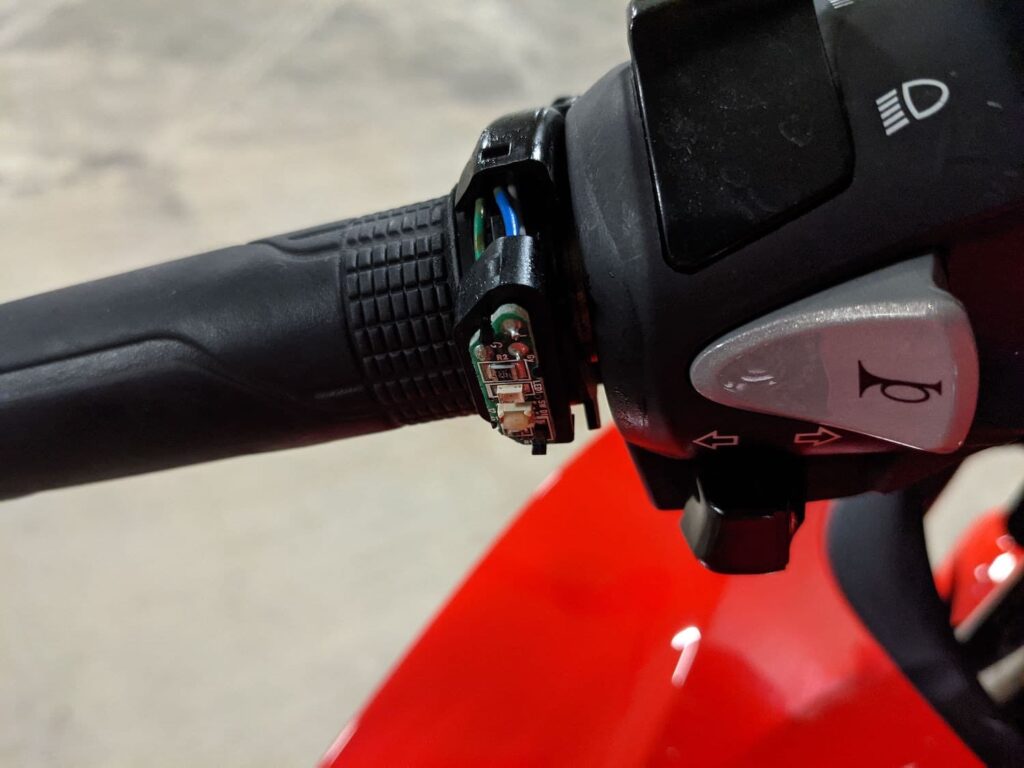
During my ownership, I only did basic cleaning, lubrication and chain maintenance. I also replaced one heated grip after its switch fell off. The part cost me A$150, plus A$100 labour because I didn’t have time to remove the fairings and route the cable.
Why did I sell the VFR800?
I thought I’d keep the VFR800 for a long time. It does so much well. But to be honest, it never really lit my fire.
The engine was fun for a commuter, but ultimately it lacked the bark I got from Ducati motorcycles, or from other high-end sport motorcycles.
One day, I went past a dealer and decided to sit on a few bikes. I thought I might go back to a BMW S 1000 R, or switch to another upright standard like the Honda CB1000R.
But then I made the mistake of sitting on a Suzuki GSX1300R Hayabusa. Or just “Hayabusa”, I have no idea why I said all that other stuff. Then I made the further mistake of riding it for about 20 minutes, including revving it while in a tunnel. The sound. Oh, that sound!
I rode home on my VFR800 and thought… This is so boring. Even revving it up in the tunnel, I could barely hear it.
I traded in my VFR800 two days later.
There’s a lot I’ll miss about the VFR800 8th gen. My Hayabusa doesn’t have traction control, heated grips, or a terribly comfortable riding position. But the one thing it has in plenty is an engine that feels like it’ll completely destroy me.
No, I’ll never get the most out of my ‘Busa — but nor would I have from the VFR. A hundred horsepower is plenty, and two hundred is just too much. I could launch and corner the VFR better, and felt more comfortable lane-splitting on it than on the ‘Busa.
Motorcycle choices aren’t always rational. I traded the VFR for an engine with more urgency and sound, even though I gave up comfort, equipment and much of the VFR’s everyday ease.

Hi Dana,
Hope you’re doing well.
Great do-it-all motorcycle this VFR, lovely riding position, and double-sided engine character.
Another great contender for fun commuting: the Z900 family, especially the RS (Café or not). Lighter, torquier, more powerful, cheaper. No luggage or heated grips though.
Talking about Kawasakis: the engine from the 1000 SX comes from the ZX-9R.
Cheers
Chakib
Hi Chakib, thanks. Those are truly great bikes. The Z900RS is a bike that makes me look at it. At first I loved the green, but I think the other colours seduce me more.
There is nothing more satisfying than passing Busa riders on mountain/canyon switchbacks in the rain on my 2007 VFR800. I enjoyed your write up. As a multiple VFR owner I think it was fair. I tell everyone the VFR is the bike that does everything well but nothing great. Too bad they don’t make them anymore, because my Microns make that V4 sound fantastic. One thing that often goes unwritten is the total lack of vibration transferred to the rider. No buzz in the grips or the foot pegs at all. This really reduces fatigue. Perhaps the others have caught up? I don’t know. Been on the 07 for over a decade now… Also the valve maintenance? Nonsense. I did my first check 70k miles on my 02. Valves were all within factory tolerance. Over 100k on the 07… no valve check. She purrs like a kitten.
That’s true. Not noticing vibration should be the standard!
You’d have passed me on my ‘Busa for sure. I’m glad I’d have made your day!
Stumbled across this and found it a good read. I owned a 95 VFR and sold it before I ever really rode it hard. Had a lot of bikes in between that bike and a 2014 Interceptor I just purchased. The bikes in between were mostly sport bikes, but there were two Triumph Sprint ST’s in there – they had professionally tuned suspensions so they handled like sport bikes. I wanted to love the VFR – the looks, the legend, the sound (I put a pipe on it and it’s glorious) – but frankly I’m struggling with it. It’s ponderously heavy to me, and I don’t get much upside because I’m not riding longer distances these days. I like the riding position to an extent, but I’d actually like a little MORE weight on the front. The pegs are higher than I thought they would be – I can make them work but was surprised at their height. I find the VTEC problematic – it seemed great on the test ride but now that I’m riding the bike harder with more confidence, I find myself bouncing around in the gearbox trying to find the right gear/RPM. It’s worse in the corners, and if I’m right at the VTEC transition point (6700 RPM) it can catch me off guard a little. I don’t care what anyone says – I can feel it. I’m beginning to fall into the camp of VTEC being a solution to a problem that didn’t really exist. It’s a big, beautiful, mostly-comfortable bike with a weird power band and strange (to me at least..) gearing. I’ll likely be trying on a Ducati Supersport S next Spring. Lighter, more a sport focus, still pretty comfy, and more than enough predictable power.
I have a seventh gen 2010 vfr 1200.
I got into a race with a vfr800 and ate its lunch. 170 hp against the vfr800’s 105 hp. It wasn’t even fair.
I was 15 carlengths ahead of that poor dude when I let off. I also have the dct transmission. The seventh gen was a leap ahead. I’ll never trade down.
Agree with most of writers comments but the 8th generation VFR800 tends to be damned by faint praise. The motor is beautiful and it has a lovely pulse at the lower rpm’s and the V-4 roar when you go through the Vtec transition. I use mine for “despatch” riding around metro. We’ve lot’s of 80km to 90km speed limits on the main distribution roads and the VFR800 is a real sweetie tootling about at those restricted speeds. It has a 21 litre fuel tank and 350km range. The bike is enjoyable and satisfying to ride inside the speed limits and that is surely an excellent quality?
Yes, one thing I did love about the VFR800 was being able to actually rev it out in a couple of gears (well, one gear legally, second gear on remote roads when it was just me and the kangaroos). It’s definitely an excellent quality, and one that I value and miss, and one that many others would appreciate. Thanks for highlighting it.
I have the same bike and like you, the cover for the heated handgrip switch fell off while I was riding. Likewise, I got a quote from the Honda dealer for a new left handgrip of $150 but they couldn’t tell me whether the replacement grip comes with the switch as part of the component. Did your replacement grip come with the compete switch assembly attached?
Yeah, it all came together, somewhat annoyingly. Wow, I was wondering if I should put a guide for that tiny bit of work, and it seems I should.
I actually cut / blistered my hand getting the new grip on. I had done that on a few bikes, but this one was the toughest. Keep a swear jar handy.
I’m picking up a used 2014 VFR800 8th Gen the week after next (if all goes to plan), so your eloquent and considered review popped up in my Google Search at just the right time.
In the past I have most recently owned a Ducati Monster 696, low kms 1997 Ducati 750SS and Triumph Scrambler 900. Out of those three the 750SS was a dream bike – egg yolk yellow with retro Ducati decals, a Staintune two into one chrome pipe, braided hydraulics, it pulled like a turbo charged coal truck and cornered like it was on rails.
That said, it was the most unreliable bike I’ve ever owned. It got to the point where every time I threw a leg over I didn’t know if I’d be going for a ride. The experience kind of burnt me with regard to Ducatis. The availability of parts, maintenance costs and limited specialist Ducati mechanics I trusted, all served to make repairs tiresome and expensive.
I sold my last bike (the Triumph) two years ago – that’s right, I haven’t ridden for two years. It looked and sounded the part but I didn’t like the tyre profile in high speed corners, and at times it felt cumbersome – particularly in heavy slow moving city traffic.
I should be starting a new job soon and wanted a commuter that looks good, is reliable and still fun to take out on the weekend. I also wanted something with a higher seating position for a pillion rider. The Missus occasionally likes to jump on the back and doesn’t like it if she can’t see over my shoulders. My commute will be a 90km return trip across Sydney (three days a week), but no real freeway or high speed roads. There will be a few multi lane 70-80 kms sections but mainly 60-70kms in heavy traffic.
Being a fan of Italian and British bikes I also considered a Triumph Thruxton 900 but it seems a little bare for a commute, and I don’t like the aesthetic of fitting side panniers or saddle bags, as it spoils the faux Cafe Racer look and feel. I also like a bike with twin discs up front. I did briefly think about a Ducati Super Sport and found one with 27,000 kms on the clock, that was in my price range. I’ll be riding roughly 15,000 kms per year and the thought of owning a Ducati that in two years will have covered over 50,000 kms does not bode well based on past experience.
The VFR ticks a lot of boxes based on what I’ve read and the one I’m buying comes with a top box for a change of clothes and other work related paraphernalia. For me, I don’t believe the VFR is going to compare to a Ducati in terms of gut wrenching performance or a retro Triumph for it’s street cool vibe, but I believe it will serve its purpose as a reliable and cost effective commuter. It also looks the part in its own right and has enough grunt to be fun on the weekends. I am a little worried about availability of spares and resale given they don’t make them any more, but I’ll let you know how I go.
Glad to have helped with your decision-making process! Which gen did you get?
I agree, 90 km daily in traffic on a Ducati sounds unpleasant. I tended to sell my Ducatis just after I fixed everything because they were always ticking time bombs. But then — I’ve never had one that was close to new (closest was 7 years old and 45000 kms).
And I think these bikes are old enough and have a solid enough fan base that you won’t have too much trouble selling it if it’s not for you, adjusting for kilometres etc.
I don’t ‘get’ the later iterations of the VFR. They kind of made sense up until the VTEC models, but after that they just felt like they were being built for people who had never ridden anything more modern (dynamically) than the previous model VFR.
My dad had a 97 RC36-2 that I got to ride quite a bit. It was beautiful, well made and sounded incredible with its staintune exhaust. It also weighed 240ish kilos and only put out a little over 100bhp and 54 lb ft. I rode it for a week when I was visiting one time, then got home and nearly threw my gsxr750 into a bush by mistake, the handling was so much lighter. I know, I know – different class of bike, but it’s crazy that a ‘sporty’ 750 can weigh so much and have such little poke.
Since then VFRs just never appealed to me. I don’t understand their purpose beyond ‘premium inoffensive bland bike’.
Any VFR fans are more than welcome to rip into me though, I just bought a Blandit 1250 to replace a s1000r. But hey, with a couple of simple mods I got 125hp and 90 lb ft, 80 of which are delivered from 2k rpm up. I’m in ‘budget inoffensive dull bike’ heaven. Plus it weighs almost as little as everyone’s favourite sporty Honda 800. And the heated grips won’t fail because it doesn’t have any.
By the way Dana, did you ever have to consider replacing the grips on your s1000r? Mine wore out by the time I got to about 30k kms and I discovered that you can’t buy the grips, you have to buy the grips, throttle tube AND controls as a unit. You can imagine how expensive that is!
PS – gimme a go on your Busa
Hi Oli,
The earlier VFRs at least had a bit of visceral engine feel and sound. I think of them as commuters or tourers with character, rather than bikes that are built as all-out fun machines. The thing is… if a bike isn’t an all-out fun machine, I at some point lose interest. Could be a bangin’ cruiser, a ripping sportbike, or a vibey naked twin. But at some point along the fun-efficiency continuum, I think… maybe I should just take the metro, and not have to change all these clothes and deal with the weather and traffic.
So yeah, for pure fun, I can imagine you would much, much rather be on your GSX-R750, pretty much the zenith of fun.
Then there’s the Bandit. I have to admit, I eye the GSX1250FA sometimes as a bike so effective but so affordable they didn’t even invest in giving it a good name. Torque everywhere, as you said. It’s the antithesis of people claiming inline fours don’t have low-end torque. And they’re cheap as chips these days.
I never had to replace the grips on the S1000R. But that story sounds familiar… you can’t buy bits separately these days. 🙁
You can have a go on the ‘Busa if you’re ever in the area (and I am), sure! Ludicrous or garishly styled bikes like the Busa, M109R, Ducati 999, Rune etc. are polarising, but it’s cool to find out on which side of the love/hate relationship you’re on as the love side is a fun place to be.
To bad you didn’t install a full Delkevic exhaust system, sounds like a MotoGP bike, and that tunnel would have been really fun.
I flew to Las Vegas to buy my 2015 DLX, my first ride on the bike was 521 miles and it was so quiet I couldn’t hear it. When the VTEC kicked in it was lame at best. The pegs were squishy, but it handled great, it was very complimentary to the rider, and it maintained its temperature even though it was 115 F for the first 158 miles of the ride.
I was not impressed to say the least. I set out to change the character of the VFR. The handling was solid , and it was well balanced. The brakes were very good also. It looked more Italian in design than Japanese, and that single sided swing arm with the bronze wheel was definitely beautiful, if only you could see it.
So after numerous upgrades, DynoJet Auto Tune, Sprint air filter, air box modifications, PAIR system removal, full Delkevic exhaust, Sato rear sets, GIVI top box, and removal of all that black shielding around the exhaust pipes and all of a sudden it has this exotic look with a beautiful MotoGP V4 sound (very Aprilia Tuono like).
Now that very quiet VFR is this yowling beautiful red honey of a bike. That deep sound at idle, that unique howl at revs, and that beautiful pipe work that exposes that exotic single sided swing arm. So much emotion now!
https://www.instagram.com/p/CjN0MPKryac/?igshid=YmMyMTA2M2Y=
Wow, that sounds incredible! I must admit I didn’t think that kind of feel was within reach of the Gen 8. I didn’t come across a bike like yours. I’m still open to VFRs, though my eye is on the Gen 5.
I appreciated your article. As a 3rd time VFR owner, I am of course biased but I also have never owned nor ridden any VFR past my present 4th gen.
I had a 95 Interceptor and a 94 VFR. In between a couple Ninjas and in my past were (ancient days) my two stroke pocket rocket RD350 and a Yamaha Seca.
You mentioned the throaty sounds of past generations, that would be the magic of a gear driven cam (last year I beleive was 2001).
Nothing so sweet as that mid range to red line sound and the expectations of knowing you won’t be vibrating to death.
My present 97 still runs like a predictable fiery but controllable scoot looking for more sweepers.
Presently I am actually looking at a Indian Scout to ease into my middle 50 years, but I plan on keeping my 97 for as long as my aching back and crakling knees allow me.
Keep having fun and being safe.
Regards,
VFR’r for life
Hi Dana,
I’m looking at an affordable bike, not to commute on, but to ride around Australia. I’m 68 and retired. For fun, I have a 2020 Triumph Speed Triple. It has had the compression damping revalved at both ends to avoid losing my fillings, and a Daytona 955i exhaust because it’s QUIET while cruising. Without those changes I’d have had to sell the bike, although I love its other attributes. Oh, and I have a BMW R1200S I may have to sell to make room in the garage for another bike. My own sweet spot for power is more like 120HP, where the BMW is, not for its power band above 6500rpm, but for its torque. The BMW has both lights on, but only in high beam. At least the low beam is pretty central in the front of the bike. The Triumph has both on too. I once read that the single headlight is a European rule, so bikes are not mistaken for more distant cars. Maybe that’s right. The 955i Speed Triple of course had 2 lights, one hi, one lo, but both had a 60/55W H4 globe. You needed to add one relay in a vacant socket to have hi/lo in both, much better.
For the big trip I wanted shaft drive, luggage capacity, long fuel range and wind protection. I was interested in the FJR1200, after rejecting the ST1300 for its excessive weight, the BMW R1200 GS and RT for various reasons, and the Sprint GT because I already have a Triumph. I like that the FJR runs on 91 octane fuel, not sure how most riders fare in outback Australia on bikes that need premium.
Still concerned about weight, and not needing huge power, or room to carry a pillion, I found myself here looking at a more compact, less powerful bike. I can buy a decent newer VFR800 with factory panniers for a bit less than a good FJR too, and add a top box. And right now there are no FJRs for sale in Victoria.
Compromising on chain drive isn’t too bad. I can install a Cameleon electronic chain oiler, as I do on all my chain driven bikes. With an added brake fluid reservoir for 35ml extra oil, I have a range of about 8000km between top ups with chainsaw oil. Wind protection is less on the VFR, and the fuel range limited, but 21 litres is much better than the 15 in my Triumph. A VFR promises to be smooth, quiet and reliable, not too large, heavy or powerful, just what I need on a very long trip by myself. I may try to find the handlebar risers you mentioned.
That said, my Speed Triple is just fine for a 500km day, about as far as I want to go on a relaxed trip.
Do you know if the VFR runs OK on regular unleaded?
IanB
Hi Ian, excellent question. Aside from not wanting to run out of petrol between stations, it’s a good call to not throw away money in the age of rising pump prices! All VFR800 generations (I just checked the manuals for all three generations) are designed to run RON 91 (Australia/Europe octane system) / 87 pump Octane (US grading system), a.k.a. regular unleaded. So there you go, your trip just got about 25% cheaper.
If you decide to sell the R 1200 S, let me know, as people periodically email me looking for them (I have one guy right now waiting). I’ll send you an email, because I also want to talk to you about bikes to ride in Australia as it sounds like we’re going through the same thought processes.
91 Ron or higher is what’s specified in the handbook, I’ve always used 91 Ron on my 2014 Gen8 but have tried 95 Ron and didn’t make any difference so can’t see the point in paying the extra.
Hi Dana,
Thanks for checking. I should have downloaded the owners manuals to find out for myself. At least the answer is out there for others. Good news, the FJR1300 and VFR800 both run on 91. For me, it’s not so much the petrol cost, but the patchy availability of premium unleaded. So often, even in Victoria and NSW, you have the choice of 91 or diesel. Or 91 and 98 when you want 95. IMO Australia should switch to 95 only pending the gradual takeover of electric vehicles. Just about any vehicle runs on 95, and the saving on refining cost and logistics should keep the cost down.
Still thinking about selling the R1200S.
My wife says I’d regret selling it, as I did with a pristine Daytona 955i I sold 3 years ago. She’s probably right.
IanB
I love my VFR, but I ride a 5th gen. Without the gear driven cams, I don’t think the VFRs make much sense. Too many other choices out there. And, although the VTEC bikes have proven reliable, I think the chain-driven VTEC is still less reliable than the gear-driven cams. I have a friend who rides a 6th gen with the VTEC, and he loves it, but it’s not for me.
I do wish the VFR800 had more power, and was lighter, but I find I can keep up pretty well with most bikes/riders.
Great write up, bought my 2014 dlx new in 2017, gotta say the $7700 price point was an influence. You could buy them new at that price (or less) until around 2020.
My only complaints about the bike are 100hp (125 would be perfect) and the +530 lbs wet weight (50 lbs lighter would be way better). I’ve added a few mods (DAM slip on, PC6 + custom map, KN air filter, bar riser blocks) and I’m getting pretty close to my ideal. Currently working on improving the suspension. I do not notice any significant VTEC surge @6700 rpm, just a change in tone and more power available.
The bike seems to fill an odd niche, I’d describe it as “the fat old guys desire for comfortable sport-like riding on a race-inspired motor” type motorcycle. I’ll be sticking with it for a while😁.
Author is obviously trying to not offend VFR lovers. I’d make a good bike reviewer, (for a novice), because I don’t soften the blow to cater to people’s sensitivities, (but piss off the magazine owner and you’re out of a job).
I started reading article to find out how bad the Series 8 2014 VFR riding position really is., (because I heard that it is so bad it’s a deal breaker). Author was being coy in this regard, and I think not entirely honest, and after a while I was never sure about which series VFR he was talking about, because they’re all different.
… and as for comparing VFR to other bikes, (Im not a VFR owner yet, but always loved the look), the VTEC engine is massively underpowered, but maybe acceptable at over 7,000 RPM. I see what author bored himself with his commutes, saving his good bike for sunny Sundays. Commuting Sport biking is about torque and acceleration, and the VFR VTEK in the lower and middle power bands is grossely underpowered. Owners will says, well it’s 105 HP, (which is not a lot for a 800, but acceptable), but that translates to about 55-60 HP <7,000 rpm which is most of your commute, and that really sucks.
And by the way, my old ZZR 600 has almost same HP and it is available all the time, with lots of torque in every gear at any RPM, for fun in any gear, (and traction control on a bike with < 110 HP is ridiculous, except perhaps a “rain mode”).
But as author says, newer VFRs are not sport bikes, just sporty looking bikes, and apparently not even touring bikes, because they’re now so uncomfortable. But from what I see, guys like good looking bikes so they they can pose beside them at their fave coffee shop.
Hey there, appreciate your take. I am not trying to “not offend” anyone, any more than I generally try to not be a jerk in real life! However, yeah, I accept your criticisms. Ultimately, it didn’t really do it for me, which is why I traded it for the Hayabusa. I usually don’t buy bikes I don’t like, nor do I write about bikes I hate, but if you want to read a negative experience, one of them was the Hyperstrada 821.